
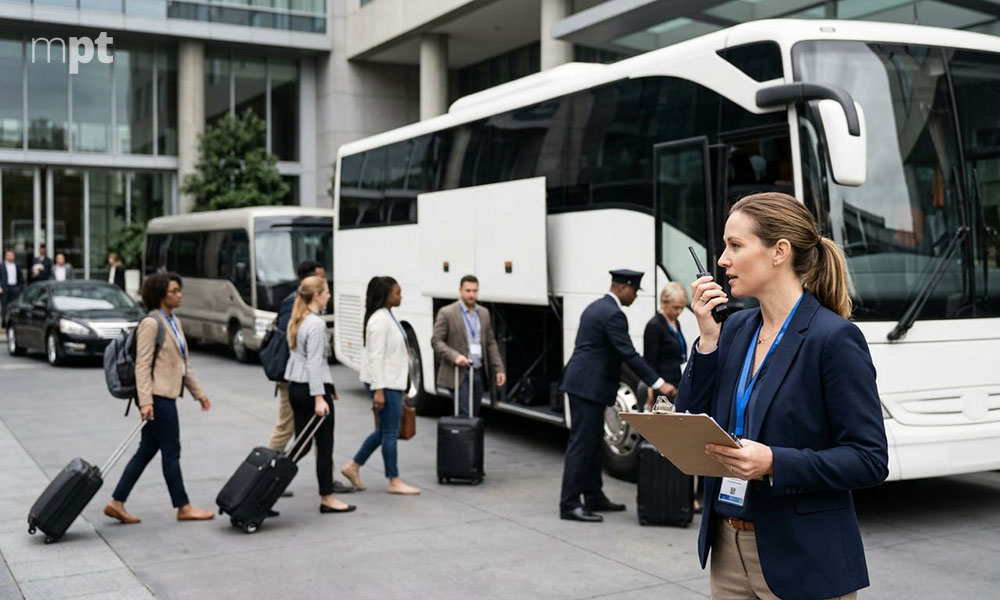
Arranging Group Transport for Conferences and Meetings


TLDR
Arranging group transport for conferences and meetings means planning and running multi-stop ground movement for delegates between airports, hotels, venues, and off-sites using coaches, minibuses, vans, and sedans. The key is sizing your fleet correctly (use cycle-time math, not guesswork), locking in compliance early (especially Queensland Driver Authorisation and DSAPT accessibility standards), and pre-booking venue loading docks. Plan for 75 to 85 percent seat fill per cycle to absorb uneven arrivals, and always add at least one standby vehicle.
What It Means and When You Need It
Arranging group transport for conferences and meetings is the process of planning, scheduling, and operating ground movement for delegates across multiple stops. Think airport pickups, hotel-to-venue shuttles, off-site dinner transfers, and end-of-event egress. It covers the full vehicle mix: 50-seat coaches for plenary sessions, minibuses for breakout groups, and sedans or SUVs for VIP speakers arriving on tight schedules.
You might also hear this called “delegate shuttles,” an “arrivals and departures program” (A&D program), or “hotel-venue circulators.” Whatever the label, the goal is the same: get the right number of people to the right place at the right time without long queues, missed sessions, or kerbside chaos.
Why does it matter? Because transport is often the first and last touchpoint delegates have with your event. A smooth shuttle operation supports your ESG goals by consolidating individual car trips. It reduces friction at hotel kerbs and venue docks. And it prevents the reputational damage that comes from 400 delegates standing in a car park wondering where their bus is.
As one event planner guide puts it, structured shuttle planning is essential for conferences and multi-venue events. Getting it wrong is expensive. Getting it right is invisible, which is exactly how it should be.
The Core Variables to Lock Early
Before you call a single coach operator, nail down these four inputs. Every other decision flows from them.
Headcount Profile and Peaks
Not all sessions create equal demand. A 1,200-person plenary empties in minutes, while staggered breakouts trickle out over an hour. Map your program timeline against expected transport demand. Identify the spikes: opening session arrivals, lunch-break off-sites, gala dinner departures, and final-day checkout surges.
Geography and Route Mapping
Walk (or drive) every route before the event. Map each hotel, note the kerb access, and confirm whether coaches can physically stop there. Some CBD hotels allow only a 5-minute kerb dwell for loading. Others have rear service lanes that fit a 57-seat coach but require advance booking.
For South East Queensland events, this means confirming loading dock availability at venues like the Brisbane Convention and Exhibition Centre (BCEC) or the Gold Coast Convention and Exhibition Centre (GCCEC). Both venues require pre-booked dock and service road access with specific vehicle length and height restrictions. If your coach is 13.5 metres long and the dock clearance is 4.2 metres, you need to know that before day one, not during it.
Accessibility Requirements
Identify delegates who use wheelchairs, mobility aids, or have visual or hearing needs. Under the Disability Standards for Accessible Public Transport (DSAPT), transport providers must ensure accessible conveyances, continuous access pathways, and information in multiple formats (PA announcements, printed schedules, digital displays). This is not optional. It shapes your vehicle selection, dwell-time calculations, and marshal briefings.
Compliance and Licensing
In Queensland, any operator providing booked-hire transport must hold a Driver Authorisation, and entities arranging bookings need a Booking Entity Authorisation. Your RFP should require vendors to supply their authorisation numbers, certificate of currency for public liability and vehicle insurance, and their fatigue management policy. Skipping this step creates legal exposure and, as practitioners on Reddit have reported from large festival shuttle operations, missing vehicle credential stickers can cause hour-plus delays at checkpoints.
Vehicle Mix and Typical Capacities
Choosing the right vehicles is about matching capacity to route characteristics. Here is a quick reference for Australian conferences.
Full-size coach (50 to 57 seats): The workhorse for high-volume routes. Australian operators typically offer 50 to 57 seat configurations. Most efficient for long loops or point-to-point transfers between a convention centre and a cluster of hotels. Requires adequate road width, turning circles, and dock clearance.
Mid-coach or minibus (24 to 33 seats): Better for tight CBD streets, short-loop circulators, or “sweeper” runs behind the main coach routes. Useful when you need frequency over capacity.
Sedans, SUVs, and MPVs: Reserved for VIPs, keynote speakers, sponsors, and late arrivals on staggered windows. These vehicles are nimble and avoid the kerb conflicts that come with parking a full coach outside a hotel lobby during check-in rush. For business travel with chauffeur services, accredited operators can provide meet-and-greet, flight tracking, and discreet service for high-profile guests.
Luggage trailers: If your conference includes incentive-trip delegates travelling with families, enclosed trailers handle surfboards, golf bags, and port-a-cots without cramming the cabin. For events where delegates fly into Brisbane, Gold Coast, or Sunshine Coast airports and need onward transfers with bulky gear, premium vehicle options with trailer capacity solve a real problem.
How to Size Your Shuttles: Quick Math
Most planning guides say “order enough buses.” That is not helpful. Here is how to calculate what you actually need.
The Shuttle Sizing Formula
The FHWA special-event shuttle framework gives a clear formula:
Route service time = round-trip travel time + (number of stops x [average load time + average unload time + average dwell per stop])
Once you know the route service time, divide your peak demand by the effective capacity per cycle to find how many vehicle rotations you need per hour. Then divide that by the number of cycles each vehicle can complete per hour.
A Worked Example
Suppose you are arranging group transport for conferences and meetings in Brisbane’s South Bank precinct. Your setup:
Route: Two hotel stops plus one venue stop (BCEC)
Round-trip drive time: 14 minutes
Loading at hotels (combined): 2 minutes
Unloading at venue: 1 minute
Buffer for traffic, signals, dwell variability: 3 minutes
Total cycle time: 20 minutes
That means each coach completes 3 cycles per hour. With 56-seat coaches at 80 percent target utilisation (roughly 45 usable seats per trip), each coach moves about 135 passengers per hour.
If 600 delegates need to arrive within a 60-minute window, you need approximately 600 divided by 135, which equals 4.4 coaches. Round up to 5, then add 1 standby. Total: 6 coaches.
Why You Should Never Plan at 100 Percent Fill
Research from the Transit Capacity and Quality of Service Manual shows that dwell-time variability alone can reduce effective capacity by 25 to 33 percent if you do not buffer for it. People board in clusters, not neat single-file lines. Some delegates stop to ask the driver a question. Others need help with luggage.
Additionally, wheelchair ramp deployment adds roughly 30 to 60 seconds per boarding, plus securement time. If you have even two wheelchair users per cycle, that is an extra 2 to 4 minutes of dwell, which eats into your cycle time and reduces throughput.
Plan for 75 to 85 percent seat utilisation. It costs slightly more in vehicles but prevents the cascading delays that ruin an entire morning’s schedule.
On-the-Day Playbook: Staging, Signage, and Comms
Staging and Marshals
Assign a marshal at every hotel pickup point and at the venue drop-off zone. Equip them with branded paddles or boards, a printed run-sheet, and a radio or WhatsApp channel connected to dispatch. The marshal’s job is simple: confirm headcounts, signal departure readiness, and communicate delays upstream.
Practitioners on LinkedIn who manage large-scale event transport recommend building optionality into your plan, meaning backup vehicles and alternate routes that can be activated within minutes. One large medical meeting case study involved 30 buses on 6 routes servicing 28 hotels, which illustrates the dispatch complexity that even a mid-size conference can generate.
Venue Load-Zone Rules
At BCEC and GCCEC, you need to pre-book loading docks and confirm coach dimensions against height and length clearances. If your event involves freight (exhibition stands, AV equipment) arriving through the same dock as passenger vehicles, coordinate porter roles to avoid conflicts. The BCEC freight and logistics guidelines detail timing windows and vehicle requirements. For events needing concierge support with dock timing and meet-and-greet coordination, a dedicated logistics partner can manage the details.
Signage and Wayfinding
At every pickup point, post a QR code linking to a live timetable. Include the pickup location photo (not just an address), shuttle frequency, and “what to do if you miss the last shuttle” instructions. Good chauffeur and pickup signage practices apply here too: high-contrast text, clear naming, and visible branding so delegates can spot their ride instantly.
Communications to Attendees
Publish exact pickup points with a photo or map in your delegate app or printed program. Include frequency (“every 10 minutes from 7:30am”), last-bus times, and SMS or push-notification updates for delays. Proactive communication is the single most cited success factor in planner guides to group transportation. For answers to common delegate questions about meeting points, timing, and pickup procedures, a well-maintained FAQ resource prevents dozens of panicked calls on the morning of the event.
Post-Event Egress
Stagger your first departures 30 to 60 minutes before the official close. Experience from event planners on Reddit consistently shows that older guests, families, and those with early flights depart well before the headline act finishes. If you only start shuttles when the closing speaker wraps up, you will face a 600-person queue and a 90-minute wait.
Festival shuttle threads on Reddit offer a cautionary tale: when egress capacity is mis-sized, particularly after a keynote or headliner that ends simultaneously for everyone, multi-hour waits become the story of the event. Buffer seat capacity for the late peak. Always.
Accessibility, Licensing, and Venue Rules (Australia and QLD)
DSAPT Obligations
The Disability Standards for Accessible Public Transport require accessible conveyances, information in accessible formats, and continuous access pathways. In practice, this means:
At least one wheelchair-accessible vehicle on each route
Priority seating identified and communicated
PA announcements and printed timetables supplemented by digital formats
Marshal briefings on assistance etiquette (ask before helping, maintain dignity)
Build the extra dwell time from ramp deployment and securement directly into your cycle-time calculations. Do not treat it as an afterthought.
Queensland Compliance
Every transport provider at your event should hold a valid Queensland Driver Authorisation. If your vendor also takes bookings (rather than simply supplying vehicles), they need a Booking Entity Authorisation. Your RFP checklist should request authorisation numbers, certificate of currency for public liability, vehicle insurance documentation, and a fatigue management policy. For context on accreditation standards, Queensland-based operators can outline how these requirements work in practice.
Costs and How to Control Them
Main Cost Drivers
When arranging group transport for conferences and meetings, costs are driven by:
Vehicle size and type: Larger coaches cost more per hour but less per seat
Hours on hire and minimum blocks: Most operators quote 4 to 5 hour minimums
Deadhead: Travel time from the depot to your first pickup (and back after the last drop-off)
After-hours surcharges: Early morning (before 6am) and late night (after 8pm) attract premiums
Tolls, parking permits, and event marshals
Branding and signage: Custom wraps or magnetic panels for shuttle identification
Indicative Australian Ranges
These figures come from public operator guides and vary by city, season, and vehicle type. Always get a live quote.
Sydney operator guidance suggests roughly $120 to $180 per hour depending on vehicle and season
Melbourne references range from $100 to $250 per hour for minibuses through to full-size coaches
One-way coach transfers in Melbourne can run from approximately $400 (small coach) to $1,200 (57-seat coach) as a directional guide
For VIP and speaker transfers, smaller private vehicles on an hourly or per-trip basis often make more sense than dedicating a full coach. Getting an instant quote for sedan or SUV transfers gives planners a quick budget line item for the executive transport component.
When comparing quotes across providers, look beyond the headline rate. Check what is included (tolls, parking, GST) and what is extra. A practical guide to comparing chauffeur quotes can help procurement teams evaluate like for like.
Sustainability Benefits in One Glance
A full coach carrying 50 to 57 passengers produces roughly one quarter of the per-passenger CO2 emissions compared to an average petrol car on equivalent journeys. That is not a marginal improvement. It is a step change.
The Bus Industry Confederation (BIC) in Australia notes that modal shift to buses can save hundreds of thousands of tonnes of CO2 annually across the country. For conference planners facing ESG reporting requirements or sustainability committee scrutiny, consolidating 300 individual taxi trips into 6 coach rotations is one of the simplest, most defensible actions available. Include the per-passenger emissions comparison in your post-event sustainability report.
Risks and How to Avoid Them
Permit and credential failures. Build a permit checklist 8 weeks out. Confirm venue dock bookings, route permits, and vehicle credential stickers. One missing sticker can strand a bus at a checkpoint for over an hour, as practitioners on Reddit have documented from large-event shuttle operations.
Under-estimating egress demand. The closing session creates the sharpest demand spike of the entire event. Buffer seat capacity by at least 20 percent above your peak arrival calculation, because arrivals spread over 90 minutes but departures concentrate in 30.
Driver and vehicle shortages. Cross-book between partner operators. Have at least one standby vehicle and driver on site during peak windows. Collect rider feedback after day one to tune headways for day two. One event transport specialist on LinkedIn recommends treating day one as a live rehearsal, with the real optimisation happening overnight before day two.
Hotel kerb chaos. Multiple events sharing the same hotel creates a kerb war. Coordinate with the hotel’s guest services team to reserve a specific loading window and lane. Assign your marshal early to claim the space before competing shuttles arrive.
Mini-Checklists (Copy and Paste Ready)
Sizing Cheat-Sheet
Peak passenger demand within the arrival or departure window
Target headway (gap between buses at each stop)
Round-trip route time including all stops
Average dwell per stop (load + unload + buffer)
Accessibility allowance (add 30 to 60 seconds per wheelchair boarding)
Target seat utilisation: 75 to 85 percent
Apply the FHWA formula, then add 1 standby vehicle
AU/QLD Compliance Box
Confirm vendor holds Queensland Driver Authorisation
Confirm Booking Entity Authorisation if vendor takes bookings
Request certificate of currency (public liability, vehicle insurance)
Request fatigue management policy
Confirm DSAPT approach for accessible vehicles and information
Verify vehicle dimensions against venue dock restrictions
Venue Logistics Box
Have you booked the loading dock and confirmed coach lengths and clearances?
Are passenger flows separated from freight bump-in and bump-out?
Are porters or marshals assigned at the dock?
Is signage installed at the venue entrance directing delegates to the shuttle pickup?
Attendee Communications Box
Publish pickup points with a photo or map
State shuttle frequency and first and last bus times
Provide SMS, app, or QR-code access to live updates
Include “What to do if you miss the last shuttle” instructions
Confirm accessibility provisions in delegate communications
KPIs to Track Post-Event
On-time departure percentage (target: 95 percent or above)
Mean wait time at each stop
Seat utilisation per cycle
DSAPT assistance requests fulfilled
Incident rate (breakdowns, delays over 10 minutes)
Attendee satisfaction score on transport (post-event survey)
Actioning This in South East Queensland
For conferences at BCEC, GCCEC, or hotels across Brisbane and the Gold Coast, the transport plan will typically combine large coach shuttles for the bulk of delegates with smaller vehicles for VIPs, speakers, and overflow.
My Private Transfers provides corporate and event transport, private car and bus charters, meet-and-greet, and 24/7 pre-booked private rides with QLD-accredited chauffeurs. This makes them well suited for VIP and speaker movements, small-group transfers, and backup capacity when the main shuttle schedule does not fit a particular guest’s itinerary. For incentive trips where delegates travel with families, child seats are provided at no extra cost, and luggage trailers handle bulky items. Multi-city coordination across Sydney, Melbourne, and other capitals is available through associate networks.
Need accredited chauffeurs for VIP movements, or a backstop for your conference shuttles in SEQ? Get an instant quote or contact the team directly to discuss complex multi-day itineraries. For PCOs and wholesale partners, the agent and partner booking portal streamlines repeat event bookings.
Frequently Asked Questions
How many buses do I need for a 500-person conference?
It depends on your route cycle time and arrival window. Using the sizing formula above, a 20-minute cycle with 56-seat coaches at 80 percent utilisation moves about 135 passengers per coach per hour. For 500 delegates arriving in 60 minutes, you need roughly 4 coaches plus 1 standby. Always run the math rather than guessing.
What vehicle credentials should I check in Queensland?
At minimum, confirm the operator holds a Queensland Driver Authorisation and, if they arrange bookings, a Booking Entity Authorisation. Request their certificate of currency for public liability and vehicle insurance, plus their fatigue management policy.
How do I handle wheelchair-accessible transport at a conference?
Under DSAPT, you must provide accessible vehicles, continuous access pathways, and information in accessible formats. Factor in 30 to 60 seconds of additional dwell time per wheelchair boarding when calculating cycle times. Brief marshals on assistance etiquette and assign at least one accessible vehicle to each route.
What is the biggest mistake planners make when arranging group transport for conferences and meetings?
Under-estimating egress demand. Arrivals spread naturally across a 60 to 90 minute window, but departures concentrate immediately after the closing session. Planners who size shuttles based on arrival patterns alone end up with multi-hour queues at the end of the event.
How far in advance should I book conference shuttle services?
For events with 200 or more delegates, book at least 8 to 12 weeks out. This gives you time to confirm venue dock access, coordinate with hotels on kerb windows, and build in the permit and credential verification steps that prevent day-of surprises.
Can I use the same vehicles for airport transfers and venue shuttles?
Yes, but schedule carefully. Airport transfers have unpredictable timing (delayed flights, customs queues), while venue shuttles need clockwork precision. Many planners use dedicated vehicles for each function and only cross-deploy standby units. For speaker and VIP airport pickups, a separate corporate private transfer with flight tracking and meet-and-greet keeps the main shuttle operation undisturbed.
How do I justify shuttle costs to stakeholders?
Lead with the sustainability angle: a full coach produces roughly one quarter of the per-passenger CO2 of individual cars. Then add the productivity argument: 500 delegates each spending 20 minutes finding a taxi equals 167 hours of lost conference time. Shuttles eliminate that waste and reduce the total number of vehicle movements around your venue.
What KPIs should I report after the event?
Track on-time departure percentage, mean wait time, seat utilisation, accessibility assistance fulfilled, incident rate, and attendee CSAT on transport from your post-event survey. These six metrics give you enough data to refine your plan for the next event and demonstrate accountability to stakeholders.