
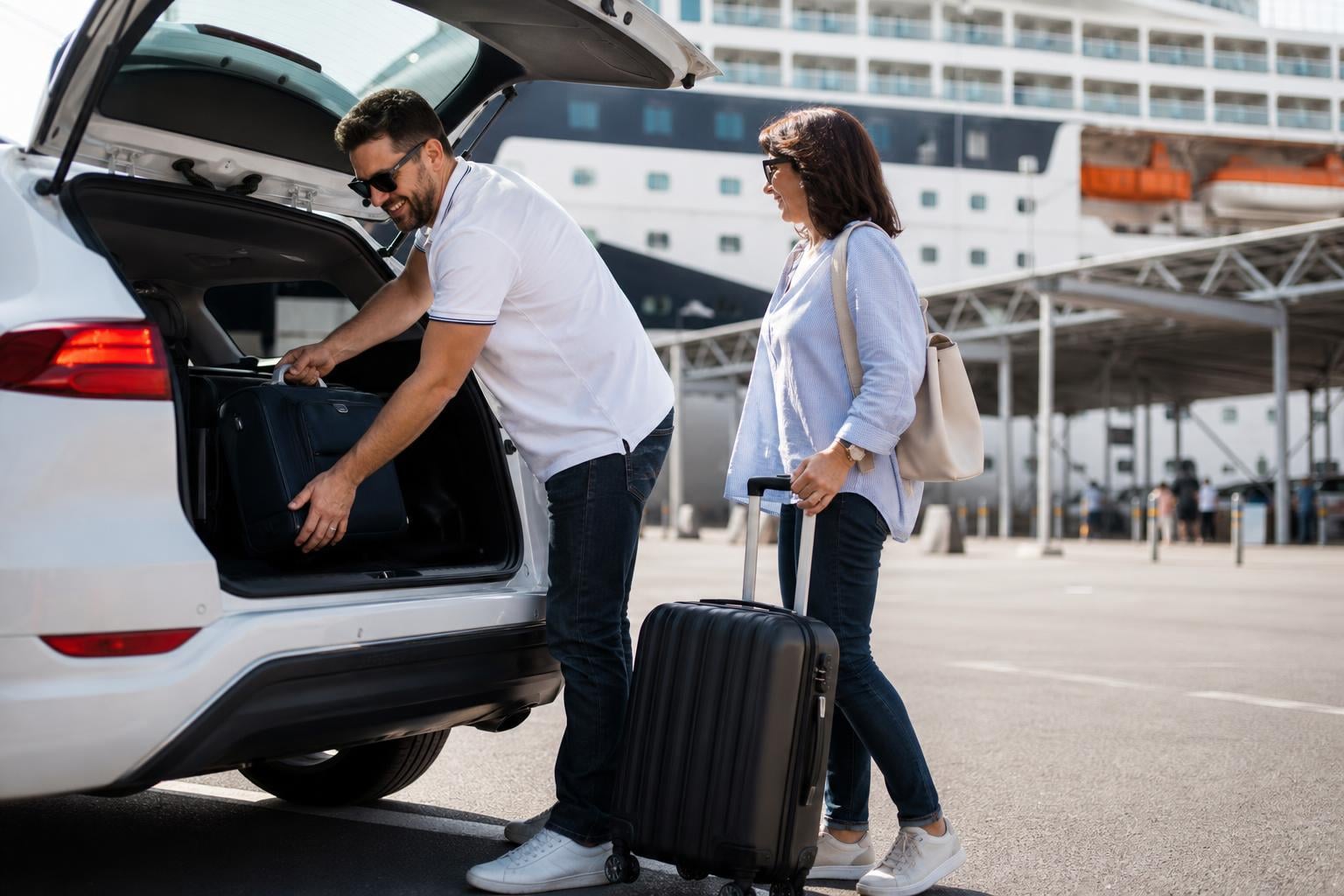
Cruise Embarkation Day Transport and Luggage Flow (2026)


TL;DR
Embarkation day is the most logistics-heavy day of any cruise. Your checked bags disappear for six to eight hours after you hand them to porters, so a well-packed day bag is essential. Brisbane’s International Cruise Terminal has no public transport, making pre-booked transfers the most reliable option, especially for families juggling strollers and car seats. This guide walks through the entire cruise embarkation day transport and luggage flow, step by step, with Brisbane-specific costs, distances, and terminal rules.
Why Embarkation Day Catches So Many Cruisers Off Guard
A record 1.45 million Australians took a cruise in 2025, a 9.5% jump from the year before. The average age of Australian cruise passengers dropped to 47.3, and more than a third of cruisers are now under 40. Cruising is growing fast, and a lot of first-timers are boarding ships without understanding how embarkation day actually works.
Here is the problem: getting yourself and your luggage from your front door to your stateroom involves two separate logistics chains that overlap in awkward ways. You need transport to a terminal that may not be easy to reach. And once you arrive, your checked bags vanish into the ship’s bowels for the better part of the day. Misunderstand either chain and your cruise starts with stress instead of a cocktail by the pool.
This guide covers the full cruise embarkation day transport and luggage flow, with specific detail for passengers departing from Brisbane’s International Cruise Terminal (BICT). The embarkation process advice applies to any Australian cruise port, but the transport realities are especially pointed for Brisbane.
Get a cruise transfer quote before your sailing date to lock in your transport early.
At-a-Glance: Transport Options to Brisbane International Cruise Terminal
Transport Mode | Cost (from Airport) | Cost (from CBD) | Travel Time | Luggage Capacity | Child Seats Available | Advance Booking Required |
|---|---|---|---|---|---|---|
Private transfer | Varies by provider | Varies by provider | 15–20 min | High (trailers available) | Yes (free with some providers) | Yes |
Taxi | $29–$35 | $30–$40 | ~16 min | Limited to boot | No | No |
Rideshare | Similar to taxi | Similar to taxi | ~16 min | Limited to boot | Not guaranteed | No |
Shared shuttle | Varies | Varies | Varies (shared stops) | Limited per passenger | Rarely | Yes |
Self-drive | Parking from ~$20/day | Parking from ~$20/day | 15–30 min | Your own vehicle | Your own | Yes (parking must be pre-booked) |
Public transport | $14–$20 | $10–$15 | 2h 28m (!!) | Whatever you can carry | No | No |
The public transport figure is not a typo. The cheapest route from Brisbane Airport to BICT involves a train and then a line 303 bus, taking nearly two and a half hours. From the CBD, it is still almost two hours with multiple connections.
1. Complete Online Check-In and Print Your Luggage Tags
This step happens days before embarkation, not the morning of. Every major cruise line now offers online check-in, and completing it early saves significant time at the terminal.
The most important output of online check-in is your luggage tags. These tags display your name, stateroom number, and ship name. Porters use them to route your bags to the correct cabin. Print them at home and attach them to each checked bag before you leave.
What if you forget? Porters at the terminal usually have generic tags they can fill out manually, but this slows the process and increases the chance of your bags going to the wrong cabin. Practitioners on Reddit’s r/Cruise community frequently mention that pre-printed tags speed up the curbside handoff dramatically and reduce errors.
Document checklist for embarkation day:
Passport or government-issued photo ID
Printed boarding pass or QR code on your phone
Luggage tags (one per checked bag)
Health declaration form (if required by your cruise line)
Travel insurance documents
Credit card for onboard account registration
2. Pack a Day Bag, Because Your Checked Bags Disappear for 6–8 Hours
This is the single most important packing decision for embarkation day, and the one most first-time cruisers get wrong.
When you hand your checked luggage to porters at the terminal, those bags go through security screening and then into the ship’s logistics system. They will not reach your cabin until late afternoon or early evening. MSC Cruises states plainly that “the expected delivery timeframe is from late afternoon through early evening.” For a noon embarkation, that means your main bags are inaccessible for six to eight hours.
Day bag essentials (general):
Swimsuit and cover-up (the pool opens on day one)
Sunscreen and sunglasses
Phone charger and any electronics you want
Prescription medications
Change of clothes
Valuables, jewelry, cash
Boarding documents
Add for families with kids:
Diapers, wipes, and a change of children’s clothes
Snacks and a water bottle
Small toys or entertainment
Any formula or baby food needed
Infant medications
One Royal Caribbean parent shared a cautionary tale that has circulated widely in cruise communities: “It wasn’t the best way to start our family cruise: My husband and I had packed our suitcases meticulously with everything we needed, except we’d left our bags in the care of the luggage porters at the pier and only now, staring down our 18-month-old, did it dawn on us that there were no diapers to be found in our carry-on bag.”
If you are travelling with a baby, the day bag becomes even more critical. Pack as though your checked luggage might not arrive until bedtime, because sometimes it does not.
3. Choose Your Transport to the Cruise Terminal
This is where the cruise embarkation day transport and luggage flow gets complicated, especially in Brisbane.
The Brisbane BICT Reality
The Brisbane International Cruise Terminal sits at 1 Cruise Terminal Drive, Pinkenba (locals know the area as Luggage Point). It is about 12 km from Brisbane Airport and 21 km from the CBD. The terminal is only open on cruise days, and there is no regular public transport service.
This is not an oversight. Translink has explicitly stated that “due to the irregular nature of cruise ship terminal operations, regular scheduled bus or ferry services are not an appropriate transport solution.” The frustration among passengers is real. On Cruise Passenger Australia forums, one commenter wrote: “I cannot fathom why public transport is not available to the terminal on cruise days. What were planners thinking of?”
So your actual options come down to five categories.
Taxi
A taxi from Brisbane Airport to BICT takes about 16 minutes and costs $29 to $35. From the CBD, expect $30 to $40 and roughly 23 minutes. Taxis are available at a dedicated rank at the terminal. The limitation is luggage space: a standard sedan boot will not fit four large suitcases, a stroller, and a car seat.
Rideshare
Similar pricing and timing to taxis. BICT has a designated rideshare pick-up and drop-off area, but it is approximately 120 metres from the terminal entrance. On cruise mornings, surge pricing is common because hundreds of passengers are requesting rides to the same location at the same time. Child seats are not guaranteed with rideshare services, which creates a compliance headache for families with young children. For a deeper comparison, see this chauffeur vs rideshare breakdown.
Shared Shuttle
Operators like Con-X-ion run shared shuttle services on cruise days. These are cheaper per person but operate on shared schedules, meaning you may wait for other passengers. Luggage limits apply per person, and child seats are typically not provided.
Private Transfer
A pre-booked private transfer runs door-to-door from your home, hotel, or the airport directly to the terminal. For families, this is often the path of least resistance. A travel expert and mother of three told National World that transport issues “cause the most stress for her family when travelling, especially when trying to juggle all the luggage, car seats, and strollers.” She noted that by booking ahead, “I can now make sure we have a vehicle that’s big enough for our family, strollers, and suitcases, and that the right car seats will be ready for the kids when we arrive.”
My Private Transfers offers private cruise terminal transfers with free child and infant seats, optional enclosed luggage trailers for bulky gear, and government-accredited chauffeurs. For fly-cruise passengers arriving at Brisbane Airport, there are also dedicated Brisbane Airport transfer services.
Self-Drive
If you drive yourself, the terminal offers over 900 onsite parking spaces managed by Wilson Parking. All parking must be booked in advance. There is no turning up and finding a spot. Offsite alternatives include East Coast Parking (1.5 km from BICT with free shuttle) and Sovereign Parking (4 km away with free shuttle and complimentary car wash). The advantages of pre-booked transport become clear when you compare the hassle of parking logistics against simply being dropped at the door.
4. Time Your Departure Right
Cruise lines either assign you an embarkation time slot or let you choose one during online check-in. This slot matters more than most people think.
Arriving too early means standing in a queue before the terminal is ready. Arriving too late means missing the lunch buffet, losing prime pool chair territory, and compressing your muster drill timeline. Most cruise lines advise arriving no earlier than one hour before your assigned slot.
The golden window: Experienced cruisers on Cruise Critic boards suggest boarding between 11:30 AM and 1:00 PM. You get lunch on the ship (free), have time to explore before it gets crowded, and avoid the peak afternoon rush.
Factor in your transport time. From Brisbane CBD, allow 30 minutes of drive time plus a 15-minute buffer. From the airport, 20 minutes is usually enough. If you are coming from the Gold Coast or Sunshine Coast, build in at least an hour, possibly more depending on the M1 traffic situation.
The night-before strategy: Many seasoned cruisers stay at a hotel near the airport or port the night before. This eliminates the stress of a long drive on embarkation morning. If you fly in the day before, consider a Brisbane Airport transfer to your hotel and then a separate cruise transfer the next morning.
5. Know the Terminal Drop-Off Zones
Understanding the physical layout of the BICT drop-off areas prevents confusion and fines on arrival.
2-minute passenger set-down zone: Located directly in front of the terminal building. Vehicles under 6.5 metres can use this area, but the driver must remain with the vehicle at all times. A two-minute limit applies. This is ideal for private transfer vehicles that are purpose-built for quick passenger and luggage unloading.
Taxi rank: A dedicated rank sits approximately 120 metres from the building entrance, connected by an undercover walkway. Two accessible parking bays with ramps are available here.
Rideshare area: The designated rideshare pick-up and drop-off location is also about 120 metres from the entrance, accessed via the same undercover walkway. For families with small children and heavy bags, that 120-metre walk with everything in tow is worth factoring in.
Coach and shuttle area: Any vehicle with a trailer, or limousines, must use the Coach & Shuttle Area and need prior permission from the terminal. This is relevant if you have booked a service with a luggage trailer for oversized items like surfboards or bulky sports gear.
Professional transfer drivers know these zones and their rules. With a pre-booked service, the driver handles the logistics of where to pull up, how to manage unloading within the time limit, and where to stage if needed.
6. Hand Off Your Luggage to Porters
This is the moment where the luggage flow portion of embarkation day kicks into gear.
When your vehicle pulls up at the terminal, porters are stationed curbside ready to take your checked bags. The process is fast: you confirm the tags are attached, the porter loads your bags onto a cart, and they go through security screening before being loaded onto the ship. Unlike airline baggage handling, there is no cost for this service. Tipping is customary in the US ($1 to $5 per bag), but in Australia the expectation is less rigid.
Self-Carry vs. Porter: When Each Makes Sense
Use porters when:
You have more than one or two bags
You are travelling with kids and all the gear that comes with them
You have mobility limitations
You board early (before 1:00 PM) and want your hands free
Self-carry when:
You board after 1:30 PM and want to go straight to your cabin to unpack
You prefer to keep your bags in sight at all times
You are travelling light with one manageable bag
One Cruise Critic user noted that self-carry “means having to lug your bags through the terminal during boarding, up the gangway, onto the ship, and to your stateroom,” which can be exhausting, especially for passengers with physical limitations. For a family with a stroller, car seat, three suitcases, and a toddler, porters are not optional. They are essential.
7. Clear Security and Board
The terminal security process resembles airport screening. Bags go through X-ray machines, and you walk through a detector. Have your boarding pass (or QR code), passport or ID, and any required health forms ready.
After security, you complete the check-in process at the counter. Staff take your photo for the onboard ID system, verify your documents, and issue your keycard. This card is your room key, your onboard charge card, and your boarding pass for the rest of the cruise.
At BICT, security screening happens on the ground level. The entire process, from entering the terminal to walking the gangway, typically takes 20 to 45 minutes depending on your time slot and how busy the terminal is.
8. Board the Ship and Wait for Your Bags
Cabins are typically available from around 1:00 PM. If you board earlier than that, head to the buffet for lunch (it is included in your fare) and start exploring the ship.
Your checked bags will arrive at your cabin sometime between late afternoon and early evening. Delivery by 6:30 PM is common, but on larger ships or busy embarkation days, it can run later. If your bags have not arrived by dinner time, contact Guest Services immediately. Lost or misrouted bags are rare but not unheard of.
While you wait, make sure you complete the muster drill. Most major cruise lines have moved to digital muster drills that you complete via the ship’s app and a brief visit to your assembly station. This must be done before the ship departs. Skipping it is not optional.
The first-day mistake: Practitioners on Reddit’s r/Cruise regularly warn about packing swimsuits in checked luggage. The pool opens on embarkation day, and kids especially will be crushed if they have to watch others swim because their gear is somewhere in the ship’s cargo hold. Put swimsuits in the day bag.
9. Plan Your Disembarkation Luggage Flow Too
The reverse process on the last day mirrors embarkation in some ways. You have two choices:
Checked luggage (easier): Place your bags outside your cabin door the night before, and they will be waiting in the terminal after you disembark. You walk off the ship with just your day bag.
Self-carry (faster): Carry everything yourself and skip the luggage collection area entirely. This is increasingly popular with passengers who want to be first off the ship.
For passengers connecting to flights from Brisbane Airport, a useful service exists: Smarte Carte offers a baggage transfer service that moves your luggage from BICT to Skygate Shopping Centre, from where Brisbane Airport runs a free transfer bus to the domestic and international terminals.
Pre-book your return transfer before you sail. The last thing you want after a week at sea is to scramble for transport at a terminal with no public transit. Check current transfer pricing before your cruise so there are no surprises on either end of the trip.
The Family Equation: Why Cruise Embarkation Day Transport and Luggage Flow Hits Harder With Kids
Everything described above gets exponentially more complicated when children are involved. A typical family of four might travel with three or four large suitcases, a stroller, a car seat (or two), a day bag per person, and whatever snacks and entertainment are needed to survive the morning.
Rideshare vehicles rarely have enough boot space for this load. Taxis almost never carry child restraints. Shared shuttles operate on their schedule, not yours.
This is where a private transfer with free child seats and optional luggage trailers changes the calculus. The vehicle is sized to your family’s needs, the car seats are pre-installed and compliant with Australian law, and the driver handles luggage loading at both ends. For families, the cruise embarkation day transport and luggage flow stops being a problem and starts being a process.
Booking Your Embarkation Day Transfer
The cruise embarkation day transport and luggage flow is a planning exercise, not a wing-it situation. The families, couples, and solo travellers who have the smoothest embarkation days are the ones who sort transport weeks ahead and pack their day bags deliberately.
Book your cruise terminal transfer with My Private Transfers for door-to-door service with government-accredited chauffeurs, free child seats, and optional luggage trailers. Instant quotes are available 24/7, and the price match guarantee means you will not pay more than accredited Queensland competitors.
You can also read what other cruise passengers say about their transfer experience.
Frequently Asked Questions
How does luggage work when you arrive at a cruise terminal?
When you arrive at the terminal, curbside porters take your tagged checked bags. These bags go through security screening and are delivered directly to your cabin, typically between late afternoon and early evening. You keep your day bag with you through the check-in and boarding process. The porter service is free, though tipping is customary in the US (less expected in Australia).
Why is there no public transport to the Brisbane International Cruise Terminal?
Translink has stated that regular bus or ferry services are “not an appropriate transport solution” due to the irregular nature of cruise terminal operations. The terminal only opens on cruise days and sits at Luggage Point, Pinkenba, roughly 12 km from the airport and 21 km from the CBD. Your options are taxi, rideshare, shuttle, private transfer, or self-drive with pre-booked parking.
What should I pack in my embarkation day carry-on bag?
Pack anything you will need during the first six to eight hours: swimsuit, sunscreen, phone charger, medications, travel documents, a change of clothes, and valuables. For families, add diapers, wipes, kids’ snacks, formula, and small toys. Your checked bags will not reach your cabin until late afternoon at the earliest.
Should I use porters or carry my own bags onto the cruise ship?
Porters are the better choice if you have multiple bags, are travelling with children, or have mobility limitations. Self-carry works best if you board after 1:30 PM and want to go directly to your cabin to unpack. The porter service is free and far less physically demanding than hauling bags through the terminal, up the gangway, and through the ship’s corridors.
How early should I arrive at the cruise terminal on embarkation day?
Most cruise lines recommend arriving no earlier than one hour before your assigned boarding time. Experienced cruisers suggest the 11:30 AM to 1:00 PM window for the best balance of shorter queues, access to the lunch buffet, and time to explore before departure. Factor in your travel time from your origin point, and add a 15-minute buffer.
Do I need to pre-book parking at the Brisbane cruise terminal?
Yes. All parking at BICT must be booked in advance through Wilson Parking. The terminal has over 900 spaces across three car parks, but walk-up availability is not guaranteed. Offsite alternatives like East Coast Parking (1.5 km away) and Sovereign Parking (4 km away) also require advance booking and offer free shuttle buses to the terminal.
Can rideshare drivers drop passengers right at the BICT entrance?
No. The designated rideshare drop-off area is approximately 120 metres from the terminal building entrance. An undercover walkway connects the two, but you will need to walk that distance with whatever luggage you are carrying. The 2-minute set-down zone directly in front of the terminal is available for vehicles under 6.5 metres, but the driver must stay with the vehicle.
What is the Smarte Carte luggage transfer service at Brisbane cruise terminal?
Smarte Carte operates a baggage transfer service for cruise passengers connecting to flights from Brisbane Airport. They transfer your luggage from BICT to Skygate Shopping Centre, where a free airport bus runs to both the international and domestic terminals. This is useful on disembarkation day if you are flying out the same day and want to avoid hauling bags between the terminal and the airport yourself.