
Baby Capsule Transfer: Queensland Airport Transfers 2026


TL;DR
A baby capsule transfer is a pre-booked ride (typically to or from an airport) where a rear-facing infant car seat is professionally installed in the vehicle before pickup. It solves the problem of travelling safely with a baby under 12 months in Queensland, where taxis and rideshares are legally exempt from child restraint requirements but where holding an infant on your lap is far from safe. Pre-booking a private transfer with a baby capsule included is the simplest way to guarantee your newborn travels in a properly fitted, Australian-standard restraint.
Need a transfer with a baby capsule included? Get an instant quote to see pricing for your route.
What Is a Baby Capsule Transfer?
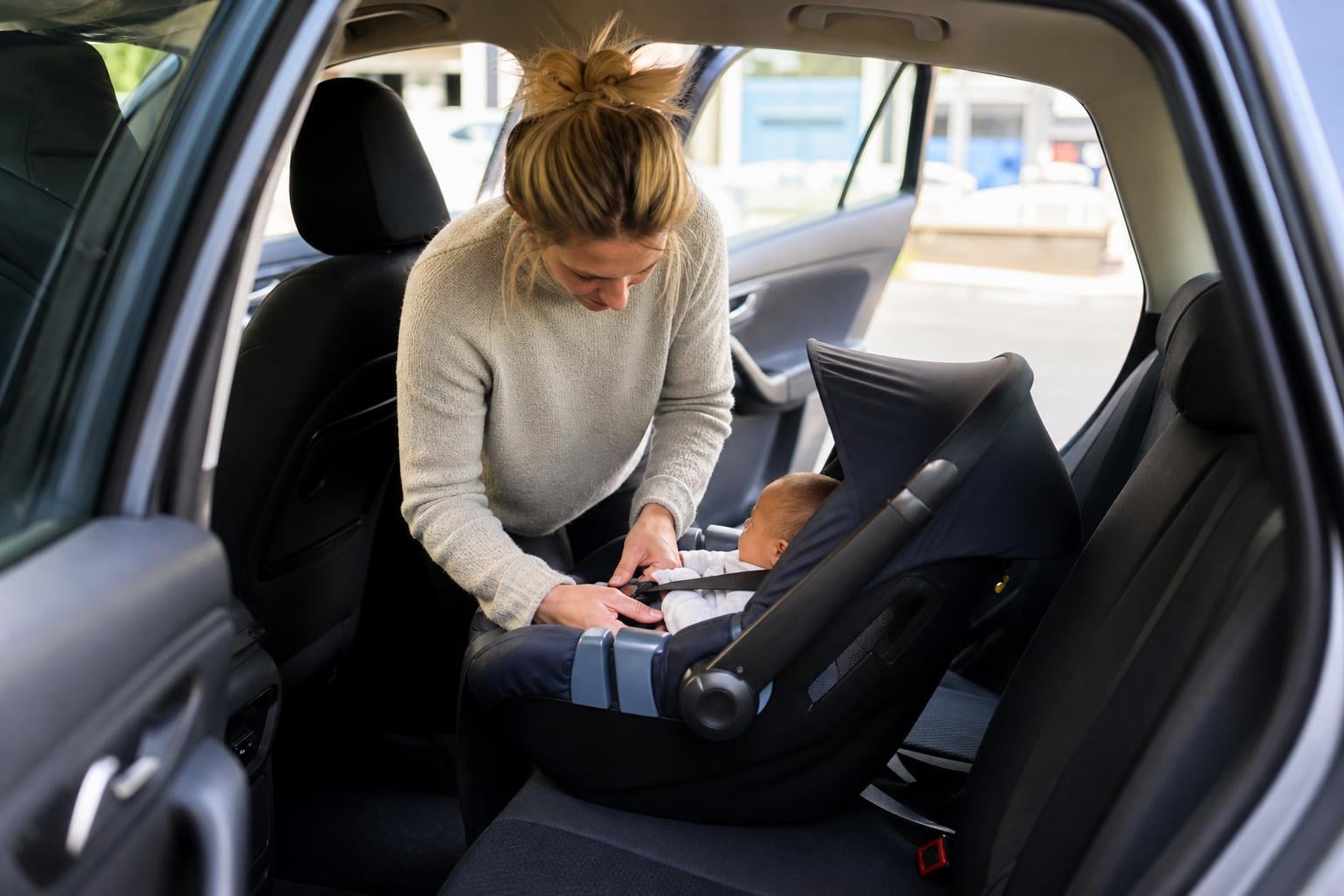
A baby capsule transfer is a pre-booked point-to-point ride, usually to or from an airport, cruise terminal, or hotel, where the vehicle comes equipped with a rear-facing baby capsule already installed. The driver fits the capsule before arriving at your pickup location, so you and your infant can get in and go without fumbling with unfamiliar hardware.
The term covers two connected ideas:
The service: A private transfer that includes a professionally fitted baby capsule as part of the booking.
The seat itself: A portable, rear-facing child restraint built in two parts, a base that stays anchored in the vehicle and a carrier with an inbuilt harness that clicks in and out of that base.
This two-part design is what makes capsules practical for transfer services. The base is pre-installed using either ISOFIX anchor points or a seatbelt, and the carrier locks into place in seconds. After the ride, parents can often lift the carrier straight onto a compatible pram frame without waking a sleeping baby.
A1 vs A2 Capsule Types
Not all baby capsules fit the same age range, and most transfer providers don’t explain the difference. There are two categories defined under Australian standards:
A1 capsules suit babies up to roughly 6 months old.
A2 capsules suit babies up to around 12 months old, depending on the child’s weight and size.
When booking a baby capsule transfer, always specify your child’s age and approximate weight. A 10-month-old will need an A2 capsule, and you don’t want to discover at pickup that the provider only carries A1 models.
The Australian Safety Standard
Every child restraint sold in Australia must meet AS/NZS 1754, one of the toughest child restraint standards in the world. It was first published in 1973 and has been updated regularly since. When booking any transfer service that provides a baby capsule, confirming AS/NZS 1754 compliance is non-negotiable.
Why Baby Capsule Transfers Matter for Families in Queensland
The Law Creates a Confusing Gap
Queensland child restraint laws are strict for private vehicles. Children under 6 months must travel in a rear-facing capsule. Children aged 6 months to under 4 years must be in a rear-facing or forward-facing seat with a harness. The penalties for getting it wrong are $391 and 3 demerit points per improperly restrained child, with double demerits for repeat offences within a year.
But here’s where it gets confusing. Taxis, limousines, and ride-booking services like Uber are exempt from child restraint requirements in Queensland. Instead, children under one year old must be held on the lap of a passenger aged 16 or older. Children between one and seven must sit in the back seat wearing a seatbelt.
This creates what parents experience as a “legal but unsafe” gap. The law says you can hold your infant on your lap in a taxi. Every road safety organisation says you shouldn’t. A thread in the r/brisbane subreddit captures this tension perfectly: a parent of a 4-month-old asking whether they can legally catch a taxi from the airport, clearly uncomfortable with the answer even before receiving it.
That cognitive dissonance is exactly what drives parents to search for baby capsule transfers. They want a clear, safe solution, not a legal loophole.
Taxis and Rideshare Won’t Solve This
Most taxi drivers in Queensland do not carry baby capsules. If you hail a cab at the airport rank with a newborn, you’re almost certainly riding without a proper restraint.
Uber launched a Child Seat option in Melbourne in late 2024, but it’s a trial limited to that city. The service includes a convertible seat and a booster, with a $9.99 surcharge per trip. It is not available in Brisbane, the Gold Coast, or anywhere else in Queensland.
Shared shuttle services present another dead end. Con-X-ion, one of Queensland’s largest shared shuttle operators, explicitly states on their FAQ page that they do not provide baby capsules and are not obligated to do so.
For families arriving at Brisbane Airport or the Gold Coast Airport with a baby, pre-booked private transfers are often the only reliable option that includes a properly installed capsule.
How a Baby Capsule Transfer Works
The process is straightforward, but the details matter.
Step 1: Book and Specify Your Child’s Details
When making your booking, provide your child’s age and approximate weight. This determines whether the provider fits an A1 or A2 capsule (or, for older children, a convertible or booster seat). Some providers also ask whether you need the capsule at pickup only or for a return trip as well.
For families needing multiple child restraints, or travelling with a mix of ages, you can read more about family airport transfer options to understand how private services handle larger groups.
Step 2: The Driver Pre-Installs the Capsule
Before arriving at your pickup point, the driver installs the capsule base in the vehicle. Professional transfer vehicles are more likely to have ISOFIX anchor points than older taxi fleets. ISOFIX is a rigid, standardised connection system that lets the capsule base lock directly into the car’s chassis without relying on a seatbelt thread. It’s faster, more secure, and harder to get wrong.
That last point is significant. Industry data suggests that roughly 80% of child seats are installed incorrectly by parents. Professional drivers who install capsules regularly eliminate this risk. It’s arguably the strongest safety argument for booking a baby capsule transfer rather than bringing your own seat and fitting it yourself in an unfamiliar vehicle.
Step 3: Pickup and Ride
At the airport, your driver meets you (many private transfer operators offer terminal meet-and-greet services with a name board) and walks you to the vehicle. The capsule is already fitted. You secure your baby in the carrier’s harness, the carrier clicks into the base, and you’re on your way.
Step 4: Arrival and Pram Transfer
Here’s an underrated benefit of capsules over fixed car seats. When you reach your destination, you can lift the entire carrier out of the base and clip it onto a compatible pram frame. Your baby doesn’t need to be disturbed. For parents arriving after a long flight with a sleeping infant, this seamless transition from car to pram is genuinely valuable.
If you’re weighing the benefits of pre-booked transfers more broadly, the capsule convenience is just one piece of a larger picture that includes flight monitoring, luggage help, and fixed pricing.
What About Cost?
The market is split. Some providers charge $25 or more per child seat. Others charge a small flat fee for installation and hire. Premium private transfer operators sometimes include baby capsules free of charge as part of the booking. My Private Transfers, for example, offers free child and infant seats for children aged 0 to 7, with baby capsules available on request.
Always confirm whether the capsule is included in your quoted price or carries an additional fee. This is one of the most important questions to ask before confirming a booking.
Baby Capsule vs Other Child Restraints
Parents booking transfers often aren’t sure which restraint type their child actually needs. Here’s a quick reference:
Restraint Type | Facing Direction | Typical Age Range | Portable? | Best For |
|---|---|---|---|---|
Baby capsule (A1) | Rear-facing | Birth to ~6 months | Yes (clicks in/out of base) | Newborns, short trips, transfer services |
Baby capsule (A2) | Rear-facing | Birth to ~12 months | Yes | Infants up to 12 months, airport transfers |
Convertible car seat | Rear then forward | Birth to ~4 years | No (fixed in vehicle) | Long-term daily use in family car |
Forward-facing seat | Forward-facing | 6 months to ~4 years | No | Toddlers who’ve outgrown capsules |
Booster seat | Forward-facing | 4 to ~7 years | Semi-portable | Older children using adult seatbelts |
The key difference between a capsule and a convertible car seat is portability. Convertible seats are designed to stay permanently installed in one vehicle. Capsules are built to move, which is exactly why they suit transfer services. The carrier detaches from the base in seconds, so drivers can prepare the vehicle in advance and parents aren’t wrestling with installation on the curb.
For children older than 12 months who no longer fit a capsule, most quality transfer providers also carry forward-facing seats or boosters. Specify your child’s age at booking, and the provider should match the right restraint.
Key Questions to Ask When Booking a Baby Capsule Transfer
Not all transfer providers handle baby capsules the same way. Before confirming your booking, ask these questions:
Is the baby capsule compliant with AS/NZS 1754? This is the mandatory Australian safety standard. Any reputable provider will confirm immediately.
Is the capsule included free, or is there an additional charge? Pricing varies significantly across the market. Get this in writing before you book.
Does the vehicle have ISOFIX anchor points? ISOFIX provides a more secure, foolproof installation than seatbelt-only methods. Newer vehicles in professional fleets almost always have them.
Will the driver install the capsule before pickup? You shouldn’t be waiting at the curb while a driver figures out the installation. Pre-installation is the standard for professional services.
What if my child has outgrown the capsule? If your baby is approaching 12 months or is particularly large for their age, ask whether a forward-facing alternative is available.
Can I request a capsule for both legs of my trip? If you need a capsule for your airport arrival and a separate booking for your return, confirm availability for both.
For more answers to common booking questions, the frequently asked questions page covers child seats, luggage, and other transfer details.
How to Travel with a Baby and a Capsule Beyond the Transfer
A baby capsule transfer solves the ground transport problem, but families travelling with infants face logistics at every stage. If you’re flying into Queensland with a baby for the first time, the airport travel with baby guide covers everything from check-in to pram gate-checking to what happens at the carousel.
For families heading to popular holiday spots, routes like Gold Coast Airport to Surfers Paradise or Noosa to Brisbane Airport are among the most commonly booked baby capsule transfer routes in South East Queensland.
Book a Baby Capsule Transfer
Travelling with a newborn is stressful enough without worrying about whether your ride will have a safe seat. A pre-booked baby capsule transfer removes that uncertainty entirely.
Ready to book? Get an instant quote for your route, or check verified customer reviews to see what other families have experienced.
Frequently Asked Questions
What age is a baby capsule transfer suitable for?
Baby capsules are designed for newborns up to roughly 6 months (A1 type) or 12 months (A2 type), depending on the model and the child’s weight. Most transfer providers carry A2 capsules that cover the full 0 to 12 month range. Always confirm when booking.
Do I legally need a baby capsule in a taxi or rideshare in Queensland?
No. Queensland law exempts taxis, limousines, and ride-booking services from child restraint requirements. Children under one must be held on the lap of a passenger aged 16 or older. However, this exemption doesn’t make the practice safe. Pre-booking a transfer with a capsule is the recommended alternative.
Can I bring my own baby capsule in a transfer vehicle?
Most private transfer providers will allow it, but you’ll need to install it yourself or ask the driver for help. Using the provider’s own capsule is usually easier because it’s already fitted to the vehicle before pickup.
How much does a baby capsule transfer cost?
It varies. Some providers charge $25 or more per seat. Others include capsules free with the booking. My Private Transfers offers free child and infant seats for ages 0 to 7, with baby capsules available on request.
Is Uber a good option for travelling with a baby in Brisbane?
Currently, no. Uber’s Child Seat option is only available as a trial in Melbourne, with a $9.99 surcharge per trip. It has not launched in Brisbane, the Gold Coast, or any other Queensland location.
What’s the difference between a baby capsule and a convertible car seat?
A baby capsule is portable and rear-facing only, designed to click in and out of a base for easy transfer between vehicles and prams. A convertible car seat is fixed in the vehicle and can be adjusted from rear-facing to forward-facing as the child grows. Capsules are better for transfer services; convertible seats are better for everyday family car use.
How do I know if the baby capsule meets Australian safety standards?
Ask the provider to confirm that the capsule complies with AS/NZS 1754, the mandatory Australian and New Zealand standard for child restraints. Reputable transfer companies will only use compliant equipment.
What if my child is too big for a baby capsule?
Children who have outgrown a capsule (typically over 12 months or exceeding the weight limit for the specific model) need a forward-facing child seat with a harness. Most professional transfer providers carry these as well. Specify your child’s age and weight when booking so the correct restraint is prepared.