
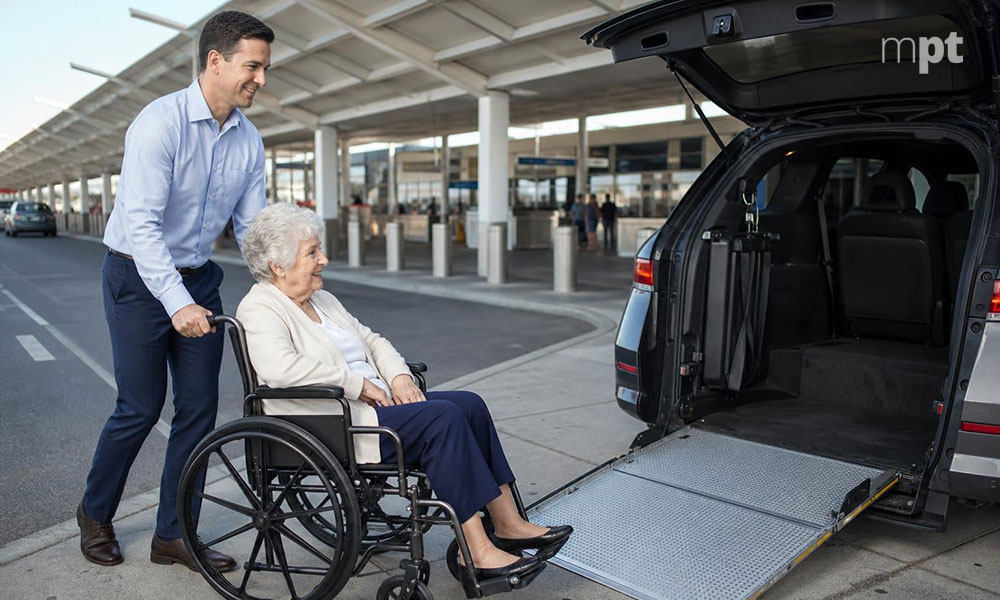
How to Get to Airport With Elderly Relative and Wheelchair


TLDR
Getting to the airport with an elderly relative who needs a wheelchair is a two-part challenge: the ground transport from home to the terminal, and then navigating the airport itself. Airlines will not help transfer your relative out of a vehicle, so the transport you choose to get there matters enormously. Request wheelchair assistance from the airline at least 48 hours before departure, arrive early, and consider a door-to-door private transfer that eliminates the parking-to-terminal walk entirely.
Why Most Guides Get This Wrong
Nearly every article about flying with an elderly wheelchair user starts at the terminal entrance. They cover airline wheelchair codes, boarding procedures, and security screening. That information matters, but it skips the hardest part: physically getting your elderly relative from their home into a vehicle, to the airport, out of that vehicle, and through the terminal door.
Research shows that 34% of elderly passengers prefer having a family member drive them to the airport, while 24.4% take a taxi. The ground transport leg is where most of the stress and planning failures happen. With 18.1% of Australia’s population now aged 65 and over, and more than three million Australians living with a disability, this is a growing need that deserves a proper, start-to-finish guide.
This article covers every step of how to get to the airport with an elderly relative and wheelchair, from the front door of their home to the moment they’re seated on the plane. It’s organized by journey stage, not alphabetically, because that’s how the day actually unfolds.
If you’re in South East Queensland and want to lock in a door-to-door ride with a professional driver, you can get an instant quote before reading further.
Stage 1: Getting From Home to the Airport
This is the stage that every competitor ignores. It’s also the stage where things go wrong most often.
The Vehicle-to-Terminal Problem
Here’s the critical fact most families discover too late: airlines will not help get your relative out of a car. Qantas explicitly states that due to occupational health and safety regulations, they are unable to provide passenger transfer assistance to and from vehicles. On arrival at the airport, the passenger must be accompanied by someone who can advise staff that a wheelchair is required kerbside.
This means the family member or the transfer driver must physically help the elderly person out of the vehicle and to the terminal entrance. The airline’s wheelchair assistance only begins once you’re inside. Your choice of ground transport is therefore the single most consequential decision in the entire journey.
Your Ground Transport Options
Driving yourself and parking. If you have a valid Disability Parking Permit, you can park in accessible spaces and leave the vehicle for up to 30 minutes, giving you time to assist your relative to and from the terminal. At Brisbane Airport’s Domestic Terminal, there are six accessible parking spaces under the skywalk pedestrian walkway, about 160 metres from the entrance. Two closer spaces (50 metres from the entrance) must be booked in advance by contacting Brisbane Airport reception. At the International Terminal, four accessible spaces on level 4 are limited to 5 minutes and the vehicle cannot be left unattended.
The challenge with driving yourself is the distance from the car park to the terminal, managing luggage, and getting your relative into a wheelchair or walking slowly across an open car park. For families figuring out how to get to the airport with an elderly relative and wheelchair, this option works best when the elderly person can walk short distances with support.
Wheelchair-accessible taxi (WAT). These modified vehicles have ramps or lifts so passengers can remain seated in their wheelchair during transport. They’re available in most Australian cities but supply is limited and wait times can be long, especially during peak periods.
Rideshare. Standard rideshare vehicles are generally unsuitable for wheelchair users. There’s no guarantee of vehicle type, no luggage assistance, and no accommodation for mobility aids. Practitioners on Reddit’s r/brisbane threads regularly note the difficulty of booking accessible vehicles through rideshare apps.
Door-to-door private transfer. A pre-booked car service picks up from the specific home address and drops at the terminal entrance. The driver handles luggage and assists the passenger to the terminal door. For wheelchair users, this eliminates the parking-to-terminal walk problem entirely. The driver is there on time, the vehicle is confirmed in advance, and someone is physically present to help at both ends of the ride.
For families across Brisbane, Gold Coast, or the Sunshine Coast who need this kind of certainty, a private airport transfer with a professional, government-accredited chauffeur removes the hardest handoff point from the journey. The driver arrives approximately 15 minutes early, assists with luggage, and ensures your relative reaches the terminal door safely.
Non-Emergency Medical Transport (NEMT)
If your elderly relative has significant medical needs beyond what a standard vehicle can accommodate, non-emergency medical transport provides vehicles with stretchers, wheelchair lifts, or medical monitoring. A doctor’s referral is typically required. This is distinct from an ambulance and is designed for patients who are stable but cannot travel in a regular car.
Patient Travel Subsidy Scheme (PTSS/PATS)
For Queensland residents travelling significant distances to access specialist medical care, the Patient Travel Subsidy Scheme may cover transport and accommodation costs. If your elderly relative’s flight is connected to medical treatment, check eligibility with the local hospital’s patient travel office. More details on this process are covered in the guide on arranging transport for medical appointment travel.
Companion Card
If your elderly relative holds a Companion Card, their carer can travel free on Airtrain services to Brisbane city and suburban stations. This can reduce costs if you’re using rail to reach the airport, though managing a wheelchair on trains adds its own complexity.
Stage 2: Arriving at the Airport and Getting Through the Terminal
Once you’ve made it to the terminal entrance, the airline and airport systems take over. But you need to have done some preparation in advance.
Requesting Wheelchair Assistance (48-Hour Rule)
Airlines provide free wheelchair assistance to move passengers with reduced mobility through the airport. It is free to take advantage of airport wheelchair assistance, and airports are required by law to provide this service to sick, injured, disabled, or elderly passengers.
The critical step: contact the airline at least 48 hours before your scheduled flight to reserve a wheelchair and an attendant. By waiting until you arrive, you risk there not being enough wheelchairs or staff, which could cause you to miss your flight.
When you call the airline, they’ll ask which level of assistance your relative needs. This is recorded using SSR codes (Special Service Request codes):
WCHR means the passenger can walk short distances (to and from the aircraft seat) but needs a wheelchair for longer distances through the terminal.
WCHS means the passenger cannot walk up or down stairs but can move to and from their seat.
WCHC means the passenger is completely immobile and must be carried to their seat.
Getting the right code matters. It determines how many attendants are assigned and what equipment is prepared.
Self-Identification at the Airport
Even if you’ve made a reservation note on your booking, the airline will not know that you are the person who requested assistance unless you self-identify. When you arrive at the terminal, go directly to the airline’s check-in counter or assistance desk and tell them your name and that you have a wheelchair assistance request. This triggers the service.
Practitioners on TripAdvisor forums consistently note that the self-identification step catches people off guard. One first-time user wrote: “I am about to go on my first trip using wheelchair/airport assistance (elderly parent finally accepted some help!). We’re both a bit nervous and unsure, so real experiences would be helpful!”
The “Forgotten Wheelchair” Problem
Forum users and senior advocacy groups report a recurring issue: wheelchair attendants leaving elderly passengers unattended at the gate or in a holding area while they attend to other tasks. As one senior advocacy blogger put it, “wheelchair-dependent travelers are at the mercy of strangers. Too many times, a person is forgotten and is raced to the gate in a cart. Think of how stressed you are when you might miss your flight and double that for a senior who has no control.”
The best insurance against this is staying with your elderly relative throughout the airport. One experienced traveller on TripAdvisor shared that they were allowed to push the wheelchair themselves every time they asked, which meant they didn’t have to wait for an attendant and could keep their own schedule.
Brisbane Airport Accessibility Features
If you’re flying out of Brisbane, the airport offers several features worth knowing about when planning how to get to the airport with an elderly relative and wheelchair.
Accessibility Journey Planner. Brisbane Airport has developed a downloadable planner to help passengers with assistance needs map their journey through the terminal. It was created in consultation with the Brisbane Airport Accessibility Reference Group.
Hidden Disability Lanyard (Sunflower Program). If your elderly relative lives with a condition that isn’t immediately visible, like dementia or cognitive decline, they can collect a hidden disability lanyard from the Visitor Information Centres in both terminals. The lanyard is recognised by BNE staff across the terminals, who can then provide additional support and patience.
Changing Places Bathrooms. These facilities provide an adult change table, hoist, toilet with moveable handrails, and extra space for people living with a profound disability and their carers. Access requires an MLAK key.
Brisbane Airport recommends arriving at least 90 minutes before domestic flights for passengers needing assistance. Qantas requires passengers needing mobility aid assistance to be at the airport at least 2 hours before departure at international terminals.
For families travelling through Brisbane Airport specifically, the Brisbane Airport transfers page has details on meet-and-greet services where the driver waits inside the terminal.
Security Screening With a Wheelchair
Your elderly relative will go through security in their wheelchair. The wheelchair itself will be screened, either by X-ray (if it’s a manual chair that can be folded) or by hand inspection. The passenger will receive a pat-down or be screened with a hand-held metal detector while remaining seated.
Let TSA or security staff know about any medical devices, prosthetics, or metal implants before screening begins. This speeds up the process and avoids unnecessary alarm. If your relative finds the process distressing, the Hidden Disability Lanyard mentioned above can help signal to staff that extra patience is needed.
Escort Pass / Gate Pass
If you’re not flying but want to accompany your elderly relative to the gate, some airlines issue an escort pass (also called a gate pass). This allows a non-travelling companion through security to assist with the boarding process. Availability varies by airline and airport, and you’ll need to request it at the check-in counter with valid ID. Not all airports or airlines offer this, so call ahead.
Stage 3: Boarding the Plane
Pre-Boarding and Priority Boarding
Passengers who need wheelchair assistance are typically invited to board before general boarding begins. This gives your relative time to get settled without the pressure of a full aisle behind them.
The Aisle Chair
Aircraft aisles are too narrow for a standard wheelchair. Once at the aircraft door, attendants transfer the passenger into an aisle chair, a narrow wheelchair designed to fit down the aircraft aisle. They then help the passenger to their assigned seat.
For caregivers on the AgingCare forum, this is often the most emotionally difficult moment. One family member shared their raw experience: “Flying time of just under 3 hours was uneventful but MIL cannot use bathroom because she can’t toilet herself anymore. We land and we’re the last to get off the plane because of the wheelchair: +20 minute delay.”
Gate-Checking a Personal Wheelchair
If your elderly relative uses their own wheelchair, ask to gate-check it. This means your parent can stay in their wheelchair through the terminal and right up to the aircraft door. The wheelchair goes into cargo at the aircraft door and is returned at the door upon arrival at your destination. This is far better than checking it at the ticket counter, which would leave your relative without their own chair for the entire airport experience.
Bulkhead Seats and Movable Armrests
Request a bulkhead seat (the first row in a section, with a wall in front rather than another row). These offer more legroom, which makes the transfer from aisle chair to seat easier. Also confirm that your relative’s seat has a movable armrest, which allows for a lateral slide transfer rather than having to lift over a fixed armrest.
Battery-Powered Wheelchair Rules
If your relative uses a power wheelchair with a lithium-ion or spillable battery, specific dangerous goods rules apply. Airlines require advance notice (usually 48 hours) and may need to disconnect or remove the battery for transport. Spillable wet-cell batteries must be removed and packed in a leak-proof container. Contact your airline directly for their specific requirements, as they vary.
Legal Protections
In Australia, the Disability Discrimination Act protects the rights of passengers with disabilities in air travel. Airlines cannot refuse to carry a passenger solely because of a disability, and they must provide reasonable accommodation. In the United States, the equivalent is the Air Carrier Access Act (ACAA). Knowing your rights matters, especially if you encounter resistance at any point.
Stage 4: On Arrival
Wheelchair Return
If you gate-checked a personal wheelchair, it should be returned at the aircraft door when you land. If it was checked at the ticket counter, it will appear at the oversized baggage area near the carousel.
Airline wheelchair assistance should also be arranged for the arrival airport. When you requested assistance during booking, confirm it covers both departure and arrival. An attendant should be waiting with a wheelchair when you deplane.
Arrival Meet-and-Greet
If someone is picking your elderly relative up at the destination, the single best thing they can do is arrange to meet inside the terminal rather than at the kerb. For families using a private transfer service on the arrival end, a meet-and-greet means the driver waits inside the arrivals hall with a name board, right where your relative exits. This eliminates the most stressful moment after landing: an elderly wheelchair user trying to find their ride in a chaotic pickup zone.
Understanding what’s included in an airport transfer helps you compare services and confirm that meet-and-greet, flight monitoring, and luggage assistance are part of the deal.
Flight Monitoring
Good transfer services track your flight in real time and adjust pickup accordingly. If the flight is delayed by an hour, the driver arrives an hour later. This matters enormously when the person waiting depends on someone else to get from the terminal to their destination. There’s more on the advantages of pre-booked transport for anyone weighing their options.
Stage 5: Planning and Booking Checklist
Here’s a timeline to follow when planning how to get to the airport with an elderly relative and wheelchair.
2+ weeks before travel:
Book flights and request wheelchair assistance (WCHR, WCHS, or WCHC)
Confirm whether a Fit-to-Fly Certificate is needed (required for some conditions; check with your airline)
Research ground transport options for both departure and arrival
Book your transfer to the airport and mention the wheelchair and any specific needs
1 week before:
Call the airline to reconfirm wheelchair assistance
Download Brisbane Airport’s Accessibility Journey Planner if flying from BNE
Prepare medications, documents, and a change of clothes in carry-on luggage
Confirm the power wheelchair battery meets airline requirements (if applicable)
Day of travel:
Arrive at the airport at least 90 minutes before domestic flights, 2 hours for international
Self-identify at the check-in counter immediately
Gate-check the personal wheelchair
Stay with your relative through the airport if possible
Medical Travel Companions
If your elderly relative needs more assistance than you can provide, and more than the airline offers, third-party medical travel companion services exist. These are professionally trained companions who travel with the passenger and handle everything from wheelchair transfers to toileting assistance. Brisbane Airport recommends contacting Medical Travel Companions for this level of support.
Frequently Asked Questions
Do I need a doctor’s note for airport wheelchair assistance?
No. Wheelchair assistance at airports is available to anyone who requests it, regardless of whether they have a formal diagnosis or medical documentation. However, a doctor’s note can be helpful if your relative has complex needs, requires oxygen, or if you’re applying for a Fit-to-Fly Certificate.
Can I push the wheelchair myself at the airport?
In most cases, yes. Experienced travellers report being allowed to push the airline-provided wheelchair themselves rather than waiting for an attendant. This avoids the delays that come when attendants are managing multiple passengers. Simply ask at the assistance desk.
How early should we arrive at the airport?
Brisbane Airport recommends at least 90 minutes before domestic flights for passengers needing assistance. For international flights, Qantas requires at least 2 hours. Build in extra buffer time, especially for a first trip. Rushing is the enemy of a calm experience.
What if my relative uses a power wheelchair?
Power wheelchairs with lithium-ion batteries are generally accepted but require at least 48 hours advance notice to the airline. The battery may need to be disconnected for transport. Spillable batteries must be removed and packed separately. Contact your airline for their exact requirements and confirm before you leave for the airport.
Can someone meet us at the gate if they’re not flying?
Some airlines issue an escort pass or gate pass that allows a non-travelling companion through security. This is not guaranteed and depends on the airline and airport. Request it at the check-in counter with valid photo ID.
What happens if the airline forgets our wheelchair request?
Self-identify immediately at the check-in counter. If the assistance still doesn’t materialise, ask to speak with a supervisor. Airlines are legally required to provide wheelchair services. Document any issues in writing and file a complaint with the airline and, if in Australia, the Airline Customer Advocate.
Is it better to fly direct or accept a connection?
Fly direct whenever possible. Every connection means another wheelchair transfer, another gate, another chance for luggage or mobility aids to be mishandled, and more fatigue for your relative. The cost difference is almost always worth it.
If you’re planning a trip from anywhere in South East Queensland and want to eliminate the ground transport stress entirely, contact the team to discuss your specific accessibility requirements and lock in a door-to-door transfer with a professional chauffeur who’ll be there from the front door to the terminal.