
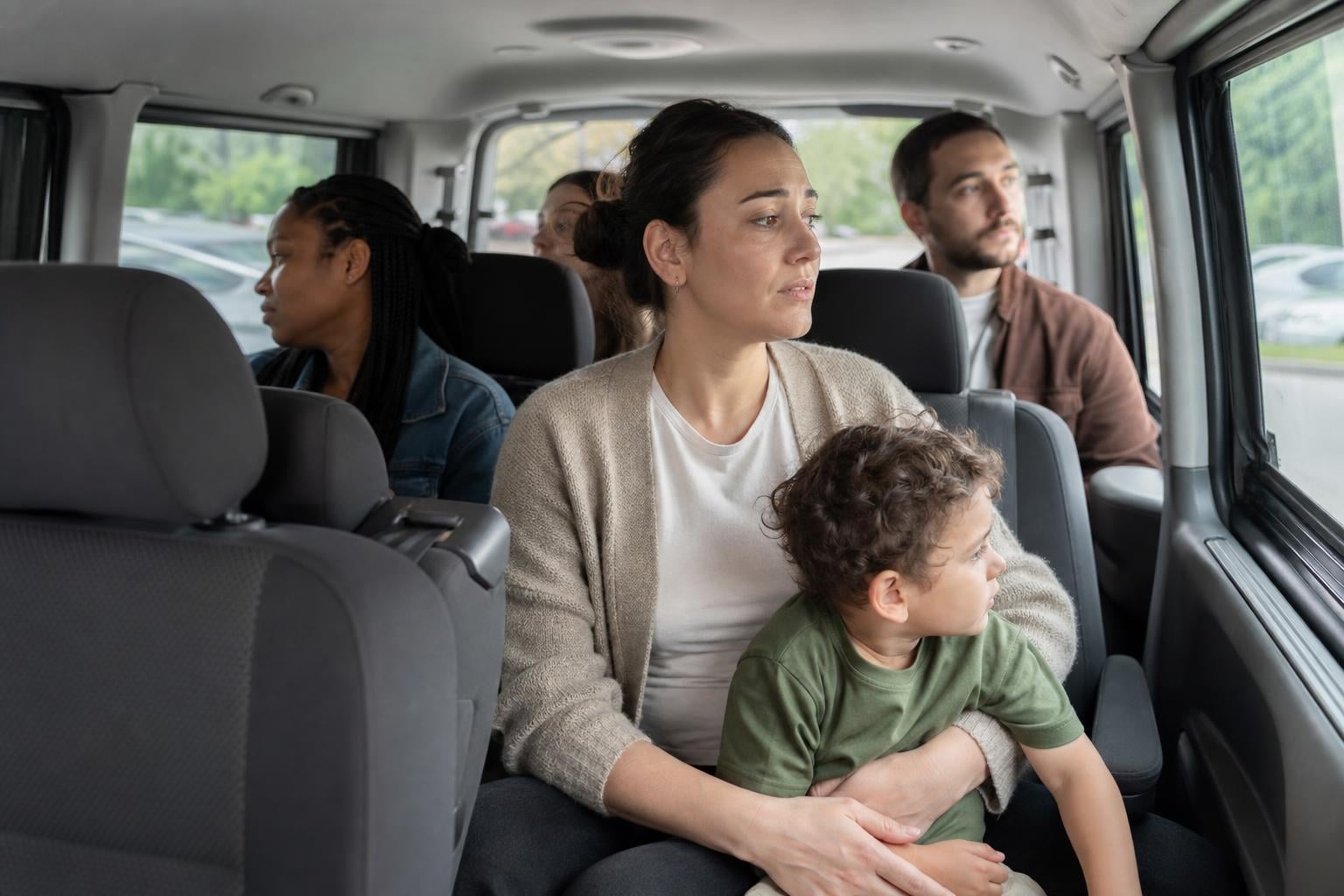
Nervous About Sharing Shuttle With Strangers With Kids?


TL;DR
Your nervousness about sharing a shuttle with strangers when you have kids is completely rational. Shared shuttles rarely provide child seats, charge per person (so families pay more than you’d expect), and add 45 to 90 minutes of travel time through multiple stops. Queensland law doesn’t even require child restraints in taxis, rideshares, or shuttles, which makes the safety gap real. For families with young children, a private transfer often costs the same as four shared shuttle tickets while eliminating every source of that anxiety.
If you’ve been searching for airport transport and feeling nervous about sharing a shuttle with strangers with kids, you’re not being overprotective. You’re paying attention to real problems that other parents have already experienced the hard way. This guide explains what shared shuttles actually involve, what Australian law says about child safety in these vehicles, and how to make a decision that fits your family.
Get an instant quote for a private family transfer and see how the cost compares.
What Is a Shared Shuttle, Exactly?
A shared shuttle (sometimes called a shared transfer or shared van) is a pre-booked vehicle, typically a 12 to 15 seat minibus, that picks up multiple unrelated passengers from the same airport and drops each group at different destinations along a set route. You share the vehicle, the luggage space, and the schedule with strangers.
On average, shared shuttles make 3 to 4 stops per route. That means your travel time stretches to roughly 1.5 to 2.5 times the direct drive time. A trip that takes 45 minutes in a private car might take 90 minutes or longer on a shared shuttle, depending on where the other passengers are headed.
The appeal is obvious: shuttles are typically 40 to 60% cheaper per person than a private car. But that per-person pricing model is exactly where the math starts working against families, which we’ll get to shortly.
If you’re new to pre-booked airport transport, this airport transfer explainer covers the basics of how these services work and what to expect.
Why Parents Feel Nervous, and Why They’re Right
Being nervous about sharing a shuttle with strangers with kids isn’t a personality flaw. It’s a reasonable response to a set of very specific, well-documented problems. Parent concerns from forums, review sites, and community discussions cluster around five areas.
1. Child Seat Uncertainty
Most shared shuttle services do not provide child safety seats. If your child is under seven and legally required (or practically needed) to be in an age-appropriate restraint, you’re often expected to bring your own. That means lugging a bulky car seat through the airport on top of everything else. Parents on Facebook groups and Reddit threads consistently flag this as their number one concern, and practitioners on Reddit’s r/brisbane have specifically discussed the difficulty of sourcing baby seats for airport transport in South East Queensland.
The reality is blunt: you should never assume a driver will have a child seat unless you’ve specifically requested and confirmed one in advance.
2. Delays From Other Passengers
A shared shuttle’s schedule isn’t yours. It belongs to the route. If another passenger’s flight is delayed, or if a pickup runs long, everyone waits.
One reviewer on ProductReview.com.au described a shared shuttle arriving 35 minutes late, then making additional hotel stops, which caused them to miss their flight entirely. Another recurring complaint about the dominant South East Queensland shared shuttle operator: “One thing I’ll never get used to is the fact that there are always other passengers to collect, usually from an address a few minutes off the main road and the time ticks by.”
When you have a toddler who skipped their nap and a check-in deadline looming, those extra minutes aren’t minor inconveniences. They’re stress multipliers.
If flight delays are a concern, read about transport that waits for delayed flights to understand your options.
3. Stranger Proximity With Tired Children
After a flight, kids are often exhausted, overstimulated, or both. A private vehicle lets them decompress. A shared shuttle puts them elbow to elbow with strangers who may not appreciate a crying two-year-old any more than your two-year-old appreciates being crammed into a minibus.
Parents who’ve used private transfers consistently note the quiet environment as a major relief, not a luxury.
4. Luggage Chaos
A family of four travelling with a stroller, two suitcases, carry-ons, and possibly a portable cot takes up serious space. On a shared shuttle, you’re competing for luggage room with every other passenger group. One family travel writer put it plainly: “You’re not negotiating space with strangers or hoping the shuttle has room for your gear.”
For families with bulky gear, the luggage trailer guide explains how optional enclosed trailers solve overflow problems.
5. Loss of Schedule Control
Private transfers build around your itinerary. Shared shuttles build around the operator’s route efficiency. That’s a fundamental difference. When you’re managing small children, strict check-in windows, or early morning flights, handing schedule control to a shared service creates a layer of unpredictability that most parents would rather avoid.
Australian Child Restraint Laws: What Queensland Parents Must Know
This is the part that surprises most parents and the part that matters most.
The Queensland Exemption
In Queensland, child restraints are not required in taxis, limousines, ride-booking services (like Uber and DiDi), or buses that carry 13 or more people. That means your child can legally ride in a shared shuttle, taxi, or rideshare vehicle without any child restraint at all.
The specific rules under this exemption:
Children under 1 year old can be held on the lap of someone aged 16 or older
Children aged 1 to 7 can use only a seatbelt (but must not sit in the front seat if the vehicle has two or more rows)
Legal Does Not Mean Safe
Just because something is legal doesn’t mean it’s wise. A five-year study by the Queensland Family and Child Commission found that vehicle-related trauma was the second leading cause of childhood deaths in Queensland. The NSW Ombudsman’s 2023/2024 report found that almost one in three child crash deaths could have been prevented with proper seatbelts or restraints.
The National Transport Commission is currently reviewing these exemptions, acknowledging concerns that they don’t provide adequate safety protection.
Interstate Differences That Catch People Off Guard
If you’re flying into Sydney or Melbourne and then catching ground transport, the rules change. In most states and territories outside Queensland and Western Australia, the laws that apply to private cars also apply to rideshare vehicles. That means all children under seven must sit in an approved child car seat.
Queensland’s exemption is the outlier, not the standard. Parents who are nervous about sharing a shuttle with strangers with kids often don’t realize the legal safety net they’re accustomed to in their home state simply doesn’t exist in QLD taxis, rideshares, and shuttles.
For a deeper look at how child seats work with Brisbane private transfers specifically, the Brisbane child seats guide covers what’s available and how to request the right restraint for your child’s age.
Shared Shuttle vs. Private Transfer: The Family Decision Guide
Here’s where the practical comparison gets interesting, especially when you look at it through the lens of a family rather than an individual traveller.
The Cost Comparison Families Miss
Shared shuttles charge per person. Private transfers charge per vehicle. This distinction changes everything for families.
Factor | Shared Shuttle | Private Transfer |
|---|---|---|
Pricing model | Per person | Per vehicle |
Family of 4 cost | $25 x 4 = $100 (kids pay full fare on most services) | Often $100 to $160 for the entire vehicle |
Child seats | Rarely available; bring your own | Pre-installed when requested |
Route time | 1.5 to 2.5x direct drive | Direct, door to door |
Stops | 3 to 4 on average | Zero |
Luggage space | Shared with all passengers | Entire boot plus optional trailer |
Flight delay handling | Driver follows route schedule | Driver tracks your flight and waits |
Meet and greet | Usually curbside only | Often inside the terminal at baggage claim |
The numbers tell the story. A private SUV for four people often costs the same as, or marginally more than, four individual shared shuttle seats. But the experience gap is enormous.
As one transport comparison site noted: “That is where the routing delay becomes more expensive than the ticket difference.” The 45 to 90 minutes you save on a private transfer has real value when you have young children.
Compare family transfer pricing to see how the per-vehicle cost stacks up against shared options for your specific route.
What About Rideshare?
Rideshare apps like Uber and DiDi are convenient, but they come with their own problems for families with kids. In Queensland, rideshare drivers are not required to provide child restraints (the taxi exemption extends to ride-booking services). Most rideshare drivers aren’t trained in installing child car seats even if you bring your own. And surge pricing during peak airport hours can push the cost above a pre-booked private transfer anyway.
The chauffeur vs. rideshare comparison breaks down the cost and safety differences in more detail.
What a Shared Shuttle Experience Actually Looks Like With Kids
To give this concrete shape, here’s what forum posts and reviews describe:
Best case: You board quickly, your child sits on your lap or in a seatbelt, the shuttle makes two stops before yours, and you arrive 30 minutes later than a direct drive would take. Mildly inconvenient but fine.
Common case: The shuttle is late. Your toddler is melting down. Other passengers are visibly annoyed. The driver makes four stops, two of which are “a few minutes off the main road.” Your 45-minute trip takes 90 minutes. You arrive frazzled.
Worst case: A mother on ProductReview.com.au described travelling with two children aged 4 and 18 months. She needed to change the baby and arrived at the pickup point at 12:03, three minutes past the scheduled time. The driver had already left. The company knew she was travelling with young children.
These aren’t hypothetical scenarios. They’re patterns documented across review platforms for South East Queensland shuttle operators. The dominant shared shuttle provider in the Brisbane to Gold Coast corridor holds a 2.7 out of 5 rating on Klook from passengers who used the service.
What to Ask Before Booking Any Transfer With Kids
Whether you choose a shared shuttle, private transfer, rideshare, or taxi, ask these questions before you book:
Does the service provide age-appropriate child restraints? Rear-facing, forward-facing, and booster seats are different products. A generic “child seat” answer isn’t good enough.
Are child seats included or charged as an extra? Some services charge $20 to $50 per seat. Others include them free.
Is the vehicle shared or exclusive to your family?
What happens if your flight is delayed? Does the driver wait, or do you get left behind?
Where does the driver meet you? Inside the terminal at baggage claim, or at a curbside pickup zone you have to find yourself with kids and luggage?
Can the vehicle fit your stroller, luggage, and car seats simultaneously? Ask specifically. Don’t assume.
What’s the cancellation policy? Flights change. Plans shift. Know the refund window.
For a more detailed framework, the airport transfer company checklist walks through every evaluation criterion.
Have specific questions about child seats or family bookings? Contact the team directly.
Key Terms Parents Search For
Shared shuttle: A pre-booked minibus that transports multiple unrelated passenger groups along a fixed route with several drop-off stops.
Private transfer: An exclusive, pre-booked vehicle dedicated to one passenger group, travelling direct from pickup to destination with no other stops.
Meet-and-greet service: A driver meets you inside the terminal (usually at the baggage carousel for domestic flights or the arrivals hall for international) holding a name board, rather than waiting at a curbside zone.
Baby capsule: A rear-facing child restraint designed for infants from birth to approximately 6 months (up to about 9 kg). Required by Australian law for children under 6 months in private vehicles.
Booster seat: A raised seat that positions a child so the vehicle’s seatbelt sits correctly across their body. Required in most Australian states for children aged 4 to 7.
AS/NZS 1754: The Australian/New Zealand standard for child restraints. Only seats meeting this standard are legal for use in Australian vehicles.
Door-to-door transfer: A service that picks you up at your exact address and drops you at your exact destination, as opposed to stopping at a central meeting point.
Flight tracking: When a transfer provider monitors your flight’s actual arrival time and adjusts the driver’s schedule accordingly, so delays don’t result in a missed pickup.
For more on what professional transfer services include, the professional driver service glossary covers related terms.
Bottom Line: Is the Upgrade to Private Worth It?
For families with children under seven, the answer is straightforward: yes.
A private transfer eliminates every concern that makes parents nervous about sharing a shuttle with strangers with kids. Child seats are pre-installed when you book. The vehicle goes directly to your destination with zero stops. Your luggage fits without negotiation. The driver tracks your flight and waits if it’s late. And your children can sleep, cry, or be children without an audience of strangers.
The cost difference is smaller than most people assume. Once you’re booking three or four shuttle seats at per-person rates, a private vehicle is comparable, sometimes cheaper. The value isn’t about luxury. It’s about predictability, safety, and the kind of peace of mind that lets you actually enjoy the start of your holiday.
Get a family transfer quote and compare it to the shared shuttle price for your route. The numbers might surprise you.
Frequently Asked Questions
Is it safe to take a shared shuttle with a baby in Queensland?
Legally, yes. Queensland exempts taxis, rideshares, limousines, and large shuttles from child restraint requirements. But safe and legal aren’t the same thing. Without an approved child seat, your baby has no crash protection beyond your arms. A pre-booked private transfer with a confirmed baby capsule is the safest ground transport option.
Do shared shuttles provide child car seats?
Most do not. The standard expectation is that parents bring their own. Even when a shared shuttle operator says seats are available, they may not have the correct type for your child’s age and weight. Always confirm the specific restraint type before booking.
How much more does a private transfer cost than a shared shuttle for a family?
Less than you’d think. Shared shuttles charge per person, and children typically pay full fare. A family of four at $25 per head pays $100 on a shared shuttle. A private vehicle for the same route often falls between $100 and $160 total. The time saved (45 to 90 minutes on popular South East Queensland routes) adds further practical value.
What if my flight is delayed and I’ve booked a shared shuttle?
Most shared shuttles operate on fixed schedules. If your flight lands late, the shuttle may leave without you. Private transfer services that offer flight tracking adjust the pickup time automatically based on your actual arrival, so the driver is waiting when you walk out.
Can I use an Uber with a child seat in Queensland?
Queensland’s taxi exemption extends to ride-booking services like Uber and DiDi. That means rideshare drivers are not required to provide child restraints, and most don’t carry them. You can bring your own, but most rideshare drivers aren’t trained to install them correctly. This is different from NSW and other states where rideshare services must follow private vehicle child restraint laws.
What does meet-and-greet mean for airport transfers?
Instead of searching for your driver at a curbside pickup zone while wrangling kids and luggage, a meet-and-greet driver waits inside the terminal, usually at the baggage carousel or arrivals hall, holding a sign with your name. This is particularly helpful for parents managing small children, strollers, and multiple bags after a flight.
Are parents just being paranoid about shared shuttles?
No. The concerns are backed by documented patterns: shuttles leaving parents behind, arriving significantly late, lacking child seats, and creating stressful conditions for families. Feeling nervous about sharing a shuttle with strangers with kids reflects an accurate assessment of real risks, not an overreaction.
What’s the safest ground transport option for families with young children in Australia?
A pre-booked private transfer with confirmed, age-appropriate child restraints that meet AS/NZS 1754 standards. This gives you crash-rated protection for your children, a direct route with no shared stops, and a driver who knows your family’s needs before you arrive.