
How to Transport Surfboard: Car, Flights & Shuttles 2026


TLDR
Transporting a surfboard is not one problem but several, depending on whether you’re driving to a local break, catching a flight, or getting from the airport to your accommodation. This guide covers every method and term surfers encounter when moving their board: roof racks, board bags, shared shuttles, rideshare uncertainty, airline fees, and Australian load laws. The right choice depends on distance, board size, and who’s driving.
Why Transporting a Surfboard Is More Complicated Than It Looks
Most surfers figure out how to transport a surfboard to their local beach pretty quickly. Strap it to the roof, drive ten minutes, done. But the moment travel enters the picture, things get complicated fast.
An airline might happily accept your 277 cm board bag, but the shared shuttle waiting at the airport refuses anything over 183 cm. Your Uber driver might take one look at your longboard and cancel the ride. And if you’re driving with a board strapped to the roof in Queensland, you might not realize there are load restraint laws that carry fines starting at $200.
No single page online covers all of these scenarios together. This guide does. It’s organized by transport method: driving yourself, having someone else drive you, flying with your board, protecting your board in transit, and staying legal in Australia.
If you’re flying into South East Queensland with surfboards, you can get an instant quote for a private transfer with an enclosed luggage trailer to sort out the ground transport leg before you land.
Self-Drive Methods: Transporting a Surfboard by Car
When you’re driving your own vehicle, you have the most control over how to transport a surfboard safely. Here are the main options, from cheapest to most secure.
Hard Roof Rack Systems
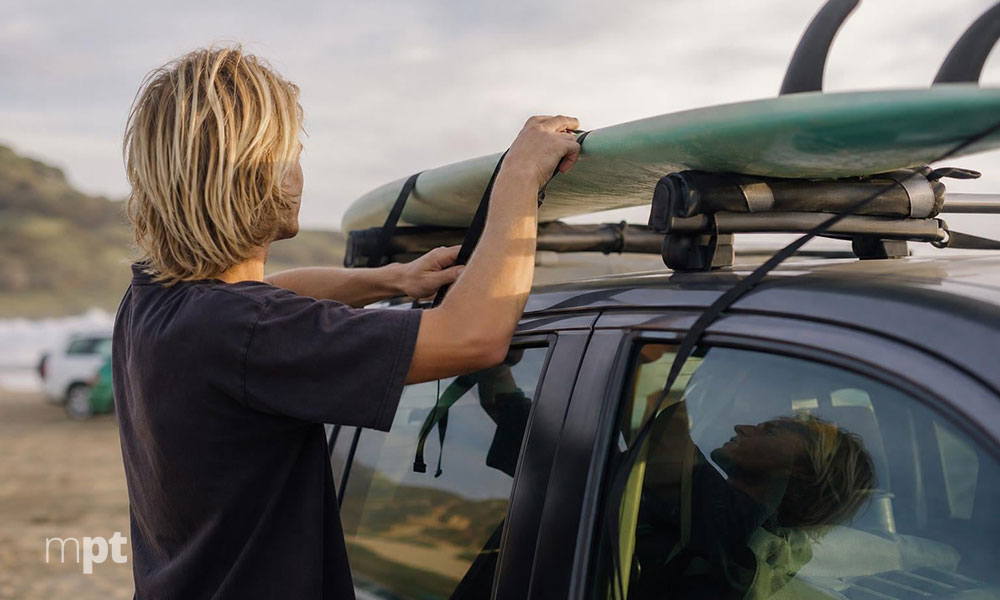
Hard rack systems from brands like Thule and Yakima provide the greatest stability and security for surfboard transport. These permanent installations include a base rack (crossbars) and specialized surfboard attachments. They cost $200 or more but offer superior wind resistance and hold boards firmly at highway speeds. If you surf regularly and own your vehicle, a hard rack is the best long-term investment.
The key consideration is your vehicle’s roof rack weight rating. Exceeding it doesn’t just risk damage to the rack, it can void your vehicle insurance.
Soft Racks
Soft racks are padded foam bars with straps that thread through your car’s interior (usually through open doors). They cost $50 to $90 and last a surprisingly long time. Soft racks are portable, making them ideal for rental cars and travel. The trade-off is that they may not provide the same security as permanent systems at highway speeds. For short, low-speed trips to the beach, they work well. For extended highway driving, consider a hard rack instead.
Magnetic Roof Racks
A newer option that attaches to any metal roof via strong magnets. Easy to assemble and disassemble, with no need to thread straps through the car doors. The appeal is convenience, but magnetic racks work best for lighter shortboards on shorter trips. Check the weight rating carefully before loading a heavy longboard.
Foam Blocks and Straps
The budget DIY option. Foam blocks sit on the roof, you place the board on top, and ratchet or cam straps hold everything down. This costs under $30 but requires careful setup every time. If the straps aren’t tight or the blocks shift, the board can move at speed. Not recommended for highway use.
Inside the Car
Folding down rear seats and sliding the board inside (nose forward, fins up) works well for shortboards in sedans and most boards in SUVs or wagons. This method eliminates aerodynamic drag, which actually reduces fuel consumption compared to rooftop methods. The downsides are obvious: it limits passenger space and only works for shorter boards in most vehicles.
Ute or Pickup Bed
Common in Australia. The board sits in the tray, but you still need tie-downs. A board sliding around in an open ute bed at 100 km/h is a hazard to everyone on the road. Strap it down properly every time.
Tie-Down Straps
Whatever method you use, purpose-built surfboard straps ($25 to $30) are worth owning. They have padded cam buckles that won’t scratch your board, and they’re designed for the specific tension needed. Generic ratchet straps can work but risk over-tightening and denting the rails.
Bicycle Surfboard Racks
For local trips only. Side-mount or rear-mount racks attach to a bicycle frame and hold a single board. They’re popular in beach towns where the break is a short ride from home. Not practical for anything beyond a few kilometres.
Protecting Your Board: Bags, Socks, and Packing
How you pack your surfboard matters as much as how you transport it. A board bouncing around in the back of a vehicle or a trailer with no protection will get damaged.
Board Bag
A padded travel bag is essential for any transport beyond a quick local trip. A new board bag costs around $100, used around $50. The padding protects against dings, and the bag keeps wax off your car interior and other luggage. For airport transfers, shuttle rides, or trailer transport, a board bag is non-negotiable.
Board Sock
A thin fabric sleeve that provides basic scratch protection but minimal impact resistance. Costs about $30. Fine for daily beach runs where the board goes from car to sand. Not enough protection for air travel or long-distance road trips.
Coffin Bag
A multi-board travel bag that accommodates two to four boards. Essential for surf trips where you’re bringing a quiver. Coffin bags are larger and heavier than single bags, which matters for both airline weight limits and ground transport capacity.
Fin Removal
Remove your fins before any non-local transport. Protruding fins puncture board bags, damage other boards in a coffin bag, and can scratch trailer interiors. Both Qantas and Virgin Australia recommend removing fins for checked surfboards. Keep fins in a separate pouch with your fin key.
Rail Protection and Nose/Tail Guards
Pipe insulation or pool noodles wrapped around the rails provide cheap, effective protection. Practitioners on Reddit’s r/surfing consistently recommend this approach, noting that most transport damage happens to rails, nose, and tail. Extra padding at the nose and tail (the most vulnerable points) is worth the few minutes it takes.
Why Packed Dimensions Matter More Than Board Length
This catches surfers out constantly. A 6’2″ shortboard becomes a 200+ cm bag once you add padding, fins, towels, and a wetsuit stuffed inside. Every transport method’s size limit refers to the packed bag, not the naked board. When telling a transfer company, airline, or shuttle service your board’s dimensions, always give the packed measurement.
Ground Transport: When Someone Else Is Driving
This is where surfers run into the most uncertainty. The question isn’t just how to transport a surfboard, it’s whether the driver will even accept it.
Private Airport Transfer with Enclosed Luggage Trailer
A pre-booked private transfer with a luggage trailer is the most reliable option for getting surfboards from an airport to your accommodation. The boards travel in a separate enclosed trailer, keeping the passenger cabin clear for people and standard luggage.
My Private Transfers offers optional enclosed luggage trailers, including for surfboards up to approximately 1.9 m. All chauffeurs are Queensland Government-accredited, and the service includes meet-and-greet at major airports, free child and infant seats for ages 0 to 7, and 24/7 online booking. Trailers incur an extra fee, so include your packed board-bag length when requesting a quote.
For the full process of booking a trailer for surfboards, including what measurements to provide, the luggage trailer surfboard guide walks through every step.
Shared Shuttles
Shared airport shuttles are cheaper per person than private transfers but come with strict size limits. Con-X-ion, one of the major shuttle operators in South East Queensland, states that surfboards must be less than 6 ft (183 cm) and that boards exceeding this limit cannot be transported due to coach trailer size restrictions. Surfboards that qualify incur an additional fee of $10 each on Gold Coast and Brisbane services. On Sunshine Coast services, passengers carrying a surfboard need to supply their own straps and attach them to vehicles themselves.
For solo travellers with a short board and a flexible schedule, a shared shuttle can work. For anyone with a board over 183 cm, it’s not an option.
Taxi and Maxi Taxi
Taxis are available on-demand at airport ranks, and Brisbane Airport notes that taxis operate 24/7 from sheltered ranks at both terminals. The problem is fit and driver acceptance. A standard taxi cannot fit a longboard. A maxi taxi might, but you’re hoping the right vehicle happens to be available when you need it. TripAdvisor users discussing surfboard transport note that surfboards “just won’t fit in most taxi” and recommend pre-booking shuttle or transfer services for oversized luggage.
Rideshare (Uber, DiDi)
No roof rack, no trailer, and the driver may cancel or refuse your board. Practitioners on Reddit’s r/GoldCoast have asked directly whether an Uber will accept a surfboard, and responses show genuine uncertainty. One user in a Byron Bay Facebook group asked for an “affordable transfer to Gold Coast airport with a longboard” (9 ft board), highlighting just how common this problem is for price-sensitive surfers.
For shortboards on non-critical trips, rideshare can work if the driver has a large enough vehicle. For longboards or trips where you have a flight to catch, it’s a gamble. A detailed comparison of chauffeur services versus rideshare covers luggage handling, pricing, and reliability differences.
Public Transport with a Surfboard
Gold Coast’s G:link trams have designated surfboard parking bays, a fact that went semi-viral on Reddit’s r/mildlyinteresting when a user posted a photo of the surfboard stands inside a tram. Trains vary by network and aren’t always surfboard-friendly. If you’re planning to use public transport, check the specific operator’s policy before showing up with a 7-foot board.
The Airline-to-Ground Gap: A Problem Nobody Talks About
Here’s something most surfers don’t realize until they’re standing at the airport with a board bag that’s too big for their ground transfer.
Airlines are relatively generous with surfboard dimensions. Qantas accepts boards up to 277 cm on most domestic routes. Virgin Australia accepts surfboards up to 3.0 m on B737, A320, and F100 aircraft. Alaska and Hawaiian Airlines allow multiple surfboards in a single bag measuring up to 10 feet, 5 inches, and 50 pounds.
Compare those limits to what happens on the ground. Con-X-ion’s shared shuttle caps surfboards at 183 cm. That’s a gap of almost a full metre compared to Qantas.
The takeaway: check airline limits before you fly, but check ground-transfer limits before you land. If your airline-accepted board bag is 250 cm, you need ground transport that can handle 250 cm. A shared shuttle won’t do it. A standard sedan won’t do it. You need either a pre-booked transfer with a trailer or a vehicle large enough to fit the bag inside.
If you’re connecting through Brisbane Airport or Gold Coast Airport with oversized board bags, confirming ground transport capacity before your flight saves the panic of figuring it out at the arrivals curb.
Airline Surfboard Fees and Policies
Airline surfboard policies change constantly, and fees vary wildly from free to $400 or more depending on the carrier and route. Some airlines have softened recently. Hawaiian Airlines made surfboards part of its standard checked baggage allowance when it merged operations with Alaska Airlines. Other carriers still charge significant fees.
Key terms to understand:
Oversized baggage means items exceeding standard checked bag dimensions. Most surfboards qualify as oversized automatically.
Linear dimensions refers to how airlines measure bags: length plus width plus height combined. A 6’6″ surfboard bag can easily exceed 300 cm in linear dimensions once padding is factored in.
Aircraft type matters. Smaller planes often have stricter length limits regardless of what the airline website says. A turboprop’s cargo hold is physically smaller than a 787’s, and your 9-foot board simply won’t fit.
Pre-registration is required by some airlines for surfboard bags. Failing to notify them in advance can mean your board is refused at check-in.
The only reliable advice: verify your specific airline’s current surfboard policy for your specific route and aircraft type before every trip. Policies listed on airline websites may not reflect regional or seasonal changes. The Inertia publishes an updated airline surfboard fee guide that’s worth checking before booking.
Australian Load Restraint Laws for Surfboards
Most surfers visiting the Gold Coast or Sunshine Coast don’t know that Australian load restraint laws apply to surfboards on cars. These aren’t suggestions. They’re enforceable laws with real fines.
Queensland Load Restraint
Queensland Government guidance states that all loads must be safely restrained and must not endanger road users, passengers, or road infrastructure. There are heavy fines for travelling with an incorrectly secured or unsecured load. In Queensland, fines for unsecured loads start at $200 or more. Breaching these laws can also void your vehicle insurance in the event of a crash.
Projecting Load Rules
Most Australian jurisdictions restrict how far items can extend beyond your vehicle, typically 3 feet from the front bumper and 4 feet from the rear. Loads projecting beyond these limits require warning flags or lights. If your longboard extends past the back of your car, you need to comply with projecting load requirements or face fines.
Practical Implications
If you’re a visiting surfer renting a car on the Gold Coast, these rules apply to you. A surfboard hanging out of the boot with no restraint, no flag, and no tie-downs isn’t just risky, it’s illegal. Strap it down, use a proper rack, or put it inside the vehicle.
South East Queensland Surfboard Transport Options
SEQ has some unique infrastructure that makes surfboard transport easier than many coastal regions.
Gold Coast Tram Surfboard Bays
The G:link trams running between Broadbeach and Helensvale have designated surfboard parking bays inside the carriages. This is one of the few public transport systems in the world that explicitly accommodates surfboards. For surfers staying along the tram corridor, it’s a free (with a go card) way to get to breaks without needing a car.
Enclosed Luggage Trailers
For airport transfers and longer-distance trips, enclosed luggage trailers keep boards separate from the passenger cabin and protect them from weather and road debris. This is particularly useful for family surf trips where the vehicle cabin is already full with child seats, suitcases, and prams. Understanding what’s included in an airport transfer helps you compare providers on trailer availability, fees, and size limits.
Meet-and-Greet with Surfboard
Some transfer services offer meet-and-greet at the airport arrivals area, where the driver meets you at the baggage carousel and handles board loading. This eliminates the logistical challenge of navigating from the terminal to a pickup zone while juggling a 7-foot board bag, suitcases, and tired kids.
Travelling with surfboards into South East Queensland? Contact the team with your board-bag measurements to confirm trailer capacity and get a quote that accounts for your specific setup.
How to Choose the Right Method
There is no single “best” way to transport a surfboard. The right method depends on three variables:
Distance. A 10-minute drive to the beach needs a soft rack or the back seat. An airport transfer needs a trailer or oversized vehicle. An interstate flight needs a padded board bag and airline compliance.
Board size. A 5’10″ shortboard fits inside most vehicles and qualifies for shared shuttles. A 9-foot longboard won’t fit in a sedan, exceeds shuttle limits, and needs careful planning for every leg of the journey.
Who’s driving. When you drive yourself, you control the setup. When someone else drives, you’re dependent on their vehicle, their willingness to accept the board, and their size limits. Pre-booking with confirmed surfboard capacity eliminates the uncertainty that rideshare and taxi options can’t avoid.
Frequently Asked Questions
Can I put a surfboard in an Uber?
Sometimes. It depends on the vehicle size, your board length, and whether the driver accepts it. Drivers can cancel if the board doesn’t fit or they don’t want it in their car. For airport trips or longboards, pre-booking a transfer with confirmed board capacity is the safer choice.
What’s the maximum surfboard length for airport shuttles in Queensland?
Con-X-ion caps surfboards at under 6 ft (183 cm) on their Gold Coast and Brisbane services. Boards exceeding this length cannot be transported due to coach trailer size restrictions. Other shuttle operators may have different limits, so always check before booking.
Do I need a board bag for a roof rack?
Not strictly, but it’s recommended for anything beyond a quick local trip. A board bag protects against road debris, UV exposure, and strap pressure on the rails. For highway driving, the combination of a proper rack and a board bag significantly reduces the risk of damage.
Is it legal to transport a surfboard on a car roof in Australia?
Yes, provided the board is properly secured and doesn’t project beyond legal limits without appropriate warning flags. Queensland law requires all loads to be safely restrained. Fines for unsecured loads start at $200 or more, and an unsecured load can void your vehicle insurance.
Should I remove fins before transport?
Yes, whenever possible. Fins puncture board bags, damage adjacent boards in coffin bags, and can scratch vehicle interiors or trailer walls. Both Qantas and Virgin Australia recommend fin removal for checked surfboards. The same applies to road transport.
Why does my airline accept my board but the shuttle won’t?
Airlines have much larger cargo holds than shuttle coach trailers. Qantas accepts boards up to 277 cm. Con-X-ion’s shuttles cap at 183 cm. This mismatch means you need to plan both the air and ground legs of your journey separately and confirm size limits for each.
How much does it cost to fly with a surfboard in Australia?
Fees vary by airline and change frequently. Some carriers include surfboards in standard checked baggage. Others charge $50 to $150 or more per leg. Always verify the current policy for your specific airline, route, and aircraft type before booking.
What’s the difference between a board bag and a coffin bag?
A board bag holds a single surfboard with padding. A coffin bag is a larger travel bag designed to hold two to four boards, plus wetsuits and accessories. Coffin bags are heavier and bulkier, which affects both airline weight limits and ground transport capacity. Always quote the coffin bag’s packed dimensions when arranging transport.