
Guide Dog Friendly Transport: Australia Rights & Tips 2026


TL;DR
Guide dog friendly transport means any transport service that lawfully accommodates assistance animals and their handlers without friction, refusal, or extra charges. In Australia, federal and state laws protect your right to travel with a guide dog on every form of transport, yet 46% of handlers report being refused by taxis or rideshare services. This guide breaks down your legal protections, defines the key terms you need to know, and offers practical advice for choosing transport that actually delivers on its obligations.
Nearly half of Australians living with low vision or blindness who use guide dogs have been refused by a taxi or rideshare driver in the past two years. That statistic, from an Ernst & Young Sweeney report commissioned by Guide Dogs Australia, is not a minor inconvenience. Refusals delay medical appointments, prevent people from getting to work, and strip away independence.
The law is clear. Every taxi, bus, train, ferry, rideshare, and private transfer in Australia must accept your guide dog. No exceptions. But knowing the law and experiencing compliance with the law are two very different things.
This guide exists to close that gap. It covers the terminology you will encounter when planning journeys with an assistance animal, your rights across different transport modes and states, what to do when a driver breaks the law, and how to choose transport providers that treat guide dog friendly policies as standard practice rather than an afterthought.
Whether you are a guide dog handler, a family member booking transport on someone’s behalf, a disability advocate, or a transport operator reviewing your obligations, this is the Australian reference you have been looking for.
Planning a trip in South East Queensland? You can arrange a tailored transfer with a government-accredited chauffeur who is briefed on assistance animal requirements before your journey.
What “Guide Dog Friendly Transport” Actually Means
A transport service is guide dog friendly when it does more than just tolerate assistance animals. It means the operator understands their legal obligations, drivers are trained to assist handlers, and the booking process does not create unnecessary barriers.
In practice, guide dog friendly transport looks like this:
The driver knows the law and welcomes the animal without hesitation.
The handler is asked if they need help, including having the door opened for the dog.
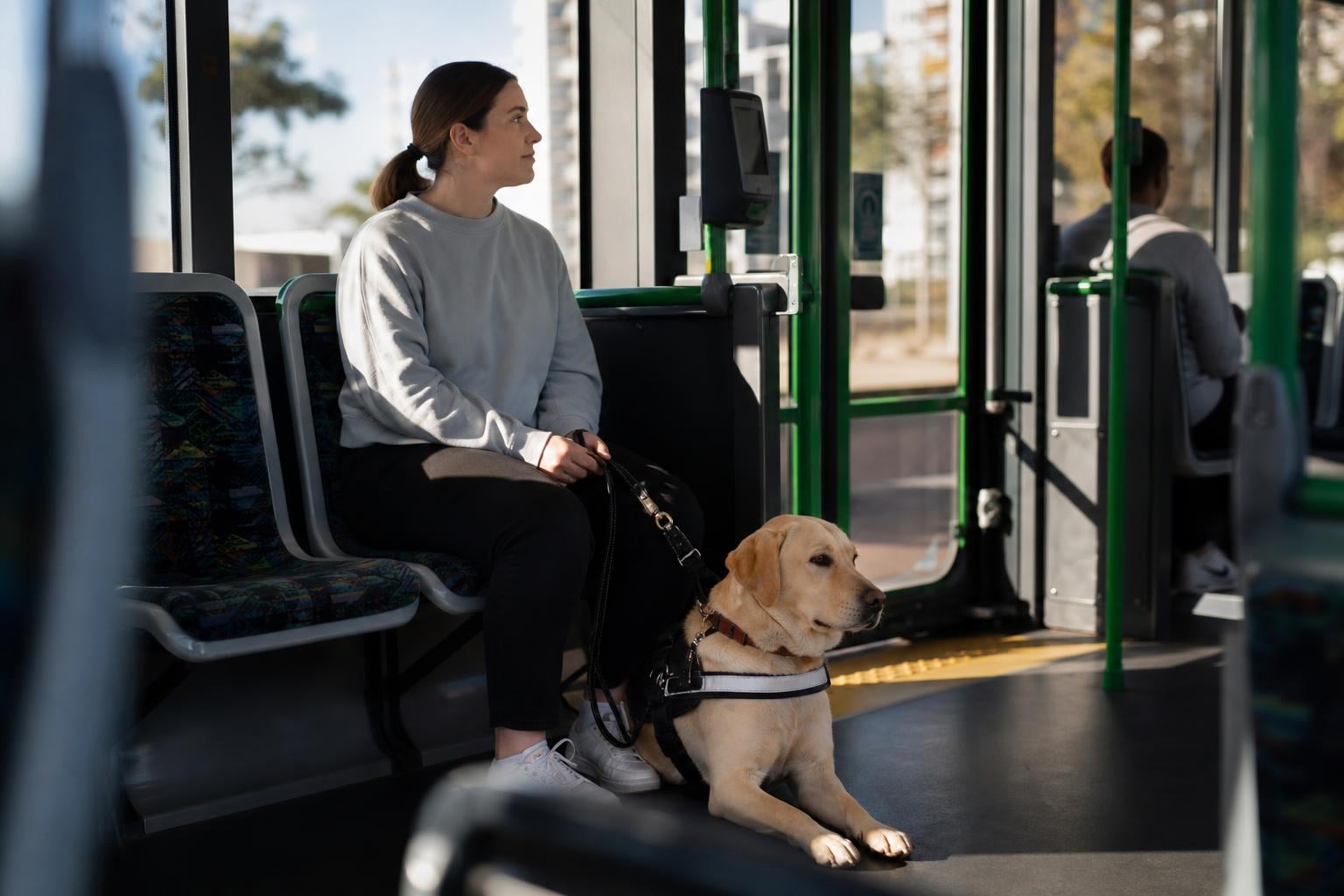
The handler chooses where they sit, and the dog typically rides in the footwell between their feet.
No extra charges are applied for the animal’s presence.
No identification is demanded beyond what the law requires.
A guide dog is not a pet. This distinction matters because many ranking pages online blur the line between pet-friendly travel advice and guide dog access rights. Pets can be refused. Guide dogs cannot.
Key Terms Every Handler and Operator Should Know
Accredited Assistance Animal
Under the Disability Discrimination Act 1992 (DDA), an assistance animal is trained to help a person with a disability and meets standards of behaviour in public. This is a legal category, not a casual label. Guide dogs, hearing dogs, and medical alert dogs all fall under this definition. Emotional support animals and untrained pets do not.
Guide Dog
A specific type of assistance animal trained to help people with blindness or low vision navigate their environment. Guide dogs are the most widely recognised subset of assistance animals, but they share the same legal protections as other accredited assistance animals.
Hearing Dog
An assistance animal trained to alert deaf or hard-of-hearing people to sounds such as doorbells, alarms, or approaching traffic. Same legal protections as guide dogs on all transport.
Medical Alert Dog
An assistance animal trained to detect and respond to medical events. In Queensland, this includes dogs trained to assist people with epilepsy, diabetes, and dementia. Medical alert dogs hold the same transport access rights as guide dogs.
Disability Discrimination Act 1992 (DDA)
The federal law that makes it illegal to discriminate against a person because of their disability, including by refusing to carry their assistance animal. The DDA applies to every form of transport in Australia: public transit, taxis, rideshare, private transfers, and domestic flights. It overrides any health, food safety, or hygiene regulations that might otherwise restrict animals from a vehicle or premises.
Guide, Hearing and Assistance Dogs Act 2009 (QLD)
Queensland’s state legislation that defines the accreditation process for assistance animals and their handlers. This Act establishes the Handler Identity Card system and sets the behavioural and training standards dogs must meet. If you are travelling in Queensland, both this Act and the DDA protect your rights.
Handler Identity Card (Queensland)
Issued under the Guide, Hearing and Assistance Dogs Act 2009, this card identifies a person as the handler of an accredited assistance animal. It is valid for five years. In Queensland, personalised transport drivers can respectfully ask for this card if the animal is not wearing a certified badge on its vest, harness, or collar, but they cannot refuse service while verification is pending.
The confusion between this card and the TransLink Animal Pass is one of the most common friction points for handlers. A Queensland Advocacy Incorporated submission documented a case where a bus driver refused to accept a Handler Identity Card and departed without the passenger, despite the handler’s dog wearing its identifying coat. This kind of incident shows that guide dog friendly transport is not just about what the law says. It is about whether drivers are trained to apply it correctly.
Assistance Animal Pass (TransLink)
A separate document issued by TransLink, the South East Queensland public transport authority. This pass allows assistance animals to travel on TransLink services (buses, trains, ferries, and light rail) and confirms the dog meets required standards of behaviour. It supplements the Handler Identity Card but is not a replacement for it.
Public Access Test (PAT)
The standardised assessment an assistance animal must pass to demonstrate it can behave safely and hygienically in public. The PAT evaluates behaviour around crowds, other animals, food, escalators, and public transport vehicles. Passing this test is typically a prerequisite for accreditation.
Personalised Transport (Queensland)
The legal term used in Queensland for transport services including taxis, rideshare vehicles, limousines, and private transfers. Under the Transport Operations (Passenger Transport) Regulation 2018, all personalised transport drivers must accept assistance animals. The fine for refusal is $3,096.
Point-to-Point Transport (NSW)
New South Wales uses this term instead of “personalised transport” to describe taxis, rideshare, and hire vehicles. The same legal obligation applies. Since November 2017, NSW has increased the fine for refusing an assistance animal to $1,000, with a maximum court penalty of $3,300.
Refusal
The unlawful denial of transport to a person because they are accompanied by an assistance animal. Refusals take many forms: a driver cancelling after seeing the dog, a driver closing bus doors and departing, verbal abuse, or demanding documentation the handler is not legally required to carry.
Over one third of handlers surveyed by Guide Dogs Australia reported having their taxi or rideshare booking cancelled outright, while 15% said they were ridiculed or discriminated against. One Australian woman documented 32 rideshare refusals in fewer than two years.
Service Animal (International Term)
The term commonly used in the United States, United Kingdom, and other countries for what Australia calls an “assistance animal.” If you are travelling internationally or reading overseas resources, “service animal” maps to the same concept. However, the specific legal protections and documentation requirements differ by country.
Your Rights by Transport Mode
Public Transport (Buses, Trains, Ferries, Light Rail)
Guide dogs and accredited assistance animals are permitted on all forms of public transport across every Australian state and territory.
Queensland: Assistance animals travel free on TransLink services. Queensland Rail requires a booking for assistance animals but carries them at no charge. Dogs must be trained and certified under the Guide, Hearing and Assistance Dogs Act 2009, including dogs still in training.
Victoria: The most accommodating state for assistance animals on public transport. Guide dogs travel free on all Victorian public transport services, with rights protected under both the DDA and Section 7 of the Victorian Domestic Animals Act 1994.
Other states (NSW, SA, WA, Tasmania): Pets are generally prohibited on public transport, but accredited assistance animals are always exempt. Specific documentation requirements vary, so check with your state’s transport authority before travelling.
Taxis and Rideshare
It is illegal under both federal and state laws for any taxi or rideshare driver to refuse a passenger because they have a guide dog. Allergies, fear of dogs, and religious beliefs are not valid reasons for refusal.
Despite this, rideshare is the transport mode where guide dog handlers face the most challenges. According to surveys conducted by Guide Dogs NSW, rideshare platforms generate more refusal complaints than any other transport type. The problem is structural: drivers on rideshare platforms have the ability to cancel a booking after seeing the passenger, and enforcement is difficult when refusals happen through an app rather than face to face.
If you are looking for a checklist for evaluating providers, questions about assistance animal policies should be near the top.
Private and Chauffeured Transfers
The same legal obligations that apply to taxis and rideshare also cover private transfers and limousine services in Queensland. Under the personalised transport regulations, drivers must accept assistance animals, assist the handler with doors, and let the handler choose where to sit.
The practical advantage of pre-booked private transfers for guide dog handlers is straightforward. When you book in advance, the operator knows an assistance animal will be present. The driver is briefed. There is no moment of surprise at pickup where a driver might panic, cancel, or make excuses. The 46% refusal rate documented in the rideshare context simply does not apply when the provider has confirmed the booking and dispatched a driver who understands their obligations.
For handlers travelling through Brisbane Airport or Gold Coast Airport, pre-booked private transfers also mean a meet-and-greet at the terminal, which removes the stress of navigating a busy arrivals area to find your ride.
Domestic Flights
Australian airlines must accommodate assistance animals on domestic flights under the DDA. Most airlines require advance notification (typically 48 hours) so they can assign appropriate seating and make cabin crew aware. The dog will usually travel in the floor space at your feet. There is no charge for the animal.
Contact your airline directly during booking to confirm their specific notification process and any documentation they require.
Cruise Terminal Transfers
If you are boarding a cruise from the Port of Brisbane or another terminal, the same guide dog friendly transport rules apply for your ground transfer. The key consideration is timing: cruise embarkation days involve queues, luggage processing, and security screening, so arriving by cruise terminal transfer with a driver who can help manage the logistics makes a meaningful difference.
What to Do If You Are Refused
Refusals are illegal, but they still happen regularly. Knowing the process for reporting them matters, both for your own case and for building the evidence base that drives enforcement.
Step 1: Complain to the service provider. If the refusal came from a rideshare platform, lodge a formal complaint through the app or website. If it was a taxi, contact the taxi company directly. Document the date, time, driver details, and what was said.
Step 2: Notify your assistance dog organisation. If your guide dog was trained by an organisation like Guide Dogs Australia or Assistance Dogs Australia, report the incident to them. These organisations often advocate on your behalf and track refusal data that informs policy campaigns.
Step 3: Report to the regulator. In Queensland, report to the Department of Transport and Main Roads. In NSW, contact the Point to Point Transport Commissioner. Each state has a regulatory body responsible for enforcing transport compliance.
Step 4: Record the incident formally. Guide Dogs Victoria operates a tool called Paws Rights specifically for recording guide dog access refusals. Even if you are not in Victoria, documenting incidents through available channels helps build the national picture.
Refusals are not just inconvenient. As Guide Dogs Australia has documented, they impede handlers’ capacity to access medical care, maintain employment, and participate in community life. In the UK, courts have fined taxi drivers and revoked their licences for refusing guide dog passengers, a precedent that underscores how seriously this issue is treated globally.
How to Choose Guide Dog Friendly Transport
The phrase “guide dog friendly” should describe every transport provider in Australia, because the law requires it. In reality, the label is most meaningful when applied to operators who go beyond legal compliance and build assistance animal awareness into their training, booking, and operational processes.
Here are the questions to ask when evaluating a provider:
Does the booking process allow you to note an assistance animal? A provider with a field or process for flagging assistance animals demonstrates awareness. If you have to fight to communicate this during booking, that is a warning sign.
Are drivers government-accredited? In Queensland, chauffeur accreditation means drivers have met regulatory standards. This does not guarantee perfect service, but it creates accountability that casual rideshare arrangements lack.
Will the driver be briefed before pickup? Pre-booked services can confirm the driver knows about your assistance animal and has been reminded of their obligations. This eliminates the refusal risk that comes with a driver discovering the dog at pickup.
Is there a meet-and-greet option? For airport arrivals, a driver who meets you at the terminal and helps you navigate to the vehicle is genuinely valuable for handlers with low vision.
What is the provider’s complaints process? A company that publishes clear contact details and responds to feedback is more likely to address issues quickly.
For a broader look at what distinguishes professional transfer services, our guide on what to expect from a chauffeur service covers driver conduct, etiquette, and service standards.
Families travelling with members who have specific needs may also find our airport travel with special needs glossary helpful for planning beyond assistance animal considerations.
Obligations for Drivers and Operators
Guide dog friendly transport is a two-way relationship. Handlers have rights, and drivers have obligations that go beyond simply not saying no.
Under Queensland’s personalised transport regulations, drivers must:
Ask the passenger if they need assistance, including opening the vehicle door for the dog to enter and exit.
Allow the handler to choose where they sit with the assistance animal.
Accept assistance animals regardless of whether the animal is wearing identification. Drivers may respectfully ask for the Handler Identity Card if no certified badge is visible, but they cannot refuse service while waiting for proof.
Recognise that assistance animals travelling from interstate may have different identifying features or documentation. Training on this point is essential for operators in border regions and airports.
Operators who run guide dog friendly transport services should invest in driver education that covers these requirements explicitly. The documented cases of refusals in Queensland, including bus drivers refusing Handler Identity Cards and departing, show that legal obligation alone is not enough. Operational culture and regular training are what turn legal compliance into genuine guide dog friendly transport.
State-by-State Quick Reference
State/Territory | Key Legislation | Assistance Animal on Public Transport | Fine for Refusal (Taxi/Rideshare) |
|---|---|---|---|
Queensland | DDA 1992 + Guide, Hearing and Assistance Dogs Act 2009 | Free; TransLink pass recommended; QR booking required | $3,096 |
New South Wales | DDA 1992 + Point to Point Transport regulations | Permitted with documentation | $1,000 (max $3,300 court) |
Victoria | DDA 1992 + Domestic Animals Act 1994 | Free on all public transport | Varies by regulation |
South Australia | DDA 1992 + state disability legislation | Permitted; assistance animals exempt from pet restrictions | Varies |
Western Australia | DDA 1992 + Dog Act 1976 | Permitted with accreditation | Varies |
Tasmania | DDA 1992 + Guide Dogs and Hearing Dogs Act 1967 | Permitted with accreditation | Varies |
The DDA provides the federal baseline across all states. State laws then add specific enforcement mechanisms, fines, and documentation requirements. When state and federal protections overlap, the stronger protection applies.
Frequently Asked Questions
Do I need to warn a driver about my guide dog before booking?
Legally, you are not required to give advance notice for taxis or rideshare. However, notifying the provider in advance, particularly for pre-booked private transfers, means the driver arrives prepared and there is no moment of surprise. For domestic flights, most airlines require 48 hours notice.
Can a driver charge me extra because I have a guide dog?
No. Under the DDA and state transport regulations, no additional fare or surcharge can be applied for an assistance animal. The dog travels free.
What if my guide dog is not wearing a vest or harness?
In Queensland, personalised transport drivers must accept your assistance animal whether or not it is wearing identification. The driver can respectfully ask to see your Handler Identity Card, but they cannot refuse service if you do not have one on you. The animal’s accreditation status, not its clothing, is what matters.
What identification should I carry when travelling in Queensland?
Carry your Handler Identity Card (valid for five years under the Guide, Hearing and Assistance Dogs Act 2009). For TransLink public transport, an Assistance Animal Pass from TransLink is also recommended. Having both covers you across all transport modes and reduces the chance of confusion or dispute.
Is rideshare or a private transfer safer for guide dog handlers?
The data speaks for itself: 46% of handlers experienced a rideshare or taxi refusal in the past 24 months. Pre-booked private transfers remove the driver-side discretion to cancel after seeing the dog. The provider confirms the booking, the driver is briefed, and no cancellation occurs. For handlers who have experienced refusals, the predictability of pre-booked transport is not a luxury. It is a practical solution to a documented problem.
What is the difference between a guide dog and an assistance animal?
A guide dog is one type of assistance animal, specifically trained for people with blindness or low vision. “Assistance animal” is the broader legal category that includes guide dogs, hearing dogs, medical alert dogs, and other dogs trained to mitigate a disability. All share the same transport access rights under Australian law.
Can I report a refusal even if I did not get the driver’s details?
Yes. Report what you can: the date, time, location, vehicle description, and which platform or company was involved. Rideshare apps retain booking records, and regulators can investigate using trip data. Even incomplete reports contribute to the enforcement picture.
Do these rules apply to private transfers and limousines?
Absolutely. In Queensland, “personalised transport” includes taxis, rideshare, limousines, and private transfer vehicles. The same $3,096 fine applies for refusal regardless of the vehicle type.
Ready to book guide dog friendly transport in South East Queensland? Contact My Private Transfers to pre-arrange your journey with a government-accredited chauffeur who understands assistance animal requirements. For general booking questions, visit our FAQ page.