
How to Arrange Return Transfers After a Cruise: 2026 Guide


TL;DR: A return transfer after a cruise is pre-arranged transport from the cruise terminal to your airport, hotel, or home. Unlike the trip to the port, return transfers are harder to plan because ship arrivals shift, passengers disembark in waves, and rideshare surge pricing hits hard on turnaround mornings. At Australian ports like Brisbane’s Pinkenba terminal, there is no public transport at all. Book your return transfer at least two weeks before sailing, provide your transfer operator with your ship name, disembarkation group, and luggage details, and confirm communication plans for the day itself.
Getting to a cruise ship is straightforward. You know your boarding time, you control when you leave for the port, and delays are your problem to manage. Getting away from a cruise ship is a different story entirely. Thousands of passengers funnel off a vessel across a two-to-four-hour window, luggage fills terminal halls, and taxi ranks stretch around the block.
This guide explains every term you will encounter when arranging return transfers after a cruise, compares your transport options honestly, and walks through the specific challenges of disembarking at Australian ports, particularly Brisbane International Cruise Terminal, where the absence of public transport turns this from a convenience question into a necessity.
Get an instant quote for your return cruise transfer before you sail.
Key Terms Explained
Before comparing options or building a plan, it helps to understand the terminology cruise lines and transfer providers use. These are listed in the order you will encounter them, not alphabetically.
Return Transfer / Post-Cruise Transfer
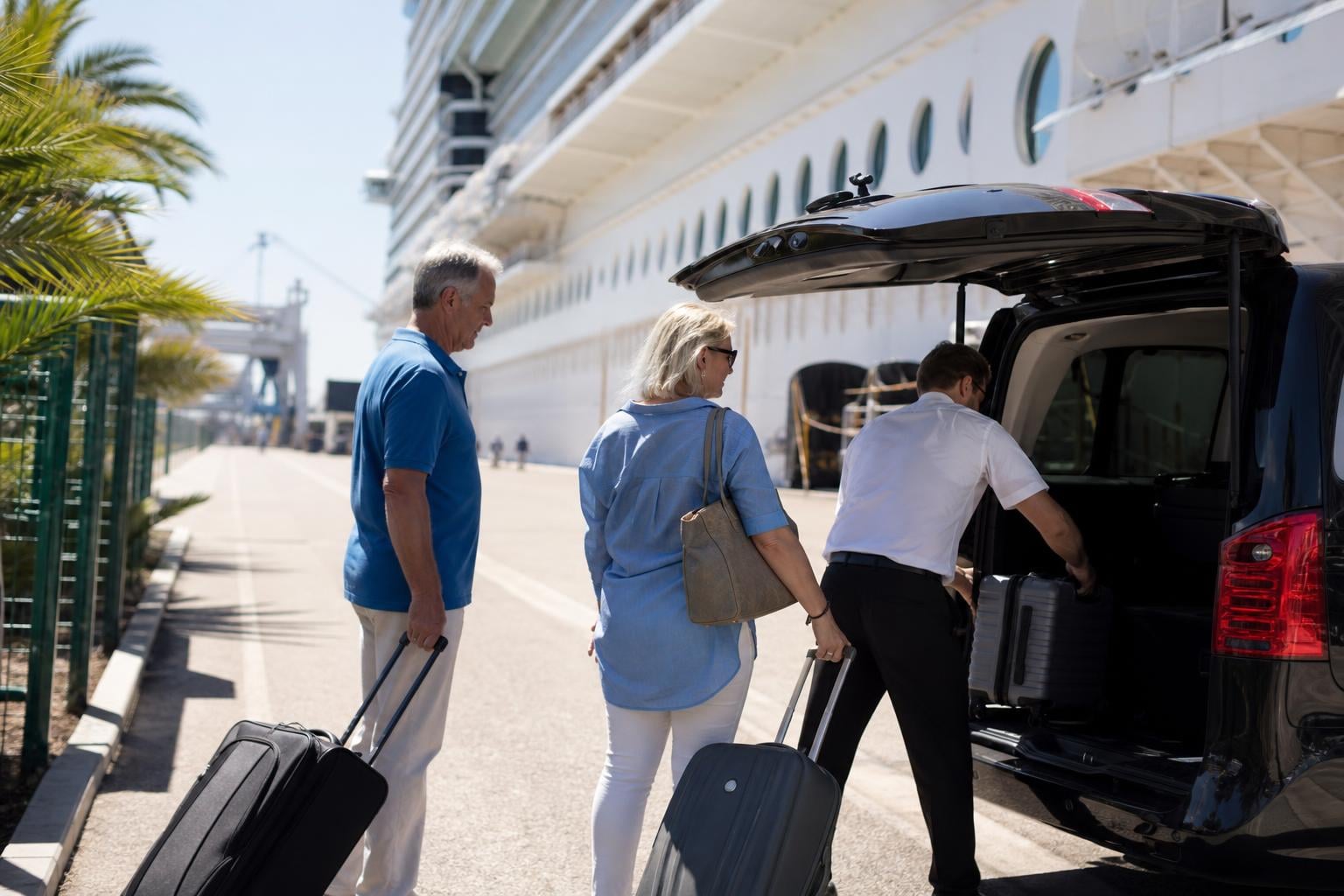
A return transfer is pre-arranged transportation from the cruise terminal to your next destination after the voyage ends. That destination might be the airport, a hotel, or your home. The word “transfer” in cruise industry language simply means a point-to-point ride connected to your cruise travel.
In practice: Return transfers require more planning than outbound transfers because your exact departure time from the terminal depends on the ship, not on you. For a deeper look at both directions, see our embarkation and disembarkation transfers guide.
Disembarkation (Debarkation)
The process of leaving the ship at the end of your cruise. It involves clearing your cabin, collecting luggage in the terminal, and passing through customs or immigration if required. Most cruise ships are cleared for passengers to disembark between 7:00 and 9:00 a.m.
In practice: Budget 45 to 90 minutes from your assigned disembarkation call to standing at the curb with your bags. The total process from start to finish for all passengers typically runs two to four hours.
Disembarkation Group (Colour-Coded Departure)
Cruise lines don’t let everyone leave at once. Your disembarkation time is assigned based on your flight departure, stateroom category, and loyalty status. You will receive a colour, number, or time slot, often on the final night of the cruise.
In practice: This assigned group is the single most important piece of information for your transfer provider. Your pickup time should reflect your disembarkation window, not the ship’s advertised docking time.
Self-Assist / Express Walk-Off
You have two luggage options on disembarkation morning. You can leave tagged bags outside your cabin the night before (the crew moves them to the terminal for collection), or you can carry everything off yourself. The second option is called self-assist or express walk-off.
In practice: Self-assist is consistently the fastest way off the ship. Passengers who carry their own bags often clear the vessel within 30 minutes of the gangway opening. If you have a morning flight or an early transfer, this is the method to choose, assuming you can manage the bags.
Turnaround Day
The day a cruise ship simultaneously disembarks arriving passengers and embarks new ones. This creates peak demand for every form of ground transport at the port.
In practice: When a 4,000-passenger ship empties between roughly 7:30 and 9:30 a.m. while another wave of passengers arrives for the next sailing, taxi ranks and rideshare pickup zones jam up fast.
Cruise Line Transfer (Shared Shuttle)
The motorcoach or bus service sold by the cruise line, typically $30 to $80 per person each way. When cruise industry materials mention a “transfer” without further detail, this shared shuttle is usually what they mean.
In practice: It is the simplest option to book (often available at the time of cruise booking or through the onboard app) but the slowest to complete. Shared shuttles make multiple stops and operate on the cruise line’s schedule, not yours.
Private Transfer
A pre-booked vehicle for your party only, arranged through the cruise line as a premium upgrade or through an independent transfer provider. Third-party operators typically offer door-to-door service with a fixed fare agreed in advance.
In practice: The cost is higher than a shared shuttle per vehicle, but for families or groups of three or more, the per-person cost often comes close to or undercuts the cruise line’s shared option. Private transfers also accommodate child seats, oversized luggage, and specific destination addresses.
Meet-and-Greet (Port Context)
A service where your driver meets you inside or immediately outside the cruise terminal, often holding a name board, rather than waiting in a general pickup zone.
In practice: At busy cruise terminals, a meet-and-greet removes the guesswork of finding your ride. Practitioners on Trustpilot report “lots of confusion around the driver getting access to the port,” so confirming your operator’s terminal access in advance matters. For tips on locating drivers in crowded terminals, see our guide on finding your driver at busy arrival points.
Tender / Tendering
When a cruise ship cannot dock directly at a port, small boats called tenders shuttle passengers between the ship and shore. This adds significant time to disembarkation.
In practice: If your cruise ends at a tender port, expect longer and less predictable disembarkation windows. Build extra buffer into your transfer pickup time.
Disembarkation Window
The specific time range during which passengers in your group are called to leave the ship. This is distinct from the ship’s arrival time and from the overall disembarkation period.
In practice: Your transfer provider needs this window, not the ship’s scheduled arrival. A sensible default is to give your driver a target 90 minutes after your assigned disembarkation call, then make contact the moment you clear customs.
Port Access / Ground Transport Zone
The designated area at a cruise terminal where vehicles are permitted to pick up passengers. Not all vehicles or operators have access to these zones. Regulations vary by port.
In practice: Some ports restrict access to licensed operators. Rideshare drivers may need to use a different pickup area than taxis or pre-booked transfers. Ask your operator exactly where they will meet you.
How Return Transfers Differ from Outbound Transfers
Planning how to arrange return transfers after a cruise trips up even experienced travelers because the return leg has variables the outbound leg does not.
Ship timing is uncertain. A cruise ship may arrive early, late, or on schedule. Weather, port traffic, and the ship’s itinerary all play a role. Your outbound transfer to the port uses a known departure time you control. Your return transfer depends on a vessel you do not control.
Passengers leave in waves. Disembarkation happens in staged groups over two to four hours. You cannot simply say “the ship arrives at 6:30 a.m., so pick me up at 7:00.” You might be in the first group off at 7:15 or the last group at 10:30.
Luggage collection adds time. Unless you chose self-assist, your bags are somewhere in the terminal, sorted by colour tag. Finding and collecting them takes 15 to 30 minutes on a good day.
Customs and immigration add further uncertainty. At Australian home ports, all passengers clear customs. Lines move steadily but add another variable to your curb time.
The core framework to understand is what you might call the timing triangle: ship arrival time, plus customs clearance time, plus your disembarkation group call, equals the earliest realistic moment you will be standing outside with your luggage. Your transfer pickup should be based on this combined estimate, with communication to your driver as you progress through each stage.
As one industry operator put it, a pick-up time should reflect your allocated disembarkation window rather than the ship’s advertised arrival time alone. Understanding the benefits of pre-booking becomes obvious once you grasp this complexity.
Your Transport Options After Disembarkation
Here is an honest comparison of the ways to arrange return transfers after a cruise.
Option | Pros | Cons | Best For |
|---|---|---|---|
Cruise line shuttle | Simple to book, luggage handled, no research needed | Slow (multiple stops), fixed schedule, $30-$80 per person | Solo travelers, budget-conscious passengers |
Taxi | No pre-booking needed | Long queues on turnaround days, no guaranteed child seats, metered uncertainty | Short distances, small groups without children |
Rideshare (Uber/DiDi) | Convenient app, usually available | Surge pricing of 1.5x to 3x on disembarkation mornings, no child seats, luggage limits | Flexible travelers without children or time pressure |
Private pre-booked transfer | Door-to-door, fixed price, child seats available, luggage capacity, meet-and-greet | Higher base cost than off-peak rideshare | Families, groups, passengers with connecting flights |
Public transport | Cheapest | Non-existent at Brisbane cruise terminal; impractical with luggage at most ports | Rarely suitable at cruise ports |
Rental car | Freedom to explore post-cruise | Must arrange pickup/return, no luggage assistance, driving after early wake-up | Extended post-cruise stays |
Reddit users on r/Cruise have recommended a creative workaround: booking a post-cruise sightseeing tour that ends at the airport. As one commenter put it, “Getting an Uber/taxi from most ports is challenging” and a tour “keeps stress to a minimum.” It is worth considering if your schedule allows it.
The surge pricing issue deserves special attention. When thousands of passengers pour out of a terminal between 7:30 and 9:30 a.m., rideshare algorithms respond predictably. Surge multipliers of double or triple the standard fare are common during morning cruise arrivals. A ride that costs $25 on a normal Tuesday might cost $50 to $75 on turnaround day.
Compare cruise transfer pricing to see how a fixed-fare private option stacks up for your route.
The Information Your Transfer Provider Needs: A Complete Checklist
This checklist works regardless of which provider you choose. Copy it, fill it out, and send it when you book. A Trustpilot reviewer reported that their return transfer vehicle “was not big enough to accommodate our group plus luggage,” which underscores why accurate details matter.
Ship name and cruise line (e.g., Ovation of the Seas, Royal Caribbean)
Terminal name and address (e.g., Brisbane International Cruise Terminal, Pinkenba, not Portside Wharf)
Scheduled docking date and time
Your assigned disembarkation group or time (update this once assigned, typically the final night)
Total passenger count (adults, children with ages)
Luggage count including oversized items (surfboards, golf bags, strollers, port-a-cots)
Child seat requirements (rear-facing, forward-facing, or booster, with child’s age and weight)
Destination address (airport terminal number, hotel name, or home address)
Flight details if connecting (airline, flight number, departure time)
Mobile number reachable on disembarkation day
Preferred communication method for day-of updates (call, SMS, WhatsApp)
Before you sail, confirm how updates should be handled if your return is delayed. Keep the operator’s booking details with your travel documents and send a message when you have phone access so they know your disembarkation status. For groups traveling together, our large group transport guide covers how to coordinate vehicles and luggage counts.
When to Book Your Return Transfer
The passengers who have the smoothest experience are the ones who sorted their transport weeks ago, not minutes before departure.
Ideal: Book at the same time as your outbound transfer, before the cruise begins. Royal Caribbean recommends booking transfers at least two weeks before sailing. Doing it early locks in availability, confirms pricing, and removes one more item from the pre-cruise checklist.
Acceptable: Some cruise lines let you arrange transfers onboard. Regent Seven Seas, for example, allows return transfers to be purchased in advance or arranged onboard and billed to the shipboard account. Celebrity Cruises allows booking through the app up to five days before the end of the cruise.
Risky: Trying to arrange transport on disembarkation morning. At ports without public transport, this can mean being stranded at the terminal with no walkable alternatives.
For a step-by-step walkthrough of the booking process, see our chauffeur transfer booking guide.
Brisbane and Southeast Queensland Cruise Ports: What to Know
This is where arranging return transfers after a cruise goes from “good idea” to “essential.”
Brisbane International Cruise Terminal (Pinkenba)
The Brisbane International Cruise Terminal sits at Luggage Point in Pinkenba, past the airport and roughly 21 kilometres (30 minutes by road) from the CBD. The Port of Brisbane confirms no public transport serves the terminal, and there are no plans to extend services there.
Onsite parking costs $30 to $44 per day, which means even passengers with cars at the terminal face a significant bill after a multi-week cruise.
The terminal sits in an industrial area near the end of a dead-end road on flat, low-lying land. As one Cruise Critic community member described it, “options for public transport are non-existent apart (from) expensive taxis or Uber.” A passenger who disembarks without pre-arranged transport faces spending their port day at or near the terminal with no walkable shops, cafes, or services.
On turnaround days, the combination of thousands of simultaneous passengers and the terminal’s isolated location creates exactly the conditions where rideshare surge pricing spikes hardest.
For Brisbane cruise terminal transfers specifically, see our dedicated Port of Brisbane transfer page.
Portside Wharf (Hamilton)
Smaller cruise ships sometimes dock at Portside Wharf in Hamilton, which is closer to the CBD and has slightly better (though still limited) transport options. Do not confuse the two terminals when booking. Giving your transfer provider the wrong terminal name is a common and costly mistake.
Child Seat Requirements
Australian law requires age-appropriate child restraints for children aged 0 to 7. This applies in transfer vehicles, not just private cars. Taxis are exempt in some states, and rideshare vehicles typically do not carry child seats. If you are traveling with young children, confirm child seat availability at the time of booking. My Private Transfers includes free child and infant seats with every booking, which removes the need to lug your own car seat through the cruise terminal.
Families: Extra Considerations for Post-Cruise Transfers
Families face compounding logistics that solo travelers and couples do not. Managing tired children through a two-hour disembarkation process while also wrangling strollers, port-a-cots, and a week’s worth of luggage is exhausting enough without adding transport uncertainty.
Things to plan for:
Child seats: Confirm type (rear-facing capsule, forward-facing, booster) when booking, not at pickup.
Oversized items: Surfboards from a Pacific cruise, strollers, and travel cots may not fit in a standard sedan. Declare everything at booking so your provider sends the right vehicle or adds a luggage trailer.
Timing buffer: Children make every stage slower. Add at least 15 minutes to your estimated curb time.
Snacks and entertainment: Your transfer vehicle might be 90 minutes away from home or the airport. Pack a bag accessible during disembarkation rather than buried in checked luggage.
Frequently Asked Questions
Can I just catch a taxi at the cruise terminal?
Sometimes. Most major cruise terminals have taxi ranks. But on turnaround days, expect queues of 30 minutes or more. Taxis also cannot guarantee child seats in most Australian states, and metered fares from remote terminals like Brisbane’s Pinkenba add up quickly.
Will Uber or DiDi pick me up at the cruise port?
At most Australian cruise ports, yes. But expect surge pricing of 1.5x to 3x during the peak disembarkation window between 7:30 and 9:30 a.m. Rideshare vehicles also do not carry child seats, making them unsuitable for families with children under seven.
What if my ship arrives late?
Contact your transfer provider immediately. Professional operators build buffer time into cruise pickups and monitor ship movements. Before sailing, confirm how day-of updates should be communicated. A flexible private transfer handles this far better than a fixed-schedule shared shuttle.
How early should I book my return cruise transfer?
At least two weeks before sailing, ideally at the same time you book your outbound transfer. Some cruise lines allow last-minute booking through their app, but availability shrinks and pricing rises the longer you wait.
Do I need child seats in a transfer from the cruise terminal?
Yes. Australian law requires approved child restraints for children aged 0 to 7, and this applies to private transfer vehicles. The exemption for taxis does not extend to pre-booked cars in all jurisdictions. Confirm seat availability when booking.
What is the difference between Brisbane International Cruise Terminal and Portside Wharf?
They are two different terminals roughly 15 kilometres apart. Brisbane International Cruise Terminal is at Pinkenba, in an industrial zone with no public transport. Portside Wharf is at Hamilton, closer to the CBD. Always verify which terminal your ship uses and provide that exact name to your transfer operator.
What if I have oversized luggage like surfboards or golf bags?
Declare all oversized items when booking your transfer. Standard sedans cannot accommodate surfboards or multiple golf bags alongside passenger luggage. Providers with luggage trailers or larger vehicles can handle these, but only if they know in advance.
Can I arrange a return transfer that includes a sightseeing stop?
Some private transfer operators and tour companies offer this. It is a practical solution when you have a late afternoon flight and do not want to sit in an airport lounge for six hours. Confirm pricing and luggage storage arrangements before booking.
Ready to lock in your post-cruise transport? Book your cruise transfer now and remove the guesswork from disembarkation day.