
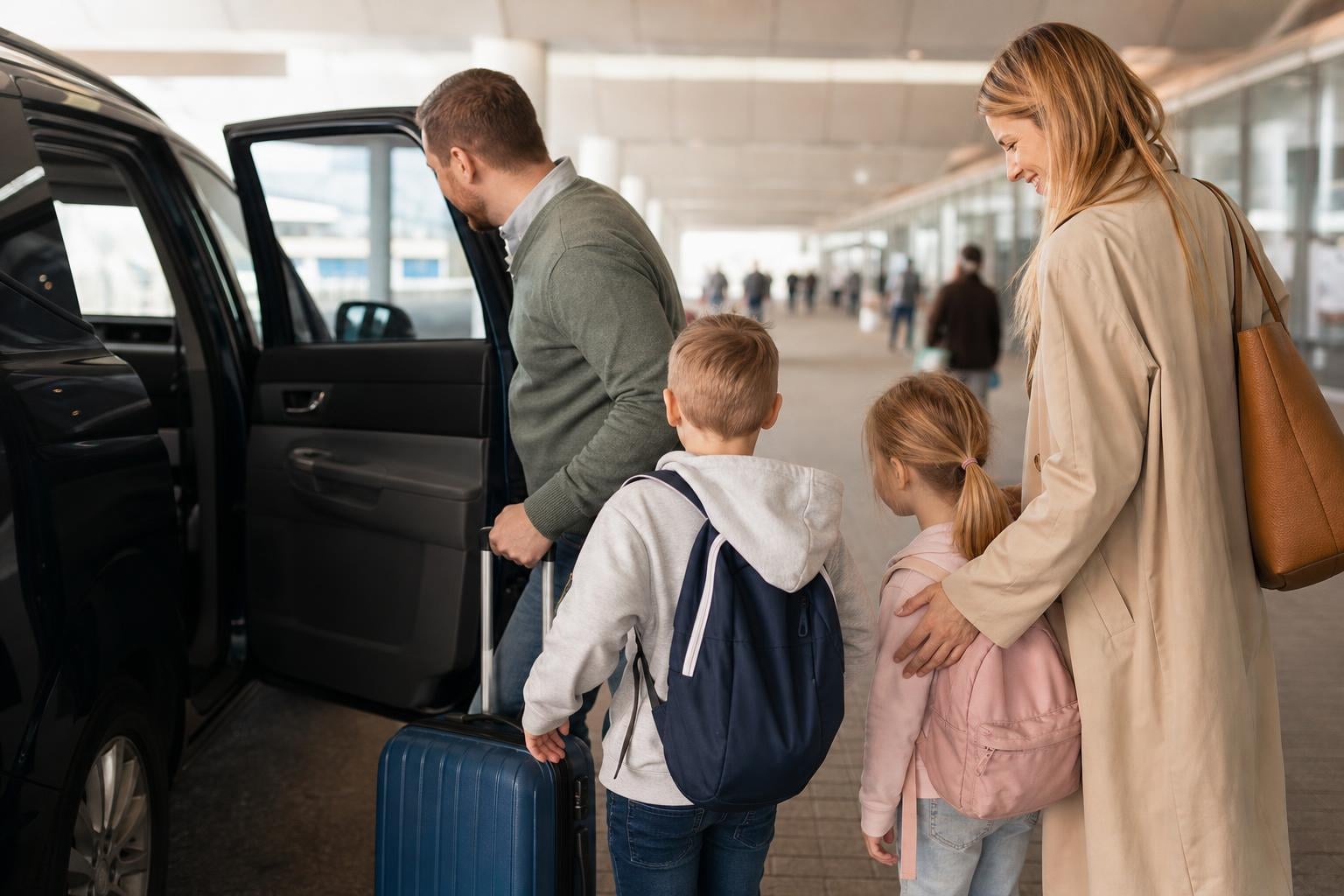
How to Arrange Airport Transfers for a Family With Young Children


TL;DR: Arranging airport transfers for a family with young children requires understanding child restraint laws (especially the difference between taxi and rideshare rules in Queensland), choosing the right transfer type, and communicating your children’s ages and seat requirements at booking. A pre-booked private transfer with child seats already fitted is the most reliable option. This guide covers every term, rule, and decision point parents need.
Getting from the airport to your destination sounds simple until you add a toddler, an infant capsule, a stroller, four suitcases, and the creeping realization that you have no idea whether your ride will have a car seat. For families with young children, the airport transfer is often the most stressful part of a trip, and it doesn’t have to be.
This guide breaks down every term and decision involved in arranging airport transfers for a family with young children, with a focus on Australian (particularly Queensland) rules and realities. Whether you’re flying into Brisbane, the Gold Coast, or anywhere in South East Queensland, this is the reference you need before you book.
Get an instant quote for a family transfer
Child Restraint Types You Need to Know
Before comparing transport options, you need to understand the restraint types. The right seat depends on your child’s age and size, and the law is specific.
Rear-Facing Infant Capsule
This is the restraint required for babies from birth to at least six months. It faces the rear of the vehicle and cradles the baby in a semi-reclined position. Queensland law requires all babies under six months to travel in an approved rear-facing restraint, and it’s recommended to keep children rear-facing for as long as their size allows. If you’re booking a transfer service, this is the seat you need to request for your youngest traveller.
Forward-Facing Car Seat with Harness
For children aged six months to four years, the law permits either a rear-facing or forward-facing restraint with a built-in harness. Most transfer providers will fit a forward-facing seat for toddlers in this age bracket. The harness is the key feature: it restrains the child independently of the vehicle’s seatbelt, which matters because adult seatbelts don’t sit correctly on small bodies.
Booster Seat
Children aged four to seven years must use either a forward-facing seat with harness or an approved booster seat restrained by an adult lap-sash seatbelt. A booster seat raises the child so the adult seatbelt crosses the chest and hips correctly rather than riding up across the neck or stomach. It’s the lightest and simplest restraint type, which is why some parents carry one in their luggage.
Convertible Car Seat
A convertible seat transitions from rear-facing to forward-facing as the child grows. These are practical for your own car, but they tend to be heavy (often 10 to 15 kilograms). Practitioners on Reddit report buying a cheaper, lighter car seat specifically for travel, since their everyday convertible is too heavy to carry through an airport. One parent noted they found a seat around 10 pounds compared to their usual 30-pound model.
If you’re using a transfer service rather than driving yourself, the provider should supply the right restraint type. The convertible seat becomes relevant mainly if you’re renting a car or insisting on using your own equipment.
ISOFIX Anchor Points
ISOFIX is the international standard for attaching child restraints directly to anchor points built into the vehicle chassis, rather than relying solely on the seatbelt to hold the seat in place. Most modern Australian vehicles have ISOFIX points, but not all transfer or taxi vehicles do. When booking a family transfer, ask whether the vehicle has ISOFIX compatibility, particularly for infant capsules where a secure installation is critical.
AS/NZS 1754: The Australian Standard
All child restraints used in Australia must meet the AS/NZS 1754 standard. This is the Australian and New Zealand safety certification. Seats purchased overseas that carry only European (ECE R44/R129) or American (FMVSS 213) certifications are not legally compliant in Australia, even if they’re perfectly good seats. If you’re arriving on an international flight with your own seat, check the label before assuming it’s legal here.
Australian Child Restraint Law: What Parents Must Understand
This section matters more than any other. The legal rules around child seats in transport are widely misunderstood, and the consequences of getting it wrong range from a fine to a genuine safety risk.
Queensland Child Restraint Requirements
Queensland law is clear on age-based restraint requirements for children in vehicles:
Birth to 6 months: Approved rear-facing restraint, properly fastened and adjusted.
6 months to 4 years: Approved rear-facing or forward-facing restraint with built-in harness.
4 to 7 years: Approved forward-facing restraint with harness, or an approved booster seat with a lap-sash seatbelt.
Children under four are not permitted in the front seat under any circumstances. Children aged four to seven can only sit in the front if all back seats are occupied by younger children in restraints.
Penalties for non-compliance sit at $300+ and three demerit points per incorrectly restrained child, applied to the driver.
The Taxi Exemption (and Its Limits)
Here is where most parents get confused. Queensland provides a partial exemption for personalised transport services, including taxis and limousines. Child restraints are not legally required in these vehicles. This means your child can technically ride in a taxi without a car seat and no one is breaking the law.
But legal does not mean safe. Most taxi drivers don’t carry child seats, and even if one is available, there’s no way to verify the fit or installation quality.
Rideshare Is Not a Taxi
This is the single most important distinction in this entire guide. Many parents assume that Uber, DiDi, and other rideshare platforms carry the same child restraint exemption as taxis. In Queensland, they do not. Rideshare vehicles are treated the same as a private car for child restraint purposes.
That means if you order an Uber in Brisbane with a two-year-old and no car seat, the driver is breaking the law. Uber’s child seat option is currently a Melbourne-only trial, so it’s not a solution in Queensland.
Parents on Reddit’s r/BabyBumpsandBeyondAu have discussed this exact dilemma, with some recommending services like Shebah and others describing the frustration of arriving at an airport with no viable rideshare option for their children.
Demerit Points and Fines
The driver, not the parent, receives the fine and demerit points for an incorrectly restrained child. But that doesn’t make it the driver’s problem alone. A rideshare driver who realizes mid-trip that they’re non-compliant may refuse the ride entirely, leaving a family stranded at the curb with luggage and tired children.
Airport Transfer Types for Families
Not all ground transport is created equal when you’re travelling with young children. Here’s what each option actually means and how it performs for families trying to arrange airport transfers with kids.
Private Airport Transfer
A pre-booked private transfer means a vehicle and driver reserved exclusively for your party, with the correct child restraints already fitted before the driver collects you. This is the most reliable option for families because the provider knows your children’s ages, your luggage requirements, and your flight details in advance. There’s no sharing the vehicle with strangers, no wondering whether a seat will be available, and no curbside scramble.
For a detailed walkthrough of how these services work, see this guide to how chauffeur transfers work.
Shared Shuttle or Coach Transfer
Shared shuttles pick up multiple passengers from the same flight or terminal and drop them at different destinations. They’re cheaper than private transfers, but they generally don’t provide child seats. For families with young children, the combination of no restraints, multiple stops, and unpredictable timing makes shuttles a poor fit. Parents who are nervous about sharing a shuttle with strangers while managing small children will find this option especially stressful.
Meet-and-Greet Service
This term describes a driver who meets you inside the terminal, typically at the baggage carousel or just outside the arrivals hall, holding a name board. The driver has tracked your flight and knows whether it landed on time, early, or late.
Meet-and-greet matters far more for families than for solo travellers. A business traveller with a carry-on can easily walk to a remote pickup zone. A parent juggling a crying toddler, a loaded stroller, and three suitcases cannot. Having someone waiting at the terminal doors, ready to help with bags and guide you to a vehicle with seats already installed, changes the entire arrival experience.
For tips on navigating Brisbane’s terminals with children, the Brisbane airport arrivals guide covers meeting points and terminal layout.
Door-to-Door Transfer vs. Curbside Pickup
A door-to-door transfer takes you from the airport terminal directly to your accommodation or home address. Curbside pickup means the driver waits at a designated vehicle zone outside the terminal, and you walk to them. The difference sounds minor, but with children and luggage, every extra step counts. Door-to-door service paired with a meet-and-greet is the gold standard for families.
Flight Tracking
Reputable transfer providers monitor your actual flight status rather than relying on a scheduled arrival time. This matters because international flights regularly arrive 20 to 40 minutes off schedule, and families with young children typically move through customs and baggage claim more slowly than other passengers. A provider using flight tracking adjusts the driver’s arrival time accordingly, so nobody is waiting unnecessarily, and nobody arrives to find the driver has left.
How to Book a Family Airport Transfer: The Terms That Matter
The booking process is where most problems either get prevented or get locked in. Knowing the right terminology helps you communicate clearly with the provider and avoid surprises.
Passenger Manifest
This is the full count of everyone travelling in the vehicle: adults, children, and any additional passengers like grandparents, nannies, or relatives joining at the airport. The manifest determines vehicle size. A couple with one child needs a sedan. A family of five with two car seats and a booster may need a people mover or SUV.
Child Details at Booking
This is the most important information you provide. Include the age (and ideally weight) of each child, the type of restraint they need (infant capsule, forward-facing seat, or booster), and any specific preference you have. Rules and availability vary, so specify everything upfront. Don’t assume the provider will guess correctly.
For a step-by-step booking guide covering the full process from quote to confirmation, that resource walks through each field.
Fixed-Fare vs. Metered Pricing
A fixed fare (or flat rate) means the price is set at booking and doesn’t change based on traffic, route, or time of day. For families, this eliminates a common stress point. You know exactly what you’re paying before you land. Metered pricing, used by most taxis, fluctuates based on distance and time. After a long flight with tired children, watching a meter climb through traffic is the last thing any parent wants.
After-Hours Surcharges
Many transfer providers charge extra for pickups between 8 pm and 6 am. Families on red-eye flights or early morning departures should factor this in. The surcharge is usually a flat fee added to the base fare, not a multiplier, so it’s predictable, but you need to know it exists before comparing quotes.
For more on how pricing and fees work, the chauffeur pricing and billing guide breaks down each component.
Luggage Count (Including Bulky Items)
A couple with one cabin bag has very different vehicle needs from a family with a stroller, two car seats, four suitcases, and a port-a-cot. When booking, count everything: checked bags, carry-ons, strollers (folded and unfolded dimensions), and any oversized items like surfboards or golf bags. Some providers offer enclosed luggage trailers for families with gear that won’t fit in a standard boot. This keeps the cabin uncluttered and avoids having bags stacked around children’s seats.
Cancellation and Refund Policy
Family travel plans change unexpectedly. Children get sick, flights get rescheduled, dates shift. Before booking, check the provider’s cancellation terms. Look for a clear refund window (for example, full refund if cancelled more than 48 hours before pickup) and understand what happens if your flight is significantly delayed. Providers who track flights and adjust pickup times without penalty are worth the premium.
Price Match Guarantee
Some providers guarantee they’ll match or beat the price of a comparable accredited operator. This is worth asking about, especially for longer transfers like Brisbane Airport to the Gold Coast, where fares can vary by $30 to $50 between providers.
The Hidden Cost of Child Seats
Not every provider includes child seats in the fare. In the South East Queensland market, competitor pricing for child seats typically runs $25 to $35 per seat per trip. For a family with two children making a return journey, that’s $100 to $140 added to the base fare just for restraints.
Some providers include child and infant seats at no extra charge. This is not standard in the industry, so treat “free child seats” as a specific feature to ask about, not an assumption. The cost difference on a return trip with two or three children is substantial enough to change which provider offers the best value.
Vehicle Capacity and Multi-Child Logistics
This is a practical problem that no amount of legal knowledge solves on its own. Fitting two or three child restraints across one back row of a standard sedan is often physically impossible. Car seats are wide, and the combination of two forward-facing seats plus a booster (or two capsules plus a toddler seat) simply won’t fit in many vehicles.
Combined with the rule that children under four cannot sit in the front seat, a family needing three restraints may be unable to travel in a standard taxi or sedan at all. This is where vehicle selection becomes a safety issue, not just a comfort preference. A people mover, SUV, or van gives the space needed to install multiple restraints correctly with proper seatbelt routing and spacing.
When booking, tell the provider exactly how many seats you need and what types. Let them recommend the right vehicle rather than trying to squeeze three restraints into a vehicle that can’t accommodate them.
Quick-Reference: Transfer Types Compared for Families
Feature | Standard Taxi | Rideshare (Uber/DiDi) | Pre-Booked Private Transfer | Shared Shuttle | Rental Car + Own Seat |
|---|---|---|---|---|---|
Child seat guaranteed? | No (exemption applies, most don’t carry seats) | No (must supply your own, legally required in QLD) | Yes, if requested at booking | No | You must supply and install |
Meet-and-greet inside terminal? | No | No | Yes (standard with reputable providers) | Sometimes | N/A |
Fixed price? | No (metered) | Surge pricing possible | Yes | Yes | Rental rate is fixed; fuel is variable |
Luggage capacity? | Limited boot space | Limited boot space | Scalable (SUV, van, trailer options) | Shared space with other passengers | Depends on vehicle size |
After-hours availability? | Yes (with surcharge) | Variable | Yes (with surcharge) | Limited schedules | 24/7 at airport desks |
Suitable for multiple young children? | Poor (seat fitting issues, no restraints) | Poor to impossible in QLD | Best option | Poor | Viable but logistically heavy |
For a broader comparison of Australian airport transfer types, that guide covers options beyond the family-specific lens.
Family Travel Essentials: Terms Worth Knowing
Essentials Bag
Pack a small, easily accessible bag with snacks, water, wipes, a charger, and a light layer of clothing for each child. This bag should be the last thing into the boot and the first thing you can reach. After a long flight, the 20-minute transfer to your hotel is when children are hungriest, thirstiest, and most likely to melt down.
Buffer Time
Family arrivals move at a different pace than solo travel. Children need bathroom stops after flights. Strollers need to be assembled. Luggage takes longer to collect when you’re wrangling a toddler at the same time. Build 20 to 30 minutes of buffer into your schedule after landing. A good transfer provider accounts for this automatically through flight tracking, but your own planning should factor it in too.
A route that is slightly slower but easier to manage with children and luggage can be the better choice than the mathematically fastest option. If the provider offers a pickup from inside the terminal rather than a distant parking structure, take it.
Premium Vehicle Upgrade
Larger or premium vehicles (Mercedes, Audi, BMW) aren’t just about comfort. For families, they often mean more cabin space, wider rear seats that accommodate car seats with better spacing, and larger boots. If your standard vehicle quote feels tight on space, asking about a premium upgrade may solve the problem more cleanly than trying to add a trailer.
Bringing Your Own Car Seat on a Transfer
You can absolutely bring your own child restraint and ask the driver to install it, or install it yourself. This makes sense if you have a lightweight travel seat, if you’ll need the seat at your destination (for a rental car, for example), or if you simply prefer using your own equipment.
The trade-offs are real, though. You’re carrying extra weight through the terminal. You’re adding installation time at the vehicle. And if the seat doesn’t have ISOFIX compatibility and the vehicle does, you may end up with a less secure seatbelt-only installation.
If you’re going this route, choose a seat that’s light, easy to install, and certified to AS/NZS 1754. Some parents on travel forums report buying inexpensive, compliant seats specifically for trips and checking them as luggage or gate-checking them on the flight.
Frequently Asked Questions
Do I need a child seat in a taxi in Queensland?
Legally, no. Queensland’s child restraint exemption applies to taxis, limousines, and other personalised transport services. But the exemption is about legality, not safety. A child in a taxi without a restraint is unprotected in a collision. If you can pre-book a taxi or transfer with a child seat fitted, that’s always the better choice.
Can I use Uber with a baby in Brisbane?
In practice, this is extremely difficult. Queensland child restraint laws apply to rideshare vehicles the same way they apply to a private car. You need an approved restraint for any child under seven. Uber’s child seat option is only available in Melbourne as a trial. In Brisbane, you would need to supply and install your own seat, which most parents arriving at an airport simply cannot do.
What information should I give when booking a family transfer?
At minimum: the number of adults and children, each child’s age, the restraint type needed for each child, your flight number and arrival time, your full luggage count (including strollers, port-a-cots, and oversized items), and your destination address. The more detail you provide, the better the provider can match you with the right vehicle and equipment.
How early should I book a family airport transfer?
Book as early as your flights are confirmed. Family transfers require specific vehicle types and restraint equipment that may not be available on short notice, especially during school holidays and peak travel periods. Two to four weeks in advance is a comfortable window. Last-minute bookings are sometimes possible, but you lose the ability to confirm restraint types and vehicle suitability.
What if my flight is delayed?
A provider that uses flight tracking will adjust the driver’s arrival time automatically based on your actual landing. Ask about this at booking. You should also confirm whether delays incur extra charges. Good providers absorb reasonable delays as part of the service.
What about oversized luggage like strollers and port-a-cots?
Mention these at booking. Standard sedans may not have the boot space for a full-size stroller plus suitcases for a family of four. Some providers offer enclosed luggage trailers, which is the cleanest solution for families travelling with bulky gear. The trailer fee is a small cost compared to the stress of trying to fit everything into an undersized vehicle.
Can a family with three young children travel in a standard sedan?
Often not. Three child restraints rarely fit side by side in a standard back seat, and children under four cannot sit in the front. You’ll likely need a people mover, van, or large SUV. Communicate your family size and ages at booking so the provider can allocate the right vehicle.
Is “free child seats” a standard inclusion with transfer services?
No. Many providers in Queensland charge $25 to $35 per child seat per trip. Some providers include child and infant seats at no additional cost, but this is a differentiator, not an industry default. Always ask explicitly whether child seats are included in the quoted price or charged separately.