
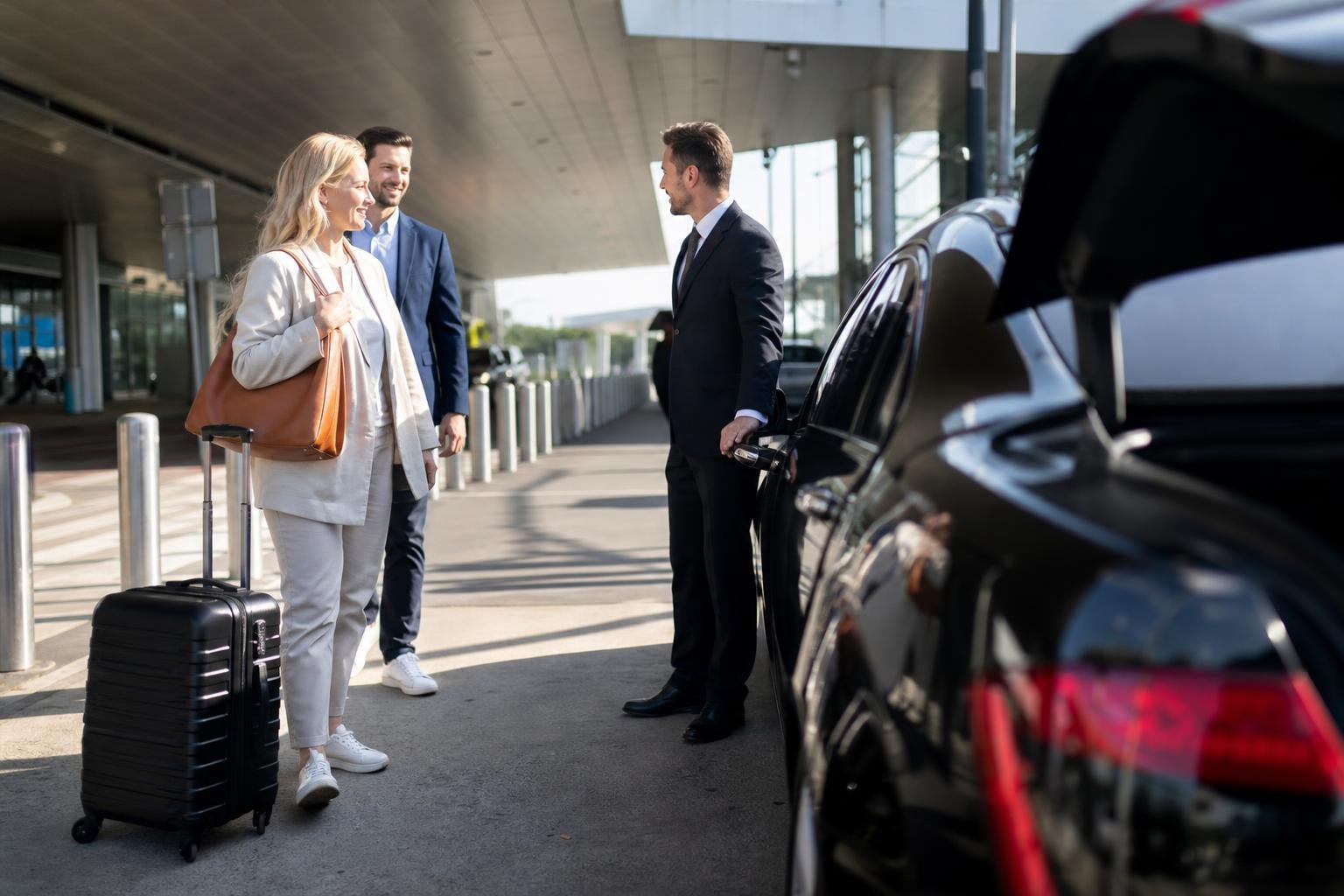
Airport Transfers Comparison Australia: 2026 Cost Guide


TL;DR: Airport transfers in Australia range from $5 trains to $185 private cars, and the right choice depends on your group size, luggage, timing, and whether you’re travelling with kids. This glossary defines every transfer type, pricing model, and service feature you’ll encounter, then compares them side by side. The biggest trap is assuming the cheapest quoted fare stays cheap (surge pricing can triple a rideshare cost), and the biggest confusion point is child seat laws, which vary by state.
Booking ground transport from an Australian airport shouldn’t require a glossary. But it kind of does. Between fixed fares, metered fares, surge pricing, ground transport access fees, child seat exemptions that change at state borders, and meet-and-greet services that mean different things to different operators, comparing your options honestly requires knowing the terminology.
This guide defines every term you’ll run into when comparing airport transfers across Australia, ties each one to real costs and Australian regulations, and helps you pick the right option for how you actually travel.
Get an instant quote to see how private transfer pricing compares for your specific route.
Transfer Types Defined
Private Transfer (Pre-Booked)
A pre-booked ground transportation service that moves you between an airport and your destination at a confirmed price with a designated driver. The vehicle and driver are assigned exclusively to you or your group. No other passengers, no extra stops.
The defining feature isn’t the vehicle type or the luxury factor. It’s the advance booking. That’s what enables flight tracking, child seat arrangement, luggage planning, and a locked-in fare. For a deeper breakdown of what a private transfer includes, that guide covers the full service model.
Shared Shuttle
A bus or van that carries multiple passengers heading to different destinations along a set route. You pay per person (typically AU$15 to $30 for an airport-to-city run), and the vehicle makes several stops before reaching yours. Cost-effective for solo travellers with flexible schedules who are staying at hotels within the service corridor. Less practical if you’re going to a private residence, travelling with young children, or on a tight timeline.
Taxi (Rank or Hail)
Metered, on-demand transport available at airport taxi ranks without advance booking. Australian airports maintain dedicated taxi zones at each terminal. Since November 2025, Sydney Airport has trialled fixed fares for non-booked taxi trips from its ranks: $60 for a standard taxi and $80 for a maxi taxi to the CBD.
Rideshare (Uber, DiDi, Ola)
App-based, on-demand transport with variable pricing. You request a car through the app, a nearby driver accepts, and the fare is calculated based on distance, time, and current demand. The critical risk is surge pricing, which practitioners on Reddit’s r/sydney frequently flag during peak arrival banks. At Sydney Airport, the gap between a base fare and a surged fare can be $65 versus $180 for the exact same journey.
Airport Express Bus or Train
Fixed-timetable, station-to-station public transport. Cheapest per-head option if you’re travelling light. Sydney’s Airport Link train costs AU$22.30 to the CBD. Melbourne’s SkyBus runs AU$25.90 one-way for adults and $6.60 for children aged 4 to 16. The trade-off: you still need last-mile transport from the station to your final destination, and luggage management is entirely on you.
Chauffeur or Limousine Service
A premium-tier private transfer, typically in a luxury vehicle (Mercedes, BMW, Audi). In Queensland, chauffeurs must hold government accreditation through the state transport authority. The service model is the same as a standard private transfer (pre-booked, fixed-price, door-to-door) but with upgraded vehicles and a higher service standard. You can explore the differences between premium and standard options if you’re weighing the upgrade.
Hotel Shuttle
Complimentary or low-cost transfer offered by some accommodation providers, usually running a set schedule between the airport and the hotel. Coverage varies wildly. Great when it exists, but rarely available outside major airport-adjacent hotels.
Intercity Transfer
Private or shared transport between cities or regions rather than a simple airport-to-city run. Think Brisbane Airport to the Gold Coast (80+ km) or Brisbane to Toowoomba (128 km). These trips change the cost calculus significantly. An UberX from Brisbane to Toowoomba, for example, is estimated around AU$213 for the roughly 128-kilometre, 100-minute trip.
Booking and Pricing Terms
Fixed Price (Flat Rate)
The fare is locked at the time of booking. No meter, no surge, no surprises. This is the pricing model used by private transfer and chauffeur companies. For a family of four, a fixed-price private van at $129 works out to $32.25 per person, which is often cheaper per head than individual rideshare fares during the same traffic window.
Metered Fare
Cost calculated in real time based on distance travelled and time elapsed. Standard for taxis. The meter runs whether you’re moving or stuck in traffic. A typical metered taxi from Perth Airport to the CBD runs AUD $40 to $60.
Surge Pricing (Dynamic Pricing)
Real-time price increases triggered by high demand, applied by rideshare apps. During major flight arrival banks, when dozens of passengers simultaneously request rides, prices can spike two to three times the base rate. This is the single biggest variable in any airport transfers comparison in Australia, and the reason many frequent travellers switched to pre-booked services.
After-Hours Surcharge
A premium charge for pickups during unsociable hours, typically between 8 pm and 6 am. Most private transfer operators and taxi networks apply some version of this. The key difference: with a pre-booked service, the surcharge is disclosed at booking. With a metered taxi, it shows up on the meter.
Understanding how pricing and fees work across providers helps avoid surprises on the day.
Ground Transport Access Fee
A fee airports charge transport operators for entering designated pick-up zones. Sydney Airport adjusted its ground transport access fee to $5.45 in June 2023. Adelaide Airport charges $4.50 per exit from its designated areas. These fees are often passed directly to passengers, sometimes as a visible line item and sometimes baked into the fare. When a budget operator displays a suspiciously low “base rate,” this fee (and the airport pickup fee) is frequently what’s been excluded.
Airport Pickup Fee
A specific levy at Australian airports, separate from the ground transport access fee in some jurisdictions. It applies to taxis, rideshares, and private hire vehicles entering airport precincts. The amount varies by airport and vehicle category.
Price Match Guarantee
A commitment by a transfer provider to match or beat a competitor’s quoted price for the same route and service level. Not all operators offer this, and the ones that do usually restrict it to like-for-like comparisons (accredited operators with similar inclusions). My Private Transfers offers a price match guarantee against accredited Queensland operators.
Service Features Glossary
Meet and Greet
Your driver enters the terminal to meet you personally, typically holding a name board near the arrivals hall or baggage carousel. This is different from curbside pickup, where the driver waits outside in a designated zone. For international arrivals especially, a meet and greet eliminates the confusion of navigating an unfamiliar airport with luggage and jet lag. You can read more about how to find your driver in a busy terminal.
Flight Tracking (Flight Monitoring)
The transfer provider monitors your flight’s status from takeoff. If your flight is delayed, your pickup time adjusts automatically. If you land early, the driver arrives early. This feature is standard with reputable private transfer companies and completely absent from taxis and rideshares. It’s one of the reasons pre-booked transfers handle flight disruptions better than on-demand options.
Curbside Pickup
The driver waits outside the terminal in a designated pick-up zone or car park. You collect your bags, exit the terminal, and find the vehicle. Standard for rideshare and some budget private transfers. Less convenient than meet and greet, but faster in airports with strict terminal access rules.
Door-to-Door Service
Pickup at your origin address, drop-off at your exact destination. No station transfers, no walking to a taxi rank, no last-mile problem. This is the default for private transfers, taxis, and rideshares. Public transport, by contrast, is station-to-station.
Complimentary Wait Time (Grace Period)
A free waiting window built into the booking to account for flight delays, customs queues, and baggage collection. Most chauffeur services include 30 minutes for domestic flights and 60 minutes for international arrivals before extra charges apply. Beyond this window, waiting fees typically start from around AUD $38 per half hour. Taxis and rideshares, by contrast, keep the meter running from the moment traffic slows.
Child Seat and Child Restraint
An age-appropriate car seat provided by the transfer company, fitted to the vehicle before pickup. This is a significant differentiator in any airport transfers comparison across Australia. My Private Transfers provides free child and infant seats for children aged 0 to 7 years, including baby capsules on request. Many competitors charge extra or require you to bring your own.
Baby Capsule
A rear-facing restraint specifically designed for infants under approximately six months old. Must be properly installed before travel. Availability is limited with taxis and rideshare, making pre-booked providers with baby capsule options the practical choice for families with newborns.
Luggage Trailer
An enclosed tow trailer for oversized items like surfboards (up to approximately 1.9 metres), golf bags, ski equipment, or bulky family gear such as strollers and port-a-cots. Available from some private transfer operators as an add-on. Sedans and standard rideshare vehicles simply cannot accommodate this volume of luggage.
Australian Regulatory Terms
Government-Accredited Chauffeur
A driver holding formal accreditation from a state transport authority. In Queensland, this means the chauffeur has passed background checks, holds the appropriate licence category, and operates under the state’s booked hire regulations. Not all rideshare drivers meet the same accreditation standards.
Taxi Exemption for Child Restraints
This is the single most confusing area of Australian transport regulation, and it directly affects how families compare airport transfer options.
Queensland: Taxis and rideshares are legally exempt from child restraint requirements. Children can ride in them without a dedicated seat. This is convenient but raises obvious safety concerns.
New South Wales: Standard taxis are not legally required to carry child seats. However, rideshare vehicles (Uber, DiDi, Ola) are classified as private vehicles. The same strict car seat laws that apply to your own car apply to every rideshare trip. No exemptions.
Victoria: Rideshare services like Uber are not exempt from Victorian child restraint road rules.
The practical consequence for families is real. Practitioners on parenting forums report arriving at airport pick-up zones with a toddler and discovering their Uber doesn’t have a suitable car seat. The rideshare app may let you request a vehicle with a child seat, but availability is patchy outside major metro areas.
Booked vs Unbooked Taxi
A critical distinction for child seat obligations in some states. A “booked” taxi (requested by phone or app in advance) may have different regulatory requirements than an “unbooked” taxi (hailed from a rank). This matters most in NSW, where the booking method can determine whether child restraint exemptions apply.
Landside vs Airside
Airport zones relevant to where your driver can meet you. Airside is past security. Landside is everything before security, including the arrivals hall, baggage claim, and the area outside the terminal. Private transfer drivers with meet-and-greet service wait in the landside arrivals area. Rideshare and some taxis pick up from designated landside zones outside the terminal building. You can see exactly what to expect at Brisbane arrivals for a practical walkthrough.
Quick Comparison Matrix: Airport Transfers in Australia
This table compares the five main transfer types across the factors that actually matter when making a booking decision.
Feature | Private Transfer | Shared Shuttle | Taxi | Rideshare | Train/Bus |
|---|---|---|---|---|---|
Pricing Model | Fixed at booking | Per person, fixed | Metered | Dynamic/surge | Fixed fare |
Door-to-Door | Yes | Partial (set route) | Yes | Yes | No (station-to-station) |
Flight Tracking | Yes | Rarely | No | No | No |
Meet and Greet | Yes (inside terminal) | Sometimes (curbside) | No | No | No |
Child Seats | Available, often free | Rarely | Exempt (most states) | Complex (varies by state) | N/A |
Luggage Capacity | High (trailers available) | Limited | Moderate | Limited | Limited |
Best For | Families, groups, business | Solo budget travellers | Quick trips, no booking | Flexible solo travellers | Light luggage, solo, budget |
A useful framework from industry comparison sites: a pre-booked private transfer is the only option that is fixed-price, flight-tracked, door-to-door, and meets you inside the terminal. Every other option drops at least two of those four.
Cost Comparison by City (2026 Estimates)
Real numbers make any airport transfers comparison in Australia more useful than generic advice. Here’s what you can expect to pay across major routes.
Sydney Airport to CBD
Airport Link train: AU$22.30
Bus 420 plus train: AU$5 to $8
Uber/DiDi/Ola: AU$35 to $55 (base), potentially $100+ during surge
Taxi (fixed fare from rank): AU$60 standard, $80 maxi taxi
Private transfer (premium): AU$95 to $185
Melbourne Airport to CBD
SkyBus: AU$25.90 one-way
Taxi/rideshare: AU$65 to $85 plus airport pickup fee and tolls
Private transfer: comparable to or less than surged rideshare during peak times
Gold Coast Airport to Surfers Paradise
Private transfer: approximately AU$85 to $100
Taxi: approximately AU$50 to $65
Uber/DiDi: approximately AU$45 to $60 (variable)
For a detailed look at this specific route, the Gold Coast Airport to Surfers Paradise page breaks down the options.
Perth Airport to CBD
Taxi: AUD $40 to $60 (metered)
Private transfer: AUD $70 to $120 (fixed at booking)
Cairns Airport to Cairns City
Taxi: $25 to $35
Rideshare: slightly cheaper during the day
Private transfer: from $79 including meet and greet
The Per-Person Economics
Solo travellers almost always save money with public transport or off-peak rideshare. But the math flips for groups. Two adults and two children in a private van at $129 is $32.25 per person. That is cheaper per head than four individual rideshare fares in the same traffic window, and it comes with fixed pricing, child seats, and a driver who is already waiting when you exit the terminal.
The meaningful time difference isn’t in the driving. It’s in the waiting. A private transfer driver is there when you walk out. A taxi rank requires queuing during peak arrival banks. Rideshare requires waiting for a driver to accept and navigate to the pickup zone.
How to Choose: Decision Framework
The right transfer type depends on four things: group size, luggage volume, whether children are travelling, and how much uncertainty you can tolerate.
Solo, light luggage, flexible timing: Train or bus is the cheapest option. Add a rideshare for the last mile if needed.
Solo, business travel, punctuality critical: Private transfer or chauffeur. The fixed price and meet-and-greet eliminate variables your schedule can’t absorb.
Couple, moderate luggage: Taxi or rideshare during off-peak. Private transfer if arriving late at night or during a known surge window.
Family with children under 7: Private transfer with child seats is the clear winner. The child seat situation with taxis and rideshares across Australian states is too inconsistent to rely on, and the per-person cost advantage for a family of four often makes it the cheaper option anyway.
Group of 4+: Private transfer in a van or SUV. The per-person cost drops below every other option except public transport, and you get door-to-door service with luggage space.
Late-night arrival: Private transfer. Taxi ranks thin out, rideshare drivers are scarce, and surge pricing often kicks in. A pre-booked service with flight tracking adjusts to your actual landing time regardless of the hour. A closer look at how late-night pickups work covers the practical details.
Ready to compare pricing for your specific route?
Get an instant quote from My Private Transfers to see exactly what a pre-booked, door-to-door service costs for your trip.
Frequently Asked Questions
What is the cheapest airport transfer option in Australia?
Trains and buses are cheapest on a per-trip basis. Sydney’s Airport Link is $22.30, Melbourne’s SkyBus is $25.90. But factor in last-mile transport from the station, luggage handling, and the time cost. For groups of three or more, a private transfer often works out cheaper per person than individual rideshare fares.
Do I need a child seat in an Uber in Australia?
It depends on the state. In Queensland, rideshares are exempt from child restraint laws. In NSW and Victoria, rideshare vehicles must comply with the same child seat rules as private cars, meaning no exemptions. If you’re travelling interstate with young children, this inconsistency makes pre-booked transfers with guaranteed child seats the safer bet.
What is included in a private airport transfer?
A standard private airport transfer typically includes a fixed price confirmed at booking, flight tracking with automatic pickup time adjustment, meet-and-greet inside the terminal, door-to-door service, luggage assistance, and a complimentary waiting period (usually 30 minutes domestic, 60 minutes international). Child seats and premium vehicle upgrades vary by provider.
How much does a private transfer from Brisbane Airport to the Gold Coast cost?
Pricing depends on the exact destination suburb and vehicle type. For current pricing on Brisbane to Gold Coast routes, the Brisbane Airport to Surfers Paradise page compares options, or you can use the instant quote tool for your specific address.
Why do some airport transfers charge more than quoted?
Several hidden cost factors can inflate an initially low quote. Ground transport access fees ($4.50 to $5.45 at major airports), airport pickup fees, after-hours surcharges, toll charges, and waiting time fees all add up. Many budget operators display a base rate that excludes these mandatory costs. A fixed-price private transfer should include all of these in the quoted fare.
What is the difference between meet and greet and curbside pickup?
Meet and greet means the driver enters the terminal, waits near arrivals or the baggage carousel, and holds a name board with your name. Curbside pickup means the driver waits outside in a designated vehicle zone and you walk out to find them. Meet and greet is standard with most private transfer companies and eliminates the confusion of navigating an unfamiliar airport.
Are airport ground transport access fees passed on to passengers?
Usually, yes. Airports charge operators between $4.50 and $5.45 (or more) each time a vehicle enters the designated pick-up area. This cost is almost always passed through to the passenger, either as a visible line item on the receipt or absorbed into the total fare. Reputable operators disclose this upfront.
Can I get a luggage trailer for surfboards or golf bags with an airport transfer?
Some private transfer operators offer enclosed tow trailers that accommodate surfboards (up to approximately 1.9 metres), golf bags, and other oversized items. This is not available with taxis, rideshare, shared shuttles, or public transport. It’s typically an add-on with an extra fee, arranged at the time of booking.