
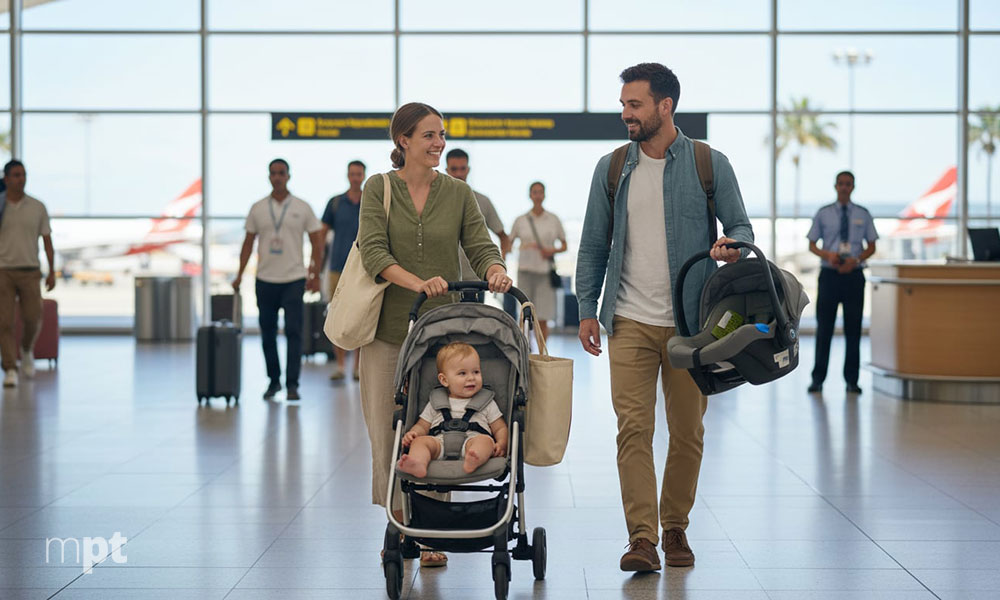
Airport Travel With Baby Australia: 2026 A-to-Z Glossary


TLDR: Airport travel with a baby in Australia involves confusing terms, state-specific car seat laws, and dozens of small decisions that add up fast. This glossary defines every term parents encounter, from baby capsules and the Queensland taxi exemption to lap infants and gate-checking prams. Pre-booked private transfers with confirmed child seats eliminate the biggest ground transport headache, and knowing the rules at security and boarding makes the rest straightforward.
Planning airport travel with a baby in Australia means wading through rules and terminology that nobody explains in one place. What’s a lap infant versus a child fare? Can a taxi legally carry your baby without a car seat in Queensland? What does gate-checking a pram actually involve?
Every ranking guide online covers this topic as a long, scrolling essay. This page takes a different approach. It’s a plain-English glossary organized by stage of the journey: getting to the airport, getting through the airport, and getting on the plane. Each entry defines the term, explains why it matters when you’re travelling with a baby, and flags the Australian-specific rules you need to know.
Whether you’re flying out of Brisbane, the Gold Coast, or the Sunshine Coast, bookmark this page before your next trip.
Ground Transport Terms
These are the terms you’ll encounter when figuring out how to get your family from home (or your hotel) to the airport terminal.
Baby Capsule (Rear-Facing Infant Restraint)
A baby capsule is a portable, rear-facing car seat designed for newborns up to roughly 6 to 12 months old (or about 9 to 12 kg). It clicks into a base that stays installed in the car, and many models also clip onto pram frames.
Why it matters for airport travel: Australian law requires all children under six months to travel in a rear-facing restraint in private vehicles. If you’re booking a taxi, rideshare, or transfer to the airport, the capsule question is the first thing to sort out. Most taxis and rideshare drivers do not carry baby capsules. Quality private airport transfer services will provide one free and pre-installed when you book, which removes this problem entirely.
Convertible Car Seat
A car seat that starts rear-facing (suitable from birth) and later converts to forward-facing as the child grows. Unlike a capsule, it stays fixed in the vehicle and doesn’t detach for carrying.
Why it matters: If you’re driving your own car to the airport and parking there, a convertible seat works fine. But if you need a transfer service, you’ll want to confirm they can provide the right restraint type for your child’s age, rather than hauling your own seat to the terminal.
Forward-Facing Car Seat (With Harness)
For children roughly six months to four years old. The child sits upright and is held by an internal harness system. In Australia, children must remain rear-facing until at least six months of age, and the national recommendation is to keep them rear-facing as long as possible.
Booster Seat
For children approximately four to seven years old. A booster seat positions the adult seatbelt correctly across the child’s body rather than using its own harness. Both high-back and backless versions exist. Under Australian law, children must use an approved restraint until age seven.
ISOFIX Anchor Points
An international standard for connecting child car seats directly to a vehicle’s chassis using built-in anchor points, rather than threading the seatbelt through the seat. ISOFIX provides a more secure and easier installation. Most modern Australian vehicles have ISOFIX points, but not all transfer or taxi vehicles do. If this matters to you, confirm it at booking.
Taxi Exemption (Queensland)
This is the single most confusing rule for parents planning airport travel with a baby in Australia, especially in Queensland.
In QLD, children are not legally required to use a car seat in taxis and rideshare vehicles. Children under one year old can be held on the lap of a person aged 16 or older (without sharing a seatbelt). Children aged one to seven can use a standard three-point seatbelt but must not sit in the front row if the vehicle has two or more rows.
The exemption exists because taxis historically couldn’t carry seats for every possible child age. But legal does not mean safe. Safety experts universally recommend using a car seat whenever possible. Pre-booked services that provide fitted child seats cut through this grey area completely.
Important state difference: In NSW, children under 12 months must be in an approved car seat even in taxis. Source: Bounty Parents Rules vary by state, so always check the requirements for your departure location.
Private Airport Transfer
A pre-booked, door-to-door car service with a professional driver. Unlike taxis or rideshare, the vehicle, driver, and any child seats are confirmed before your travel day. The price is fixed at booking, with no meters or surge pricing.
For families, the key advantage is certainty. You know the car seat will be there, the driver will be waiting, and the vehicle will have space for your luggage and baby gear. Practitioners on Whirlpool forums consistently note the difficulty of ordering Uber with child seats. The consensus: bringing your own seat for rideshare is awkward but sometimes necessary, and pre-booked services with included seats are preferred.
For a deeper look at what this service involves, the guide on what is an airport transfer breaks down the differences between private transfers, shared shuttles, and public transport.
Meet-and-Greet Service
A service where the transfer driver meets you inside the terminal, usually at the arrivals hall or baggage carousel for domestic flights, or the international arrivals hall for overseas flights. The driver holds a name board with your name and waits according to your flight schedule.
Why it matters with a baby: When you’re juggling a baby, a pram, carry-on bags, and a nappy bag, the last thing you want is to wander around a pickup zone trying to find your ride. Members of the Noosa Crew Facebook group have noted the difference directly, with one community member comparing options: “Private transfer costs more but you get meet n greet, door to door and… child seats. Shuttle bus, cheaper maybe but…” The meet-and-greet alone can justify the price difference when you’re travelling with an infant.
Accredited Chauffeur (QLD Driver Authorisation)
In Queensland, drivers of booked hire vehicles must hold a Driver Authorisation issued by the Department of Transport and Main Roads. This requires passing police checks and health assessments. When booking any transfer service for airport travel with a baby in Australia, confirming the driver holds this accreditation is a basic safety check.
After-Hours Surcharge
An additional fee charged by transfer services for pickups or drop-offs outside standard hours, typically between 8 PM and 6 AM. Common across the industry. If you’re catching an early morning or late-night flight with a baby, factor this into your budget. For full details on how surcharges and cancellations work, the FAQ page covers booking specifics.
Enclosed Luggage Trailer
An additional trailer towed behind the transfer vehicle to accommodate bulky family items: port-a-cots, surfboards, extra suitcases, and strollers that won’t fit in a standard boot. Not available with taxis or rideshare. This is one of those things you don’t think about until you’re standing at the kerb with a pram, two suitcases, a port-a-cot, and a sedan that clearly won’t fit it all.
Price Match Guarantee
A commitment from a transfer provider to match or beat a competitor’s quoted price for an equivalent service. My Private Transfers guarantees to match any accredited QLD operator’s price and discount it by at least one dollar, which takes the guesswork out of price comparisons.
The Real-World Problem These Terms Solve
In October 2025, a Brisbane mother and her baby were left stranded at Brisbane Airport after three taxis refused to take them. The drivers reportedly rejected them because the trip was too short. The mother posted on Reddit: “We walk up the taxi rank, to not only be refused by one but three.” Source: The Nightly
This is not an isolated incident. Practitioners on the r/brisbane subreddit regularly confirm frustration with taxis that don’t carry car seats at Brisbane Airport. A pre-booked private transfer with confirmed child seats solves both the availability problem and the safety question in one step. You can get an instant quote for your family airport transfer and lock in the price before you travel.
At the Airport: Terms Every Parent Should Know
Once you arrive at the terminal, a different set of terms takes over.
Parent Room (Parenting Room)
Dedicated rooms inside airport terminals equipped with baby change facilities, feeding chairs, and microwaves for warming bottles or food.
Brisbane Airport locations: The Domestic Terminal has parent rooms on Level 1 (near Qantaslink Check-in, opposite Baggage Reclaim 1, and next to the Airtrain Ticket Desk) and on Level 2 (Qantas end, Virgin end, and the Central satellite). The International Terminal also has parent rooms throughout. Source: BNE.com.au
Knowing where these are before you arrive saves you from walking the full length of the terminal with a screaming baby. Pull up the terminal map on your phone while you’re still in the car.
Security Screening with a Baby
Babies and children go through the security checkpoint with a parent. They do not go through body scanners. Strollers and prams are screened separately (placed on the X-ray belt or hand-checked).
The formula rule: Baby formula, breast milk, and baby food are permitted through Australian airport security. There are no quantity restrictions on powdered formula. Liquids like pre-mixed formula and breast milk are exempt from the standard 100ml liquid rule, though they may be tested. Source: BNE.com.au
This is one of the most searched questions for parents planning airport travel with a baby in Australia, and the answer is reassuring: bring what you need. Security staff are experienced with families.
Gate-Check (Pram/Stroller)
The practice of using your pram right up to the aircraft door, where ground crew tag it and stow it in the cargo hold. You collect it either at the aircraft door on arrival or at baggage claim, depending on the airline and airport.
Gate-checking is free on most Australian airlines. Jetstar allows prams to be checked as part of your checked baggage allowance. The advantage is obvious: you keep your baby in the pram through the terminal, through the gate area, and right up to the plane door.
Family / Priority Boarding
Most Australian airlines allow families with small children to board before general boarding begins. This gives you time to get settled, stow your gear, and organise the baby before the aisle fills up.
However, Brisbane Airport’s own advice notes that “boarding last can work better” since it reduces the time your baby is confined in a cramped seat. Which approach works depends on your baby’s temperament. An active crawler might do better boarding late. A baby who settles easily in your arms might prefer the quiet of an early board.
Interactive Play Area
Some terminals have play zones for children. Brisbane’s International Terminal has a permanent interactive screen in the Village Green area, located after passport control. It won’t entertain a newborn, but if you’re travelling with a toddler and an infant, the play area can save your sanity during a long wait.
Airline and Ticketing Terms
Airlines use specific age classifications that differ from car seat age brackets. Getting these right when booking avoids confusion at check-in.
Lap Infant
A child under two years old who travels seated on an adult’s lap using a special infant extension seatbelt. The child does not get their own seat. On Qantas domestic flights (QF-coded), no fare is required for lap infants. Other airlines charge a nominal lap infant fee. Source: Point Hacks
Infant (Airline Definition)
Under two years old. This is the airline’s definition, and it differs from car seat age brackets. The moment your child turns two, they need their own seat and a child fare. If your baby turns two during your trip, most airlines require the child fare for the return leg.
Child (Airline Definition)
Two to 11 years old. Children in this bracket need their own seat and ticket. The fare is usually a percentage of the adult fare on domestic routes.
Bassinet (In-Flight)
A small cot that attaches to the cabin wall (the bulkhead) for infants to sleep in during flight. Weight and size limits apply.
Critical limitation on domestic flights: On Qantas, bassinets are only available on A330 aircraft, which mainly operate on Perth routes. They are not available on Boeing 737s, which make up the majority of domestic flights. Bassinets generally cannot be pre-booked and are requested at check-in on a first-come basis. Source: Point Hacks
If you’re flying Sydney to Brisbane or Melbourne to Gold Coast, don’t count on a bassinet. Plan to hold your baby for the flight.
Infant Extension Seatbelt
The extra belt clip that attaches to the adult seatbelt, creating a loop for a lap infant. Flight attendants provide this during boarding. It’s standard equipment, not something you need to bring.
Bulkhead Seat
The front-row seats in each cabin section, where the wall (bulkhead) is directly in front of you instead of another row of seats. This is where bassinets attach when available. Bulkhead seats also offer more legroom, which matters when you’re holding a baby on your lap for hours. Request these seats at check-in if bassinets are available on your aircraft.
Brisbane and Queensland-Specific Terms
Since most searches for airport travel with baby Australia skew heavily toward Queensland, here are the local terms you need.
Terminal Transfer Bus (Brisbane Airport)
The free orange shuttle bus that runs between Brisbane’s Domestic Terminal (T2) and International Terminal (T1), which are approximately 4 km apart. It runs every 10 minutes, from 4:00 AM to 1:30 AM daily.
If you’re connecting between a domestic and international flight at Brisbane Airport, this bus is how you get between terminals. It’s pram-accessible, but managing a baby, luggage, and a stroller on a shuttle bus during a connection is a juggling act. For a full breakdown of how the connection works, the domestic transfer Brisbane Airport guide covers timing, luggage handling, and alternatives.
Airtrain (Brisbane)
A rail connection between both Brisbane Airport terminals and the city. The inter-terminal fare is approximately $5. Trains run every 15 to 30 minutes depending on time of day. The stations are pram-accessible with lifts.
Brisbane Airport Domestic Terminal (T2) and International Terminal (T1)
These are separate buildings roughly 4 km apart. You cannot walk between them. This catches out first-time Brisbane travellers who assume the terminals are connected.
Gold Coast Airport (OOL)
A single-terminal airport at Coolangatta on the Queensland-NSW border. Simpler layout than Brisbane, with shorter walking distances. For families flying in or out of OOL, Gold Coast Airport private transfers with free child seats are available for door-to-door service.
Sunshine Coast Airport (MCY)
A smaller regional airport at Marcoola. Compact, easy to navigate, and far less hectic than Brisbane or the Gold Coast. Ideal for families who can fly directly here. If you’re heading to or from MCY, Sunshine Coast Airport transfers cover the region from Caloundra to Noosa.
Uber Child Seat Availability in Australia
Uber has been trialling an “Uber Child Seat” option in Melbourne only, with forward-facing seats for children roughly one to four years old. This option is not available for infants under 12 months (no rear-facing capsules are provided), and it is not available in Brisbane or anywhere else in Queensland.
Practitioners on Reddit’s r/brisbane have recommended Shebah (a women-and-children-focused rideshare app) as an alternative for booking baby seats, though availability varies. The consistent theme across forums is that rideshare child seat options remain unreliable outside Melbourne.
Packing and Equipment Terms
Travel Pram / Compact Stroller
A lightweight, foldable pram designed for air travel. Most weigh under 7 kg, fold to cabin-luggage size (some are approved as cabin baggage on certain airlines), and can be gate-checked for free. If your everyday pram is heavy or bulky, a travel pram is worth considering for airport travel with a baby in Australia, especially if you’ll be navigating terminals solo.
Port-a-Cot / Travel Cot
A portable crib for use at your destination. Too large for cabin baggage, but most airlines accept them as checked luggage (sometimes counting toward your baggage allowance, sometimes free as an infant item). Check your airline’s policy before you fly. If you’re taking a port-a-cot to the airport, an enclosed luggage trailer on your transfer vehicle solves the boot-space problem.
Cabin Baggage Allowance (With Baby)
Most Australian airlines allow one additional bag for infant items (nappies, wipes, change of clothes, formula, bottles) on top of the adult’s cabin baggage allowance. Qantas and Virgin Australia both permit this. The size and weight limits vary by airline, so check before packing.
Nappy Bag Essentials (Airport Edition)
Not a formal term, but worth noting. For the airport and flight itself, pack: nappies (more than you think you need), wipes, a change of clothes for the baby and for you (blowouts happen at altitude), formula or snacks, a dummy or comfort toy, and any medication. Keep everything accessible, not buried in checked luggage.
Comparing Your Transport Options to the Airport
Here’s a quick reference for families weighing up how to get to the airport.
Driving and parking: Airport parking runs $150 to $400 or more per week depending on the airport and parking type. Brisbane Airport does not offer a loan stroller service, so you’ll carry your own gear from the car park. The upside is using your own car seat.
Taxi: Legally, no child seat required in QLD. Availability of car seats is not guaranteed even when pre-booked through apps like 13CABS. Risk of refusal for short trips, as the Brisbane Airport incident demonstrated.
Rideshare (Uber/DiDi): No child seat option available in QLD. Legal to hold baby on lap in QLD, but not safe. Surge pricing applies during peak times.
Private transfer: Car seat confirmed at booking. Fixed price. Meet-and-greet inside the terminal. Driver assists with luggage and baby gear. Higher upfront cost, but certainty and safety included. For families exploring this option, the page on family and group airport transfers in Queensland explains what the service looks like in practice.
Frequently Asked Questions
Do I need a car seat for my baby in a taxi in Queensland?
No. Queensland law exempts taxis and rideshare vehicles from child restraint requirements. Babies under one can be held on the lap of a person aged 16 or older. However, this exemption exists for practical reasons, not safety ones. Every child safety organisation recommends using a proper restraint whenever possible.
Can I take baby formula through airport security in Australia?
Yes. Baby formula (including powdered and pre-mixed), breast milk, and baby food are all permitted through Australian airport security. Powdered formula has no quantity restrictions. Liquid formula and breast milk are exempt from the standard 100ml liquid rule but may be tested by security staff.
Are bassinets available on domestic flights in Australia?
Rarely. On Qantas, bassinets are only available on A330 aircraft, which primarily operate Perth routes. They are not available on Boeing 737s, the most common domestic aircraft. Bassinets cannot typically be pre-booked and are allocated at check-in. For most domestic routes, plan to hold your baby as a lap infant.
How do I gate-check a pram at an Australian airport?
Use your pram through the terminal and right up to the aircraft door. At the gate, ground crew will tag it and stow it in the cargo hold. On arrival, it’s usually returned at the aircraft door (though some airports deliver it to baggage claim). Gate-checking is free on most Australian airlines.
What is the legal age for a child to fly without a car seat on a plane in Australia?
Airlines do not require car seats on aircraft for children under two who travel as lap infants. Children aged two and over need their own seat. Some parents choose to purchase a seat for their infant and use an approved car seat on board, but this is optional, not required.
How far apart are Brisbane Airport’s domestic and international terminals?
About 4 km. You cannot walk between them. The free Terminal Transfer Bus runs every 10 minutes from 4:00 AM to 1:30 AM. The Airtrain takes about two minutes between terminals and costs roughly $5. Allow at least 2 to 3 hours for international-to-domestic connections.
What transport options provide baby seats to the airport in Queensland?
Pre-booked private transfer services are the most reliable option for guaranteed baby seats. My Private Transfers provides free child and infant seats for children aged 0 to 7, including baby capsules on request. Taxis can sometimes be booked with car seats via 13CABS, but availability isn’t guaranteed. Uber does not offer child seats in Queensland.
Is it worth pre-booking a transfer just for the car seat?
For many parents, yes. The combination of a confirmed car seat, a driver who meets you inside the terminal, help with luggage, and a fixed price makes the experience significantly less stressful than the alternatives. When the alternative is standing in a taxi rank with a baby, hoping someone will take you, the value becomes clear. Get an instant quote to see what it costs for your specific trip.