
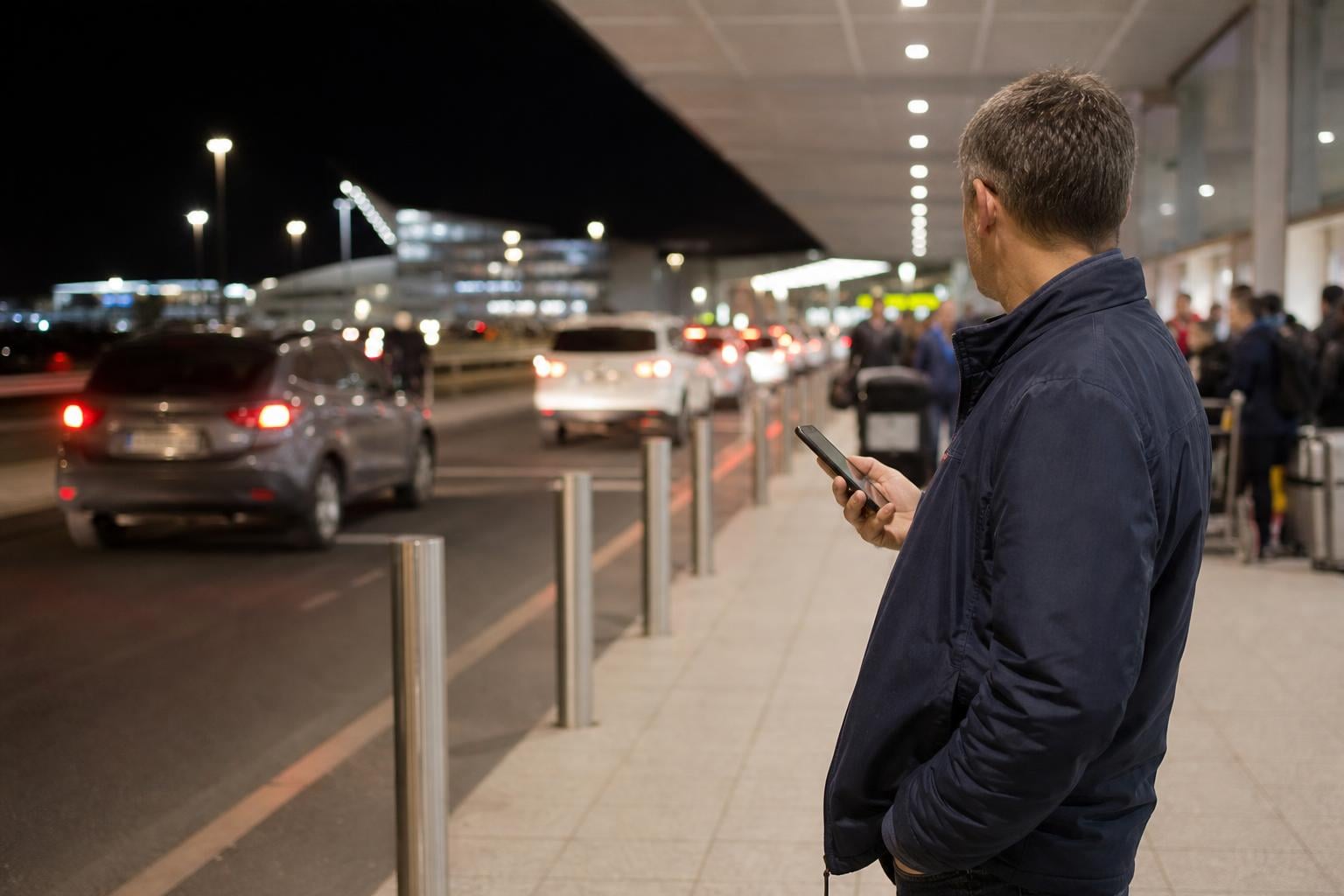
How to Arrange Pick Up for Late Arriving International Flight


TL;DR: “Late arriving” can mean two different things: a flight scheduled to land at night, or a flight delayed beyond its original time. Both create ground transport challenges. International arrivals at Australian airports take 60 to 90 minutes from landing to exiting the terminal. When you provide your flight number to a pre-booked transfer service, the driver tracks your actual arrival and adjusts automatically. The key is booking a service with adequate free waiting time and understanding what happens at each delay threshold.
Arranging a pick up for a late arriving international flight is one of those problems that sounds simple until you’re standing in a customs queue at 11:30 PM, wondering whether your ride is still waiting outside.
The challenge isn’t just the hour. International flights layer delay upon delay in ways domestic flights don’t. Your plane lands late. Immigration queues are longer because three other flights landed at the same time. Baggage takes longer because overnight staff are thinner. And when you finally walk out of the terminal, conventional transport options have either disappeared or tripled in price.
This guide covers every term, process, and decision point involved in arranging ground transport when your international flight arrives late, whether “late” means a scheduled 10 PM landing or a three-hour delay that pushes you past midnight.
Get an instant quote to lock in your fare before you fly.
Understanding the Two Types of “Late” Arrival
Most guides treat these as the same problem. They’re not. The solutions differ, and confusing them leads to wasted money or missed pickups.
Scheduled Late-Night Flight
Your flight is booked to arrive at 10 PM, 11 PM, or later. Nothing has gone wrong. The airline simply operates that route at night. You know the arrival time weeks in advance and can plan around it.
The challenge here is that ground transport options thin out after dark. Public transport stops running, taxi ranks shrink, and rideshare surge pricing peaks. At Brisbane Airport, for example, the free Terminal Transfer Bus stops at 1:30 AM and doesn’t resume until 4:00 AM. The Airtrain has limited overnight services. Flights arriving in that window face genuinely limited options.
For a deeper look at overnight transport realities, the guide on late-night and early-morning transfers covers Brisbane-specific details.
Delayed Flight
Your flight was supposed to land at 6 PM but weather, mechanical issues, or air traffic control pushed it to 9 PM. Now your pre-arranged transport needs to adjust, and you may be arriving during that dead zone when options are scarce.
The solution depends on the length of the delay and whether you’ve pre-booked transport. Short delays under an hour are handled automatically by any provider using flight tracking. Longer delays require different responses.
International Arrival Processing Time: Why Pickup Timing Is Different
This is the foundational fact that makes arranging pick up for a late arriving international flight fundamentally different from a domestic arrival.
At Australian airports, international arrivals typically involve five stages after the plane touches down:
Disembarkation: 15 to 20 minutes
Immigration and passport control: 20 to 40 minutes
Baggage collection: 20 to 30 minutes
Customs clearance: 10 to 20 minutes
Walking to the pickup area: roughly 10 minutes
Most travellers clear the entire process within 60 to 90 minutes after landing, though this stretches during busy periods. At Brisbane Airport, it typically takes around an hour to clear passport control and claim baggage. At Sydney Airport, customs processing alone can run 20 to 45 minutes during peak hours.
Anyone picking someone up from an international flight needs to understand these timeframes. A driver who arrives based on the scheduled landing time will be waiting an hour before the passenger appears. A driver who doesn’t account for processing time will arrive too late.
The “Double Delay” Effect
Here’s something most guides miss entirely. When an international flight arrives late, the processing time often gets worse, not better. Multiple delayed flights create bottlenecks at immigration. Staff numbers don’t increase just because three wide-body aircraft landed within twenty minutes of each other. The delay compounds.
A flight that’s two hours late doesn’t just add two hours to your pickup time. It may add two hours plus an extra 20 to 30 minutes of processing because immigration and customs are now overwhelmed with passengers from overlapping delayed arrivals.
SmartGate (Australian Automated Border Processing)
SmartGate uses facial recognition to compare your face against your passport’s electronic chip. Eligible passengers (those aged 7 or older with an ePassport) can use it instead of queuing for a manual booth. It’s significantly faster and worth using whenever possible, especially during late-night arrivals when every minute counts.
For a full walkthrough of what happens at Brisbane’s terminals, the Brisbane international and domestic arrivals guide covers each step in detail.
How Flight Tracking Works with Pre-Booked Transfers
This is the single most important mechanism to understand when arranging pick up for a late arriving international flight.
Flight Tracking (Flight Monitoring)
When you provide your flight number at booking, a professional transfer provider monitors your flight’s actual status. The operations team tracks the arrival and adjusts the pickup plan if your flight lands later than expected. In most cases when a flight is delayed, nothing changes for the passenger, and that’s the whole advantage of pre-booking.
The driver’s schedule follows your flight, not the original time printed on your itinerary. If your flight is delayed by two hours, your pickup time moves with it. No phone calls needed. No frantic texting from the arrivals hall.
This is a clear differentiator from taxis and rideshares. A taxi at the rank doesn’t know your flight exists. A rideshare driver who accepted your booking at 9 PM isn’t going to sit at the airport until 11 PM waiting for you.
What Flight Tracking Cannot Do
There’s an important distinction most guides miss: the difference between a delayed flight and a delayed passenger. Flight tracking handles the former automatically. But if your flight lands on time and you’re held up in a secondary biosecurity inspection for 45 minutes, the tracking system doesn’t know about it. That situation requires you to communicate directly with the driver or provider.
A Trustpilot complaint illustrates what happens when this goes wrong. A long-term customer was left stranded at LAX after an 11-hour flight from London because the driver left before the passenger cleared immigration from the international terminal. The provider’s grace period had technically expired, but the passenger was still inside the building going through standard processing.
Free Waiting Time (Grace Period)
This term appears on every transfer booking platform and confuses nearly everyone.
What It Means
Free waiting time is the period included at no extra charge, measured from the moment your flight actually lands. It covers the gap between touchdown and you walking out of the terminal. For international arrivals, this buffer needs to be generous enough to cover immigration, baggage, and customs.
Industry Standards
The standard across most professional providers is 60 minutes of free waiting time for international arrivals, compared to 45 minutes for domestic flights. Some Australian shuttle services provide 90 minutes from actual landing for international flights, covering the full immigration-customs-baggage process.
The 60-minute standard works for most situations. But late-night arrivals with the double delay effect can push processing past that window, which is why choosing a provider with adequate grace periods matters.
What Happens When Your Flight Is Delayed: Scenario by Scenario
Understanding the response at each delay threshold removes the guesswork from arranging pick up for a late arriving international flight.
Delay Length | What Happens | Action Required |
|---|---|---|
Under 1 hour | Pickup time slides automatically via flight tracking | None |
1 to 3 hours | Pickup continues to adjust, driver reschedules | None in most cases |
Major delay (3+ hours) or overnight | May require reschedule to a later pickup or next day | Contact provider directly |
Diversion to different airport | Automatic tracking won’t carry over to a new airport | Contact provider immediately |
Cancelled flight, rebooked on new flight number | New flight number means the tracker loses you | Update provider with new flight details |
For short to medium delays, the pickup simply slides. The system works. For major disruptions, a provider who operates 24/7 becomes essential. Even the best transfer company cannot keep a driver standing by indefinitely during weather events or airport shutdowns.
The flight disruptions and ground transport glossary covers the full range of disruption scenarios and what each means for your ground transport.
Meet-and-Greet vs. Curbside Pickup for International Arrivals
These two service types sound similar but produce very different experiences at midnight after a long flight.
Meet-and-Greet
The driver enters the terminal and waits in the arrivals hall, holding a name board with your surname. After you clear customs, the driver is already visible. They greet you, help with luggage, and walk you to the vehicle.
For late-night international arrivals, meet-and-greet eliminates the confusion of navigating an unfamiliar airport when you’re exhausted. You don’t need to find a pickup zone, cross a road, or match a license plate in a dark car park. The driver comes to you.
Curbside Pickup
The driver waits outside in a designated vehicle zone. You collect your bags, exit the terminal, and find the vehicle yourself. Cheaper in some cases, but significantly less convenient after a 12-hour flight at 1 AM.
For practical tips on locating drivers in crowded terminals, the guide on finding your driver in a busy arrivals hall walks through the specifics.
Brisbane Airport Late-Night Specifics
Brisbane Airport has two terminals (International T1 and Domestic T2) separated by 4 km with no walkway between them. This matters because late-night arrivals face compounding logistical challenges specific to this airport.
The 1:30 AM to 4:00 AM Dead Zone
Brisbane’s free Terminal Transfer Bus stops running at 1:30 AM and doesn’t resume until 4:00 AM. The Airtrain has limited overnight services. International flights arriving in this window face genuinely constrained options: taxis (if available at the rank), rideshare (subject to surge pricing and driver availability), or a pre-booked private transfer.
Practitioners on Reddit’s r/brisbane and r/GoldCoast regularly flag rideshare surge pricing and taxi scarcity at night as pain points, reinforcing why pre-booked transfers matter for international arrivals during these hours.
International Terminal Pickup Zones
At Brisbane Airport’s International Terminal, drivers can wait for up to 10 minutes free in the Passenger Pick-up area. This is a tight window, and it means private vehicle pickups require precise coordination. Pre-booked transfer drivers avoid this constraint because they use dedicated meeting points inside the terminal rather than circling outside.
The Brisbane Airport terminal map and arrivals guide shows exact pickup zone locations for each transport type.
After-Hours Surcharge
A flat fee added to transfers booked outside standard operating hours, typically between 8 PM and 6 AM. This is standard across the Australian private transfer industry and covers the higher cost of operating during unsociable hours, including driver availability and vehicle positioning.
The surcharge should be visible in your quote before you book. Unlike rideshare surge pricing (which fluctuates unpredictably based on demand), an after-hours surcharge is fixed and disclosed upfront.
Fixed-Price Transfer vs. Surge Pricing at Night
This distinction matters most when arranging pick up for a late arriving international flight, because late-night arrivals are exactly when rideshare pricing is least predictable.
A fixed-price transfer locks in the fare at booking. The price is the same whether you land at 6 PM or midnight, whether traffic is light or heavy, whether three other flights arrive at the same time or not. The after-hours surcharge is included in the quoted price, so the number you see is the number you pay.
Rideshare apps use dynamic pricing that spikes when demand exceeds supply. Late-night international arrivals create exactly these conditions: hundreds of passengers pouring into rideshare zones simultaneously, with fewer drivers available. A ride that costs $45 at noon might cost $90 or more at 11 PM.
Your Booking Checklist for Late International Arrivals
When booking a transfer for a late-arriving international flight, provide all of these details:
Flight number (the exact alphanumeric code, not just the airline name)
Arrival airport and terminal (International vs. Domestic, especially at airports like Brisbane where they’re separated)
Scheduled landing time (this is the baseline the provider works from)
Destination address (hotel name and street address, or home address)
Mobile number that works on landing (ensure roaming is active or you have a local SIM)
Passenger count including children
Luggage count including oversized items like surfboards, golf bags, or strollers
Child seat requirements (rear-facing, forward-facing, or booster, with each child’s age)
Special requests (Wi-Fi, enclosed luggage trailer)
Keep three things easy to find on your phone: your transfer provider’s contact number, your reservation confirmation, and the pickup instructions. After a long flight, nobody wants to search through a crowded inbox while standing beside baggage claim.
For families with specific child seat needs, the guide on arranging airport transfers with young children covers Queensland child restraint requirements in detail.
Comparing Late-Night Transport Options
Feature | Pre-Booked Private Transfer | Taxi | Rideshare (Uber/DiDi) | Airtrain |
|---|---|---|---|---|
Flight tracking | Yes, automatic adjustment | No | No | No |
Waiting policy | 60+ min free from landing | No waiting, rank-based | Booking may cancel | Fixed schedule |
Price certainty | Fixed at booking | Metered, variable | Surge pricing likely | Fixed fare |
Child seats | Available, often free | Not guaranteed | Not guaranteed | N/A |
Available at 1 AM | Yes (24/7 with surcharge) | Thin supply | Variable driver supply | Limited service |
Meet-and-greet | Yes, inside terminal | No | No, curbside only | N/A |
The comparison is straightforward: for late-night international arrivals, a pre-booked transfer is the only option that combines flight tracking, a guaranteed driver, fixed pricing, and child seat availability.
Get a quote for your late-night arrival and compare the cost against other options.
No-Show Policy for Delayed Flights
A no-show policy defines what happens if the passenger doesn’t appear within the grace period. With reputable providers, flight-tracked delays don’t count as no-shows because the system adjusts automatically. The no-show scenario typically arises when a passenger fails to appear without any communication, even though the flight landed on time.
Cancellation and refund terms are worth understanding before booking. Common structures include a full refund if cancelled more than 48 hours before pickup, a partial refund between 24 and 48 hours, and no refund within 24 hours. The cancellation and refund guide explains typical policy structures in detail.
Incoming Passenger Card and Customs Declaration
Every international passenger arriving in Australia must complete an Incoming Passenger Card before landing. The card requires your personal details, flight number, accommodation address, and declarations about food, animal products, plant material, and currency exceeding AUD $10,000.
This card is part of the processing time that makes international arrivals slower. Fill it out on the plane. Biosecurity officers take undeclared items seriously, and secondary inspections add unpredictable time to your arrival. When in doubt, declare everything. Officers are far more forgiving of honest declarations than of hidden items discovered during screening.
Frequently Asked Questions
What happens to my pre-booked transfer if my flight is delayed?
If you provided your flight number at booking, the transfer provider tracks your flight automatically. For delays under three hours, the pickup time simply slides to match your actual arrival. For longer delays or overnight disruptions, contact the provider directly to arrange a reschedule. Most professional services absorb standard delays at no extra charge.
Will the driver wait if customs takes a long time?
That depends on the provider’s free waiting time policy. The industry standard is 60 minutes from landing for international arrivals, which covers most normal processing. If you anticipate a longer wait (secondary inspection, biosecurity issues), send a text to the driver or provider as soon as you can. Communication prevents the driver from leaving prematurely.
Do I need to contact the driver when my flight is delayed?
For short to medium delays, no. Flight tracking handles it. For major delays of three or more hours, diversions, or rebookings onto a different flight number, contact the provider. A new flight number means the automatic tracker loses your booking.
What if my flight arrives after the last Airtrain at Brisbane Airport?
Your options narrow to taxis (if available at the rank), rideshare (subject to surge pricing), or a pre-booked private transfer. The Airtrain has limited overnight services, and the free Terminal Transfer Bus stops at 1:30 AM. A pre-booked service with 24/7 availability is the most reliable choice during that gap.
How long does it take to clear customs at Brisbane Airport?
Most international passengers clear the entire process (immigration, baggage, biosecurity, customs) within 60 minutes of landing. Busy periods with multiple simultaneous arrivals can push this to 90 minutes or beyond. Using SmartGate instead of manual immigration processing saves significant time.
Is there a surcharge for late-night pickups?
Most transfer providers apply an after-hours surcharge for trips between 8 PM and 6 AM. Unlike rideshare surge pricing, this surcharge is fixed, disclosed at booking, and included in your quoted fare. It doesn’t fluctuate based on demand.
Can I get a child seat for a late-night transfer?
Yes, if you book with a provider that offers them. Some providers include child and infant seats at no extra charge, fitted to the vehicle before your arrival. This is particularly important for late-night pickups because taxis and rideshares in Queensland are legally exempt from child restraint requirements, meaning they typically don’t carry seats.
What if my flight is diverted to another airport?
Contact your transfer provider immediately. Automatic flight tracking may not carry over to a completely different airport. Options typically include a same-day pickup from the new airport, a next-day pickup, or a refund. The sooner you communicate, the more options the provider can offer.
Ready to lock in reliable transport for your late-arriving international flight? Contact My Private Transfers to discuss your specific situation, or use the online quote tool to see your fare before you fly.