

What Does Free Child Seat Include for Airport Transfers?
TL;DR
A free child seat for airport transfers means the provider supplies and pre-installs an age-appropriate child restraint (baby capsule, forward-facing seat, or booster seat) at no extra cost above your transfer fare. This covers children from birth to seven years old. In Queensland, this matters more than most parents realise because taxis and rideshares are legally exempt from child restraint requirements, making a pre-booked private transfer one of the only ways to guarantee your child rides in a proper seat from the airport.
Planning an airport transfer with young children creates a specific kind of stress. You’ve got luggage, a stroller, possibly a sleep-deprived toddler, and the nagging question: will there actually be a proper car seat waiting when you land? Many transfer companies advertise “free child seats,” but the details of what that includes vary more than you’d expect.
This guide breaks down exactly what a free child seat offer covers, which seat types are included, and why Queensland’s unusual legal exemption makes this a bigger deal than it first appears.
Get an instant quote to see your fare with child seats included at no extra charge.
What “Free Child Seat” Actually Means
When an airport transfer provider offers a free child seat, they are committing to three things:
Supplying the correct type of child restraint for your child’s age and size
Pre-installing it in the vehicle before your pickup (not fumbling with straps at the kerb while your flight-weary family waits)
Absorbing the cost entirely, with no per-seat surcharge added to your fare
This is different from “child seats available on request for a fee,” which is the more common industry approach. It’s also completely different from shared shuttles, which typically provide no child seats at all. Con-X-ion’s FAQ, for example, explicitly states that child seats are not provided on their services, and infants must sit on an adult’s lap.
The word “free” should mean all three standard seat categories are included. If a provider only covers booster seats but charges extra for baby capsules, that’s not a genuinely free child seat offering.
For a broader explanation of what airport transfers involve, see this airport transfers overview.
The Three Seat Types Covered
A complete free child seat offering for airport transfers includes three distinct restraint types, each designed for a specific age and size range. All must comply with Australian Standard AS/NZS 1754, which governs the materials, design, construction, and testing of child restraints sold and used in Australia.
Baby Capsule (Birth to Approximately 6 Months)
A rear-facing capsule designed for newborns and young infants. Australian law requires children from birth to six months to travel in an approved rearward-facing restraint. The capsule must always face the rear of the vehicle, no exceptions. Maximum use depends on the child’s shoulder height reaching the marked limit on the restraint rather than a strict age cutoff.
This is the seat type most commonly requested by parents with infants arriving on flights. If you’re travelling with a newborn, see this detailed guide on baby capsule transfers in Queensland.
Forward-Facing Child Seat (6 Months to 4 Years)
From six months, children can use either a rearward-facing or forward-facing restraint with an internal harness. Most transfer providers install forward-facing seats with a five-point harness for this age group. The child must be seated in the rear of the vehicle.
Booster Seat (4 to 7 Years)
Children aged four to seven need either a forward-facing child restraint or a booster seat used with the vehicle’s lap-sash seatbelt. The booster raises the child so the seatbelt sits correctly across their chest and hips rather than their neck and abdomen.
Safety organisations recommend children stay in a booster seat until they reach at least 145cm tall, even after the legal requirement ends at age seven.
Quick Reference Table
Age Range | Required Seat Type | Facing Direction | Position in Vehicle |
|---|---|---|---|
Birth to 6 months | Baby capsule / rear-facing restraint | Rear-facing only | Rear seat |
6 months to 4 years | Forward-facing or rear-facing with harness | Either direction | Rear seat |
4 to 7 years | Booster seat or forward-facing restraint | Forward-facing | Rear seat |
Why Free Child Seats Matter More in Queensland
Here’s where the question of what free child seats include for airport transfers takes on real urgency, especially for families flying into Brisbane or the Gold Coast.
Queensland has a legal exemption that surprises many parents. According to the Queensland Government, child restraints are not required in taxis, limousines, or ride-booking services. Children under one year old can be held on the lap of someone over 16. Children aged one to seven must sit in the back seat and wear a seatbelt, but a dedicated child seat is not mandatory.
This exemption also applies to rideshare services like Uber and DiDi. The Queensland law treats rideshares the same as taxis for child restraint purposes.
Parents from New South Wales, where rideshare vehicles must follow the same child restraint rules as private cars, are often shocked to discover this. The National Transport Commission has flagged the inconsistency, noting that growing rideshare use across Australia makes the patchwork of state rules confusing and potentially unsafe.
Uber Child Seat Doesn’t Exist in Queensland
Some parents assume they can request an Uber with a child seat. Uber does offer a “Child Seat” ride option, but it’s currently only available as a trial in Melbourne, with a $9.99 surcharge per trip. It does not operate in Brisbane, the Gold Coast, or anywhere in Queensland.
This means families arriving at Brisbane Airport or Gold Coast Airport have two realistic options for guaranteed child seats: rent a car, or book a private transfer that includes them.
If you’re comparing providers, this checklist for choosing a transfer company covers what to look for beyond just price.
What “Free” Actually Includes vs. Common Hidden Costs
Not every company defines “free child seat” the same way. Here’s what genuine inclusion looks like compared to what some providers actually deliver.
What Full Inclusion Looks Like
Pre-installation before pickup. The driver arrives with the correct seat already fitted and inspected. You don’t need to install anything yourself.
Professional fitting by a trained chauffeur. Professional chauffeurs are trained in proper car seat installation. This directly addresses one of the biggest anxieties parents express on forums: not whether a seat is available, but whether it’s been installed correctly.
Correct seat type matched to your child’s age. You specify your child’s details at booking, and the provider selects the appropriate restraint.
No per-seat surcharge. The transfer fare is the transfer fare. No surprise line items at checkout.
What Other Providers Charge
The industry norm is to charge extra. Here’s what families typically face:
Provider Type | Typical Child Seat Cost |
|---|---|
Budget chauffeur services | $10 to $15 per seat |
Premium transfer companies | $25 per seat |
Rideshare (Melbourne only) | $9.99 surcharge per trip |
Shared shuttles | Not provided at all |
For a family with two children, the difference between a provider that includes seats free and one charging $25 per seat adds up to $50 each way, or $100 for a return trip. That’s a meaningful saving, especially on top of flights and accommodation.
Check Gold Coast fares with child seats included at no extra charge.
The Wrong Seat Problem
Price isn’t the only risk. Getting the wrong seat type is arguably worse than getting no seat. One Trustpilot reviewer recounted paying extra for an infant car seat through another provider, only to find a basic booster seat with no five-point harness or head protection waiting in the vehicle. No harness, no side-impact protection, for an infant.
This is exactly why specifying your child’s age at booking time, and choosing a provider that takes seat matching seriously, matters so much.
What to Tell the Provider When Booking
The quality of the child seat you receive depends entirely on the information you provide at booking. Here’s what to include:
Your child’s exact age. Not “toddler” or “young child.” Specify months for babies (a five-month-old needs a capsule, a seven-month-old may use a forward-facing seat).
Approximate weight and height. This helps with borderline cases. A tall three-year-old might need a different restraint than a small three-year-old.
Number of children needing seats. If you have three children under seven, mention this upfront. Larger vehicles like SUVs or people-movers can accommodate multiple car seats, but the provider needs to plan.
Whether you have special requirements. Some parents near age boundaries (say, a five-month-old who’s large for their age) may prefer a rear-facing convertible seat over a capsule. Mention your preference.
For families with complex needs or multiple children, contact the provider directly to confirm availability before booking.
Overseas Child Seats Are Illegal in Australia
This catches international visitors off guard every time. Child restraints bought outside Australia do not comply with AS/NZS 1754 and are illegal to use in Australian vehicles. A seat bought in the United States, United Kingdom, or Europe, even a high-quality one, cannot be legally used here.
Airlines will let you check your car seat as luggage for free, and practitioners on Reddit’s r/brisbane threads frequently recommend doing this for domestic travel. But for international visitors arriving at Brisbane or Gold Coast airports, your home-country seat won’t pass muster.
This makes a provider-supplied, AS/NZS 1754-compliant seat even more critical for tourists. It’s one less thing to research and worry about during an already complicated international trip.
Commonly Confused Child Restraint Terms
The terminology around child seats is surprisingly inconsistent. Here’s what each term actually means.
Baby capsule vs. baby seat vs. infant seat. These get used interchangeably, but a baby capsule specifically refers to a rear-facing, semi-reclined restraint designed for newborns up to roughly six months. A “baby seat” could mean a capsule or a rear-facing convertible. An “infant seat” is equally vague. When booking, specify your child’s age in months to avoid confusion.
Child restraint vs. child seat. “Child restraint” is the legal and technical term covering all approved devices (capsules, seats, boosters). “Child seat” is the everyday term most people use. They mean the same thing in practice.
Approved vs. non-approved. In Australia, “approved” means the restraint carries the AS/NZS 1754 mark. Any seat without this mark is not legal for use, regardless of how safe it may be by other countries’ standards.
Forward-facing vs. rear-facing. Rear-facing seats position the child looking toward the back of the car, which provides better head and neck support in a collision. Forward-facing seats face the windshield. Australian law requires rear-facing only until six months, then allows either direction until the child moves to a booster.
For more terms related to family airport travel, the airport travel with baby glossary covers additional concepts.
How Free Child Seats Compare Across Transfer Types
Understanding what free child seats include for airport transfers also means understanding what you don’t get with other transport options.
Private pre-booked transfer with free seats: The provider supplies and installs the correct restraint. The vehicle is private to your family. The driver meets you at the terminal. This is the most controlled, predictable option for families.
Taxi: Legally exempt from child restraint requirements in Queensland. Your child rides with just a seatbelt (or on your lap if under one). Some taxi drivers may have a booster in the boot, but there’s no guarantee and no obligation.
Rideshare (Uber, DiDi): Same legal exemption as taxis in Queensland. No child seat option available in the state. Practitioners on Reddit forums consistently flag this as the biggest pain point for parents, with many noting that Shebah (a women-only rideshare) is one of the few rideshare alternatives that sometimes offers child seats, though availability varies.
Shared shuttle: Child seats are not provided. Infants sit on laps. The vehicle is shared with other passengers, leaving no room for car seat installation even if you brought your own.
Rental car: You can hire a child seat from the rental company (usually $10 to $15 per day). This works well for longer stays but is overkill for a simple airport-to-hotel trip.
If the idea of sharing a shuttle with strangers while managing young kids concerns you, this article on private vs. shared transfers with children goes deeper.
Queensland’s Free Car Seat Fitting Services
Beyond what transfer providers offer, Queensland also has free child car seat fitting services where certified fitters will check your restraint is installed correctly. This is mainly relevant for parents using their own vehicles, but it’s worth knowing about if you’re a Queensland resident. The guide to free child seat fitting in Queensland explains where to find these services and when they’re useful.
FAQ
Can I bring my own child seat for the airport transfer?
Yes, most private transfer providers will allow you to use your own seat and may install it for you. However, the seat must be AS/NZS 1754 approved. Seats purchased overseas (including from the US, UK, or EU) do not meet this standard and are illegal to use in Australia.
What if I have three children who all need car seats?
Larger vehicles like SUVs or people-movers can fit up to three child restraints. Mention the number and ages of all children at booking so the provider can assign the right vehicle and prepare all seats in advance.
Do shared airport shuttles provide child seats?
Generally, no. Major shared shuttle operators explicitly state that child seats are not provided, and infants are required to sit on an adult’s lap. This is one of the strongest reasons families with young children choose private transfers instead.
Is a booster seat the same as not having a seat at all?
Not at all. A booster seat raises the child so the vehicle’s seatbelt crosses their chest and hips correctly. Without a booster, the seatbelt can ride up across the child’s neck and stomach, which is dangerous in a collision. Boosters are legally required for children aged four to seven in private vehicles.
Are child seats required in Queensland taxis and Ubers?
No. Queensland law exempts taxis, limousines, and ride-booking services from child restraint requirements. Children under one can be held on a lap, and children one to seven need only wear a seatbelt in the back seat. This exemption is why pre-booked private transfers that include child seats carry extra value for safety-conscious families.
What happens if the transfer company brings the wrong seat type?
This is a real risk, especially with budget providers. The best way to prevent it is to provide your child’s exact age in months (not just “baby” or “toddler”) when booking. Reputable providers match the restraint to your child’s age and have the seat pre-installed and inspected before you board.
Does Uber offer child seats in Brisbane or the Gold Coast?
No. Uber’s Child Seat option is a trial running only in Melbourne, with a $9.99 surcharge. It is not available anywhere in Queensland.
How much do families save with free child seats compared to other providers?
Providers that charge typically add $10 to $25 per seat. A family with two children saves $20 to $50 per trip, or $40 to $100 on a return transfer. Over a holiday with multiple legs, the savings add up quickly.
Knowing exactly what a free child seat includes for airport transfers puts you in control of your family’s safety and budget before you even land. The combination of Queensland’s legal exemption, the absence of Uber Child Seat in the state, and the limitations of shuttles and taxis makes this one of the most important details to confirm when booking.
Book a transfer with free child seats for your next Brisbane Airport trip.

Flight Disruptions Ground Transport Support: 2026 Glossary
TL;DR
Flight disruptions ground transport support refers to the surface-level travel options (private cars, buses, trains, shuttles) that move stranded passengers from airports to their destinations when flights go wrong. More than 30 million domestic passengers were affected by flight delays and cancellations across Australia in 2025, and only 31% were satisfied with how disruptions were handled. This glossary defines the terms you need to know, explains your rights under Australian law, and covers the ground transport options that can salvage your journey.
Every fourth flight at Brisbane Airport ran late in 2025. Across the country, 55% of Australian travellers experienced a flight disruption in the twelve months to August 2025. When your flight is cancelled, delayed, or diverted, the plane is only half the problem. The other half is getting from wherever you end up to wherever you need to be.
That is where flight disruptions ground transport support comes in: the cars, buses, shuttles, and trains that fill the gap between a broken itinerary and your actual destination. This glossary breaks down the terms you will encounter across airline policies, passenger rights frameworks, and ground transport services so you can act quickly when things go sideways.
If you are planning travel through South East Queensland and want a transport option that adjusts to disruptions automatically, get an instant quote before your trip.
Flight Disruption Terminology
Flight Cancellation
A flight cancellation occurs when an airline removes a scheduled flight entirely, meaning it will not depart at any time. Under Australian Consumer Law, a cancellation may entitle you to a replacement service or refund, depending on whether the cause was within the airline’s control.
Australian context: The Bureau of Infrastructure and Transport Research Economics (BITRE) recorded a 2.5% cancellation rate across domestic airlines for the year ending December 2025, above the long-term average of 2.2%. That gap may sound small, but applied across millions of passengers, it translates to hundreds of thousands of stranded travellers each year.
Flight Delay
A flight delay means the aircraft departs or arrives later than its published schedule. BITRE classifies any arrival or departure more than 15 minutes past the scheduled time as “late” for reporting purposes.
Why it matters for ground transport: Even a short delay can cascade. If your pre-arranged pickup is a standard taxi rank or rideshare, the driver will not wait. Pre-booked transfer services that track your flight status adjust automatically, which is the core advantage of transport that waits for delayed flights.
IROPS (Irregular Operations)
IROPS is the airline industry’s umbrella term for any disruption that throws the schedule off course. According to IATA, an IROP is identified when a disruption on the day of travel (or the day before) prevents the customer from using the flights they were ticketed for. This includes delays, cancellations, diversions caused by weather, mechanical problems, air traffic congestion, or crew issues.
The scale is staggering. IATA estimates that around 30% of all flight delays and cancellations worldwide stem from irregular operations, costing the industry roughly $25 billion annually. For passengers, the practical effect is simple: when IROPS hit, everything on the ground gets harder too, from rental car availability to rideshare pricing.
Controllable vs. Uncontrollable Disruption
This distinction determines what the airline owes you.
A controllable disruption is caused by something within the airline’s power: crew scheduling failures, mechanical problems the airline should have caught, IT outages. Airlines generally accept responsibility for rebooking, meals, and sometimes accommodation for controllable disruptions.
An uncontrollable disruption results from external forces: severe weather, air traffic control restrictions, security incidents, volcanic ash. Airlines typically offer less support for these, often limited to rebooking on the next available flight with no obligation to provide meals, hotels, or ground transport.
In practice: The line between controllable and uncontrollable is not always clear, and airlines sometimes classify borderline situations in their own favour. Check your airline’s Conditions of Carriage for the specific language.
Ground Stop
A ground stop is an air traffic control instruction that halts all departures to a specific airport for a defined period. It is usually triggered by severe weather, runway incidents, or ATC staffing shortages at the destination airport.
Cascading effects: A ground stop at Sydney does not just affect Sydney. Aircraft that cannot depart Brisbane for Sydney sit on the tarmac in Brisbane, blocking gates and pushing back other flights. This is how a weather event in one city creates disruptions across the entire network.
Flight Diversion
A diversion occurs when an aircraft lands at an airport other than its intended destination. Medical emergencies, weather at the arrival airport, and mechanical warnings are common causes.
Ground transport implications: If your Brisbane flight diverts to the Gold Coast (or vice versa), you may need to arrange your own surface transport to reach your original destination. Airlines sometimes provide bus transport for diversions, but not always, and availability depends on the time of day and the number of affected passengers. This is one of the clearest cases where flight disruptions ground transport support becomes essential. Options like Gold Coast airport transfers can bridge the gap when you land somewhere unexpected.
Cascading Delay
A cascading delay (also called a knock-on delay) is the domino effect that occurs when one disrupted flight causes delays to subsequent flights using the same aircraft, crew, or gate. A single aircraft arriving two hours late in the morning can push back four or five later rotations.
Why this matters: Cascading delays are the reason your 6pm flight gets cancelled even though the weather was perfect all day. The aircraft you were supposed to fly on was delayed in Melbourne at 9am, and the schedule never recovered. For passengers with tight onward connections, cascading delays are particularly dangerous. More on managing that risk in our guide to tight flight connections.
Tarmac Delay
A tarmac delay occurs when passengers are confined to the aircraft on the ground, either before takeoff or after landing, for an extended period. In the United States, DOT rules require airlines to allow passengers to deplane after three hours on domestic flights.
Australian context: Australia has no equivalent tarmac delay rule as of mid-2026. The proposed Aviation Consumer Protection Bill may address this gap, but for now, airline-specific policies vary and are generally vague.
Passenger Rights Terms
Australian Consumer Law (ACL) Guarantee
Australian Consumer Law guarantees that services are provided within a reasonable time. This applies to airline tickets. If your flight is delayed or cancelled, you may be entitled to a replacement service or refund depending on the circumstances, according to the ACCC’s guidance on travel delays.
The catch: “Reasonable time” is not defined with a specific number of hours or minutes. There are no fixed dollar compensation amounts for delays, unlike the EU system. This vagueness is the central frustration for Australian air passengers and the reason the federal government is pursuing reform.
Aviation Consumer Protection Bill 2026
The Australian Government introduced legislation to Parliament in April 2026 to establish an Aviation Consumer Protection Framework. The bill would create minimum standards for how airlines handle disruptions, including clearer obligations around communication, rebooking, and support.
Key detail: Many of the specific consumer-facing standards (such as compensation thresholds or required ground transport provisions) are intended to be set later in subordinate legislation. The bill creates the framework; the rules will follow. The government has allocated almost $40 million to support the reforms, including stronger oversight and a complaints-handling mechanism.
Aviation Consumer Ombudsperson
Part of the proposed 2026 reforms, the Aviation Consumer Ombudsperson would be an independent body to handle complaints between passengers and airlines. It is expected to begin operations pending passage of the legislation.
Why it matters: Currently, if you dispute an airline’s response to a disruption, your options are the airline’s internal complaints process or taking the matter to the ACCC, a state tribunal, or a court. The Ombudsperson would provide a faster, less adversarial path.
Conditions of Carriage
Conditions of Carriage (sometimes called Contract of Carriage) is the legal agreement between you and the airline. It governs what the airline will and will not do when things go wrong. These differ significantly between carriers.
Example: Jetstar does not have interline agreements. If you miss a Jetstar connection because your inbound flight was disrupted, Jetstar will not rebook you onto Qantas or any other carrier. Qantas, by contrast, may rebook you on partner airlines. Always read the Conditions of Carriage for your specific airline before assuming you will be looked after. For more on how transfer logistics interact with airline policies, see our frequently asked questions.
EU261 / EC 261
EU Regulation 261/2004 is the European framework that entitles passengers to fixed compensation (up to €600) for flight delays exceeding certain thresholds, plus meals, accommodation, and ground transport during the wait. It applies to flights departing from EU airports or arriving in the EU on EU-based carriers.
Australian context: EU261 does not apply to Australian domestic flights. It is included here because Australian travellers frequently encounter it when researching their rights and assume similar protections exist at home. They do not, at least not yet.
Ground Transport Support Terms
Ground Transport Support
The core term. Ground transport support during flight disruptions refers to the provision of surface-level travel (car, bus, train, shuttle) to move disrupted passengers from an airport to their destination, hotel, or an alternate airport. It operates on two tracks:
Airline-arranged ground transport: Some airlines will organise buses, taxis, or car hire for passengers during controllable disruptions. Delta’s policy, for example, states that under certain circumstances it will pay for ground transportation during irregular operations. In practice, Australian domestic carriers have used buses as substitutes for short-haul routes, sometimes turning a one-hour flight into an eight-hour overnight bus ride.
Passenger-arranged ground transport: When airlines do not arrange it (which is common for uncontrollable disruptions), passengers must sort their own travel. This is where pre-booked private transfers, rideshare apps, taxis, and rental cars come into play.
During mass disruptions, ground transportation services experience severe demand spikes. Rental car counters sell out. Rideshare prices surge. Taxi queues stretch for hours. Having a pre-booked option with a confirmed driver and fixed price is the most reliable fallback.
For airport transfers across South East Queensland, a pre-booked service removes the scramble entirely.
Airport Transfer
An airport transfer is a pre-arranged transport service that moves passengers between an airport and a specified destination (hotel, home, cruise terminal, another airport). Unlike hailing a taxi or requesting a rideshare on arrival, an airport transfer is booked in advance with pickup details confirmed before you travel.
During disruptions: The key advantage is that the booking exists before the disruption happens. Your driver knows your flight number, monitors its status, and adjusts the pickup time accordingly. A rideshare driver has no idea you exist until you open the app after landing.
Meet and Greet Service
A meet and greet service means a driver meets you inside the terminal, typically at the arrivals hall or baggage carousel, holding a name board. The driver is already positioned before you clear security or collect luggage.
Why this matters during disruptions: When you land at 11:30pm after a four-hour delay, tired and disoriented, the last thing you want is to figure out which pickup zone your driver is parked in. A meet and greet eliminates that friction. The driver comes to you. At My Private Transfers, drivers aim to be in position 15 minutes before your flight’s actual arrival time, not the original scheduled time, because the service tracks your flight in real time.
Flight Tracking (Transfer Feature)
Flight tracking, in the context of ground transport, means the transfer provider monitors your commercial flight’s live status and automatically adjusts your pickup time if the flight is delayed or arrives early.
This is the single most useful feature that separates pre-booked private transfers from consumer rideshares during a disruption. A rideshare driver does not know your flight was delayed by two hours. A transfer driver with flight tracking does, and adjusts without you having to do anything from the aircraft.
Disruption Management (Airline Side)
Disruption management refers to the coordinated process airlines and ground handlers use to reroute, rebook, and support passengers during irregular operations. It involves operations control centres, gate agents, customer service teams, and sometimes third-party ground transport providers working together.
In reality: The quality of disruption management varies enormously between airlines. During the April 2026 mass disruption event, a single day saw over 460 delays and 36 cancellations across Sydney, Melbourne, Brisbane, and Perth. The ripple effect extended into ground services, hospitality, and adjacent transport sectors. Airlines that had pre-established relationships with ground transport providers managed the fallout better than those relying on passengers to self-solve.
Pre-booked Private Transfer
A pre-booked private transfer is a door-to-door car service arranged and paid for before your travel date. The vehicle is exclusively yours (not shared with strangers), the price is locked at booking, and the driver is assigned to your specific pickup.
Contrast with rideshare during disruptions: When hundreds of passengers pour out of a terminal after a mass cancellation event, rideshare demand explodes and prices spike accordingly. Practitioners on Reddit and travel forums consistently report that rental car counters empty out within hours of major disruption events, and rideshare surge pricing can triple or quadruple normal fares. A pre-booked private transfer avoids both problems because the price and the driver are already confirmed.
For families with young children, pre-booked transfers also solve the child seat problem. You can request the correct restraint type in advance rather than hoping the rideshare driver happens to have one (most do not). My Private Transfers includes free child and infant seats for children aged 0 to 7, arranged at booking time.
Surge Pricing
Surge pricing (also called dynamic pricing) is the practice of increasing fares during periods of high demand. Rideshare platforms like Uber and DiDi use algorithmic surge pricing, meaning the fare for the same route can be two, three, or five times higher during a mass disruption than on a normal evening.
During flight disruptions ground transport support becomes urgent, and surge pricing is the mechanism that punishes passengers who did not plan ahead. There is no price cap and no price lock. If your flight lands at the same time as three other delayed flights, every passenger on those planes is opening the same app at the same time, and the algorithm responds by raising the price for everyone. For a detailed comparison of your options at Brisbane’s terminals, see this guide to ground transport at Brisbane Airport.
Planning and Insurance Terms
Trip Interruption Insurance
Trip interruption insurance covers expenses incurred when your trip is disrupted after departure. This can include accommodation, meals, and ground transportation costs. Some premium credit cards (like Chase Sapphire Reserve and Capital One Venture Rewards, for example) include trip interruption coverage that reimburses ground transport costs incurred due to flight delays or cancellations.
Practical note: Check whether your policy requires you to pay upfront and submit receipts for reimbursement, or whether it provides direct assistance. Most require the former, which means you still need to arrange and pay for your own ground transport in real time.
Travel Insurance Disruption Cover
Travel insurance disruption cover is a specific benefit within a travel insurance policy that addresses flight delays, cancellations, and missed connections. Coverage varies wildly between policies. Some cover ground transport to an alternate departure point; others cover only accommodation.
The gap: Only around 20% of Australians read their travel insurance policies in full before travelling. Many discover their policy’s disruption provisions for the first time while standing in an airport terminal at midnight. Read the Product Disclosure Statement before your trip, not during it. For a broader checklist on preparing your ground transport, see our guide on how to choose an airport transfer company.
Consequential Loss
Under Australian Consumer Law, consequential loss refers to additional financial damage you suffer as a result of a service failure. If a flight cancellation caused you to miss a paid event, lose a hotel booking, or incur emergency ground transport costs, you may have a claim for consequential loss against the airline, provided you can demonstrate the loss was reasonably foreseeable.
In practice: Proving consequential loss requires documentation. Save every receipt, screenshot every booking confirmation, and keep records of all communications with the airline. This evidence is essential whether you are claiming through the airline directly, through your insurer, or through a future Aviation Consumer Ombudsperson.
The Brisbane and SEQ Vulnerability
South East Queensland airports face compounding ground transport risks that make flight disruptions ground transport support particularly critical in this region.
Brisbane’s Airtrain rail connection shut down from April 3 to 26 in 2026, removing the primary public transport link to the airport for most routes. During that period, passengers whose flights were also disrupted faced a double problem: no flight and no train.
The ACCC has reported that domestic seat capacity continued to lag demand, with June 2025 seats flown 2.8% below June 2019 levels. This leaves limited slack in the system. When an aircraft or crew pairing falls out of position, there is less capacity to absorb the disruption, and recovery takes longer.
Brisbane recorded 4.65 million passengers impacted by disruptions in 2025, with a 24% delay rate. For passengers arriving at Brisbane, the Gold Coast, or the Sunshine Coast, having a confirmed ground transport plan is not a luxury. It is a contingency against compounding failures.
For travellers passing through SEQ, Brisbane airport transfers with flight tracking provide a fixed-price, driver-assigned backup that works regardless of what happens to the Airtrain, the taxi queue, or the rideshare algorithm.
Building a Ground Transport Backup Plan
Flight disruptions ground transport support works best when arranged before the disruption happens. Here is a quick checklist:
Book a pre-booked transfer with flight tracking so your driver adjusts to your actual landing time, not the scheduled one.
Confirm child seats and luggage capacity at booking, not at the terminal.
Save your driver’s contact details (phone number, booking reference) on your phone before you fly.
Screenshot your booking confirmation in case you lose mobile data at the airport.
Know your ACL rights so you can request a refund or rebooking from the airline with confidence.
Check your travel insurance PDS for disruption cover before your departure date.
Have a backup route in mind. If your flight diverts from Brisbane to the Gold Coast, know that Sunshine Coast transfers and Gold Coast services exist and can be booked quickly.
When you are ready to lock in your ground transport, contact us for a 24/7 booking with fixed pricing and meet-and-greet at your terminal.
Frequently Asked Questions
What does “ground transport support” mean during a flight disruption?
Ground transport support refers to any surface-level travel arrangement (private car, bus, shuttle, train, taxi) that moves passengers from an airport to their final destination when their flight has been delayed, cancelled, or diverted. It can be arranged by the airline or by the passenger independently.
Are Australian airlines required to provide ground transport when flights are disrupted?
There is no blanket legal requirement in Australia for airlines to provide ground transport during disruptions. Under Australian Consumer Law, services must be provided within a reasonable time, which may entitle you to a refund or replacement service. Some airlines voluntarily provide buses or taxi vouchers for controllable overnight cancellations, but policies vary by carrier.
What is IROPS and how does it affect my ground transport?
IROPS stands for Irregular Operations, the industry term for schedule disruptions caused by weather, mechanical issues, crew shortages, or air traffic control delays. When IROPS hit, airport ground transport systems become overwhelmed. Rental cars sell out, rideshare prices spike, and taxi queues lengthen dramatically. Pre-booked transfers with flight tracking are the most resilient option because the driver and price are confirmed before the disruption occurs.
How does flight tracking work with a pre-booked transfer?
The transfer provider monitors your flight’s live status using aviation data feeds. If your flight is delayed by two hours, the driver’s pickup time shifts automatically by two hours. You do not need to call, text, or update anything from the plane. This is the key difference between a pre-booked transfer and a rideshare, which has no awareness of your flight status.
Will the Aviation Consumer Protection Bill 2026 change what airlines owe passengers?
The bill establishes a framework for new consumer protections, including an Aviation Consumer Ombudsperson and minimum handling standards. However, many specific obligations (like compensation amounts or mandatory ground transport provisions) will be set in subordinate legislation that has not yet been drafted. The framework is a significant step forward, but the detailed rules are still to come.
What happens if my flight diverts to a different airport in SEQ?
If your Brisbane flight diverts to the Gold Coast (or the reverse), the airline may arrange bus transport, but this is not guaranteed, especially for uncontrollable disruptions. You may need to arrange your own ground transport to reach your original destination. Pre-booked transfer providers that cover multiple SEQ airports can often redirect a driver to the diversion airport, though you should confirm this capability at booking.
Does travel insurance cover ground transport during flight disruptions?
Many travel insurance policies and premium credit cards include trip interruption coverage that reimburses ground transport expenses incurred due to flight delays or cancellations. However, coverage varies significantly between policies. You typically need to pay upfront and submit receipts for reimbursement. Always read your Product Disclosure Statement before travelling.
Why is surge pricing a problem during flight disruptions?
Rideshare platforms use dynamic pricing algorithms that raise fares when demand exceeds supply. During a mass disruption event, hundreds of passengers simultaneously request rides, causing fares to multiply. There is no price cap. A pre-booked private transfer avoids this entirely because the fare is locked at the time of booking, regardless of what happens at the airport on the day.

Getting to Port of Brisbane Cruise Terminal Without Parking
TL;DR
The Brisbane International Cruise Terminal (BICT) at Pinkenba has no public transport connections, and onsite parking costs $30 to $44 per day. Your realistic options for getting there without parking include taxis ($41 to $60), rideshare apps like Uber ($40 to $55), shared shuttles (~$25 per person), pre-booked private transfers, or offsite parking lots with shuttle services. The Bus 303 technically exists but runs weekdays only, three times a day, and doesn’t stop at the terminal itself.
The Brisbane International Cruise Terminal sits at the mouth of the Brisbane River in Pinkenba, about 12 km from Brisbane Airport and 21 km from the CBD. It opened as South East Queensland’s first purpose-built cruise hub, designed to handle mega-ships over 270 metres long. It’s a significant upgrade from the old days of cruising out of Portside Wharf in Hamilton.
There’s just one problem. The terminal is isolated, and there is no public transport connecting it to anywhere useful. If you’re figuring out how to get to the Port of Brisbane cruise terminal without parking, you’re far from alone. Forum threads on Cruise Critic, TripAdvisor, and Reddit are filled with passengers asking this exact question, often with visible frustration.
This guide covers every transport option available, what each one actually costs, and the practical details that matter when you’re hauling suitcases to a terminal in, as one Cruise Critic user put it, “the middle of nowhere.”
Get a quote for cruise terminal transfers →
Understanding the Terminal’s Location (and Why This Is Complicated)
BICT: Not Where You Think It Is
If you’ve cruised from Brisbane before 2024, you probably departed from Portside Wharf at Hamilton, which is close to the city and easy to reach. That terminal no longer handles cruise ships of any size. All departures now use the Brisbane International Cruise Terminal at 1 Cruise Terminal Drive, Pinkenba (sometimes called Luggage Point).
The distinction matters because many passengers, locals included, still search for the Hamilton terminal. If you’re looking for information about the old location, our Portside Wharf Hamilton page explains the difference.
Why There’s No Public Transport
Translink has confirmed there are no plans to extend bus or rail services to the cruise terminal. A Translink spokesperson told Cruise Passenger that “the provision of transport options, such as shuttle buses, to and from Brisbane’s cruise ship terminals is commonly operated by the individual cruise ship operators.” The agency said it would continue to monitor demand as the area develops, but for now, you’re on your own.
This is the core challenge when working out how to get to the Port of Brisbane cruise terminal without parking. Unlike terminals in Sydney or Melbourne with rail connections, BICT requires you to arrange your own transport, every single time.
The Terminal Only Opens on Cruise Days
One detail that catches people off guard: BICT is only open when a cruise ship is at berth. You can’t do a reconnaissance trip the day before to scope out the drop-off zone or test your route. Plan everything in advance.
Transport Options That Don’t Require Parking
Taxis
A taxi is the most straightforward option for getting to the cruise terminal without a car. No app needed, no pre-booking required (though you can book ahead if you prefer).
From Brisbane Airport: Fares start at approximately AUD $41.20, and the drive takes about 15 to 20 minutes in normal traffic.
From Brisbane CBD: Expect to pay $45 to $60, with a travel time of roughly 22 to 30 minutes.
The catch comes on disembarkation days. TripAdvisor users report “extremely long waits for a taxi” when thousands of passengers pour out of the terminal at once. If you’re arriving at BICT for embarkation, taxis work well. If you’re leaving after a cruise, have a backup plan.
Taxis generally don’t carry child seats. Under Queensland law, children up to 7 years old need an approved child restraint, which puts families in a difficult position. More on that below.
Rideshare (Uber, DiDi, Ola, Shebah)
Rideshare apps work at BICT, and they’re often slightly cheaper than taxis. Practitioners on Reddit’s r/brisbane report that Uber fares from the CBD to the terminal run around $40 to $55, though surge pricing on busy embarkation mornings can push that higher.
A few important details:
The terminal has a designated rideshare pickup zone, and the Port of Brisbane advises passengers not to request their ride until they’ve exited the building and are physically ready for collection.
On disembarkation days, the “Uber wait” problem is real. When 3,000+ passengers all open the app simultaneously, supply can’t match demand. One TripAdvisor reviewer described drivers avoiding the terminal because they anticipated short, low-value fares. Another Brisbane local on Reddit calculated that it was actually cheaper to drive and pay $60 for parking than to pay for rideshare both ways.
Like taxis, rideshare vehicles rarely have child restraints installed. If you’re travelling with young children, this matters. Our guide on child car seat fitting in Queensland explains the legal requirements.
Pre-Booked Private Transfers
A private transfer is a door-to-door service booked in advance. Your driver knows your pickup time, tracks your flight (if applicable), and meets you with a name board. The vehicle is yours alone, not shared with strangers.
For BICT specifically, private transfers solve several problems that taxis and rideshare don’t:
No surge pricing. The fare is locked in at booking.
No waiting in a queue. Your driver is already there.
Child seats included. Reputable operators provide age-appropriate restraints at no extra charge.
Luggage capacity. Optional trailers handle oversized bags, strollers, and sporting equipment.
The trade-off is cost. Private transfers are typically more expensive than a standard Uber fare, though the gap narrows once you factor in surge pricing and the stress of competing for rides on a busy cruise day.
Travel time from Brisbane Airport is about 15 to 20 minutes. From the CBD, expect 22 to 30 minutes.
If you’re weighing the differences between rideshare and a professional driver, our chauffeur vs rideshare comparison breaks down the costs and trade-offs in detail.
Shared Shuttle Services
Shared shuttles (sometimes called coach transfers) carry multiple passengers and operate on fixed schedules. Two names come up most often for the Brisbane cruise terminal:
Con-X-ion runs scheduled services to and from BICT, with fares around $25 per person.
River City Bus offers airport shuttle services from Brisbane domestic airport to the cruise terminal.
The appeal is price. For solo travelers or couples, a shared shuttle can be the cheapest door-to-terminal option available.
The downsides are predictable. You’re on the shuttle’s timetable, not yours. TripAdvisor reviews mention delays, missed connections, and rigid departure windows. If your flight is late, the shuttle won’t wait.
For families with young children, shared shuttles present an additional concern. Our article on shuttle safety with kids covers the practical considerations.
Cruise Line Coach Transfers
Some cruise lines sell their own coach transfers as an add-on during the booking process. These typically cost around $15 USD per person and run between designated pickup points (usually CBD hotels or the airport) and the terminal.
The advantage: everything is coordinated with your ship’s schedule. The disadvantage: you’re locked into their timing, their pickup points, and their luggage limits. If you want flexibility, this isn’t the option for you.
Check your cruise line’s “already booked” portal or pre-cruise documentation to see if coach transfers are offered for your sailing.
Bus 303: The “Public Transport” Option That Barely Exists
If you search Rome2Rio or Moovit for public transit to BICT, you’ll find the Bus 303. Let’s be honest about what this actually involves.
The 303 runs from Lamington Avenue at Doomben Rail Station. It operates weekdays only, with just three departures per day, starting at 6:26 AM and stopping at 5:50 PM.
Here’s the critical detail that most transit apps omit: the 303 stops at Marine Road at Main Beach Road, not at the cruise terminal itself. You’d still need to walk or arrange another ride to actually reach BICT.
The total journey from Brisbane Airport via train to Doomben and then the 303 bus takes approximately 2 hours and 28 minutes and costs $14 to $19. Most cruise departures happen on weekends, when the 303 doesn’t run at all.
This route exists on paper. In practice, it’s not a viable option for cruise passengers with luggage.
The Drop-Off Zone: Rules You Need to Know
If someone is driving you to the terminal (friend, family member, hotel courtesy car), BICT has a 2-minute passenger set down area at the front of the building. The rules are strict:
Vehicles must be under 6.5 metres long.
The driver must remain with the vehicle at all times.
Two-minute limit, enforced.
Larger vehicles (anything over 6.5 metres or towing a trailer) must use the Coach and Shuttle Area, and this requires prior permission from the port operator and Wilson Parking. If your transfer involves a luggage trailer, make sure your provider has arranged access.
For details on how meet-and-greet pickups work at busy terminals, see our driver meeting point guide.
Offsite Parking with Shuttle Transfers
Some passengers search for how to get to the Port of Brisbane cruise terminal without parking because they want to avoid the high cost of onsite parking, not because they lack a car. If that’s you, offsite parking lots with shuttle services are the middle ground.
What Onsite Parking Costs (For Context)
BICT has over 1,200 onsite spaces managed by Wilson Parking. The closest lot (P1) starts at $44 per day, with the furthest lot (P3) starting at $30 per day. For a 10-day cruise, that’s $300 to $440. Parking must be booked online in advance; P1 and P2 don’t accept drive-ups.
Offsite Alternatives
East Coast Parking is located just 1.5 kilometres from BICT and includes a shuttle transfer.
Sovereign Parking sits about 4 km away, offering free shuttle transfers, 24/7 monitored security, and a complimentary car wash when you return.
Portside Cruise Parking is further out, with a 15-minute coach ride to the terminal. Indoor and outdoor options available.
Andrew’s Airport Parking and Park N Cruise (Wilson’s offsite lot at 142 Main Beach Road) also serve cruise passengers with shuttle connections.
Offsite lots typically run $15 to $25 per day, a significant saving over onsite parking. The trade-off is the shuttle schedule and the added transfer time.
For a broader look at the parking-versus-transfer calculation, our parking vs chauffeur cost comparison is worth reading.
Transport Cost Comparison Table
Here’s the side-by-side comparison that no other guide provides:
Option | Estimated Cost | Travel Time (from CBD) | Travel Time (from Airport) | Pre-booking Required? | Key Limitation |
|---|---|---|---|---|---|
Private Transfer | Quote-based | 22-30 min | 15-20 min | Yes | Higher cost per trip |
Taxi | $45-60 | 22-30 min | $41+ / 15-20 min | No | No child seats, long queues on disembarkation |
Uber/Rideshare | $40-55 | 22-35 min | 15-20 min | No (app-based) | Surge pricing, wait times on busy days |
Shared Shuttle | ~$25 pp | Varies | 30-45 min | Yes | Fixed schedule, delays common |
Cruise Line Coach | ~$15 USD pp | Set by cruise line | N/A | Yes (via cruise line) | Limited flexibility |
Bus 303 | $14-19 | 2+ hours (with connections) | ~2h 28m | No | Weekdays only, 3x daily, doesn’t reach terminal |
Offsite Parking + Shuttle | $15-25/day + shuttle | N/A | N/A | Yes | Shuttle schedule dependency |
Special Considerations for Families
Travelling to BICT with children adds layers of complexity that single travelers and couples simply don’t face.
Queensland law requires children under 7 to be secured in an approved child restraint appropriate for their age and size. Taxis in Queensland are technically exempt from child restraint laws, but that exemption doesn’t apply to rideshare vehicles. In practice, neither taxis nor rideshares reliably carry child seats.
This leaves families with three realistic choices: bring your own seats (awkward with cruise luggage), book a cruise line coach (which may not have restraints either), or use a private transfer service that provides child seats as standard.
For a full rundown on child restraint requirements for airport and cruise transfers, our baby capsule transfer guide covers the specifics.
Embarkation vs. Disembarkation: Why the Direction Matters
Getting to the terminal and getting away from it are two very different experiences.
Embarkation day (boarding) is usually manageable. You control your departure time, can pre-book transport, and arrive on your own schedule. The terminal opens several hours before sailing, so there’s no rush to show up at a specific minute.
Disembarkation day (leaving) is where things get chaotic. Thousands of passengers exit within a few hours, all needing transport simultaneously. This is when rideshare surge pricing spikes, taxi queues stretch, and shared shuttles fill up. One passenger on TripAdvisor reported having to “catch an Uber to the nearest bus stop which was still $20 down the road.”
If you’re going to pre-book transport for only one direction, make it disembarkation. Our embarkation and disembarkation transfer guide walks through the logistics for both.
Hotel Transfers Near Brisbane Airport
Fly-in cruise passengers who stay overnight near the airport before their cruise have another option worth exploring. Hotels like the Pullman, Novotel, and Ibis Brisbane Airport are a short drive from BICT, and some offer transfers to the cruise terminal.
This isn’t guaranteed, and availability varies by hotel and sailing date. Call the hotel directly before booking and ask specifically about cruise terminal transfers, not just airport shuttles. Some hotels partner with third-party operators, so the “hotel transfer” may actually be a pre-arranged private car at a negotiated rate.
GPS and Navigation Tips
A small but important detail: some GPS systems and mapping apps don’t recognise “Cruise Terminal Drive” as an address. If yours doesn’t, navigate to Marine Road, Pinkenba instead, then follow signage to the terminal.
The terminal is well signposted once you’re in the area, but the surrounding roads are industrial and unfamiliar to most visitors. Give your driver or yourself extra time on a first visit, especially early in the morning when signage is harder to spot.
Pre-Booked vs. On-Demand Transport: Which Makes Sense for BICT?
For most destinations, the choice between pre-booking and hailing a ride on the spot is a matter of preference. BICT is different. The terminal’s isolation, the absence of public transport, and the chaos of embarkation and disembarkation days all tilt the balance toward pre-booking.
On-demand options (taxis, rideshare) work fine when supply is plentiful. At BICT, supply is limited by geography. Drivers need to travel to a remote industrial area with no guarantee of a return fare, which reduces the number willing to make the trip.
Pre-booked services, whether a private transfer, shared shuttle, or cruise line coach, guarantee that someone will be there when you need them. The cost is known in advance, the timing is confirmed, and there’s accountability if something goes wrong.
For a deeper comparison, see our guide on the benefits of pre-booked private transfers.
The Wikipedia “Free Shuttle” Confusion
You may have read on Wikipedia that a “free shuttle bus connects cruise ship passengers with parking/public transport facilities near Brisbane Airport.” This is misleading in 2025. The official Port of Brisbane FAQ explicitly states that the Brisbane International Cruise Terminal does not provide a shuttle bus between the CBD and the terminal.
The “free shuttle” Wikipedia references likely refers to the complimentary shuttles run by offsite parking operators (like East Coast Parking or Sovereign Parking) for their paying customers. It does not mean there’s a free public shuttle available to all passengers. Don’t plan your transport around this claim.
Frequently Asked Questions
Is there any public transport to the Brisbane cruise terminal?
Effectively, no. The Bus 303 runs weekdays only with three daily departures and stops at Marine Road, not the terminal itself. Translink has confirmed there are no plans to extend services. For weekend cruise departures (which is most of them), public transport is not an option.
How much does an Uber cost from Brisbane Airport to BICT?
Expect to pay $40 to $55 in standard conditions. However, surge pricing on busy embarkation mornings can push fares higher. One TripAdvisor reviewer reported paying $45 each way.
Can I catch a taxi or Uber from the cruise terminal after disembarking?
Yes, but expect significant wait times. When thousands of passengers exit simultaneously, demand overwhelms supply. Pre-booking a return transfer is the most reliable approach for disembarkation days.
Do taxis at BICT have child seats?
Generally, no. Queensland taxis are exempt from child restraint laws, but this means your child rides unrestrained, which many parents understandably find unacceptable. Private transfer services that include child seats are the safer alternative for families.
What’s the cheapest way to get to the Brisbane cruise terminal without a car?
A shared shuttle at around $25 per person, or a cruise line coach transfer at approximately $15 USD per person if your cruise line offers one. The Bus 303 is technically cheaper at $14 to $19 but is impractical for most passengers.
Is the Brisbane cruise terminal the same as Portside Wharf Hamilton?
No. All cruise ships now depart from the Brisbane International Cruise Terminal at Pinkenba. Portside Wharf at Hamilton no longer handles cruise ships. The two are about 15 km apart.
What if my GPS can’t find the cruise terminal address?
Search for Marine Road, Pinkenba instead. Once you’re on Marine Road, follow the signage to the Brisbane International Cruise Terminal. The access road is Cruise Terminal Drive.
Should I pre-book transport or just grab an Uber on the day?
For BICT specifically, pre-booking is the safer choice. The terminal is isolated, rideshare availability fluctuates dramatically on cruise days, and there’s no fallback option like a train station or bus stop nearby. Locking in your transport before you leave home removes the biggest logistical uncertainty of the day.
Getting to the Port of Brisbane cruise terminal without parking requires planning that most cruise ports don’t demand. The lack of public transport, the remote location, and the surge-and-queue dynamics on cruise days all mean that the passengers who have the smoothest experience are the ones who sorted their transport weeks ago, not minutes before departure.

Guide Dog Friendly Transport: Australia Rights & Tips 2026
TL;DR
Guide dog friendly transport means any transport service that lawfully accommodates assistance animals and their handlers without friction, refusal, or extra charges. In Australia, federal and state laws protect your right to travel with a guide dog on every form of transport, yet 46% of handlers report being refused by taxis or rideshare services. This guide breaks down your legal protections, defines the key terms you need to know, and offers practical advice for choosing transport that actually delivers on its obligations.
Nearly half of Australians living with low vision or blindness who use guide dogs have been refused by a taxi or rideshare driver in the past two years. That statistic, from an Ernst & Young Sweeney report commissioned by Guide Dogs Australia, is not a minor inconvenience. Refusals delay medical appointments, prevent people from getting to work, and strip away independence.
The law is clear. Every taxi, bus, train, ferry, rideshare, and private transfer in Australia must accept your guide dog. No exceptions. But knowing the law and experiencing compliance with the law are two very different things.
This guide exists to close that gap. It covers the terminology you will encounter when planning journeys with an assistance animal, your rights across different transport modes and states, what to do when a driver breaks the law, and how to choose transport providers that treat guide dog friendly policies as standard practice rather than an afterthought.
Whether you are a guide dog handler, a family member booking transport on someone’s behalf, a disability advocate, or a transport operator reviewing your obligations, this is the Australian reference you have been looking for.
Planning a trip in South East Queensland? You can arrange a tailored transfer with a government-accredited chauffeur who is briefed on assistance animal requirements before your journey.
What “Guide Dog Friendly Transport” Actually Means
A transport service is guide dog friendly when it does more than just tolerate assistance animals. It means the operator understands their legal obligations, drivers are trained to assist handlers, and the booking process does not create unnecessary barriers.
In practice, guide dog friendly transport looks like this:
The driver knows the law and welcomes the animal without hesitation.
The handler is asked if they need help, including having the door opened for the dog.
The handler chooses where they sit, and the dog typically rides in the footwell between their feet.
No extra charges are applied for the animal’s presence.
No identification is demanded beyond what the law requires.
A guide dog is not a pet. This distinction matters because many ranking pages online blur the line between pet-friendly travel advice and guide dog access rights. Pets can be refused. Guide dogs cannot.
Key Terms Every Handler and Operator Should Know
Accredited Assistance Animal
Under the Disability Discrimination Act 1992 (DDA), an assistance animal is trained to help a person with a disability and meets standards of behaviour in public. This is a legal category, not a casual label. Guide dogs, hearing dogs, and medical alert dogs all fall under this definition. Emotional support animals and untrained pets do not.
Guide Dog
A specific type of assistance animal trained to help people with blindness or low vision navigate their environment. Guide dogs are the most widely recognised subset of assistance animals, but they share the same legal protections as other accredited assistance animals.
Hearing Dog
An assistance animal trained to alert deaf or hard-of-hearing people to sounds such as doorbells, alarms, or approaching traffic. Same legal protections as guide dogs on all transport.
Medical Alert Dog
An assistance animal trained to detect and respond to medical events. In Queensland, this includes dogs trained to assist people with epilepsy, diabetes, and dementia. Medical alert dogs hold the same transport access rights as guide dogs.
Disability Discrimination Act 1992 (DDA)
The federal law that makes it illegal to discriminate against a person because of their disability, including by refusing to carry their assistance animal. The DDA applies to every form of transport in Australia: public transit, taxis, rideshare, private transfers, and domestic flights. It overrides any health, food safety, or hygiene regulations that might otherwise restrict animals from a vehicle or premises.
Guide, Hearing and Assistance Dogs Act 2009 (QLD)
Queensland’s state legislation that defines the accreditation process for assistance animals and their handlers. This Act establishes the Handler Identity Card system and sets the behavioural and training standards dogs must meet. If you are travelling in Queensland, both this Act and the DDA protect your rights.
Handler Identity Card (Queensland)
Issued under the Guide, Hearing and Assistance Dogs Act 2009, this card identifies a person as the handler of an accredited assistance animal. It is valid for five years. In Queensland, personalised transport drivers can respectfully ask for this card if the animal is not wearing a certified badge on its vest, harness, or collar, but they cannot refuse service while verification is pending.
The confusion between this card and the TransLink Animal Pass is one of the most common friction points for handlers. A Queensland Advocacy Incorporated submission documented a case where a bus driver refused to accept a Handler Identity Card and departed without the passenger, despite the handler’s dog wearing its identifying coat. This kind of incident shows that guide dog friendly transport is not just about what the law says. It is about whether drivers are trained to apply it correctly.
Assistance Animal Pass (TransLink)
A separate document issued by TransLink, the South East Queensland public transport authority. This pass allows assistance animals to travel on TransLink services (buses, trains, ferries, and light rail) and confirms the dog meets required standards of behaviour. It supplements the Handler Identity Card but is not a replacement for it.
Public Access Test (PAT)
The standardised assessment an assistance animal must pass to demonstrate it can behave safely and hygienically in public. The PAT evaluates behaviour around crowds, other animals, food, escalators, and public transport vehicles. Passing this test is typically a prerequisite for accreditation.
Personalised Transport (Queensland)
The legal term used in Queensland for transport services including taxis, rideshare vehicles, limousines, and private transfers. Under the Transport Operations (Passenger Transport) Regulation 2018, all personalised transport drivers must accept assistance animals. The fine for refusal is $3,096.
Point-to-Point Transport (NSW)
New South Wales uses this term instead of “personalised transport” to describe taxis, rideshare, and hire vehicles. The same legal obligation applies. Since November 2017, NSW has increased the fine for refusing an assistance animal to $1,000, with a maximum court penalty of $3,300.
Refusal
The unlawful denial of transport to a person because they are accompanied by an assistance animal. Refusals take many forms: a driver cancelling after seeing the dog, a driver closing bus doors and departing, verbal abuse, or demanding documentation the handler is not legally required to carry.
Over one third of handlers surveyed by Guide Dogs Australia reported having their taxi or rideshare booking cancelled outright, while 15% said they were ridiculed or discriminated against. One Australian woman documented 32 rideshare refusals in fewer than two years.
Service Animal (International Term)
The term commonly used in the United States, United Kingdom, and other countries for what Australia calls an “assistance animal.” If you are travelling internationally or reading overseas resources, “service animal” maps to the same concept. However, the specific legal protections and documentation requirements differ by country.
Your Rights by Transport Mode
Public Transport (Buses, Trains, Ferries, Light Rail)
Guide dogs and accredited assistance animals are permitted on all forms of public transport across every Australian state and territory.
Queensland: Assistance animals travel free on TransLink services. Queensland Rail requires a booking for assistance animals but carries them at no charge. Dogs must be trained and certified under the Guide, Hearing and Assistance Dogs Act 2009, including dogs still in training.
Victoria: The most accommodating state for assistance animals on public transport. Guide dogs travel free on all Victorian public transport services, with rights protected under both the DDA and Section 7 of the Victorian Domestic Animals Act 1994.
Other states (NSW, SA, WA, Tasmania): Pets are generally prohibited on public transport, but accredited assistance animals are always exempt. Specific documentation requirements vary, so check with your state’s transport authority before travelling.
Taxis and Rideshare
It is illegal under both federal and state laws for any taxi or rideshare driver to refuse a passenger because they have a guide dog. Allergies, fear of dogs, and religious beliefs are not valid reasons for refusal.
Despite this, rideshare is the transport mode where guide dog handlers face the most challenges. According to surveys conducted by Guide Dogs NSW, rideshare platforms generate more refusal complaints than any other transport type. The problem is structural: drivers on rideshare platforms have the ability to cancel a booking after seeing the passenger, and enforcement is difficult when refusals happen through an app rather than face to face.
If you are looking for a checklist for evaluating providers, questions about assistance animal policies should be near the top.
Private and Chauffeured Transfers
The same legal obligations that apply to taxis and rideshare also cover private transfers and limousine services in Queensland. Under the personalised transport regulations, drivers must accept assistance animals, assist the handler with doors, and let the handler choose where to sit.
The practical advantage of pre-booked private transfers for guide dog handlers is straightforward. When you book in advance, the operator knows an assistance animal will be present. The driver is briefed. There is no moment of surprise at pickup where a driver might panic, cancel, or make excuses. The 46% refusal rate documented in the rideshare context simply does not apply when the provider has confirmed the booking and dispatched a driver who understands their obligations.
For handlers travelling through Brisbane Airport or Gold Coast Airport, pre-booked private transfers also mean a meet-and-greet at the terminal, which removes the stress of navigating a busy arrivals area to find your ride.
Domestic Flights
Australian airlines must accommodate assistance animals on domestic flights under the DDA. Most airlines require advance notification (typically 48 hours) so they can assign appropriate seating and make cabin crew aware. The dog will usually travel in the floor space at your feet. There is no charge for the animal.
Contact your airline directly during booking to confirm their specific notification process and any documentation they require.
Cruise Terminal Transfers
If you are boarding a cruise from the Port of Brisbane or another terminal, the same guide dog friendly transport rules apply for your ground transfer. The key consideration is timing: cruise embarkation days involve queues, luggage processing, and security screening, so arriving by cruise terminal transfer with a driver who can help manage the logistics makes a meaningful difference.
What to Do If You Are Refused
Refusals are illegal, but they still happen regularly. Knowing the process for reporting them matters, both for your own case and for building the evidence base that drives enforcement.
Step 1: Complain to the service provider. If the refusal came from a rideshare platform, lodge a formal complaint through the app or website. If it was a taxi, contact the taxi company directly. Document the date, time, driver details, and what was said.
Step 2: Notify your assistance dog organisation. If your guide dog was trained by an organisation like Guide Dogs Australia or Assistance Dogs Australia, report the incident to them. These organisations often advocate on your behalf and track refusal data that informs policy campaigns.
Step 3: Report to the regulator. In Queensland, report to the Department of Transport and Main Roads. In NSW, contact the Point to Point Transport Commissioner. Each state has a regulatory body responsible for enforcing transport compliance.
Step 4: Record the incident formally. Guide Dogs Victoria operates a tool called Paws Rights specifically for recording guide dog access refusals. Even if you are not in Victoria, documenting incidents through available channels helps build the national picture.
Refusals are not just inconvenient. As Guide Dogs Australia has documented, they impede handlers’ capacity to access medical care, maintain employment, and participate in community life. In the UK, courts have fined taxi drivers and revoked their licences for refusing guide dog passengers, a precedent that underscores how seriously this issue is treated globally.
How to Choose Guide Dog Friendly Transport
The phrase “guide dog friendly” should describe every transport provider in Australia, because the law requires it. In reality, the label is most meaningful when applied to operators who go beyond legal compliance and build assistance animal awareness into their training, booking, and operational processes.
Here are the questions to ask when evaluating a provider:
Does the booking process allow you to note an assistance animal? A provider with a field or process for flagging assistance animals demonstrates awareness. If you have to fight to communicate this during booking, that is a warning sign.
Are drivers government-accredited? In Queensland, chauffeur accreditation means drivers have met regulatory standards. This does not guarantee perfect service, but it creates accountability that casual rideshare arrangements lack.
Will the driver be briefed before pickup? Pre-booked services can confirm the driver knows about your assistance animal and has been reminded of their obligations. This eliminates the refusal risk that comes with a driver discovering the dog at pickup.
Is there a meet-and-greet option? For airport arrivals, a driver who meets you at the terminal and helps you navigate to the vehicle is genuinely valuable for handlers with low vision.
What is the provider’s complaints process? A company that publishes clear contact details and responds to feedback is more likely to address issues quickly.
For a broader look at what distinguishes professional transfer services, our guide on what to expect from a chauffeur service covers driver conduct, etiquette, and service standards.
Families travelling with members who have specific needs may also find our airport travel with special needs glossary helpful for planning beyond assistance animal considerations.
Obligations for Drivers and Operators
Guide dog friendly transport is a two-way relationship. Handlers have rights, and drivers have obligations that go beyond simply not saying no.
Under Queensland’s personalised transport regulations, drivers must:
Ask the passenger if they need assistance, including opening the vehicle door for the dog to enter and exit.
Allow the handler to choose where they sit with the assistance animal.
Accept assistance animals regardless of whether the animal is wearing identification. Drivers may respectfully ask for the Handler Identity Card if no certified badge is visible, but they cannot refuse service while waiting for proof.
Recognise that assistance animals travelling from interstate may have different identifying features or documentation. Training on this point is essential for operators in border regions and airports.
Operators who run guide dog friendly transport services should invest in driver education that covers these requirements explicitly. The documented cases of refusals in Queensland, including bus drivers refusing Handler Identity Cards and departing, show that legal obligation alone is not enough. Operational culture and regular training are what turn legal compliance into genuine guide dog friendly transport.
State-by-State Quick Reference
State/Territory | Key Legislation | Assistance Animal on Public Transport | Fine for Refusal (Taxi/Rideshare) |
|---|---|---|---|
Queensland | DDA 1992 + Guide, Hearing and Assistance Dogs Act 2009 | Free; TransLink pass recommended; QR booking required | $3,096 |
New South Wales | DDA 1992 + Point to Point Transport regulations | Permitted with documentation | $1,000 (max $3,300 court) |
Victoria | DDA 1992 + Domestic Animals Act 1994 | Free on all public transport | Varies by regulation |
South Australia | DDA 1992 + state disability legislation | Permitted; assistance animals exempt from pet restrictions | Varies |
Western Australia | DDA 1992 + Dog Act 1976 | Permitted with accreditation | Varies |
Tasmania | DDA 1992 + Guide Dogs and Hearing Dogs Act 1967 | Permitted with accreditation | Varies |
The DDA provides the federal baseline across all states. State laws then add specific enforcement mechanisms, fines, and documentation requirements. When state and federal protections overlap, the stronger protection applies.
Frequently Asked Questions
Do I need to warn a driver about my guide dog before booking?
Legally, you are not required to give advance notice for taxis or rideshare. However, notifying the provider in advance, particularly for pre-booked private transfers, means the driver arrives prepared and there is no moment of surprise. For domestic flights, most airlines require 48 hours notice.
Can a driver charge me extra because I have a guide dog?
No. Under the DDA and state transport regulations, no additional fare or surcharge can be applied for an assistance animal. The dog travels free.
What if my guide dog is not wearing a vest or harness?
In Queensland, personalised transport drivers must accept your assistance animal whether or not it is wearing identification. The driver can respectfully ask to see your Handler Identity Card, but they cannot refuse service if you do not have one on you. The animal’s accreditation status, not its clothing, is what matters.
What identification should I carry when travelling in Queensland?
Carry your Handler Identity Card (valid for five years under the Guide, Hearing and Assistance Dogs Act 2009). For TransLink public transport, an Assistance Animal Pass from TransLink is also recommended. Having both covers you across all transport modes and reduces the chance of confusion or dispute.
Is rideshare or a private transfer safer for guide dog handlers?
The data speaks for itself: 46% of handlers experienced a rideshare or taxi refusal in the past 24 months. Pre-booked private transfers remove the driver-side discretion to cancel after seeing the dog. The provider confirms the booking, the driver is briefed, and no cancellation occurs. For handlers who have experienced refusals, the predictability of pre-booked transport is not a luxury. It is a practical solution to a documented problem.
What is the difference between a guide dog and an assistance animal?
A guide dog is one type of assistance animal, specifically trained for people with blindness or low vision. “Assistance animal” is the broader legal category that includes guide dogs, hearing dogs, medical alert dogs, and other dogs trained to mitigate a disability. All share the same transport access rights under Australian law.
Can I report a refusal even if I did not get the driver’s details?
Yes. Report what you can: the date, time, location, vehicle description, and which platform or company was involved. Rideshare apps retain booking records, and regulators can investigate using trip data. Even incomplete reports contribute to the enforcement picture.
Do these rules apply to private transfers and limousines?
Absolutely. In Queensland, “personalised transport” includes taxis, rideshare, limousines, and private transfer vehicles. The same $3,096 fine applies for refusal regardless of the vehicle type.
Ready to book guide dog friendly transport in South East Queensland? Contact My Private Transfers to pre-arrange your journey with a government-accredited chauffeur who understands assistance animal requirements. For general booking questions, visit our FAQ page.

Free Child Car Seat Fitting in QLD: 2026 Safety Guide
TLDR
Free child car seat fitting is a no-cost service where a qualified fitter installs, checks, or adjusts your child’s car seat, capsule, or booster in your vehicle. It does not usually include a free seat. In South East Queensland, the Transurban and Kidsafe Queensland program offers free checks on Fridays at rotating Brisbane and Logan locations, but bookings are required weeks in advance. If you are not driving your own car (for example, you are catching an airport transfer), a fitting appointment is not what you need. Instead, pre-book the correct child restraint with your transport provider before your trip.
What Does “Free Child Car Seat Fitting” Actually Mean?
A free child car seat fitting is a no-cost appointment or event where a qualified child restraint fitter installs, checks, adjusts, or demonstrates how to correctly use a baby capsule, forward-facing car seat, or booster seat. These services are typically run through road safety organisations or government-backed programs.
The word “free” refers to the service, not the equipment. If a fitter finds that your restraint is too old, the wrong type for your child, damaged, or non-compliant with Australian Standards, you will likely need to buy or hire a replacement. Kidsafe Queensland notes that a restraint may fail a check if it is older than 10 years, unsuitable for the child, or does not meet AS/NZS 1754.
A fitting is especially useful when you are:
Installing a new seat for the first time
Moving a seat between vehicles
Switching from rear-facing to forward-facing, or from harness to booster
Using a second-hand or inherited restraint
Preparing for a road trip or long drive with children
Kidsafe Queensland also offers paid 30-minute Fitcheck appointments at $55 each, conducted by qualified Type One Fitters and including a full demonstration on daily use and adjustment. But the free alternative, when available, covers the same core safety check.
If you are not driving your own car but instead booking an airport transfer for a family trip, a fitting appointment is not the right solution. What you need is a transport provider that supplies a properly sized child restraint as part of the ride.
Why a Professional Fitting Matters More Than You Think
Most parents believe their child’s car seat is installed correctly. The data says otherwise.
In 2024, Transurban and Kidsafe Queensland checked 1,677 child car seats across Brisbane and Logan. Of those, 99% were incorrectly fitted. Only 12 seats out of nearly 1,700 were installed correctly.
That is not a rounding error. It is a systemic problem.
Research from NeuRA (Neuroscience Research Australia) shows that a correctly fitted child restraint, appropriate for the child’s age and size, can reduce the risk of serious injury or death in road crashes by up to 70%. But installation and use errors reduce that protection significantly. NeuRA identifies three common failure points: when the seat is installed or moved between cars, when a carer buckles the child in, and when a child interferes with the harness or sash during travel.
A child restraint is safety equipment. Think of it like a seatbelt that only works when it is the right type, properly anchored, correctly tensioned, and used consistently. A free child car seat fitting exists to close the gap between owning a seat and actually having it protect your child.
One parent on LinkedIn shared that she took her 5-year-old’s harnessed restraint to a free check and was alarmed to learn how common incorrect fittings are, then recommended the service to other parents and carers. Free fitting is not only for new parents. It is also valuable when children move to the next restraint type or when seats get swapped between family vehicles.
Where to Get a Free Child Car Seat Fitting in Brisbane or Logan
The best-known free program in South East Queensland is the Transurban and Kidsafe Queensland partnership, often called “Free Fit Friday.” This program offers free car seat checks every Friday at rotating locations across Brisbane and Logan.
Locations that have appeared in the rotation include:
Orion Springfield Central
Aspley Hypermarket
Cannon Hill Kmart Plaza
Forest Lake Shopping Centre
Rochedale Village
Logan Central Plaza
Bookings are required, and Transurban advises planning at least six weeks ahead because demand is high. Since 2018, the program has fitted almost 9,000 car seats correctly across South East Queensland.
Locations and schedules change regularly, so rather than listing specific upcoming dates here, check the current Transurban/Kidsafe Queensland booking page for the latest availability. Some local councils and community health centres also run occasional free fitting events or blitz days, but these are less frequent and usually announced through local channels.
If a free spot is not available when you need one, Kidsafe Queensland’s paid Fitcheck service is a reliable alternative at $55 for a 30-minute appointment.
What Happens During a Child Car Seat Fitting or Check
A qualified fitter will typically work through a structured inspection that covers the restraint, the vehicle, and the child. Here is what they usually check:
The restraint itself: Is it Australian Standard compliant (AS/NZS 1754 sticker present)? Is it less than 10 years old? Has it been in a crash? Is it in good condition with no cracks, fraying, or missing parts?
The match to the child: Does the seat suit the child’s age, weight, and height? Are the shoulder-height markers in the correct position?
The vehicle installation: Is the seatbelt or ISOFIX path correct? Is the top tether connected to the right anchor point (not a luggage fixing point)? Is the seat at the right recline angle?
Strap and harness condition: Are there twists in the seatbelt or harness? Is the harness snug on the child? Is the chest clip (if present) at armpit height?
Demonstration: The fitter shows you how to use, adjust, and maintain the seat for everyday use, so you can get it right after the appointment ends.
The ACCC’s car seat safety guidance warns that risk increases when a seat is installed incorrectly, the child is not restrained correctly, the seat is damaged or too old, or aftermarket accessories interfere with the restraint’s performance.
A fitting is not a DIY replacement. It is an expert check. But the education component matters just as much as the installation itself, because the seat needs to be used correctly on every single trip.
Queensland Child Restraint Rules in Plain English
Queensland law requires all children up to 7 years of age to travel in a properly fastened and adjusted child restraint that meets Australian Standard AS/NZS 1754. This rule applies to private cars and rental vehicles. Overseas restraints must not be used unless they comply with AS/NZS 1754.
Here is how the age categories break down:
Age | Required restraint | Practical note |
|---|---|---|
Birth to under 6 months | Approved rear-facing restraint | Keep rear-facing as long as the child’s size allows |
6 months to under 4 years | Rear-facing or forward-facing with built-in harness | Rear-facing is recommended for as long as possible |
4 years to under 7 years | Forward-facing harnessed restraint or approved booster with lap-sash belt | A harnessed seat may still be best if the child fits |
7 years and older | Adult seatbelt, booster, or harnessed restraint | Use the 5-step test before removing the booster |
Source: Queensland Government, types of child restraints.
Babies and children under 4 must not sit in the front seat of a vehicle with two or more rows of seats. Children aged 4 to 6 can sit in the front only if all rear seats are already occupied by children under 7. A rear-facing restraint should never be placed in front of an active passenger airbag.
Do not graduate children to the next seat type just because they had a birthday. Queensland Government and ACCC guidance both encourage keeping children in the more protective restraint for as long as their size allows. When it is time to move from a booster to an adult belt, the 5-step test checks whether the belt sits correctly across the shoulder and hips, the child’s back stays against the seat, and their knees bend at the seat edge.
The penalty for a child not properly restrained in Queensland is $1,295 and 4 demerit points, with double demerits for second or subsequent offences within one year. Fines and rules can change, so check the Queensland Government website for current details.
Child Restraints in Queensland Taxis, Ubers, and Private Transfers
This is where confusion runs highest, and where most competing pages offer almost no practical advice.
Queensland classifies taxis, limousines, and ride-booking services (including Uber) as personalised transport. These vehicles are exempt from standard child restraint laws. That means a young child can legally travel without a car seat in a taxi or Uber, as long as the child wears a seatbelt and, if under 7, does not sit in the front seat of a vehicle with two or more rows.
But “legal” and “safe” are not the same thing.
NeuRA’s research is clear: a correctly fitted, appropriate restraint reduces serious injury or death risk by up to 70%. That protection does not suddenly stop mattering because you are in a taxi. The exemption exists because taxis and rideshares cannot practically carry every size of restraint for every possible passenger. It is a practical concession, not a safety endorsement.
Practitioners on Reddit regularly surface this tension. In one Brisbane thread, multiple users were surprised to learn that Queensland taxis and rideshares have child restraint exemptions. Others warned that even when a taxi company offers a pre-booked child seat, there is no guarantee it will be the right type or correctly installed. In a separate thread about getting to Brisbane Airport with a baby, parents discussed the difficulty of juggling a capsule, pram, luggage, and an unfamiliar vehicle, with suggestions ranging from Shebah to bringing a seat on the plane.
The safest approach for families using any hired vehicle: pre-book the correct restraint type, give the provider your child’s age and approximate size, and confirm the seat before you get in the car.
For families flying into or out of South East Queensland, pre-booked private transfers with child seats arranged in advance remove the guesswork entirely.
Free Fitting vs Free Child Seat in an Airport Transfer
These are two different things, and confusing them is easy.
A free child car seat fitting is a service appointment for your own vehicle (or a rental car you bring to the appointment). It checks or installs a restraint you already own.
A free child seat with a transport booking is when a transfer provider supplies a child restraint as part of the ride. No fitting appointment is needed because the provider handles the seat.
For families who are not driving their own car, the second option is what matters. My Private Transfers offers free child and infant seats for children aged 0 to 7 years, with baby capsules available on request. Vehicles are driven by professional, government-accredited chauffeurs, and families can specify the child’s age and required restraint type at booking.
If you are travelling with a baby and managing a pram, luggage, and a capsule through a terminal, having the child seat already waiting in the vehicle is a significant practical advantage over trying to install one yourself in an airport pickup zone.
When comparing transport options, the key question for families is not just “is a child seat legally required?” but “will the right seat actually be there, and will it be fitted correctly?”
Compare family transfer pricing to see what is included before you travel.
Can Visitors Use Overseas Child Car Seats in Queensland?
No, unless the seat complies with AS/NZS 1754. Queensland explicitly states that child restraints purchased overseas must not be used unless they meet this Australian and New Zealand standard.
This catches many international visitors off guard. Travellers on Reddit frequently ask whether a US, UK, or European car seat can be used in Queensland, and the answers are consistently the same: if it does not carry an AS/NZS 1754 label, it is not legal in a private or rental car.
Practical options for visitors include:
Bringing an AS/NZS 1754-compliant restraint if you already own one
Hiring or buying a compliant restraint after arrival
Renting a car that includes an appropriate child seat
Booking a private transfer service that supplies compliant child restraints
The taxi and rideshare exemption does technically apply, meaning a visitor could ride in a taxi without a child seat. But again, the exemption is a concession for practicality, not a recommendation. If you can arrange a suitable restraint, that is the better choice.
For families arriving at Brisbane or Gold Coast airports, booking a transfer with child seats included avoids the hassle of sourcing an Australian-compliant seat while jet-lagged and managing children.
Common Mistakes a Fitting Can Catch
The 99% error rate from the 2024 Transurban/Kidsafe data is not caused by one type of mistake. It is a collection of small errors that add up. Here are the most common ones:
Top tether not connected, or attached to a luggage anchor instead of a child restraint anchor point
Seatbelt threaded through the wrong path on the restraint
Twisted straps in the harness or seatbelt
Harness too loose, allowing the child to move excessively in a crash
Wrong recline angle for a rear-facing infant seat
Shoulder-height markers ignored, meaning the child has outgrown the seat
Child moved to the next seat type too early, before they physically fit the new restraint
Booster belt sitting on the child’s neck or belly instead of across the shoulder and hips
Seat older than 10 years, even if it looks fine
No crash history known for a second-hand seat, making it impossible to confirm safety
Queensland StreetSmarts installation guidance emphasises reading both the restraint manual and the vehicle manual, avoiding any twists in belts or straps, and checking anchor points carefully.
One important detail from CREP (Child Restraint Evaluation Program): their ease-of-use ratings matter because seats that are easier to install and adjust are more likely to be used correctly. The safest seat is not just the one with the best crash-test score. It is the one that fits your child, fits your vehicle, and can be used correctly by every carer who drives with that child.
What to Bring to a Free Child Car Seat Fitting Appointment
If you have booked a free child car seat fitting, arrive prepared. Most fitters recommend bringing:
The child restraint, capsule, or booster seat
The vehicle the seat will be used in (drive to the appointment)
The child, so the fitter can check size and shoulder-height markers
The restraint’s instruction manual
Your vehicle owner’s manual (for anchor point locations)
Any known crash history or second-hand purchase details
Any accessories currently attached to the seat
Your booking confirmation
The ACCC advises against using second-hand restraints if you cannot verify their history, condition, age, or standard compliance. If you have a hand-me-down seat, bring all the information you have, and be prepared for the possibility that the fitter may recommend a replacement.
If you are not sure what to expect from a transfer versus a fitting appointment, the distinction is straightforward: a fitting is for your vehicle, while a transfer provider handles the seat in their vehicle.
How to Choose the Right Option for Your Situation
Not every family needs the same thing. Here is a quick decision framework:
If you are driving your own car: Book a free child car seat fitting or a paid Kidsafe check. Do it before a long trip, after moving seats between vehicles, or whenever you switch restraint types.
If you are hiring a rental car: Queensland child restraint rules apply to rental vehicles. Make sure the seat meets AS/NZS 1754 and is fitted correctly. A free fitting appointment can help if you are installing a seat in an unfamiliar car.
If you are using a taxi or rideshare: The Queensland exemption applies, but the safest option is still to pre-book or bring a suitable restraint where possible.
If you are booking a private airport transfer: Give the provider your child’s age and size at booking, confirm the seat type, and check the restraint before departure. Choosing a provider with a clear checklist of family-friendly inclusions saves time and stress.
Frequently Asked Questions
Is a free child car seat fitting really free?
Yes. Programs like the Transurban and Kidsafe Queensland Free Fit Friday provide free professional checks across Brisbane and Logan. Bookings are required and availability is limited, so plan ahead. If no free spots are available, Kidsafe Queensland offers paid Fitcheck appointments at $55 for 30 minutes.
Does a free fitting include a free car seat?
Usually not. The fitting or check service is free, but if your restraint is too old, non-compliant, or unsuitable for your child, you will need to buy or hire a replacement.
Are child restraints legally required in Queensland taxis and rideshares?
Queensland classifies taxis, limousines, and ride-booking services as personalised transport, and these are exempt from standard child restraint laws. Children must still wear seatbelts, and those under 7 must not sit in the front seat of a vehicle with two or more rows if no suitable restraint is available. The exemption is legal, but using a proper restraint is still the safer choice.
Can I use an overseas car seat in Queensland?
Only if it complies with AS/NZS 1754. Queensland law says child restraints purchased overseas must not be used unless they meet this standard. If your seat does not have the AS/NZS 1754 label, you need to hire, buy, or arrange a compliant alternative.
Can a child use an adult seatbelt after turning 7?
Queensland allows children aged 7 and older to use an adult seatbelt, but recommends keeping them in a booster or harnessed restraint until they pass the 5-step test. The test checks belt positioning across the shoulder and hips, the child sitting with their back flat against the seat, and their knees bending at the seat edge.
Do I need a professional fitting if my seat has ISOFIX?
Yes. ISOFIX simplifies installation, but it does not eliminate the need for correct top tether use, correct child fit, proper harness tension, and daily use checks. Queensland StreetSmarts guidance still recommends checking ISOFIX indicators, anchor points, recline angle, and shoulder markers even with ISOFIX-equipped seats.
Can I use a second-hand child car seat?
Only if you can verify it is AS/NZS 1754 compliant, under 10 years old, in good condition, has not been in a crash, and comes with its original instructions. The ACCC advises against using or buying a second-hand seat if you are unsure of its history, condition, or age.
How far in advance should I book a free fitting?
Transurban advises booking at least six weeks ahead for their free Friday checks, as demand is consistently high. If your need is more urgent, a paid Kidsafe appointment can usually be scheduled sooner.
Flying into Brisbane, the Gold Coast, or the Sunshine Coast with children? Instead of worrying about sourcing a child seat at the terminal, book a family transfer with child and infant seats included at no extra cost. Give your child’s age and size when booking, and the right restraint will be waiting in the vehicle.

How to Find Reliable Pickup After International Arrival
TL;DR
Finding reliable pickup after international arrival starts before you board your flight. Pre-book a service that tracks your flight, offers a fixed price, and provides a meet-and-greet inside the arrivals hall. Allow up to 90 minutes after landing for immigration, baggage, and customs. Avoid anyone who demands cash, lacks visible ID, or pressures you to leave the terminal quickly.
You’ve just spent 8, 12, maybe 16 hours in the air. You’re carrying bags, possibly wrangling kids, and navigating an unfamiliar airport. The last thing you need is to discover your ride is unclear, overpriced, or simply not there. Finding reliable pickup after international arrival is the first real decision after landing, and it shapes how the rest of your trip feels.
Australia welcomed over 8.4 million visitor arrivals in 2024-25, a 5.5% increase year on year. Every one of those travelers faced the same question at the terminal exit: how do I get where I’m going safely and without hassle?
This guide defines every term you’ll encounter when arranging airport pickup, explains what “reliable” actually means, and gives you a practical framework to evaluate providers before you fly.
Get an instant quote for your arrival transfer before you read further, or keep going to learn exactly what to look for.
Understanding the International Arrival Process
Before you can meet any driver, you need to clear several checkpoints. Knowing what to expect, and how long it takes, is essential for coordinating a smooth pickup.
Immigration and Passport Control
Every international arrival passes through immigration. At Australian airports, this means presenting your passport and visa documentation. Processing times vary based on queue length, staffing, and time of day.
SmartGate
Australia’s automated passport system uses facial recognition technology to speed up immigration processing. Eligibility is limited: you must hold an ePassport from an eligible country and be 16 years or older. If you qualify, SmartGate can cut your immigration wait significantly.
Incoming Passenger Card
On your flight into Australia, cabin crew will hand you an incoming passenger card. You need to fill it in with your details, flight number, a health declaration, where you’ll be staying, and how long for. Have a pen ready; it saves time.
Biosecurity Screening
Australia takes agricultural quarantine seriously. Your bags may be checked by Australian Border Force or Department of Agriculture Biosecurity Officers. Declaring items honestly speeds this up. Trying to sneak through a piece of fruit can result in fines and serious delays.
Customs Clearance
The full customs clearance process at Brisbane Airport takes around 40 minutes on average. During peak periods, expect up to 60 minutes. This is the number your transfer provider needs to account for.
For more on what to expect at specific terminals, see the terminal pickup guide covering Brisbane, Sydney, and Melbourne.
Ground Transport Options After Landing
Once you exit the arrivals hall, you’ll face several choices. Each has trade-offs worth understanding.
Kerbside (Curbside) Pickup
This is the designated zone outside the terminal where private vehicles and taxis collect passengers. At Brisbane Airport’s international terminal, you follow green signage from the arrivals hall, take the lifts or travelators down to Level 1, and walk to the Passenger Pick-Up kerbside zone. Drivers can wait up to 10 minutes free; after that, fees apply.
Taxi Rank
A queued area where licensed taxis wait. No pre-booking needed, but no price guarantee either. Metered fares fluctuate, and at busy times, taxi lines can stretch long.
Rideshare Pickup Zone
Uber, Ola, and similar platforms operate from designated zones at most Australian airports. The zones are often a walk from the terminal. At major international airports, practitioners on Reddit and travel forums regularly report that rideshare availability drops sharply after midnight, and surge pricing can double or triple fares during peak landing windows.
Shared Shuttle
Coach services that stop at multiple hotels. They’re cheaper but operate on fixed schedules (often 7 AM to 11 PM), and you may wait up to 30 minutes for other passengers to board. If your flight lands outside operating hours or you’re traveling with young children, shared shuttles create more friction than they solve. There’s a detailed comparison of shuttle concerns for families with kids.
Private Airport Transfer
A vehicle dedicated exclusively to your booking. Pre-booked, fixed price, direct route to your destination. Unlike shared options, a private transfer doesn’t stop for other passengers or follow a preset route. This is where most travelers land when they prioritize reliability.
Airport Train (Airtrain)
Brisbane has a rail link between the airport and the city. It’s efficient for solo travelers heading to CBD hotels, but limited for families with luggage or anyone heading to the Gold Coast or Sunshine Coast.
What “Reliable” Actually Means: Key Service Terms
The word “reliable” gets thrown around a lot. Here’s what it looks like in practice, broken down term by term.
Meet and Greet
A meet-and-greet airport transfer means a professional driver meets you inside the arrivals hall, not at the curb outside. The driver holds a name board with your name for easy recognition. This distinction matters because it eliminates the stress of navigating an unfamiliar airport exterior while searching for your car. A basic curbside pickup puts the burden on you to find the vehicle. A genuine meet-and-greet shifts that burden to the driver.
For a full breakdown of how this works, the chauffeur pickup sign guide explains the process step by step.
Flight Tracking
When you provide your flight number at booking, a reputable provider monitors your flight in real time. Delays, early arrivals, terminal changes: the driver adjusts accordingly. Flight tracking doesn’t mean perfect real-time visibility, but it does mean the service is using flight status data to plan dispatch and waiting time. This matters most for international travel, where immigration lines and baggage claim can shift your actual exit time by 30 to 60 minutes.
A provider that expects those variables will deliver a smoother experience than one that treats every delay as an exception.
Free Waiting Time
Good providers build a buffer into their service. This means your driver waits at the arrivals hall without charging additional fees, even if it takes longer than expected to collect your bags. Ask about this before booking. The waiting window varies by provider, but any service that charges by the minute from wheels-down is not designed for international arrivals.
Fixed-Price Transfer
You pay once, and that’s it. No surge pricing, no metered fare climbing in traffic, no “additional fees” at drop-off. Fixed pricing removes the financial uncertainty that makes rideshare and taxi pickups stressful, particularly for families budgeting a holiday.
Surge Pricing
The opposite of fixed pricing. Rideshare platforms use dynamic pricing that increases during high demand, which is exactly when you need a ride most: late at night, during major events, or when multiple international flights land simultaneously.
Government Accreditation and Licensing
In Queensland, commercial passenger transport operators must hold state-level accreditation. This applies to chauffeurs, not just companies. An accredited driver has passed background checks and meets regulatory standards. Always verify this, especially if you’re comparing a branded service against someone offering a cheap ride in the arrivals hall.
24/7 Dispatch
Airports operate around the clock, and your transfer provider should too. Early departures, late arrivals, weather delays, and missed connections often happen outside normal business hours. 24/7 dispatch is especially valuable for travelers arriving after midnight, when taxi ranks thin out and rideshare availability becomes unpredictable. For more on this specific scenario, there’s a guide on arranging late-night pickups.
Door-to-Door Service
Transport from the terminal directly to your accommodation. Not to a bus depot, not to a central stop where you transfer again. Door-to-door means exactly that, and it’s worth confirming before you book.
How to Evaluate a Pickup Provider: A Practical Checklist
Knowing the terms is useful. Knowing what to check before you book is what actually protects you.
Booking Confirmation
A reliable provider sends written or digital confirmation that includes the driver’s name, vehicle type, pickup point, and contact details. If you don’t receive this before you fly, follow up. If they can’t provide it, book elsewhere.
Driver Details Pre-Trip
Save your driver’s name and phone number before you land. If arrivals take longer than expected, a quick message keeps everyone on the same page. Providers who withhold driver details until the last minute are harder to coordinate with when things go sideways.
What Your Provider Should Ask You
A good service will request your airline, flight number, arrival airport, arrival time, number of passengers, luggage count, destination, and preferred pickup style. If a provider doesn’t ask for your flight number, they can’t track your arrival. That’s a basic reliability indicator.
Cancellation Policy
Travel plans change. Look for clear, published cancellation terms. Understand the refund window, any partial-refund tiers, and what happens if your flight is cancelled. Vague cancellation policies protect the provider, not you.
Review Signals
Look for patterns in reviews, not individual comments. If travelers consistently mention clear communication and smooth airport pickups, that’s a strong signal. If reviews repeatedly mention confusion, hidden fees, or last-minute changes, take that seriously. Checking verified customer reviews is one of the fastest ways to gauge a provider’s actual track record.
Child Seat Availability
Australian law requires children up to 7 years old to travel in an approved child restraint. Some providers include age-appropriate seats at no extra charge. Others require you to bring your own. For families, this is a deal-breaker worth confirming at the booking stage, not upon arrival. There’s a useful overview of baby capsule requirements for Queensland airport transfers.
Luggage Capacity
International travelers carry more luggage. If you’re traveling with surfboards, golf bags, strollers, or extra cases, ask whether the provider can accommodate them. Some services offer enclosed trailers or larger vehicles for oversized gear.
Red Flags and Scam Signals
Australia is generally safe, but international arrivals halls at any airport can attract opportunistic operators. If you’re arriving from a destination where touting is common, your guard may already be up. Keep it up.
Unlicensed Operators
Unauthorized drivers sometimes approach passengers in the arrivals area offering low prices. They may raise the fare mid-trip, take a longer route, or pressure you to pay cash before you reach your destination. If someone approaches you unsolicited inside the terminal, they are almost certainly not a legitimate pre-booked service.
Cash-Only Payment Demands
Reputable transfer services accept card or online payment. A demand for cash, especially upfront, is a red flag. It removes your ability to dispute charges later.
Bait-and-Switch
You book a specific vehicle type and a different, lower-quality car shows up. This is more common with aggregator platforms that subcontract to whoever is available. Direct providers with their own fleet or vetted driver network are less likely to pull this.
Touting
Unsolicited offers inside the terminal from unofficial drivers. If they don’t have visible identification, branded signage, or a name board with your name on it, walk past them. Your pre-booked driver will be where they said they’d be, holding a sign with your name.
Verified Provider Signals
Choose providers with good reviews on independent platforms, a physical business address, published accreditation details, and a proper website with clear pricing. If you can’t find any verifiable information about them online, that tells you something.
Timing Your Pickup: What to Tell Your Provider
The most common mistake travelers make when arranging international arrival pickup is confusing “landing time” with “ready time.” Your plane touching down is not the moment you’ll be standing at the pickup zone.
The Post-Landing Buffer
Allow 20 to 30 minutes for domestic arrivals and up to 90 minutes for international arrivals. That buffer covers deplaning, immigration, baggage claim, biosecurity, and customs. At Brisbane Airport specifically, customs alone averages around 40 minutes.
Peak vs. Off-Peak
Security and immigration queues are typically busiest between 6 and 9 AM, and again from 4 to 7 PM. Midday flights usually face shorter queues. If your flight lands during peak, pad your estimate toward the longer end.
Late-Night Arrivals
Fewer customs officers work overnight, but there are also fewer passengers. The net effect varies. What doesn’t vary is that rideshare availability drops and taxi ranks shrink after midnight. Pre-booking a private transfer for late arrivals removes the risk of being stranded at the terminal.
What to Communicate
Give your provider your exact flight number, your airline, and the number of passengers and bags. A provider with flight tracking will handle the rest. A good service that monitors incoming flights and adjusts pickup timing accordingly will deliver a smoother experience than one that treats every delay as your problem.
Quick-Reference Comparison: Your Pickup Options
Feature | Taxi Rank | Rideshare | Shared Shuttle | Private Transfer (Meet and Greet) |
|---|---|---|---|---|
Pre-booking | No | Optional | Usually | Always |
Fixed price | No (metered) | Varies (surge) | Yes | Yes |
Flight tracking | No | No | Rarely | Yes (reputable providers) |
In-terminal meet | No | No | Rarely | Yes |
Child seats | No | No | Rarely | Provider-dependent (some include free) |
Luggage flexibility | Limited | Limited | 1 bag per person typical | High (trailers available) |
Available 24/7 | Usually | Varies | Often limited hours | Yes (reputable providers) |
Late-night reliability | Moderate | Low | Often unavailable | High |
For travelers who want a smooth, predictable arrival, especially after a long flight or with kids, a pre-booked private transfer is hard to beat. If you’re heading to the Gold Coast, there are dedicated transfer options from both Brisbane and Gold Coast airports.
Three Non-Negotiables for a Reliable International Pickup
After everything above, it comes down to three things:
Pre-book with your flight number. This enables flight tracking and lets the driver adjust for delays. Sorting transport after you land, jet-lagged and surrounded by luggage, is the worst time to make this decision.
Confirm a meet-and-greet with driver details. You should know your driver’s name and have their contact information before you board your flight. They should be inside the arrivals hall with a name board when you clear customs.
Lock in a fixed price with clear cancellation terms. No surge pricing, no meter anxiety, no surprise fees. Know what you’re paying and what happens if plans change.
If your service ticks all three boxes, you have a reliable pickup. If any one is missing, keep looking.
Check prices and book your arrival transfer to lock in your pickup before you fly.
Frequently Asked Questions
How long does it take to clear customs at Brisbane Airport after an international flight?
On average, about 40 minutes. During peak periods (early morning and late afternoon), it can stretch to 60 minutes. Allow up to 90 minutes total from wheels-down to reaching the pickup zone, accounting for immigration, baggage, and biosecurity.
What is a meet-and-greet airport transfer?
A meet-and-greet means a driver meets you inside the arrivals hall, holding a name board with your name. This is different from a curbside pickup, where you need to navigate outside the terminal and find your vehicle. The driver comes to you, not the other way around.
Should I pre-book my airport pickup or sort it out when I land?
Pre-book. Landing after a long international flight is the worst time to compare options, negotiate prices, or search for a rideshare zone. Pre-booking locks in your price, ensures a driver is waiting, and eliminates the uncertainty that makes arrivals stressful.
Is Uber reliable for international airport pickups in Australia?
Uber operates at most Australian airports, but reliability varies. Surge pricing is common during peak hours, pickup zones can require a long walk from the terminal, and driver availability drops significantly after midnight. For consistent reliability, a pre-booked private transfer with flight tracking is a safer choice.
How do I know if an airport transfer service is legitimate?
Check for government accreditation (in Queensland, chauffeurs must be state-accredited), a physical business address, published pricing, and consistent positive reviews on independent platforms. A legitimate provider will send booking confirmation with driver details before your flight.
Do airport transfer services provide child seats in Australia?
Some do, some don’t. Australian law requires children up to 7 years old to use an approved restraint. Certain providers include free child and infant seats with bookings, while others require you to supply your own. Always confirm at the booking stage.
What information should I give my transfer provider when booking?
Your airline name, flight number, arrival time, airport and terminal, number of passengers, luggage count, destination address, and any special requirements (child seats, extra luggage, wheelchair access). The more detail you provide, the smoother your pickup will be.
What are the red flags for an unreliable airport pickup?
No visible driver ID or vehicle branding, cash-only payment demands (especially upfront), vague pricing with mention of “additional fees,” pressure to leave the terminal quickly, and no booking confirmation or driver details before travel. If any of these apply, find a different provider.

Arranging Pickups for Late Night Airport Arrivals (2026)
TL;DR
Arranging pickups for late night airport arrivals requires understanding the transport options that actually work after midnight, when public transit shuts down and rideshare availability drops sharply. In Brisbane, the Airtrain stops running at 10 PM, taxis thin out, and rideshare surge pricing becomes unpredictable. Pre-booked private transfers with flight tracking and fixed after-hours surcharges offer the most reliable solution, especially for families needing child seats or travelers with oversized luggage.
Late flights happen constantly. Red-eyes from the west coast, delayed connections through Sydney, international arrivals that were always scheduled for midnight but somehow feel worse than expected. The problem isn’t the flight itself. The problem is what happens after you clear customs at 1 AM, exhausted, dragging luggage, possibly with kids, and discover that your transport options have evaporated.
This guide defines every term you’ll encounter when arranging pickups for late night airport arrivals in South East Queensland, from Brisbane to the Gold Coast and Sunshine Coast. Each entry explains what the concept means and why it matters specifically when the clock strikes midnight.
Get an instant quote for your late-night arrival before reading further, so you have a benchmark to compare against the options below.
After-Hours Surcharge
A fixed percentage added to the base fare for transport booked during overnight hours, typically between 8 PM and 6 AM. Most private transfer companies in Queensland charge a 20% to 25% surcharge for after-hours pickups.
Why it matters at night: The surcharge is disclosed upfront when you book. You know the exact cost before you land. This predictability is the fundamental difference between an after-hours surcharge and rideshare surge pricing (covered below). One Queensland operator, for example, lists a base rate of $99 from Noosa to Sunshine Coast Airport, with the after-hours rate at $123.75, a straightforward 25% increase.
For current after-hours rates on South East Queensland routes, check pricing here.
Airtrain Cutoff and Public Transit Window
The last-service time for airport rail or bus connections. In Brisbane, the Airtrain runs between 4:30 AM and 10 PM, with services every 15 minutes during peak. Any arrival after roughly 9:30 PM means the train is no longer an option.
This single fact reshapes the entire late-night transport picture. The Airtrain is the cheapest way to get between Brisbane Airport and the CBD or Gold Coast (via connection at Helensvale), but it doesn’t exist after 10 PM. No ranking page in a Google search for arranging pickups for late night airport arrivals mentions this cutoff, yet it’s the most important piece of local knowledge for anyone landing late in Brisbane.
Gold Coast Airport (Coolangatta) has no rail connection at all, making pre-arranged transport essential at any hour, but especially at night.
Curbside Pickup vs. Terminal Meet and Greet
Two distinct approaches to collecting a passenger at the airport.
Curbside pickup means the driver waits in the vehicle at a designated pickup zone or cell phone lot. The passenger exits the terminal, finds the correct zone, and locates the car. At Brisbane’s Domestic Terminal, taxis queue centrally in front of the building. At the International Terminal, the cab rank sits on Level 2 Arrivals Road, through the doors and to the left.
Meet and greet means a driver enters the arrivals hall holding a name board. They greet you at the carousel (domestic) or just past customs (international), help with luggage, and walk you to the vehicle.
The difference matters more at night. Terminals are quieter but also less staffed, signage is harder to read when you’re fatigued, and navigating pickup zones in the dark with children and bags is genuinely stressful. Meet and greet eliminates the hardest part of arriving exhausted: finding your driver. Learn more about how terminal pickup points work at major Australian airports.
Dynamic / Surge Pricing
The mechanism rideshare apps use to adjust fares based on real-time supply and demand. When few drivers are active and many riders are requesting trips, the fare multiplier climbs. Late-night arrivals consistently trigger this because driver availability drops significantly between midnight and 5 AM.
Practitioners on Reddit and travel forums are blunt about this. One user advised that “if the upside is saving $50 across 3 people and the downside is potentially missing your flight, why don’t you use a pro?” Another pointed out that “paying the extra for a real airport shuttle service would be safer than trusting that there happens to be a suitable gig worker driving at that time.”
Uber’s own Brisbane page acknowledges the gap, noting that early or late flights may involve longer driver arrival times and recommending advance reservations. But even scheduled rideshare bookings come with a catch (see Flight Tracking below). Multipliers of 1.5x to 3x are common during overnight hours, and wait times become completely unpredictable.
Brisbane Airport also adds a $4.86 access fee to every rideshare trip, itemized separately on your receipt.
Flight Tracking (Flight Monitoring)
The process by which a pre-booked transfer provider uses your flight number to monitor your aircraft’s actual arrival time and adjust the pickup accordingly. If your flight is delayed 40 minutes, the driver shifts 40 minutes later. If it arrives early, the driver moves up.
This is the single most important feature separating pre-booked transfers from consumer rideshare when arranging pickups for late night airport arrivals. Rideshare scheduled pickups do not adjust for flight delays. If your flight lands 40 minutes late, your scheduled Uber may have already cancelled or left, and you’ll need to request a new ride at whatever the surge price happens to be.
For travelers worried about delays specifically, there’s a deeper guide on transport that waits for delayed flights.
Free Waiting Time
The grace period after your flight lands during which a pre-booked driver waits at no extra charge. Industry standard is typically 30 to 60 minutes for international arrivals (accounting for customs, immigration, and baggage claim) and 15 to 30 minutes for domestic.
At night, customs queues can be oddly long because fewer processing lanes are open. International arrivals at Brisbane Airport routinely take 30 to 45 minutes from touchdown to the arrivals hall, sometimes longer. A pre-booked service with adequate free waiting time absorbs this without penalty.
Some providers let you extend the wait window when booking. If you know you’ll need extra time (say, to collect a pet from the animal quarantine area or to repack luggage), you can select additional wait time and the driver plans around it.
Meet and Greet Service
A premium airport pickup where a professional driver meets you inside the terminal rather than at the curb. The driver typically holds a name board with your surname, assists with luggage, and walks you to the vehicle.
For late-night arrivals, meet and greet transforms the experience. You step out of customs, see your name, hand over the bags, and follow someone who knows exactly where the car is parked. No searching, no texting, no standing at a dark pickup zone refreshing an app.
This service is standard with most private transfer operators in Queensland. It’s especially valuable for families with young children, elderly travelers, and anyone arriving from a long-haul red-eye. You can see how past travelers have rated the meet and greet experience in South East Queensland.
Pre-Booked / Pre-Arranged Transfer
A transport booking made in advance (typically 24 to 48 hours before arrival) with a confirmed driver, vehicle, and price. Distinct from on-demand options like hailing a taxi from the rank or requesting a rideshare after landing.
When booking, have these details ready: flight number, arrival terminal, full destination address, number of passengers, luggage count, and any special requirements (child seats, oversized items, wheelchair accessibility). Book earlier than 48 hours if you need child restraints, a larger vehicle, or are traveling during peak holiday periods, since those are in shorter supply.
The core advantage of a pre-booked transfer for late-night arrivals is certainty. A driver is assigned to your trip. The price is locked. The flight is tracked. There’s no hoping someone is available at 2 AM. For a fuller picture of what pre-booking gets you, read about the benefits of pre-booked transfers.
Red-Eye Flight
A flight that departs at night and arrives the next morning, typically when the total flight time is insufficient for a full night’s sleep. The name comes from the bloodshot eyes passengers tend to have on arrival.
Red-eye flights are one of the most common reasons people search for help arranging pickups for late night airport arrivals. Perth to Brisbane, for instance, lands early morning after a roughly five-hour flight. International red-eyes from Asia or the Pacific often arrive between midnight and 4 AM.
Passengers stepping off a red-eye are operating at their lowest. Decision fatigue is real. The simpler the handoff from terminal to vehicle, the better.
Child Restraint Provision
Under Queensland law, children under seven must travel in an age-appropriate restraint: a rear-facing capsule for infants, a forward-facing seat for toddlers, and a booster for older children. This applies in private vehicles, including taxis and rideshare.
At midnight, you cannot walk into a service station and buy a child seat. Taxis and rideshare vehicles almost never carry them. This makes late-night arrivals with young children a genuine logistical problem.
Pre-booked private transfer operators can fit the correct seat type based on the child’s age when you specify it at booking. My Private Transfers provides free child and infant seats as part of the service, which eliminates both the cost and the coordination headache. For families traveling with babies specifically, there’s a glossary on airport travel with infants covering restraint types in detail.
Luggage Trailer and Oversized Baggage Handling
An enclosed trailer attached to the transfer vehicle, used for surfboards, golf bags, port-a-cots, extra suitcases, or other bulky items that won’t fit in a standard sedan boot.
Late-night arrivals amplify this problem. Left-luggage counters are closed. You can’t leave a surfboard at the airport and come back in the morning. Everything has to come with you, and it has to fit in your ride.
Standard rideshare and taxi vehicles have limited boot space. A family of four returning from an international holiday might have four large suitcases, a stroller, and a car seat, more than a sedan can handle. Pre-booked services that offer trailer options solve this cleanly. If you’re traveling with boards or bulky gear, the guide on arranging a luggage trailer covers the practicalities.
Airport Access Fee
A per-trip charge that airports levy on ground transport operators, typically passed through to passengers. At Brisbane Airport, rideshare services incur a $4.86 access fee added to your fare. Taxis incorporate airport surcharges differently (often bundled into the metered rate). Private transfer operators may include the fee in their quoted price or itemize it separately.
This fee exists regardless of the time of day, but it’s worth knowing about when comparing late-night costs across transport types. A taxi from Brisbane Airport to the CBD runs roughly $67 to $82 one way before any late-night surcharges.
No-Show Policy
The terms governing what happens when either the driver or the passenger fails to appear. This applies in both directions.
Driver no-show: The transfer company fails to have a driver present at the agreed time and location. Trustpilot reviews of transfer services reveal this is travelers’ number one fear. One reviewer wrote: “An airport transfer service that does not reliably show up, or communicate delays in advance, should not be operating.”
Passenger no-show: The traveler doesn’t appear within the free waiting window. Most providers charge a fee or forfeit the booking after a set period.
The recurring theme across forums and review sites: no-shows and non-communication are worse than any surcharge. At 2 AM, with no backup, a driver who doesn’t appear is a crisis. Clear no-show policies (and the company’s track record of honoring them) matter more at night than at any other time.
24/7 Availability: What It Actually Means
Different transport types define “24/7” very differently.
Taxis: Available around the clock from airport ranks, but supply thins dramatically after midnight. You may wait 20 to 40 minutes at Brisbane Airport’s taxi rank during the small hours.
Rideshare: Technically 24/7, but entirely dependent on whether a driver happens to be nearby and willing to accept your trip. Uber’s Brisbane page openly warns of longer arrival times for early and late flights.
Pre-booked private transfers: 24/7 with a confirmed, assigned driver. The booking exists before you land, the driver is committed to the job, and the vehicle is allocated. This is the only form of “24/7” that doesn’t come with an asterisk.
For travelers who need certainty at any hour, the distinction between theoretical availability and confirmed availability is everything.
Putting It All Together: How to Plan a Late-Night Pickup
Arranging pickups for late night airport arrivals in South East Queensland comes down to a few steps:
Check your arrival time against the Airtrain cutoff. Anything after 9:30 PM at Brisbane Airport means no train.
Decide between on-demand and pre-booked. On-demand (taxi rank, rideshare) is a gamble after midnight. Pre-booked is a guarantee.
Provide complete details at booking. Flight number, terminal, passenger count, child ages, luggage volume, destination address.
Confirm the after-hours surcharge. Know the exact cost before you fly. Compare it against potential rideshare surge pricing.
Understand the waiting policy. Make sure your provider tracks flights and offers adequate free waiting time for international arrivals.
Arrange child seats and trailers in advance. These aren’t available on demand at midnight.
Book your Brisbane airport transfer or Gold Coast airport transfer with flight tracking and meet and greet included.
Frequently Asked Questions
Can I get an Uber at Brisbane Airport after midnight?
Technically yes, but driver availability drops significantly between midnight and 5 AM. Uber’s own Brisbane page warns of longer wait times for late flights. Surge pricing is common, and the $4.86 airport access fee still applies. If reliability matters, pre-booking is safer.
What time does the Brisbane Airtrain stop running?
The last Airtrain service departs around 10 PM. Services resume at approximately 4:30 AM. Any arrival between those hours means you need an alternative, whether that’s a taxi, rideshare, or pre-booked transfer.
How much extra do private transfers charge for late-night pickups?
Most Queensland operators add a 20% to 25% surcharge for pickups between roughly 8 PM and 6 AM. The exact percentage varies by provider, but it’s always disclosed at booking, unlike rideshare surge pricing which fluctuates by the minute.
What happens if my flight is delayed and I have a pre-booked transfer?
Providers that use flight tracking will automatically adjust the pickup time based on your flight’s actual arrival. This is a standard feature of reputable private transfer companies. Rideshare scheduled pickups, by contrast, do not adjust and may cancel if you’re significantly late.
Can I get a child seat in a taxi or Uber at 2 AM?
Almost certainly not. Taxis and rideshare vehicles rarely carry child restraints, and Queensland law requires age-appropriate seats for children under seven. Pre-booked private transfers allow you to request the correct seat type when booking.
How far in advance should I book a late-night airport pickup?
Twenty-four to 48 hours is the standard recommendation. If you need child seats, a larger vehicle for a group, or a luggage trailer, book earlier. Holiday periods and major event weekends tighten availability for specialized vehicles.
Where does my driver meet me at Brisbane Airport at night?
For pre-booked private transfers with meet and greet, the driver waits in the arrivals hall with a name board. For rideshare, Brisbane Airport directs you to the Pre-Booked Express and Ride Booking pickup area (domestic) or the buses and coaches pickup zone (international). Taxis queue at the ranks directly outside each terminal.
Is arranging pickups for late night airport arrivals more expensive than daytime transfers?
Yes, across all transport types. Taxis add a late-night flag fall, rideshare apps apply surge multipliers, and private transfers add a fixed after-hours surcharge. The difference is in predictability. Only the pre-booked option tells you the total cost before you fly.
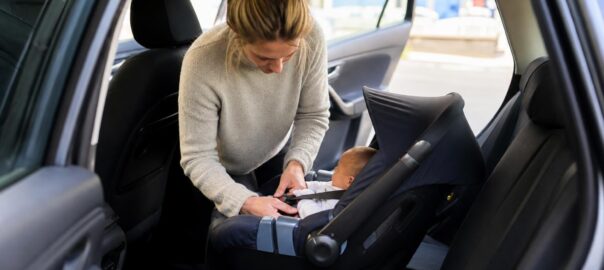
Baby Capsule Transfer: Queensland Airport Transfers 2026
TL;DR
A baby capsule transfer is a pre-booked ride (typically to or from an airport) where a rear-facing infant car seat is professionally installed in the vehicle before pickup. It solves the problem of travelling safely with a baby under 12 months in Queensland, where taxis and rideshares are legally exempt from child restraint requirements but where holding an infant on your lap is far from safe. Pre-booking a private transfer with a baby capsule included is the simplest way to guarantee your newborn travels in a properly fitted, Australian-standard restraint.
Need a transfer with a baby capsule included? Get an instant quote to see pricing for your route.
What Is a Baby Capsule Transfer?
A baby capsule transfer is a pre-booked point-to-point ride, usually to or from an airport, cruise terminal, or hotel, where the vehicle comes equipped with a rear-facing baby capsule already installed. The driver fits the capsule before arriving at your pickup location, so you and your infant can get in and go without fumbling with unfamiliar hardware.
The term covers two connected ideas:
The service: A private transfer that includes a professionally fitted baby capsule as part of the booking.
The seat itself: A portable, rear-facing child restraint built in two parts, a base that stays anchored in the vehicle and a carrier with an inbuilt harness that clicks in and out of that base.
This two-part design is what makes capsules practical for transfer services. The base is pre-installed using either ISOFIX anchor points or a seatbelt, and the carrier locks into place in seconds. After the ride, parents can often lift the carrier straight onto a compatible pram frame without waking a sleeping baby.
A1 vs A2 Capsule Types
Not all baby capsules fit the same age range, and most transfer providers don’t explain the difference. There are two categories defined under Australian standards:
A1 capsules suit babies up to roughly 6 months old.
A2 capsules suit babies up to around 12 months old, depending on the child’s weight and size.
When booking a baby capsule transfer, always specify your child’s age and approximate weight. A 10-month-old will need an A2 capsule, and you don’t want to discover at pickup that the provider only carries A1 models.
The Australian Safety Standard
Every child restraint sold in Australia must meet AS/NZS 1754, one of the toughest child restraint standards in the world. It was first published in 1973 and has been updated regularly since. When booking any transfer service that provides a baby capsule, confirming AS/NZS 1754 compliance is non-negotiable.
Why Baby Capsule Transfers Matter for Families in Queensland
The Law Creates a Confusing Gap
Queensland child restraint laws are strict for private vehicles. Children under 6 months must travel in a rear-facing capsule. Children aged 6 months to under 4 years must be in a rear-facing or forward-facing seat with a harness. The penalties for getting it wrong are $391 and 3 demerit points per improperly restrained child, with double demerits for repeat offences within a year.
But here’s where it gets confusing. Taxis, limousines, and ride-booking services like Uber are exempt from child restraint requirements in Queensland. Instead, children under one year old must be held on the lap of a passenger aged 16 or older. Children between one and seven must sit in the back seat wearing a seatbelt.
This creates what parents experience as a “legal but unsafe” gap. The law says you can hold your infant on your lap in a taxi. Every road safety organisation says you shouldn’t. A thread in the r/brisbane subreddit captures this tension perfectly: a parent of a 4-month-old asking whether they can legally catch a taxi from the airport, clearly uncomfortable with the answer even before receiving it.
That cognitive dissonance is exactly what drives parents to search for baby capsule transfers. They want a clear, safe solution, not a legal loophole.
Taxis and Rideshare Won’t Solve This
Most taxi drivers in Queensland do not carry baby capsules. If you hail a cab at the airport rank with a newborn, you’re almost certainly riding without a proper restraint.
Uber launched a Child Seat option in Melbourne in late 2024, but it’s a trial limited to that city. The service includes a convertible seat and a booster, with a $9.99 surcharge per trip. It is not available in Brisbane, the Gold Coast, or anywhere else in Queensland.
Shared shuttle services present another dead end. Con-X-ion, one of Queensland’s largest shared shuttle operators, explicitly states on their FAQ page that they do not provide baby capsules and are not obligated to do so.
For families arriving at Brisbane Airport or the Gold Coast Airport with a baby, pre-booked private transfers are often the only reliable option that includes a properly installed capsule.
How a Baby Capsule Transfer Works
The process is straightforward, but the details matter.
Step 1: Book and Specify Your Child’s Details
When making your booking, provide your child’s age and approximate weight. This determines whether the provider fits an A1 or A2 capsule (or, for older children, a convertible or booster seat). Some providers also ask whether you need the capsule at pickup only or for a return trip as well.
For families needing multiple child restraints, or travelling with a mix of ages, you can read more about family airport transfer options to understand how private services handle larger groups.
Step 2: The Driver Pre-Installs the Capsule
Before arriving at your pickup point, the driver installs the capsule base in the vehicle. Professional transfer vehicles are more likely to have ISOFIX anchor points than older taxi fleets. ISOFIX is a rigid, standardised connection system that lets the capsule base lock directly into the car’s chassis without relying on a seatbelt thread. It’s faster, more secure, and harder to get wrong.
That last point is significant. Industry data suggests that roughly 80% of child seats are installed incorrectly by parents. Professional drivers who install capsules regularly eliminate this risk. It’s arguably the strongest safety argument for booking a baby capsule transfer rather than bringing your own seat and fitting it yourself in an unfamiliar vehicle.
Step 3: Pickup and Ride
At the airport, your driver meets you (many private transfer operators offer terminal meet-and-greet services with a name board) and walks you to the vehicle. The capsule is already fitted. You secure your baby in the carrier’s harness, the carrier clicks into the base, and you’re on your way.
Step 4: Arrival and Pram Transfer
Here’s an underrated benefit of capsules over fixed car seats. When you reach your destination, you can lift the entire carrier out of the base and clip it onto a compatible pram frame. Your baby doesn’t need to be disturbed. For parents arriving after a long flight with a sleeping infant, this seamless transition from car to pram is genuinely valuable.
If you’re weighing the benefits of pre-booked transfers more broadly, the capsule convenience is just one piece of a larger picture that includes flight monitoring, luggage help, and fixed pricing.
What About Cost?
The market is split. Some providers charge $25 or more per child seat. Others charge a small flat fee for installation and hire. Premium private transfer operators sometimes include baby capsules free of charge as part of the booking. My Private Transfers, for example, offers free child and infant seats for children aged 0 to 7, with baby capsules available on request.
Always confirm whether the capsule is included in your quoted price or carries an additional fee. This is one of the most important questions to ask before confirming a booking.
Baby Capsule vs Other Child Restraints
Parents booking transfers often aren’t sure which restraint type their child actually needs. Here’s a quick reference:
Restraint Type | Facing Direction | Typical Age Range | Portable? | Best For |
|---|---|---|---|---|
Baby capsule (A1) | Rear-facing | Birth to ~6 months | Yes (clicks in/out of base) | Newborns, short trips, transfer services |
Baby capsule (A2) | Rear-facing | Birth to ~12 months | Yes | Infants up to 12 months, airport transfers |
Convertible car seat | Rear then forward | Birth to ~4 years | No (fixed in vehicle) | Long-term daily use in family car |
Forward-facing seat | Forward-facing | 6 months to ~4 years | No | Toddlers who’ve outgrown capsules |
Booster seat | Forward-facing | 4 to ~7 years | Semi-portable | Older children using adult seatbelts |
The key difference between a capsule and a convertible car seat is portability. Convertible seats are designed to stay permanently installed in one vehicle. Capsules are built to move, which is exactly why they suit transfer services. The carrier detaches from the base in seconds, so drivers can prepare the vehicle in advance and parents aren’t wrestling with installation on the curb.
For children older than 12 months who no longer fit a capsule, most quality transfer providers also carry forward-facing seats or boosters. Specify your child’s age at booking, and the provider should match the right restraint.
Key Questions to Ask When Booking a Baby Capsule Transfer
Not all transfer providers handle baby capsules the same way. Before confirming your booking, ask these questions:
Is the baby capsule compliant with AS/NZS 1754? This is the mandatory Australian safety standard. Any reputable provider will confirm immediately.
Is the capsule included free, or is there an additional charge? Pricing varies significantly across the market. Get this in writing before you book.
Does the vehicle have ISOFIX anchor points? ISOFIX provides a more secure, foolproof installation than seatbelt-only methods. Newer vehicles in professional fleets almost always have them.
Will the driver install the capsule before pickup? You shouldn’t be waiting at the curb while a driver figures out the installation. Pre-installation is the standard for professional services.
What if my child has outgrown the capsule? If your baby is approaching 12 months or is particularly large for their age, ask whether a forward-facing alternative is available.
Can I request a capsule for both legs of my trip? If you need a capsule for your airport arrival and a separate booking for your return, confirm availability for both.
For more answers to common booking questions, the frequently asked questions page covers child seats, luggage, and other transfer details.
How to Travel with a Baby and a Capsule Beyond the Transfer
A baby capsule transfer solves the ground transport problem, but families travelling with infants face logistics at every stage. If you’re flying into Queensland with a baby for the first time, the airport travel with baby guide covers everything from check-in to pram gate-checking to what happens at the carousel.
For families heading to popular holiday spots, routes like Gold Coast Airport to Surfers Paradise or Noosa to Brisbane Airport are among the most commonly booked baby capsule transfer routes in South East Queensland.
Book a Baby Capsule Transfer
Travelling with a newborn is stressful enough without worrying about whether your ride will have a safe seat. A pre-booked baby capsule transfer removes that uncertainty entirely.
Ready to book? Get an instant quote for your route, or check verified customer reviews to see what other families have experienced.
Frequently Asked Questions
What age is a baby capsule transfer suitable for?
Baby capsules are designed for newborns up to roughly 6 months (A1 type) or 12 months (A2 type), depending on the model and the child’s weight. Most transfer providers carry A2 capsules that cover the full 0 to 12 month range. Always confirm when booking.
Do I legally need a baby capsule in a taxi or rideshare in Queensland?
No. Queensland law exempts taxis, limousines, and ride-booking services from child restraint requirements. Children under one must be held on the lap of a passenger aged 16 or older. However, this exemption doesn’t make the practice safe. Pre-booking a transfer with a capsule is the recommended alternative.
Can I bring my own baby capsule in a transfer vehicle?
Most private transfer providers will allow it, but you’ll need to install it yourself or ask the driver for help. Using the provider’s own capsule is usually easier because it’s already fitted to the vehicle before pickup.
How much does a baby capsule transfer cost?
It varies. Some providers charge $25 or more per seat. Others include capsules free with the booking. My Private Transfers offers free child and infant seats for ages 0 to 7, with baby capsules available on request.
Is Uber a good option for travelling with a baby in Brisbane?
Currently, no. Uber’s Child Seat option is only available as a trial in Melbourne, with a $9.99 surcharge per trip. It has not launched in Brisbane, the Gold Coast, or any other Queensland location.
What’s the difference between a baby capsule and a convertible car seat?
A baby capsule is portable and rear-facing only, designed to click in and out of a base for easy transfer between vehicles and prams. A convertible car seat is fixed in the vehicle and can be adjusted from rear-facing to forward-facing as the child grows. Capsules are better for transfer services; convertible seats are better for everyday family car use.
How do I know if the baby capsule meets Australian safety standards?
Ask the provider to confirm that the capsule complies with AS/NZS 1754, the mandatory Australian and New Zealand standard for child restraints. Reputable transfer companies will only use compliant equipment.
What if my child is too big for a baby capsule?
Children who have outgrown a capsule (typically over 12 months or exceeding the weight limit for the specific model) need a forward-facing child seat with a harness. Most professional transfer providers carry these as well. Specify your child’s age and weight when booking so the correct restraint is prepared.

How to Arrange Transport for Large Groups to & From Airports
TL;DR
Moving seven or more people with luggage to or from an airport is a logistics problem, not just a booking task. The biggest mistakes are underestimating luggage volume, skipping flight number coordination, and assuming rideshare apps can handle groups larger than six. This guide defines every key term you’ll encounter when arranging group airport transport and connects each one to the decisions that actually matter.
Organising transport for a large group sounds straightforward until you’re standing in an arrivals hall with twelve tired passengers, fourteen suitcases, a stroller, and no vehicle big enough to carry everyone at once. The difference between a smooth transfer and a logistical mess comes down to understanding a handful of terms and planning steps that most first-time group coordinators never think about.
This glossary covers every concept you’ll encounter when figuring out how to arrange transport for large groups to and from airports. Each term is defined in plain language, then connected to the practical decision it affects.
If you’re coordinating a group transfer through Brisbane, the Gold Coast, or the Sunshine Coast, you can get a tailored quote to match your group size and luggage needs.
What Is a Group Airport Transfer?
Group airport transfer means a pre-booked, coordinated vehicle (or set of vehicles) arranged to move seven or more passengers between an airport and their destination. It is not the same as booking several taxis, requesting multiple rideshares, or putting everyone on a shared shuttle with strangers.
The distinction matters because once your group hits seven passengers, standard transport options start breaking down. Rideshare platforms cap their largest vehicle category at six passengers. Taxis seat four. Shared shuttles make multiple stops that stretch a 40-minute trip into two hours. Seven is the tipping point where you stop booking rides and start planning logistics.
A proper group transfer typically includes a single point of contact with the driver or operator, a vehicle matched to your headcount and luggage, and a pickup plan that accounts for flight timing rather than a generic clock time.
For a foundational overview, see our guide on what an airport transfer is and how it differs from other options.
Key Terms: Vehicle Types and Sizing
Sedan and SUV
A standard sedan (Toyota Camry, Honda Accord) seats three passengers comfortably with luggage. An SUV handles four to five passengers with more boot space. These work for small executive pickups or airport runs with light baggage, not for groups.
People Mover or Van
A people mover (sometimes called a maxi van) typically seats 7 to 11 passengers. This is the workhorse for family groups, small corporate delegations, and wedding parties flying in together. Most operators in South East Queensland offer this tier.
Minibus
A minibus carries 11 to 24 passengers. Think wedding shuttles, school groups, or small conference delegations. Luggage capacity varies widely, so check the underfloor storage dimensions before assuming everyone’s bags will fit.
Full-Size Coach or Motorcoach
For 25 to 56 passengers. Sports teams, large corporate conferences, and festivals are the typical use cases. Coaches usually have dedicated luggage bays, but oversized items (surfboards, golf bags, instrument cases) may still need separate arrangements.
The Full Capacity Trap
This is the single most common mistake when arranging group airport transport. Vehicle listings advertise maximum seating. A 12-seater van technically holds 12 people, but it does not hold 12 people and 12 checked bags. Luggage volume is the number one reason groups end up needing an extra vehicle they didn’t budget for.
The rule is simple: if your group number sits close to the vehicle’s maximum capacity, go up a size. A 10-passenger group with full luggage often needs a 14-seat minibus, not a 10-seat van.
Quick vehicle sizing guide:
Group Size | Vehicle Type | Luggage Reality |
|---|---|---|
1–3 passengers | Sedan or SUV | 2–3 checked bags comfortably |
4–10 passengers | Van or people mover | Size up if everyone has checked luggage |
11–24 passengers | Minibus | Confirm underfloor storage dimensions |
25–56 passengers | Full-size coach | Luggage bays standard, but check oversized item policy |
Key Terms: Booking and Coordination
Flat-Rate Transfer
A fixed price for an A-to-B journey. You know the cost before you book, regardless of traffic or minor route variations. This is the standard model for airport pickups and drop-offs.
Hourly Charter
The vehicle and driver are hired for a block of time. This makes sense for complex itineraries with multiple stops, like collecting passengers from several hotels before heading to the airport. Charter pricing is built around the vehicle type, time on duty, route complexity, and waiting time, not a simple per-seat number. First-time bookers often expect a per-head rate and get confused when the quote comes back as a lump sum.
For a deeper comparison of pricing structures, our chauffeur vs rideshare breakdown covers the cost differences in detail.
Staggered Pickup
When group members arrive on different flights, a staggered pickup means the operator sends a vehicle (or the same vehicle on a loop) to collect passengers at different times. This costs more than a single coordinated pickup, but it protects timing for families with young children, elderly travellers, or anyone who can’t afford to wait two hours in an arrivals hall.
Professional transfer services typically plan 30 to 45 minute windows between scheduled pickups to absorb customs delays and baggage wait times.
Arrival Window
The realistic time between a plane touching down and your group actually standing curbside with luggage. For domestic flights, allow 20 to 30 minutes. For international arrivals (customs, immigration, biosecurity in Australia), allow 45 to 75 minutes. Work backward from the likely airport exit time rather than the posted landing time when you communicate with your driver.
Transfer Brief
A one-page document listing every detail the driver and passengers need: passenger names, flight numbers, arrival times, terminal information, luggage notes (especially oversized items), and destination addresses. Creating this document is the single most effective coordination step you can take.
Practitioners in the group travel space consistently report that groups sharing flight numbers upfront almost never have timing problems. The ones who book “pickup at 3pm” without flight context run into issues constantly.
Single Point of Contact
Assign one person to be the link between your group and the transport operator. Instead of twelve travellers texting the driver individually with updates, one coordinator manages all communication and schedule changes. This is not optional for groups over ten people. It is survival.
If you’re planning a corporate group airport transfer, the single-contact model becomes even more critical when juggling multiple departments and expense codes.
Flight Tracking
Most professional transfer operators monitor flight arrivals in real time. This means the driver adjusts their arrival based on actual landing data, not the scheduled time. Always confirm that your provider offers this, especially for early morning or red-eye arrivals where delays are common.
Buffer Time
The extra time built into your schedule between the last passenger clearing the terminal and the vehicle’s departure deadline. For groups, 15 to 20 minutes of buffer time is the minimum. For international arrivals with families, 30 minutes is safer.
Key Terms: Airport Pickup Logistics
Meet-and-Greet
A representative meets your group inside the terminal, usually at the baggage carousel or arrivals hall, holding a name board. Each passenger is checked in and escorted to the vehicle. For groups of eight or more, meet-and-greet is dramatically more effective than curbside pickup because it prevents the “where’s the car?” confusion that scatters large groups across a busy terminal.
Learn more about confirming driver meet points at busy terminals to make this process smoother.
Curbside Pickup
The vehicle waits in a designated pickup zone and passengers walk to it. This works fine for small groups who know the airport layout. For large groups with luggage trolleys and children, it adds friction and delay.
Ground Transport Licence
At Brisbane Airport, all vehicles picking up pre-booked fares must hold a Brisbane Airport Ground Transport Licence. This is not a nice-to-have. Unlicensed vehicles risk being turned away, leaving your group stranded. Always confirm your operator holds the appropriate airport access credentials.
Designated Pickup Zones (Brisbane Airport)
Buses and coaches at Brisbane Airport use specific collection areas. The bus and coach zone sits approximately 100 metres from the Domestic Terminal and only 50 metres from the International Terminal. For domestic arrivals, passengers use the Skywalk to reach the collection zone. Knowing this layout in advance saves your group from wandering around a car park with suitcases.
Key Terms: Luggage and Special Requirements
Luggage Capacity
The amount of baggage a vehicle can carry beyond its passenger seating. When planning how to arrange transport for large groups to and from airports, count bags, not just people. Instead of asking “how many bags?” ask the more useful question: how many checked bags, carry-ons, and oversized items? The distinction between a group with backpacks and a group with hard-shell suitcases can be the difference between one vehicle and two.
Oversized Items
Golf clubs, surfboards, strollers, large instrument cases, ski equipment, coolers, and bulky conference display materials. These items don’t fit in a standard boot and often can’t share cabin space with passengers. If your group is travelling with oversized gear, ask whether a trailer option or a second vehicle is more practical.
For groups travelling with boards, our guide on transporting surfboards covers the rules and logistics for flights and ground transport.
Luggage Trailer
An enclosed trailer towed behind the vehicle. This is an underused option that solves the oversized luggage problem without upgrading to a larger (and more expensive) vehicle. Few competitors in the Australian market even mention trailers, but they’re particularly useful for holiday groups heading to the Gold Coast or Sunshine Coast with surfboards, port-a-cots, and camping gear.
Child Restraint (Australian Law)
Australian law requires appropriate child restraints for children aged 0 to 7 years. This applies in transfer vehicles, not just private cars. Many transfer operators charge extra for child seats or require you to bring your own. Some don’t offer them at all, which creates a compliance headache for families arriving after a long flight with no car seat in hand.
This is a practical detail worth confirming before you book. If your group includes young children, check what’s included. For more on travelling with infants, see our airport travel with baby guide.
Accessibility Requirements
Wheelchair-accessible vehicles, extra time for boarding, and ground-level entry (no steps) are all considerations for groups that include elderly travellers or passengers with mobility challenges. Confirm accessibility features explicitly at booking, not at pickup.
Key Terms: Pricing and Contracts
Per-Head Cost
The total vehicle cost divided by the number of passengers. This is where group transport starts to make obvious financial sense. A minibus for 15 people almost always costs less per head than booking five separate rideshares or taxis, especially when airport surcharges and surge pricing are factored in.
After-Hours Surcharge
Most operators apply a surcharge for pickups between roughly 8 pm and 6 am. Early morning flights and late-night arrivals cost more. Factor this into your budget from the start rather than being surprised on the invoice.
Airport Access Fee
Some airports charge operators a fee for entering terminal pickup zones. This cost is typically passed through to the customer. At Brisbane Airport, this is bundled into most transfer quotes, but confirm with your provider.
Cancellation Policy
Group bookings involve more coordination than individual transfers, so cancellation terms matter more. Policies vary widely. Some operators offer full refunds up to 48 hours before the transfer, partial refunds within 24 to 48 hours, and no refund within 24 hours. Read the terms before you book, because group plans change more often than individual ones.
Price Match Guarantee
Some operators will match or beat a competitor’s quote for an equivalent service. This is worth asking about, particularly when comparing quotes from multiple accredited Queensland operators.
Key Terms: Safety and Compliance
Operator Accreditation (Queensland)
In Queensland, most passenger transport services must be provided by operators who hold accreditation through the Department of Transport and Main Roads. This accreditation covers business systems, safety management, vehicle standards, and complaint handling. An unaccredited operator is not just risky; they’re potentially illegal.
Driver Authorisation
Separate from operator accreditation, individual drivers in Queensland must hold driver authorisation. This includes fit and proper person assessments, medical clearance, and criminal history checks. When arranging transport for large groups to and from airports, especially groups with children, confirming driver authorisation is a baseline safety step.
Government-Accredited Chauffeur
A driver who holds both driver authorisation and operates under an accredited operator. This is the standard you should expect for any group airport transfer in Queensland.
Vehicle Inspection
Accredited operators must maintain vehicles to specified safety standards. This includes regular mechanical inspections, insurance coverage, and compliance with seating and seatbelt regulations. For groups, this matters because overloading an uninspected vehicle is both dangerous and uninsured.
Step-by-Step Checklist: How to Arrange Transport for Large Groups
Everything above distils into a practical sequence. Follow these steps when arranging group airport transport for any occasion, whether it’s a corporate conference, a wedding party, a family reunion, or a sports team.
Step 1: Get an accurate headcount and luggage audit. Count passengers. Then count bags: checked, carry-on, oversized. Be specific. “About twelve people with luggage” is not enough information for a quote.
Step 2: Map all flight details. Collect flight numbers, arrival times, airlines, and terminals for every passenger. Share this with your transport provider, not just a clock time.
Step 3: Choose your vehicle tier based on real capacity. Use the sizing guide above. Account for luggage, not just seats. If you’re on the boundary, size up.
Step 4: Decide between a single coordinated pickup or staggered service. If all flights land within 30 minutes, a single pickup with buffer time usually works. If arrivals are spread across hours, staggered pickups protect everyone’s time and patience.
Step 5: Assign a single coordinator. One phone number, one email, one point of contact between the group and the driver.
Step 6: Book early. For groups up to 10 people, 48 hours’ advance notice is often sufficient. For larger groups, book at least two to four weeks ahead. During peak periods (school holidays, Christmas, Easter), six to eight weeks is safer.
Step 7: Create and distribute a transfer brief. One page. Passenger names, flight numbers, times, terminals, luggage notes, destination. Send it to the operator and every traveller.
Step 8: Confirm 24 hours before. Reconfirm the booking, verify the flight numbers are still correct, and ensure the coordinator’s phone will be on and reachable upon landing.
Step 9: Have a contingency plan. What happens if a flight is delayed by three hours? What if luggage is lost and someone needs to stay behind? Discuss backup scenarios with your operator before travel day.
For weddings, see our dedicated wedding guest shuttle checklist. For conferences and events, our group event transfer planning guide covers the nuances of multi-day coordination.
Don’t Forget the Return Trip
Many organisers focus their energy on the outbound leg and treat the return as an afterthought. In practice, the most difficult movement is typically airport arrivals or the return leg, when passengers are fatigued, scattered, and less patient. Book the return transfer at the same time as the outbound. Confirm pickup times and locations the day before. A group that sailed through the arrival pickup can still fall apart on the way back if nobody planned it.
Frequently Asked Questions
Can I use rideshare apps for a large group airport transfer?
Not effectively. Rideshare platforms cap their largest vehicle category at six passengers. If your group has seven or more travellers, you need purpose-built group transport. Some apps allow requesting multiple rides simultaneously, but coordinating split rideshares with 10+ people at an international terminal, after a 14-hour flight and with full luggage, has a high failure rate. Book a vehicle designed for the group size from the start.
How far in advance should I book group airport transport?
For groups of up to 10 people, 48 hours is generally sufficient. For larger groups or peak travel periods, book at least two to four weeks ahead. During summer holidays, Christmas, and Easter, aim for six to eight weeks to secure the right vehicle.
What if our group arrives on different flights?
This is called a staggered pickup. Your operator sends a vehicle (or rotates the same vehicle) to collect passengers as each flight lands. It costs more than a single pickup but avoids stranding early arrivals in the terminal for hours. Share all flight numbers upfront so the operator can plan 30 to 45 minute windows between pickups.
Do children need car seats in an airport transfer vehicle in Australia?
Yes. Australian law requires appropriate child restraints for children aged 0 to 7 years, and this applies to transfer vehicles. Confirm with your provider whether seats are included, available for an extra fee, or need to be supplied by you.
How do I avoid the Full Capacity Trap?
Count bags, not just passengers. A vehicle with 12 seats does not comfortably carry 12 passengers with 12 suitcases. If your group number is close to the vehicle’s maximum capacity, go up a size. Ask your operator specifically about luggage volume, not just seating.
What is a transfer brief and do I really need one?
A transfer brief is a one-page document listing passenger names, flight numbers, arrival times, terminals, luggage notes, and destination addresses. It takes 15 minutes to create and eliminates most coordination problems. For groups over seven people, it’s not optional.
Is a meet-and-greet worth the cost for a large group?
For groups of eight or more, absolutely. A representative meets your group at baggage claim, confirms everyone is accounted for, and escorts the group to the vehicle. Without this, large groups scatter across the terminal and waste 20 to 30 minutes just finding each other and the car.
What should I look for in a group transfer provider?
Operator accreditation, driver authorisation, appropriate airport ground transport licensing, a vehicle fleet that matches your group size, transparent pricing, and a clear cancellation policy. Our airport transfer company checklist covers the vetting process step by step.
If you’re ready to organise group transport to or from Brisbane Airport, the Gold Coast, or the Sunshine Coast, get an instant quote matched to your group size, luggage needs, and schedule.

2026 Brisbane Cruise Embarkation & Disembarkation Transfers
Summary
Coordinating transfers for cruise embarkation and disembarkation requires careful timing, the right vehicle choice, and awareness of terminal logistics. The Brisbane International Cruise Terminal has no public transport access, making pre-booked transfers nearly essential. Most customers book well in advance—earlier is better, especially around peak sailings and school holidays. Allow at least five hours between your ship’s arrival and any outbound flight on disembarkation day. Families need to plan for child seats, extra luggage space, and the unpredictable timing of the debarkation process.
Why Transfer Coordination matters more than you think
Most cruise passengers spend weeks comparing staterooms, shore excursions, and dining packages. The transfer to and from the terminal? That gets about five minutes of thought, usually the night before. This is a mistake.
Getting to a cruise terminal on time with all your luggage, your family, and your sanity intact is the first real test of a holiday. Getting away from one, especially when 2,000 other passengers are trying to do the same thing, is the last. Both deserve proper planning.
This guide breaks down the key terms, timelines, and decisions involved in coordinating ground transfers for cruise embarkation and disembarkation, with a particular focus on Brisbane’s cruise terminal and the unique challenges it presents.
Get an instant quote for cruise transfers to start planning your embarkation or disembarkation day transport.
Understanding Embarkation: Getting to the Ship
What Embarkation Day actually involves
Embarkation is the process of boarding the cruise ship. On embarkation day, passengers arrive at the cruise terminal, check in, pass through security screening, and walk aboard. Each cruise line manages this differently, but the sequence is broadly the same: arrive, queue, scan documents, drop luggage, board.
The critical detail is the cutoff. Check-in and boarding close two hours before the ship’s scheduled departure. Miss that window and the ship leaves without you. There is no flexibility here. This means your transfer timing needs to account for traffic, luggage loading, and the check-in queue itself, not just the drive time.
Check-in Windows and Why They Shape Your Transfer
Cruise lines assign check-in windows (sometimes called boarding groups or arrival appointments) to stagger the flow of passengers and prevent bottlenecks. Your window might be 11:00 AM or 2:00 PM, but you still need to clear the process before that two-hour cutoff.
For a ship departing at 4:00 PM, the latest you could realistically arrive at the terminal is 2:00 PM. Back-calculate from there. If the drive from your hotel or the airport takes 30 minutes and you want a 30-minute buffer, you need to leave by 1:00 PM at the absolute latest.
The Case for Arriving the Day Before
For families flying into Brisbane to catch a cruise, arriving the day before embarkation eliminates the biggest risk: flight delays cascading into a missed ship. With kids, strollers, and checked luggage, there are simply too many variables on travel day to leave it all to the same morning. One delayed flight, one lost bag, and the holiday is over before it starts.
Practitioners on TripAdvisor forums consistently recommend this approach, especially for passengers coming from interstate or international origins.
Turnaround Port and Homeport
A turnaround port (or homeport) is where a cruise begins and ends. Brisbane’s cruise terminal functions as a turnaround port for lines like Royal Caribbean, Carnival, Princess, Celebrity, and Cunard. On turnaround days, the terminal handles both disembarking passengers from the arriving ship and embarking passengers for the next voyage, often on the same day. This creates concentrated demand for transfers during a narrow time window.
Meet and Greet at the Terminal
In transfer terminology, “meet and greet” means your driver is waiting at a designated point with a name board when you arrive. This is distinct from a curbside pickup where you need to find the vehicle yourself. At a busy cruise terminal on turnaround day, having someone waiting specifically for you removes the guesswork. If you haven’t used this type of service before, here’s what to expect at a chauffeur pickup.
Understanding Disembarkation: Getting Off the Ship
How the Disembarkation Process Works
Disembarkation is the process of leaving the cruise ship at the end of your voyage. It sounds simple, but it involves customs clearance, luggage retrieval, and a staged exit process that can stretch across three hours for the entire ship.
Most cruise ships are cleared for passengers to begin disembarking between 7:00 and 9:00 AM, depending on when the vessel actually docks. If a ship arrives later than scheduled, a general rule of thumb is that clearance begins about one hour after docking.
Express Debarkation (Self-Assist)
Express debarkation, sometimes called self-assist disembarkation, is for passengers who can carry all their own luggage off the ship. These passengers are typically the first to leave once local authorities clear the vessel, often starting around 7:00 AM. The trade-off is obvious: you get off earlier, but you need to manage every bag yourself.
For transfer coordination, express debarkation gives you more control over timing. You know roughly when you’ll be off the ship, so you can give your transfer provider a tighter pickup window.
Checked Luggage Debarkation
With checked luggage debarkation, you place your bags outside your stateroom the night before arrival. A stateroom attendant delivers a disembarkation letter and color-coded luggage tags. The letter tells you your assigned debarkation time and group number.
On the morning of disembarkation, you wait in your stateroom or a designated lounge until your group is called. Once called, you’re typically off the ship within about 15 minutes. Your bags are waiting in the terminal’s baggage claim area, arranged by color code.
Disembarkation Groups and Color Codes
Cruise lines assign passengers to disembarkation groups identified by color codes or numbers. The assignment determines the order in which you leave the ship. Priority groups (suite passengers, loyalty members, those with early flights) go first. Everyone else follows in sequence.
This system matters enormously for transfer coordination. If you’re in a late group, you might not be off the ship until 10:00 AM or later. Booking a transfer for 7:30 AM because the ship docks at 6:00 AM is a recipe for a stressed driver and a wasted booking.
Customs Clearance: The Hidden Delay
Before anyone sets foot on the gangway, Australian Border Force must clear the vessel. This process typically takes 15 to 30 minutes after docking, but it can run longer. Contributors on Reddit’s r/brisbane community consistently report that customs clearing at the Brisbane terminal takes about an hour from the time the ship docks to when the first passengers actually walk out.
Factor this into every transfer booking. The ship’s scheduled arrival time is not the time you’ll be ready for pickup.
Transfer Options: Knowing What’s Available
Understanding the different types of transfers helps you match the right option to your situation. Here’s how they compare when you’re coordinating transfers for cruise embarkation and disembarkation.
Pre-booked Private Transfer
A pre-booked private transfer means a dedicated vehicle and driver arranged before your trip at a fixed price. The key advantage for cruise passengers is flexibility: a good provider will track your ship’s arrival and adjust the pickup time if the vessel is delayed. You’re not sharing the vehicle with strangers, so departure happens on your schedule.
For families, this also means requesting child seats, extra luggage capacity, or even an enclosed luggage trailer for oversized gear. At My Private Transfers, we offer an enclosed luggage trailer option for families traveling with extra luggage (available on request). Read more about the benefits of pre-booking your transfer to understand how this compares with ad-hoc options.
Cruise-Line Transfers
Many cruise lines sell shuttle or coach transfers as an add-on. These are convenient in one sense (you book through the cruise line directly) but limiting in another. They run on fixed schedules, pick up at fixed points, and don’t wait for you individually. TripAdvisor forum contributors note that cruise-line shuttles tie you to their timetable, which is a problem if your plans don’t align with the departure slots they offer.
Shared Shuttles
Shared shuttle services (like Con-X-ion in Brisbane) offer a cheaper alternative but involve multiple stops and fixed departure times. They work well for solo travelers or couples with minimal luggage and flexible schedules. For families or groups with significant luggage, the stops and scheduling constraints can turn a 30-minute trip into an hour-long ordeal.
Taxis and Rideshare
On paper, hailing a taxi or ordering an Uber from the cruise terminal seems straightforward. In practice, when 2,000-plus passengers pour off a ship simultaneously, the taxi queue stretches long and rideshare surge pricing kicks in. One TripAdvisor reviewer noted paying AU$45 for an Uber from BICT to the CBD, while forum contributors report taxi fares of AU$50 to $60 for the same route. These prices aren’t outrageous, but availability during peak disembarkation is the real issue.
Reddit users in r/brisbane recommend pre-booking transfers rather than hoping for available taxis when an entire ship unloads at once.
The Coach and Shuttle Zone
At terminals like BICT, larger vehicles (limousines, coaches, anything with a trailer) must use the designated Coach and Shuttle Area rather than the standard passenger pickup zone. Vehicles under 6.5 metres can use the 2-minute Passenger Pick-Up and Set Down Area. Chartered transfer services need prior access agreements with terminal management. This is an operational detail, but it matters: it means your transfer provider needs to know the terminal rules and have the right permissions.
Brisbane International Cruise Terminal: The Specifics
Location and the Public Transport Problem
The Brisbane International Cruise Terminal (BICT) sits at 1 Cruise Terminal Drive, Pinkenba, at the mouth of the Brisbane River. It’s about 12 km from Brisbane Airport (roughly 15 minutes by car) and 21 km from the Brisbane CBD (25 to 30 minutes).
Here’s the critical fact: there is no public transport to the Brisbane International Cruise Terminal. None. No bus, no train, no ferry. The Port of Brisbane confirms this directly. The nearest train stations are Doomben and Eagle Junction, but from there you’d need a taxi or rideshare to cover the final stretch into Pinkenba.
TransLink has stated that due to the irregular nature of cruise ship operations, regular scheduled services aren’t considered appropriate for the terminal. There are no plans to change this.
This single fact shapes every transfer decision for cruise passengers using Brisbane. When you disembark at BICT, you need to have arranged transport in advance or be prepared to compete with every other passenger for limited taxis.
Explore cruise transfer options from BICT including routes to bayside suburbs and the airport.
BICT vs. Portside Wharf
Portside Wharf in Hamilton is an older cruise terminal location in Brisbane that still handles some smaller vessels and river-based operations. It’s sometimes confused with BICT, but they’re different facilities in different locations. When booking a transfer, confirm which terminal your ship uses. Getting dropped at the wrong one is a surprisingly common and entirely avoidable mistake.
The 2-Minute Set Down Zone
BICT has a designated quick drop-off and pickup area for vehicles under 6.5 metres. You get two minutes, which is enough to unload luggage and say goodbye but not enough to park and walk someone inside. Larger vehicles and those towing trailers must use the Coach and Shuttle Area with prior terminal approval.
How to Coordinate Transfers for Cruise Embarkation Day
Here’s the step-by-step process for getting your embarkation day transfer right.
Step 1: Confirm your check-in window. Your cruise line will send boarding documents with an assigned arrival time. This is the anchor for your entire day.
Step 2: Calculate backward from the cutoff. Boarding closes two hours before sailing. If the ship departs at 4:00 PM, you must be checked in by 2:00 PM. Add 30 to 45 minutes for the check-in and security queue, and you should aim to arrive at the terminal by 1:00 to 1:15 PM.
Step 3: Add travel time and a buffer. The drive from Brisbane CBD to BICT takes about 25 to 30 minutes in normal traffic. From Brisbane Airport, it’s closer to 15 minutes. Add a 20-minute buffer for unexpected delays. So a CBD pickup for a 4:00 PM departure should happen no later than 12:00 to 12:15 PM.
Step 4: Book your transfer. Share your pickup address, number of passengers, luggage count, and any special requirements (child seats, wheelchair access, oversized items) with your transfer provider. For tips on confirming your driver’s meeting point, especially at hotels or the airport, plan this detail in advance.
Step 5: Confirm the day before. A quick confirmation call or message to your transfer provider the day before embarkation catches any last-minute changes to your schedule or theirs.
How to Coordinate Transfers for Cruise Disembarkation Day
Disembarkation day is where transfer coordination gets genuinely complicated. Here’s how to handle it.
Step 1: Know your debarkation method. Decide whether you’re doing express (self-assist) or checked luggage disembarkation. This determines when you’ll actually leave the ship.
Step 2: Estimate your off-ship time. For express debarkation, plan for 7:00 to 7:30 AM assuming the ship docks on schedule and customs clearance runs smoothly. For checked luggage debarkation, you could be off the ship anywhere from 7:30 AM to 10:00 AM depending on your assigned group. If you don’t know your group assignment until the night before, plan for flexibility.
Step 3: Communicate with your transfer provider. The best approach is to book a transfer with an estimated pickup time and then update the provider once you know your disembarkation group. Providers who track ship arrivals can adjust automatically, which is why private transfers outperform fixed-schedule shuttles on disembarkation day.
Step 4: Apply the five-hour rule for flights. MSC Cruises and other lines advise allowing at least five hours between the ship’s scheduled arrival and your flight departure. This accounts for customs clearance, luggage retrieval, the transfer to the airport, and airline check-in. If your ship is due at 6:00 AM, don’t book a flight before 11:00 AM. Noon is safer.
Step 5: Have a plan for the gap. If you’re doing express debarkation and your flight isn’t until the afternoon, you’ll have time to fill. Some passengers head to the airport early and use the lounge. Others arrange a transfer to the CBD for breakfast before heading to the Brisbane Airport for their flight.
Family-Specific Coordination Challenges
Families face amplified versions of every challenge in coordinating cruise transfers. Here’s what to plan for.
Child Restraint Requirements
Australian law requires children aged 0 to 7 to travel in an approved child restraint appropriate for their age and size. When booking a transfer, specify the ages of your children so the provider can fit the correct seats. At My Private Transfers, we provide complimentary child seats including booster seats, forward-facing seats, and rear-facing seats (available on request). If you’re travelling with babies and young children, check this well before your cruise.
Luggage Volume After a Cruise
Passengers consistently underestimate how much stuff they’ll have on disembarkation day. You boarded with suitcases, but you’re leaving with suitcases plus duty-free purchases, souvenirs, and anything you bought at ports of call. Families with young children also have strollers, port-a-cots, and bags of snacks that somehow multiplied during the voyage.
A standard sedan might have handled your luggage on embarkation day but fall short on the return trip. SUVs, people movers, and vehicles with optional luggage trailers give families the space they actually need.
Timing With Young Children
Express debarkation sounds appealing until you picture wrangling a toddler, two suitcases, and a stroller through the ship’s corridors at 6:45 AM. For families with small children, checked luggage debarkation is usually more realistic. Hands are free for kids. The pace is calmer. The trade-off is a later departure from the ship and a later transfer time.
Common Mistakes When Coordinating Cruise Transfers
Booking an Early Morning Flight on Disembarkation Day
This is the single most common and most consequential mistake. Ships can arrive late. Customs clearance adds time. Your disembarkation group might be called last. A 9:00 AM flight when your ship docks at 6:00 AM leaves almost no margin. The five-hour rule exists for a reason.
Assuming Public Transport Reaches BICT
It doesn’t. Not a bus. Not a train. Not a ferry. The terminal is in an industrial port area with no public transit connections, and there are no plans to add any. If you show up expecting to catch a bus, you’ll be stranded.
Not Pre-booking When Thousands Disembark Simultaneously
A large cruise ship carries 2,000 to 4,000 passengers. When they all need transport at roughly the same time from a terminal with no public transit, available taxis and rideshares run thin fast. Pre-booking guarantees a vehicle is allocated to you, not to whoever opens an app fastest.
Forgetting to Specify Child Seats
Showing up at the terminal with two kids under five and no child seats booked means your transfer provider either scrambles to source seats (unlikely on short notice). Book the seats when you book the vehicle.
Underestimating the Drive to Gold Coast or Sunshine Coast
Some passengers assume the transfer from BICT to the Gold Coast or Sunshine Coast is a quick trip. BICT to Surfers Paradise is about 90 minutes. BICT to Noosa is closer to two hours. Factor these distances into your disembarkation day timeline, especially if you have a flight from Gold Coast Airport or a hotel check-in window.
Parking Problems at BICT
BICT has 1,282 parking bays, which sounds adequate until you learn that spots fill up months in advance for peak sailings. Cruise Passenger AU readers have expressed frustration at this. If you planned to self-drive and park, and the lot is full, you’re stuck. Private transfers sidestep this entirely.
Your Disembarkation Day Coordination Checklist
Use this as a practical reference for disembarkation day planning.
Choose your debarkation method (express or checked luggage) and note the implications for timing.
Book your transfer with an estimated pickup time, sharing your ship name, arrival date, and expected off-ship time.
Share flight details with your transfer provider so they can factor in the five-hour buffer and airport check-in requirements.
Confirm the pickup point at the terminal (2-minute set down zone for standard vehicles, coach zone for larger vehicles).
Communicate special needs including child seat requirements (specify ages), wheelchair access, oversized luggage, or extra bags.
Update your transfer provider once you receive your disembarkation group assignment (usually the evening before arrival).
Keep your phone charged and accessible on disembarkation morning so you can contact your driver if plans shift.
Carry essentials in a day bag including travel documents, medications, and phone chargers. If doing checked luggage debarkation, your main bags won’t be accessible until you reach the terminal’s baggage area.
For help choosing a reliable transfer provider, review their policies on schedule changes, child seats, and terminal access permissions.
Planning Your Cruise Transfer From Brisbane
Whether you’re heading to the ship or heading home, the logistics of coordinating transfers for cruise embarkation and disembarkation at Brisbane’s terminal demand more planning than most other Australian ports simply because of the public transport gap. The good news is that with the right preparation, the process is straightforward.
Book early. Communicate your needs clearly. Build in time buffers. And don’t assume you’ll figure it out on the day.
Book your Brisbane cruise terminal transfer with instant online quotes, free child seats, and drivers who know the BICT access rules.
Frequently Asked Questions
Is there public transport to the Brisbane International Cruise Terminal?
No. There are no bus, train, or ferry services to BICT, and TransLink has confirmed there are no plans to introduce them. The nearest train stations (Doomben and Eagle Junction) are several kilometres away with no connecting bus service into Pinkenba. You need a taxi, rideshare, or pre-booked transfer.
How early should I arrive at the cruise terminal on embarkation day?
Aim to arrive at least 2.5 to 3 hours before the ship’s departure time. Check-in and boarding close two hours before departure, and you need time for the security and check-in queue. If your cruise line has assigned a specific check-in window, follow that timing but don’t cut it closer than the two-hour cutoff.
How long does disembarkation take at Brisbane?
The entire ship typically takes about three hours to empty from start to finish. Once your specific group is called, you’re usually off within 15 minutes. However, customs clearance at BICT can take about an hour after the ship docks before anyone is allowed to leave, based on reports from passengers on Reddit.
Should I book a morning flight on disembarkation day?
No. Cruise lines recommend allowing at least five hours between the ship’s scheduled arrival and your flight departure. A ship arriving at 6:00 AM means your earliest safe flight is 11:00 AM, and noon is better. Delays in docking, customs, or your disembarkation group can eat through any tighter margin.
How much does a taxi or Uber cost from BICT to Brisbane CBD?
Based on traveler reports, expect around AU$45 to $60 for a taxi or rideshare from the cruise terminal to central Brisbane. The drive takes about 25 to 30 minutes. Availability during peak disembarkation periods is the bigger concern, as thousands of passengers compete for limited vehicles.
What’s the difference between express debarkation and checked luggage debarkation?
Express (self-assist) debarkation means you carry all your own luggage off the ship and are among the first to leave, typically from around 7:00 AM. Checked luggage debarkation means you leave bags outside your stateroom the night before, receive a color-coded group assignment, and wait to be called. It’s more relaxed but means a later departure from the ship.
Do I need child seats in a transfer vehicle in Australia?
Yes. Australian law requires approved child restraints for children aged 0 to 7, and this applies to all passenger vehicles including transfer cars and SUVs. Specify your children’s ages when booking so the provider can install the correct seats. Some providers include them at no additional charge.
What if my cruise ship arrives late and my transfer is already booked?
This is one of the key advantages of a private pre-booked transfer over a fixed-schedule shuttle. A quality transfer provider will track your ship’s arrival status and adjust the pickup time accordingly. Communicate your ship name and arrival date when booking so the provider can monitor for delays.