
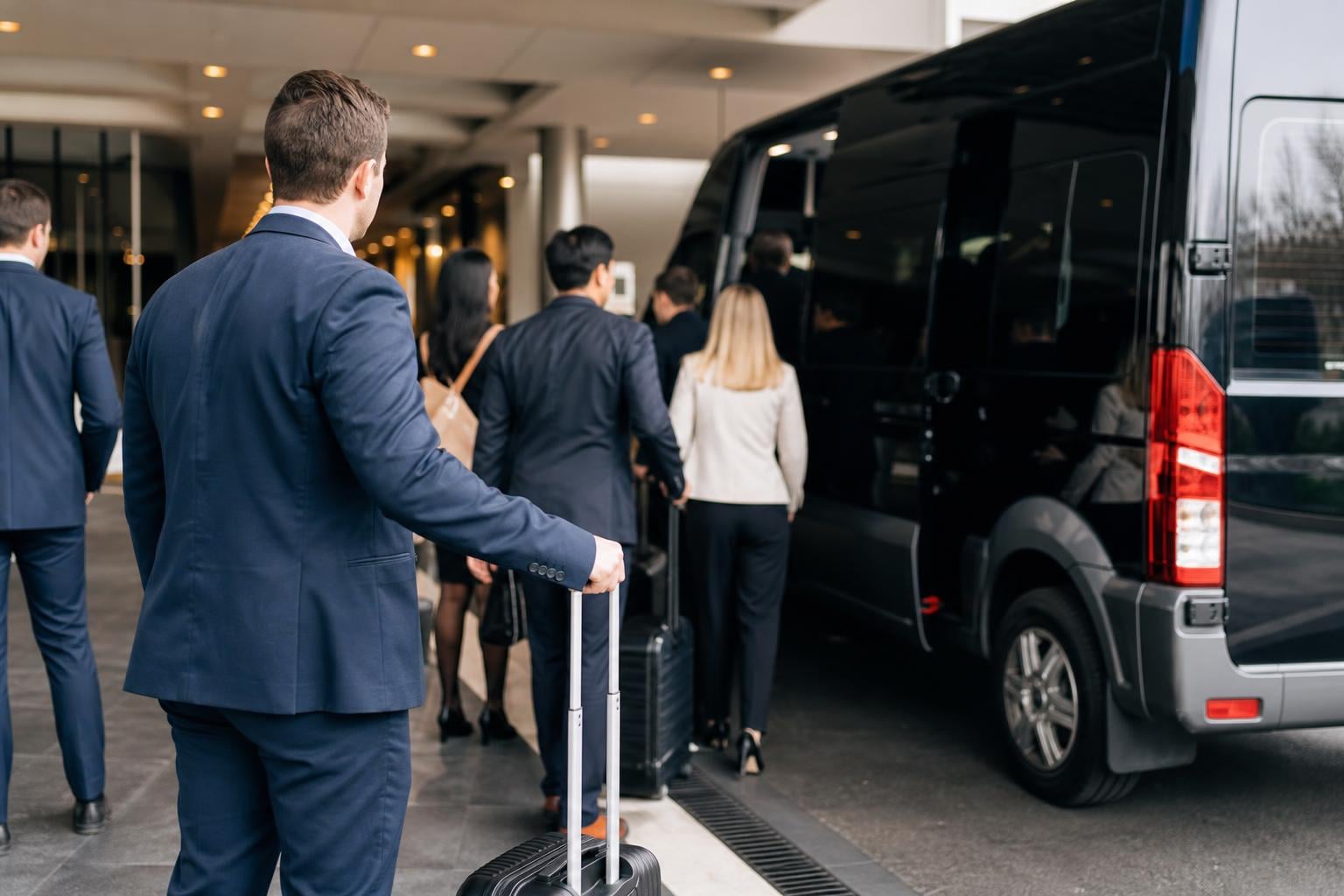
How to Arrange Corporate Event Group Transport Brisbane


TLDR: Arranging group transport for a corporate event in Brisbane requires matching vehicle types to guest tiers, understanding venue access constraints (like height clearances at BCEC and the Showgrounds), and building a timeline that starts at least six weeks out. This guide defines every term you’ll encounter during planning, provides Brisbane-specific venue data, and walks through the steps that separate seamless transfers from the kind of logistics failures that derail an entire event day.
Corporate event transport sits in a category of its own. It is not commuter travel, not a leisure ride, and definitely not something you can leave to individual attendees armed with rideshare apps. When 40 delegates need to move from three hotels to a convention centre and arrive within the same 15-minute window, the logistics demand professional coordination.
The first and last mile of any corporate event shapes how attendees perceive the entire experience. A chauffeur-driven sedan waiting at arrivals signals professionalism before a single handshake. A group left standing on a kerb outside a CBD venue, waiting for a coach that can’t fit down the access road, signals the opposite.
This guide covers every term, vehicle type, and planning step you need to arrange group transport for a corporate event in Brisbane, whether you’re moving six executives or 200 conference delegates.
Get an instant quote for your corporate event transport needs.
Glossary of Key Terms
Before mapping out logistics, it helps to speak the language. These are the terms that come up repeatedly when arranging corporate event transport, and most of them cause genuine confusion among first-time planners.
Booked Hire Service Licence (BHSL)
A Queensland licence that allows a vehicle to operate as a commercial passenger vehicle for pre-booked services. The vehicle nominated on the licence must be a passenger vehicle with no more than 12 seats, including the driver. This covers sedans, SUVs, and smaller vehicles used for private transfers and chauffeur work. If your provider is supplying vehicles in this category, they should hold a valid BHSL.
Charter / Private Charter
To charter a vehicle means to rent it exclusively for your group, with a route and schedule you control. Unlike a shared shuttle with fixed stops, a charter vehicle operates on your terms. You decide the pickup points, the timing, and the route. For corporate events, chartering is the standard approach because it removes the unpredictability of shared services.
Chauffeur
A professionally trained, government-accredited driver who provides a premium transport experience beyond simply getting passengers from A to B. In Queensland, chauffeurs must hold the appropriate Driver Authorisation (see below). The distinction between a chauffeur and a regular driver matters in corporate settings, where professionalism, discretion, and punctuality are non-negotiable.
Coach
A large vehicle built for long-distance travel, accommodating anywhere from 30 to 70 passengers. Coaches come equipped with features like reclining seats, air conditioning, overhead storage, and sometimes onboard restrooms. They are the right choice for moving large delegate groups, but they come with access constraints in inner-city Brisbane that planners must account for.
Deadhead
Miles a vehicle travels without passengers, typically to reach a pickup location or return to base after a drop-off. Some transport providers bill deadhead mileage back to the client. When comparing quotes, ask whether deadhead costs are included or itemised separately.
Driver Authorisation (DA)
Queensland requires all commercial passenger vehicle drivers to hold a Driver Authorisation issued by the Department of Transport and Main Roads. The process includes a fit and proper person assessment, medical clearance, and criminal history check. When booking transport for a corporate event, confirming that all assigned drivers hold current DA is a basic due diligence step.
Guest Segmentation / Tiering
The practice of categorising attendees into tiers based on seniority, role, or VIP status, then allocating vehicle types accordingly. A common framework uses four tiers:
Tier 1: Board members and senior executives (executive sedans or SUVs)
Tier 2: Keynote speakers and VIP clients (premium sedans or small private transfers)
Tier 3: Delegates and general attendees (minibuses or coaches)
Tier 4: Internal staff and event support teams (shuttle loops or coaches)
This tiering directly shapes your transport budget and vehicle mix. Executives get sedans. General attendees get shuttle loops.
Luggage-to-Passenger Ratio
A planning concept that catches out many organisers. A group whose headcount fits a 12-seat sprinter van may need a larger vehicle once bags, presentation materials, exhibition stands, or conference swag are in the equation. Always account for cargo volume, not just passenger count.
Meet-and-Greet
A service where the chauffeur waits inside the airport terminal, typically at the baggage carousel (domestic) or in the arrivals hall (international), holding a name sign. This is standard practice for VIP and executive tiers. For more on how this works in practice, see this guide on finding your driver in busy arrivals halls.
MICE Transport
MICE stands for Meetings, Incentives, Conferences, and Exhibitions. MICE transport refers to the ground logistics specifically supporting these event types. It often involves complex multi-day itineraries, staggered arrivals from multiple airports, and transfers between hotels, venues, and offsite dinner locations.
Minibus
A mid-size vehicle designed for groups of roughly 8 to 25 people. Minibuses are compact and agile, making them particularly useful for short-distance travel and situations where venue access is tight. In Brisbane, a 14 or 21-seat minibus is often the most flexible option for navigating inner-city streets and suburban event venues with limited turning radius.
Operator Accreditation (OA)
Required for operators running road-based public passenger services in Queensland, particularly bus and coach operations. OA ensures the operator meets safety, vehicle maintenance, and service standards. Services exempt from OA include booked hire services (including limousines) and taxi services, which fall under different licensing frameworks.
Run Sheet / Transport Manifest
The master document listing every transfer movement for the event: vehicle assignments, driver names, pickup times, pickup addresses, passenger names, drop-off locations, and contact numbers. A good run sheet is the single most important document in corporate event transport. Without it, coordination falls apart.
Sedan / Executive SUV
Chauffeur-driven vehicles for 1 to 6 passengers. An executive sedan signals to a C-suite guest that the event is professionally managed from the moment they land. These vehicles are the standard choice for Tier 1 and Tier 2 guests, airport meet-and-greets, and any transfer where personal attention matters.
Shuttle Loop
A continuous-circuit transport service running between fixed points, typically hotels and the event venue. Shuttle loops work well for events with staggered arrivals, large delegate numbers, or multiple accommodation locations. The shuttle runs on a repeating schedule (say, every 20 minutes), so attendees don’t need individual pickups.
Sprinter Van
A commercial passenger van, typically seating 7 to 14 people. Sprinters bridge the gap between executive sedans and minibuses. They are common for mid-size executive groups where a coach would be overkill but individual sedans would be impractical.
Staggered Arrivals
When group members arrive on different flights, a single pickup time forces a choice: leave early arrivals waiting at the airport or dispatch vehicles before everyone has landed. The solution is grouping flights into windows and assigning pickup batches accordingly. This is one of the trickiest parts of how to arrange group transport for a corporate event in Brisbane when delegates fly in from multiple cities.
Transfer
A point-to-point passenger movement. Airport transfers move guests between the airport and their hotel or venue. Venue transfers move them between the hotel and the event. Inter-hotel transfers handle guests moving between accommodation. Some events also require cruise terminal transfers for waterfront venues or post-event departures.
Vehicle Types at a Glance
Choosing the right vehicle, or combination of vehicles, is the core decision when arranging group transport for a corporate event in Brisbane. Here is a quick reference:
Vehicle Type | Capacity | Best For | Brisbane Access Notes |
|---|---|---|---|
Executive Sedan/SUV | 1–6 passengers | VIP transfers, airport meet-and-greet, C-suite guests | No access restrictions. Fits all venues. |
Sprinter Van | 7–14 passengers | Mid-size executive groups, airport pickups with luggage | Minor luggage constraints. Flexible access. |
Minibus | 15–25 passengers | Delegate groups, short-distance transfers, tight venues | Excellent for inner-city and suburban venues. Fits most drop-off zones. |
Coach | 30–55+ passengers | Large delegate movements, inter-city transfers | Height and turning restrictions at many Brisbane venues. Requires advance access confirmation. |
Shuttle Loop | Variable | Staggered arrivals, multi-hotel pickups, all-day events | Depends on vehicle assigned to the loop. |
The best approach for most corporate events under 30 attendees is a combination: executive sedans for your senior guests and a minibus for the broader group. This hybrid model provides appropriate service levels for each tier without the access headaches that come with a full-size coach.
For events where you need to coordinate airport transfers across multiple flights and vehicle types, a single provider managing the full run sheet simplifies everything.
Brisbane Venue Access: What Planners Need to Know
This is where corporate event transport planning gets Brisbane-specific, and where many organisers run into trouble. A vehicle that fits your headcount may not fit the venue’s driveway. Physical constraints like height restrictions, narrow lanes, and limited turning circles determine which vehicles can actually reach the drop-off zone.
Brisbane Convention and Exhibition Centre (BCEC)
The BCEC is Brisbane’s most popular large-scale conference venue, and its car park entry heights are the detail most planners overlook:
Car Park 1 (Merivale Street): 2.3m clearance
Car Park 2 (Merivale Street entry): 2.2m; Russell Street entry: 2.1m
Car Park 3 (Melbourne Street entry): 2.0m; Grey Street entry: 2.1m
These clearances rule out coaches and most minibuses for undercover access. Large coaches must use designated event loading areas rather than the car park. The facility provides undercover parking for up to 1,500 vehicles with direct lift access to convention and exhibition levels, but this is for standard cars and smaller vehicles only.
Brisbane Showgrounds / Royal ICC
The Showgrounds have variable clearances across three car park entries:
Gate 5 (O’Connell Terrace): 4.0m clearance, 650 bays — suitable for coaches
600 Gregory Terrace entry: 3.0m clearance, 214 bays — suitable for minibuses
Machinery/Alexandria Streets entry: 2.2m clearance, 380 bays — sedans and small vehicles only
Knowing which gate to direct your coach driver to can be the difference between a smooth arrival and a vehicle stuck in an access lane with 50 passengers onboard.
Howard Smith Wharves
A designated pick-up and drop-off zone is located at 5 Boundary Street, Brisbane City. Coaches cannot enter the precinct itself. All large vehicle movements must use the Boundary Street drop-off, with guests walking into the venue. Factor this into your timing, especially for guests in heels or inclement weather.
Brisbane Central Traffic Area
The Brisbane Central Traffic Area is a regulated parking zone covering Brisbane CBD, Fortitude Valley, Newstead, Petrie Terrace, South Bank, South Brisbane, and Spring Hill. Parking restrictions within this area are tighter than in surrounding suburbs, and event-day restrictions around stadiums add another layer of complexity. Sporting and entertainment events at venues across Brisbane trigger area-wide parking regulations that can displace your planned drop-off or staging zones.
If your corporate event coincides with a Gabba cricket match or a Suncorp Stadium game, confirm in advance whether your planned routes and staging areas will be affected by road closures.
The Planning Timeline
Knowing how to arrange group transport for a corporate event in Brisbane is largely about starting early enough. The ideal timeline has two phases: a broad planning phase that starts months out, and a detailed execution phase in the final six weeks.
90 to 180 Days Before the Event
Choose your event venue and confirm the event date.
Begin scoping transport requirements: estimated attendee numbers, likely origins (local, interstate, international), and VIP guests.
Research transport providers. Start conversations early, especially for peak conference season (July through October in Brisbane) when vehicle availability tightens.
Consider whether your event requires after-hours transport for gala dinners or late-night functions.
6 Weeks Before the Event
This is when detailed planning begins. The checklist:
Confirm total attendee count. Add a 10% buffer for last-minute additions.
Identify all pickup locations with full street addresses. Don’t accept “somewhere near the CBD” from attendees.
Confirm the venue address and any specific vehicle entrance, loading bay, or drop-off zone.
Check venue vehicle access: height restrictions, turning radius, bay availability, and any event-day road closures.
Determine return trip requirements. Is it one-way to the venue, or does the group need transport back to hotels at the end of the night?
Segment your guests by tier and assign vehicle types accordingly.
Collect flight details for anyone requiring airport transfers. Group flights into pickup batches to manage staggered arrivals.
30 Days Before
Finalise transport routes. Drive them yourself if possible, or use Google Street View to check for obvious access issues.
Confirm attendee numbers and lock in vehicle bookings.
Draft the run sheet.
7 to 14 Days Before
Confirm transport manifests with your provider. Every vehicle, every driver, every pickup time.
Distribute transport details to attendees: pickup times, locations, vehicle descriptions, and a contact number for the day.
Confirm any special requirements: wheelchair access, luggage trailers, child seats for guests travelling with family.
Day of the Event
Build timing backwards from your venue arrival deadline. Start with the time attendees must be seated, then subtract travel time, boarding time at each pickup point (allow 5 to 10 minutes per stop for a group to board), and a 15-minute traffic buffer for Brisbane peak-hour travel.
Brisbane peak hours run roughly 7:00 to 9:00 AM and 4:00 to 6:30 PM. The Pacific Motorway (M3), ICB, and Story Bridge approaches are consistent bottleneck zones.
For complex multi-day events or tailored itineraries that don’t fit a standard template, working with a provider who handles custom scheduling is worth the premium.
Common Mistakes That Derail Corporate Event Transport
One delayed airport pickup, a guest sent to the wrong entrance, or a group left waiting outside a CBD venue can affect the entire tone of the day. These are the mistakes that experienced planners have learned to avoid.
Undersizing Vehicles by Ignoring Luggage
This is the most common planning error. A group of 12 with carry-on bags fits a minibus. A group of 12 arriving from interstate with checked luggage, laptop bags, and a set of exhibition banners does not. Always calculate luggage-to-passenger ratio before confirming vehicle size.
Booking Too Late for Peak Seasons
Brisbane’s conference season peaks between July and October, and major events like EKKA, the Brisbane Festival, and international sporting fixtures compress vehicle availability. Booking three weeks out during peak season is a gamble. Ninety days is safer.
Not Confirming Venue Access for Large Vehicles
A bus that can’t fit down the access road, a coach turned away because of a 2.2-metre height barrier, a drop-off zone blocked by event-day restrictions. These problems are entirely preventable with a single phone call to the venue.
Relying on Rideshare for Coordinated Group Movements
Practitioners on Reddit frequently discuss the pitfalls of decentralised transport for group events. The consensus is clear: relying on individual rideshares or taxis introduces too many variables. Unpredictable wait times, inconsistent vehicle quality, surge pricing during peak hours, and fragmented arrivals make it nearly impossible to get everyone to the venue at the same time. Centralised transport removes these risks.
According to industry research, 78% of event planners cite rising travel and accommodation costs as a primary concern, which makes consolidated group bookings more cost-effective than reimbursing individual rideshares across dozens of attendees.
Skipping the Run Sheet
No run sheet means no coordination. Every vehicle, driver, passenger, pickup time, and drop-off location should be documented in one master document. The run sheet is the backbone of your transport plan. Distribute it to your provider, your on-site event coordinator, and a backup contact.
For a deeper look at selecting the right provider, this transfer company checklist covers the evaluation criteria that matter most.
Why Centralised Transport Beats Ad-Hoc Arrangements
The case for centralised corporate event transport is straightforward. When one provider manages the full run sheet (airport pickups, hotel-to-venue transfers, inter-venue movements, return trips), you get:
Unified arrivals. Everyone reaches the venue within the planned window, so your event starts on time.
Consistent experience. Every guest receives the same standard of vehicle and driver professionalism, regardless of tier.
Single point of accountability. If something changes (a delayed flight, a road closure, a last-minute venue switch), you make one phone call instead of coordinating with five separate drivers.
Cost control. One consolidated booking is easier to budget than reimbursing 30 individual expense claims.
For events drawing delegates from both Brisbane and Gold Coast airports, having a single provider with coverage across South East Queensland eliminates the coordination headache of managing separate operators for each airport.
Queensland Licensing: What to Ask Your Provider
When you arrange group transport for a corporate event in Brisbane, you are responsible for ensuring your provider is properly accredited. Queensland has specific licensing requirements depending on the vehicle type:
Vehicles with 12 or fewer seats (including driver): The operator needs a Booked Hire Service Licence (BHSL), and the driver needs a valid Driver Authorisation (DA).
Buses and coaches (13+ seats): The operator typically needs Operator Accreditation (OA) unless an exemption applies.
The practical takeaway: always ask your provider to confirm they hold the correct QLD authorisation for the specific vehicle type they are supplying. A provider who is properly licensed for sedan work may not hold the accreditation needed for coach operations, and vice versa. For a broader look at how the private car hire industry is regulated, that guide covers pricing rules and licensing in more detail.
Cost Factors to Consider
Pricing for corporate event transport in Brisbane varies based on several factors:
Vehicle type and size. Executive sedans cost more per vehicle but carry fewer passengers. Coaches cost more in total but less per head.
Duration. Most providers charge hourly rates for event work, with minimums. Rates for coaches in Brisbane typically start around $120 to $140 per hour.
Distance and route. Longer routes or multi-stop pickups increase cost. Deadhead mileage may be billed separately.
Time of day. After-hours surcharges commonly apply for pickups and drop-offs outside standard business hours, particularly for gala dinners or late-night returns.
Peak season demand. Rates increase during Brisbane’s conference season and around major events.
Special requirements. Luggage trailers, accessibility features, and premium vehicle upgrades all carry additional costs.
The most cost-effective approach is usually a tiered vehicle mix rather than a single vehicle type for all guests. Sedans for your VIPs, a minibus for your core delegate group, and a shuttle loop for staff keeps costs proportional to service levels.
How My Private Transfers Supports Corporate Event Transport
My Private Transfers provides private chauffeur services and event transfers across South East Queensland, covering Brisbane, Gold Coast, Sunshine Coast, and Toowoomba. The service is built around government-accredited chauffeurs, pre-booked private vehicles, and meet-and-greet at Brisbane and Gold Coast airports.
For corporate events, the relevant capabilities include:
Executive sedan and SUV transfers for VIP and Tier 1 guests, with meet-and-greet at domestic and international terminals.
Corporate private transfers with professional drivers, flexible scheduling, and premium vehicle upgrades (Mercedes, Audi, BMW).
Event transfers with coordination across multiple pickup points, venues, and return journeys.
Optional luggage trailers for groups travelling with conference materials or oversized items.
24/7 availability with online instant quoting and booking.
Price Match Guarantee against accredited QLD operators.
For events drawing delegates through both Brisbane (BNE) and Gold Coast (OOL) airports, a single provider managing both arrival points eliminates the need to coordinate with separate operators.
Get your corporate event transport quote now.
Frequently Asked Questions
How far in advance should I book group transport for a corporate event in Brisbane?
Start planning 90 to 180 days before the event for large groups, and lock in vehicle bookings at least 6 weeks out. During Brisbane’s peak conference season (July through October), earlier is better because coach and minibus availability tightens quickly.
Can a full-size coach access the Brisbane Convention and Exhibition Centre?
Not through the car parks. BCEC car park clearances range from 2.0m to 2.3m, which rules out coaches and most minibuses. Large coaches must use designated event loading areas. Confirm the correct loading zone with BCEC directly when planning your transport.
What is the difference between a charter and a shuttle for corporate events?
A charter is an exclusive vehicle booking where your group controls the route and schedule. A shuttle loop is a continuous-circuit service running between fixed points (like hotels and a venue) on a repeating schedule. Charters suit VIP movements and precise timing. Shuttles suit large groups with flexible arrival windows.
Should I use rideshare apps instead of booking group transport?
For coordinated corporate movements, no. Rideshares introduce unpredictable wait times, inconsistent vehicle quality, surge pricing, and fragmented arrivals. Centralised transport ensures everyone arrives together, on time, and with a consistent experience.
How do I know if my transport provider is properly licensed in Queensland?
Ask them directly. For vehicles with 12 or fewer seats, the provider should hold a Booked Hire Service Licence (BHSL) and drivers should hold Driver Authorisation (DA). For buses and coaches, Operator Accreditation (OA) is typically required. Legitimate providers will confirm their credentials without hesitation.
What is guest tiering and why does it matter for transport?
Guest tiering means segmenting attendees by seniority or VIP status and matching vehicle types to each group. Board members and keynote speakers get executive sedans. General delegates get minibuses or coaches. Staff get shuttle loops. This approach ensures appropriate service levels while keeping costs proportional.
How do I account for luggage when sizing vehicles?
Count bags, not just bodies. A 12-seat vehicle that fits 12 passengers with carry-ons will not fit 12 passengers with checked luggage and conference materials. When in doubt, size up to the next vehicle category or add a luggage trailer to your booking.
What happens if flights are delayed and my group’s airport pickups are affected?
A good transport provider monitors flight statuses and adjusts pickup times accordingly. When arranging group transport for a corporate event in Brisbane, confirm that your provider tracks live flight data and has a clear protocol for handling delays, whether that means holding drivers at the terminal or rescheduling pickups dynamically.