
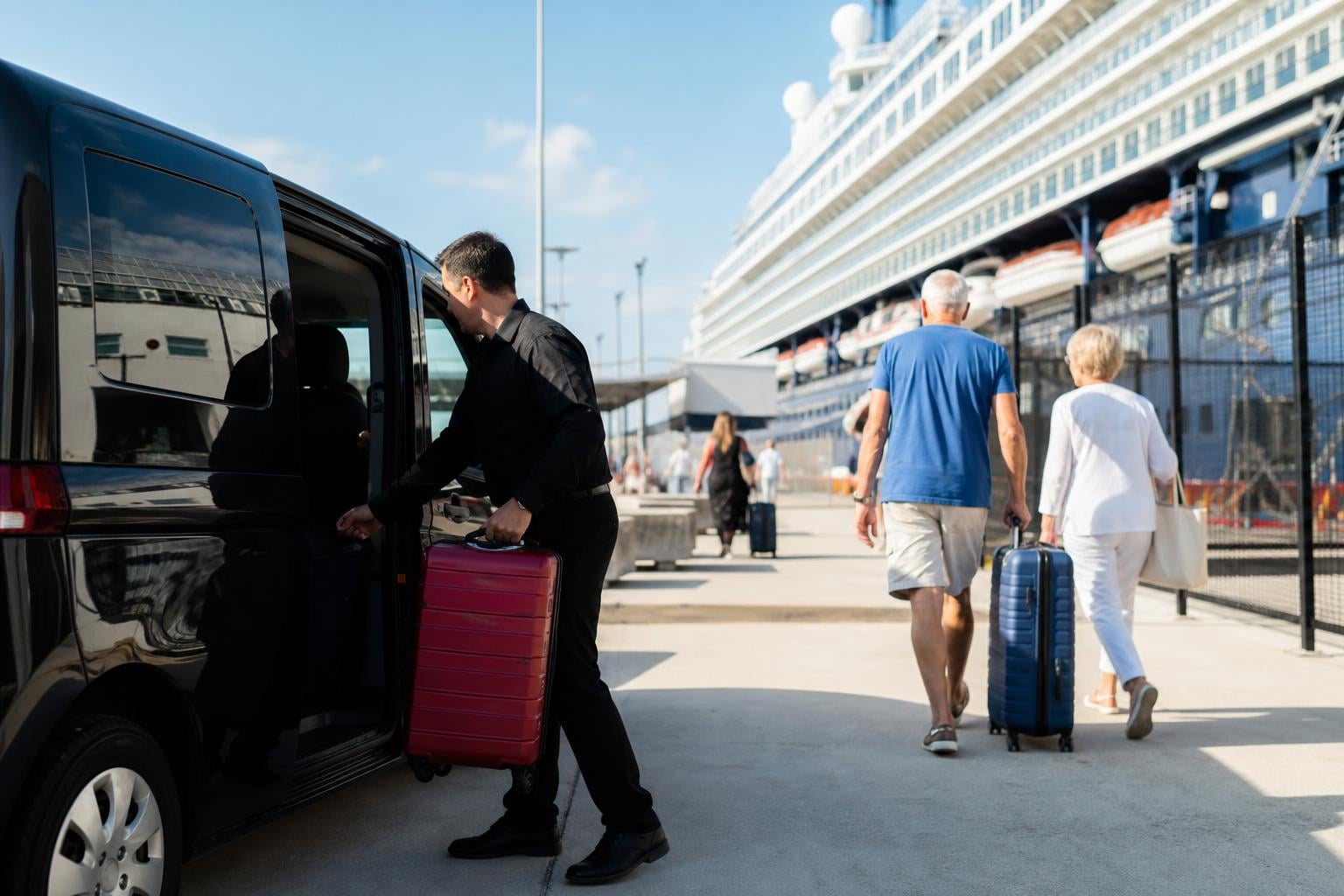
2026 Brisbane Cruise Embarkation & Disembarkation Transfers


Summary
Coordinating transfers for cruise embarkation and disembarkation requires careful timing, the right vehicle choice, and awareness of terminal logistics. The Brisbane International Cruise Terminal has no public transport access, making pre-booked transfers nearly essential. Most customers book well in advance—earlier is better, especially around peak sailings and school holidays. Allow at least five hours between your ship’s arrival and any outbound flight on disembarkation day. Families need to plan for child seats, extra luggage space, and the unpredictable timing of the debarkation process.
Why Transfer Coordination matters more than you think
Most cruise passengers spend weeks comparing staterooms, shore excursions, and dining packages. The transfer to and from the terminal? That gets about five minutes of thought, usually the night before. This is a mistake.
Getting to a cruise terminal on time with all your luggage, your family, and your sanity intact is the first real test of a holiday. Getting away from one, especially when 2,000 other passengers are trying to do the same thing, is the last. Both deserve proper planning.
This guide breaks down the key terms, timelines, and decisions involved in coordinating ground transfers for cruise embarkation and disembarkation, with a particular focus on Brisbane’s cruise terminal and the unique challenges it presents.
Get an instant quote for cruise transfers to start planning your embarkation or disembarkation day transport.
Understanding Embarkation: Getting to the Ship
What Embarkation Day actually involves
Embarkation is the process of boarding the cruise ship. On embarkation day, passengers arrive at the cruise terminal, check in, pass through security screening, and walk aboard. Each cruise line manages this differently, but the sequence is broadly the same: arrive, queue, scan documents, drop luggage, board.
The critical detail is the cutoff. Check-in and boarding close two hours before the ship’s scheduled departure. Miss that window and the ship leaves without you. There is no flexibility here. This means your transfer timing needs to account for traffic, luggage loading, and the check-in queue itself, not just the drive time.
Check-in Windows and Why They Shape Your Transfer
Cruise lines assign check-in windows (sometimes called boarding groups or arrival appointments) to stagger the flow of passengers and prevent bottlenecks. Your window might be 11:00 AM or 2:00 PM, but you still need to clear the process before that two-hour cutoff.
For a ship departing at 4:00 PM, the latest you could realistically arrive at the terminal is 2:00 PM. Back-calculate from there. If the drive from your hotel or the airport takes 30 minutes and you want a 30-minute buffer, you need to leave by 1:00 PM at the absolute latest.
The Case for Arriving the Day Before
For families flying into Brisbane to catch a cruise, arriving the day before embarkation eliminates the biggest risk: flight delays cascading into a missed ship. With kids, strollers, and checked luggage, there are simply too many variables on travel day to leave it all to the same morning. One delayed flight, one lost bag, and the holiday is over before it starts.
Practitioners on TripAdvisor forums consistently recommend this approach, especially for passengers coming from interstate or international origins.
Turnaround Port and Homeport
A turnaround port (or homeport) is where a cruise begins and ends. Brisbane’s cruise terminal functions as a turnaround port for lines like Royal Caribbean, Carnival, Princess, Celebrity, and Cunard. On turnaround days, the terminal handles both disembarking passengers from the arriving ship and embarking passengers for the next voyage, often on the same day. This creates concentrated demand for transfers during a narrow time window.
Meet and Greet at the Terminal
In transfer terminology, “meet and greet” means your driver is waiting at a designated point with a name board when you arrive. This is distinct from a curbside pickup where you need to find the vehicle yourself. At a busy cruise terminal on turnaround day, having someone waiting specifically for you removes the guesswork. If you haven’t used this type of service before, here’s what to expect at a chauffeur pickup.
Understanding Disembarkation: Getting Off the Ship
How the Disembarkation Process Works
Disembarkation is the process of leaving the cruise ship at the end of your voyage. It sounds simple, but it involves customs clearance, luggage retrieval, and a staged exit process that can stretch across three hours for the entire ship.
Most cruise ships are cleared for passengers to begin disembarking between 7:00 and 9:00 AM, depending on when the vessel actually docks. If a ship arrives later than scheduled, a general rule of thumb is that clearance begins about one hour after docking.
Express Debarkation (Self-Assist)
Express debarkation, sometimes called self-assist disembarkation, is for passengers who can carry all their own luggage off the ship. These passengers are typically the first to leave once local authorities clear the vessel, often starting around 7:00 AM. The trade-off is obvious: you get off earlier, but you need to manage every bag yourself.
For transfer coordination, express debarkation gives you more control over timing. You know roughly when you’ll be off the ship, so you can give your transfer provider a tighter pickup window.
Checked Luggage Debarkation
With checked luggage debarkation, you place your bags outside your stateroom the night before arrival. A stateroom attendant delivers a disembarkation letter and color-coded luggage tags. The letter tells you your assigned debarkation time and group number.
On the morning of disembarkation, you wait in your stateroom or a designated lounge until your group is called. Once called, you’re typically off the ship within about 15 minutes. Your bags are waiting in the terminal’s baggage claim area, arranged by color code.
Disembarkation Groups and Color Codes
Cruise lines assign passengers to disembarkation groups identified by color codes or numbers. The assignment determines the order in which you leave the ship. Priority groups (suite passengers, loyalty members, those with early flights) go first. Everyone else follows in sequence.
This system matters enormously for transfer coordination. If you’re in a late group, you might not be off the ship until 10:00 AM or later. Booking a transfer for 7:30 AM because the ship docks at 6:00 AM is a recipe for a stressed driver and a wasted booking.
Customs Clearance: The Hidden Delay
Before anyone sets foot on the gangway, Australian Border Force must clear the vessel. This process typically takes 15 to 30 minutes after docking, but it can run longer. Contributors on Reddit’s r/brisbane community consistently report that customs clearing at the Brisbane terminal takes about an hour from the time the ship docks to when the first passengers actually walk out.
Factor this into every transfer booking. The ship’s scheduled arrival time is not the time you’ll be ready for pickup.
Transfer Options: Knowing What’s Available
Understanding the different types of transfers helps you match the right option to your situation. Here’s how they compare when you’re coordinating transfers for cruise embarkation and disembarkation.
Pre-booked Private Transfer
A pre-booked private transfer means a dedicated vehicle and driver arranged before your trip at a fixed price. The key advantage for cruise passengers is flexibility: a good provider will track your ship’s arrival and adjust the pickup time if the vessel is delayed. You’re not sharing the vehicle with strangers, so departure happens on your schedule.
For families, this also means requesting child seats, extra luggage capacity, or even an enclosed luggage trailer for oversized gear. At My Private Transfers, we offer an enclosed luggage trailer option for families traveling with extra luggage (available on request). Read more about the benefits of pre-booking your transfer to understand how this compares with ad-hoc options.
Cruise-Line Transfers
Many cruise lines sell shuttle or coach transfers as an add-on. These are convenient in one sense (you book through the cruise line directly) but limiting in another. They run on fixed schedules, pick up at fixed points, and don’t wait for you individually. TripAdvisor forum contributors note that cruise-line shuttles tie you to their timetable, which is a problem if your plans don’t align with the departure slots they offer.
Shared Shuttles
Shared shuttle services (like Con-X-ion in Brisbane) offer a cheaper alternative but involve multiple stops and fixed departure times. They work well for solo travelers or couples with minimal luggage and flexible schedules. For families or groups with significant luggage, the stops and scheduling constraints can turn a 30-minute trip into an hour-long ordeal.
Taxis and Rideshare
On paper, hailing a taxi or ordering an Uber from the cruise terminal seems straightforward. In practice, when 2,000-plus passengers pour off a ship simultaneously, the taxi queue stretches long and rideshare surge pricing kicks in. One TripAdvisor reviewer noted paying AU$45 for an Uber from BICT to the CBD, while forum contributors report taxi fares of AU$50 to $60 for the same route. These prices aren’t outrageous, but availability during peak disembarkation is the real issue.
Reddit users in r/brisbane recommend pre-booking transfers rather than hoping for available taxis when an entire ship unloads at once.
The Coach and Shuttle Zone
At terminals like BICT, larger vehicles (limousines, coaches, anything with a trailer) must use the designated Coach and Shuttle Area rather than the standard passenger pickup zone. Vehicles under 6.5 metres can use the 2-minute Passenger Pick-Up and Set Down Area. Chartered transfer services need prior access agreements with terminal management. This is an operational detail, but it matters: it means your transfer provider needs to know the terminal rules and have the right permissions.
Brisbane International Cruise Terminal: The Specifics
Location and the Public Transport Problem
The Brisbane International Cruise Terminal (BICT) sits at 1 Cruise Terminal Drive, Pinkenba, at the mouth of the Brisbane River. It’s about 12 km from Brisbane Airport (roughly 15 minutes by car) and 21 km from the Brisbane CBD (25 to 30 minutes).
Here’s the critical fact: there is no public transport to the Brisbane International Cruise Terminal. None. No bus, no train, no ferry. The Port of Brisbane confirms this directly. The nearest train stations are Doomben and Eagle Junction, but from there you’d need a taxi or rideshare to cover the final stretch into Pinkenba.
TransLink has stated that due to the irregular nature of cruise ship operations, regular scheduled services aren’t considered appropriate for the terminal. There are no plans to change this.
This single fact shapes every transfer decision for cruise passengers using Brisbane. When you disembark at BICT, you need to have arranged transport in advance or be prepared to compete with every other passenger for limited taxis.
Explore cruise transfer options from BICT including routes to bayside suburbs and the airport.
BICT vs. Portside Wharf
Portside Wharf in Hamilton is an older cruise terminal location in Brisbane that still handles some smaller vessels and river-based operations. It’s sometimes confused with BICT, but they’re different facilities in different locations. When booking a transfer, confirm which terminal your ship uses. Getting dropped at the wrong one is a surprisingly common and entirely avoidable mistake.
The 2-Minute Set Down Zone
BICT has a designated quick drop-off and pickup area for vehicles under 6.5 metres. You get two minutes, which is enough to unload luggage and say goodbye but not enough to park and walk someone inside. Larger vehicles and those towing trailers must use the Coach and Shuttle Area with prior terminal approval.
How to Coordinate Transfers for Cruise Embarkation Day
Here’s the step-by-step process for getting your embarkation day transfer right.
Step 1: Confirm your check-in window. Your cruise line will send boarding documents with an assigned arrival time. This is the anchor for your entire day.
Step 2: Calculate backward from the cutoff. Boarding closes two hours before sailing. If the ship departs at 4:00 PM, you must be checked in by 2:00 PM. Add 30 to 45 minutes for the check-in and security queue, and you should aim to arrive at the terminal by 1:00 to 1:15 PM.
Step 3: Add travel time and a buffer. The drive from Brisbane CBD to BICT takes about 25 to 30 minutes in normal traffic. From Brisbane Airport, it’s closer to 15 minutes. Add a 20-minute buffer for unexpected delays. So a CBD pickup for a 4:00 PM departure should happen no later than 12:00 to 12:15 PM.
Step 4: Book your transfer. Share your pickup address, number of passengers, luggage count, and any special requirements (child seats, wheelchair access, oversized items) with your transfer provider. For tips on confirming your driver’s meeting point, especially at hotels or the airport, plan this detail in advance.
Step 5: Confirm the day before. A quick confirmation call or message to your transfer provider the day before embarkation catches any last-minute changes to your schedule or theirs.
How to Coordinate Transfers for Cruise Disembarkation Day
Disembarkation day is where transfer coordination gets genuinely complicated. Here’s how to handle it.
Step 1: Know your debarkation method. Decide whether you’re doing express (self-assist) or checked luggage disembarkation. This determines when you’ll actually leave the ship.
Step 2: Estimate your off-ship time. For express debarkation, plan for 7:00 to 7:30 AM assuming the ship docks on schedule and customs clearance runs smoothly. For checked luggage debarkation, you could be off the ship anywhere from 7:30 AM to 10:00 AM depending on your assigned group. If you don’t know your group assignment until the night before, plan for flexibility.
Step 3: Communicate with your transfer provider. The best approach is to book a transfer with an estimated pickup time and then update the provider once you know your disembarkation group. Providers who track ship arrivals can adjust automatically, which is why private transfers outperform fixed-schedule shuttles on disembarkation day.
Step 4: Apply the five-hour rule for flights. MSC Cruises and other lines advise allowing at least five hours between the ship’s scheduled arrival and your flight departure. This accounts for customs clearance, luggage retrieval, the transfer to the airport, and airline check-in. If your ship is due at 6:00 AM, don’t book a flight before 11:00 AM. Noon is safer.
Step 5: Have a plan for the gap. If you’re doing express debarkation and your flight isn’t until the afternoon, you’ll have time to fill. Some passengers head to the airport early and use the lounge. Others arrange a transfer to the CBD for breakfast before heading to the Brisbane Airport for their flight.
Family-Specific Coordination Challenges
Families face amplified versions of every challenge in coordinating cruise transfers. Here’s what to plan for.
Child Restraint Requirements
Australian law requires children aged 0 to 7 to travel in an approved child restraint appropriate for their age and size. When booking a transfer, specify the ages of your children so the provider can fit the correct seats. At My Private Transfers, we provide complimentary child seats including booster seats, forward-facing seats, and rear-facing seats (available on request). If you’re travelling with babies and young children, check this well before your cruise.
Luggage Volume After a Cruise
Passengers consistently underestimate how much stuff they’ll have on disembarkation day. You boarded with suitcases, but you’re leaving with suitcases plus duty-free purchases, souvenirs, and anything you bought at ports of call. Families with young children also have strollers, port-a-cots, and bags of snacks that somehow multiplied during the voyage.
A standard sedan might have handled your luggage on embarkation day but fall short on the return trip. SUVs, people movers, and vehicles with optional luggage trailers give families the space they actually need.
Timing With Young Children
Express debarkation sounds appealing until you picture wrangling a toddler, two suitcases, and a stroller through the ship’s corridors at 6:45 AM. For families with small children, checked luggage debarkation is usually more realistic. Hands are free for kids. The pace is calmer. The trade-off is a later departure from the ship and a later transfer time.
Common Mistakes When Coordinating Cruise Transfers
Booking an Early Morning Flight on Disembarkation Day
This is the single most common and most consequential mistake. Ships can arrive late. Customs clearance adds time. Your disembarkation group might be called last. A 9:00 AM flight when your ship docks at 6:00 AM leaves almost no margin. The five-hour rule exists for a reason.
Assuming Public Transport Reaches BICT
It doesn’t. Not a bus. Not a train. Not a ferry. The terminal is in an industrial port area with no public transit connections, and there are no plans to add any. If you show up expecting to catch a bus, you’ll be stranded.
Not Pre-booking When Thousands Disembark Simultaneously
A large cruise ship carries 2,000 to 4,000 passengers. When they all need transport at roughly the same time from a terminal with no public transit, available taxis and rideshares run thin fast. Pre-booking guarantees a vehicle is allocated to you, not to whoever opens an app fastest.
Forgetting to Specify Child Seats
Showing up at the terminal with two kids under five and no child seats booked means your transfer provider either scrambles to source seats (unlikely on short notice). Book the seats when you book the vehicle.
Underestimating the Drive to Gold Coast or Sunshine Coast
Some passengers assume the transfer from BICT to the Gold Coast or Sunshine Coast is a quick trip. BICT to Surfers Paradise is about 90 minutes. BICT to Noosa is closer to two hours. Factor these distances into your disembarkation day timeline, especially if you have a flight from Gold Coast Airport or a hotel check-in window.
Parking Problems at BICT
BICT has 1,282 parking bays, which sounds adequate until you learn that spots fill up months in advance for peak sailings. Cruise Passenger AU readers have expressed frustration at this. If you planned to self-drive and park, and the lot is full, you’re stuck. Private transfers sidestep this entirely.
Your Disembarkation Day Coordination Checklist
Use this as a practical reference for disembarkation day planning.
Choose your debarkation method (express or checked luggage) and note the implications for timing.
Book your transfer with an estimated pickup time, sharing your ship name, arrival date, and expected off-ship time.
Share flight details with your transfer provider so they can factor in the five-hour buffer and airport check-in requirements.
Confirm the pickup point at the terminal (2-minute set down zone for standard vehicles, coach zone for larger vehicles).
Communicate special needs including child seat requirements (specify ages), wheelchair access, oversized luggage, or extra bags.
Update your transfer provider once you receive your disembarkation group assignment (usually the evening before arrival).
Keep your phone charged and accessible on disembarkation morning so you can contact your driver if plans shift.
Carry essentials in a day bag including travel documents, medications, and phone chargers. If doing checked luggage debarkation, your main bags won’t be accessible until you reach the terminal’s baggage area.
For help choosing a reliable transfer provider, review their policies on schedule changes, child seats, and terminal access permissions.
Planning Your Cruise Transfer From Brisbane
Whether you’re heading to the ship or heading home, the logistics of coordinating transfers for cruise embarkation and disembarkation at Brisbane’s terminal demand more planning than most other Australian ports simply because of the public transport gap. The good news is that with the right preparation, the process is straightforward.
Book early. Communicate your needs clearly. Build in time buffers. And don’t assume you’ll figure it out on the day.
Book your Brisbane cruise terminal transfer with instant online quotes, free child seats, and drivers who know the BICT access rules.
Frequently Asked Questions
Is there public transport to the Brisbane International Cruise Terminal?
No. There are no bus, train, or ferry services to BICT, and TransLink has confirmed there are no plans to introduce them. The nearest train stations (Doomben and Eagle Junction) are several kilometres away with no connecting bus service into Pinkenba. You need a taxi, rideshare, or pre-booked transfer.
How early should I arrive at the cruise terminal on embarkation day?
Aim to arrive at least 2.5 to 3 hours before the ship’s departure time. Check-in and boarding close two hours before departure, and you need time for the security and check-in queue. If your cruise line has assigned a specific check-in window, follow that timing but don’t cut it closer than the two-hour cutoff.
How long does disembarkation take at Brisbane?
The entire ship typically takes about three hours to empty from start to finish. Once your specific group is called, you’re usually off within 15 minutes. However, customs clearance at BICT can take about an hour after the ship docks before anyone is allowed to leave, based on reports from passengers on Reddit.
Should I book a morning flight on disembarkation day?
No. Cruise lines recommend allowing at least five hours between the ship’s scheduled arrival and your flight departure. A ship arriving at 6:00 AM means your earliest safe flight is 11:00 AM, and noon is better. Delays in docking, customs, or your disembarkation group can eat through any tighter margin.
How much does a taxi or Uber cost from BICT to Brisbane CBD?
Based on traveler reports, expect around AU$45 to $60 for a taxi or rideshare from the cruise terminal to central Brisbane. The drive takes about 25 to 30 minutes. Availability during peak disembarkation periods is the bigger concern, as thousands of passengers compete for limited vehicles.
What’s the difference between express debarkation and checked luggage debarkation?
Express (self-assist) debarkation means you carry all your own luggage off the ship and are among the first to leave, typically from around 7:00 AM. Checked luggage debarkation means you leave bags outside your stateroom the night before, receive a color-coded group assignment, and wait to be called. It’s more relaxed but means a later departure from the ship.
Do I need child seats in a transfer vehicle in Australia?
Yes. Australian law requires approved child restraints for children aged 0 to 7, and this applies to all passenger vehicles including transfer cars and SUVs. Specify your children’s ages when booking so the provider can install the correct seats. Some providers include them at no additional charge.
What if my cruise ship arrives late and my transfer is already booked?
This is one of the key advantages of a private pre-booked transfer over a fixed-schedule shuttle. A quality transfer provider will track your ship’s arrival status and adjust the pickup time accordingly. Communicate your ship name and arrival date when booking so the provider can monitor for delays.