
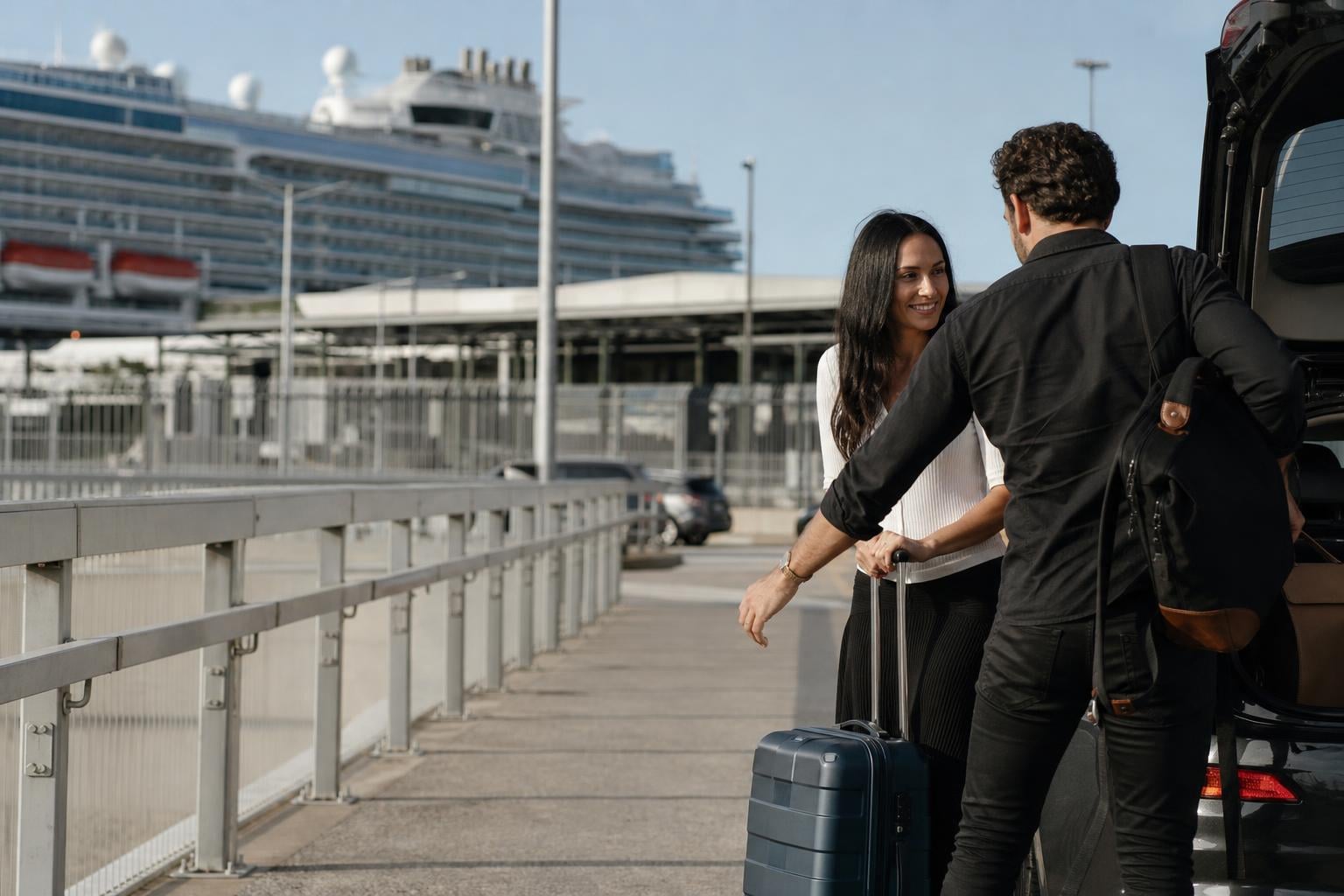
Getting to Port of Brisbane Cruise Terminal Without Parking


TL;DR
The Brisbane International Cruise Terminal (BICT) at Pinkenba has no public transport connections, and onsite parking costs $30 to $44 per day. Your realistic options for getting there without parking include taxis ($41 to $60), rideshare apps like Uber ($40 to $55), shared shuttles (~$25 per person), pre-booked private transfers, or offsite parking lots with shuttle services. The Bus 303 technically exists but runs weekdays only, three times a day, and doesn’t stop at the terminal itself.
The Brisbane International Cruise Terminal sits at the mouth of the Brisbane River in Pinkenba, about 12 km from Brisbane Airport and 21 km from the CBD. It opened as South East Queensland’s first purpose-built cruise hub, designed to handle mega-ships over 270 metres long. It’s a significant upgrade from the old days of cruising out of Portside Wharf in Hamilton.
There’s just one problem. The terminal is isolated, and there is no public transport connecting it to anywhere useful. If you’re figuring out how to get to the Port of Brisbane cruise terminal without parking, you’re far from alone. Forum threads on Cruise Critic, TripAdvisor, and Reddit are filled with passengers asking this exact question, often with visible frustration.
This guide covers every transport option available, what each one actually costs, and the practical details that matter when you’re hauling suitcases to a terminal in, as one Cruise Critic user put it, “the middle of nowhere.”
Get a quote for cruise terminal transfers →
Understanding the Terminal’s Location (and Why This Is Complicated)
BICT: Not Where You Think It Is
If you’ve cruised from Brisbane before 2024, you probably departed from Portside Wharf at Hamilton, which is close to the city and easy to reach. That terminal no longer handles cruise ships of any size. All departures now use the Brisbane International Cruise Terminal at 1 Cruise Terminal Drive, Pinkenba (sometimes called Luggage Point).
The distinction matters because many passengers, locals included, still search for the Hamilton terminal. If you’re looking for information about the old location, our Portside Wharf Hamilton page explains the difference.
Why There’s No Public Transport
Translink has confirmed there are no plans to extend bus or rail services to the cruise terminal. A Translink spokesperson told Cruise Passenger that “the provision of transport options, such as shuttle buses, to and from Brisbane’s cruise ship terminals is commonly operated by the individual cruise ship operators.” The agency said it would continue to monitor demand as the area develops, but for now, you’re on your own.
This is the core challenge when working out how to get to the Port of Brisbane cruise terminal without parking. Unlike terminals in Sydney or Melbourne with rail connections, BICT requires you to arrange your own transport, every single time.
The Terminal Only Opens on Cruise Days
One detail that catches people off guard: BICT is only open when a cruise ship is at berth. You can’t do a reconnaissance trip the day before to scope out the drop-off zone or test your route. Plan everything in advance.
Transport Options That Don’t Require Parking
Taxis
A taxi is the most straightforward option for getting to the cruise terminal without a car. No app needed, no pre-booking required (though you can book ahead if you prefer).
From Brisbane Airport: Fares start at approximately AUD $41.20, and the drive takes about 15 to 20 minutes in normal traffic.
From Brisbane CBD: Expect to pay $45 to $60, with a travel time of roughly 22 to 30 minutes.
The catch comes on disembarkation days. TripAdvisor users report “extremely long waits for a taxi” when thousands of passengers pour out of the terminal at once. If you’re arriving at BICT for embarkation, taxis work well. If you’re leaving after a cruise, have a backup plan.
Taxis generally don’t carry child seats. Under Queensland law, children up to 7 years old need an approved child restraint, which puts families in a difficult position. More on that below.
Rideshare (Uber, DiDi, Ola, Shebah)
Rideshare apps work at BICT, and they’re often slightly cheaper than taxis. Practitioners on Reddit’s r/brisbane report that Uber fares from the CBD to the terminal run around $40 to $55, though surge pricing on busy embarkation mornings can push that higher.
A few important details:
The terminal has a designated rideshare pickup zone, and the Port of Brisbane advises passengers not to request their ride until they’ve exited the building and are physically ready for collection.
On disembarkation days, the “Uber wait” problem is real. When 3,000+ passengers all open the app simultaneously, supply can’t match demand. One TripAdvisor reviewer described drivers avoiding the terminal because they anticipated short, low-value fares. Another Brisbane local on Reddit calculated that it was actually cheaper to drive and pay $60 for parking than to pay for rideshare both ways.
Like taxis, rideshare vehicles rarely have child restraints installed. If you’re travelling with young children, this matters. Our guide on child car seat fitting in Queensland explains the legal requirements.
Pre-Booked Private Transfers
A private transfer is a door-to-door service booked in advance. Your driver knows your pickup time, tracks your flight (if applicable), and meets you with a name board. The vehicle is yours alone, not shared with strangers.
For BICT specifically, private transfers solve several problems that taxis and rideshare don’t:
No surge pricing. The fare is locked in at booking.
No waiting in a queue. Your driver is already there.
Child seats included. Reputable operators provide age-appropriate restraints at no extra charge.
Luggage capacity. Optional trailers handle oversized bags, strollers, and sporting equipment.
The trade-off is cost. Private transfers are typically more expensive than a standard Uber fare, though the gap narrows once you factor in surge pricing and the stress of competing for rides on a busy cruise day.
Travel time from Brisbane Airport is about 15 to 20 minutes. From the CBD, expect 22 to 30 minutes.
If you’re weighing the differences between rideshare and a professional driver, our chauffeur vs rideshare comparison breaks down the costs and trade-offs in detail.
Shared Shuttle Services
Shared shuttles (sometimes called coach transfers) carry multiple passengers and operate on fixed schedules. Two names come up most often for the Brisbane cruise terminal:
Con-X-ion runs scheduled services to and from BICT, with fares around $25 per person.
River City Bus offers airport shuttle services from Brisbane domestic airport to the cruise terminal.
The appeal is price. For solo travelers or couples, a shared shuttle can be the cheapest door-to-terminal option available.
The downsides are predictable. You’re on the shuttle’s timetable, not yours. TripAdvisor reviews mention delays, missed connections, and rigid departure windows. If your flight is late, the shuttle won’t wait.
For families with young children, shared shuttles present an additional concern. Our article on shuttle safety with kids covers the practical considerations.
Cruise Line Coach Transfers
Some cruise lines sell their own coach transfers as an add-on during the booking process. These typically cost around $15 USD per person and run between designated pickup points (usually CBD hotels or the airport) and the terminal.
The advantage: everything is coordinated with your ship’s schedule. The disadvantage: you’re locked into their timing, their pickup points, and their luggage limits. If you want flexibility, this isn’t the option for you.
Check your cruise line’s “already booked” portal or pre-cruise documentation to see if coach transfers are offered for your sailing.
Bus 303: The “Public Transport” Option That Barely Exists
If you search Rome2Rio or Moovit for public transit to BICT, you’ll find the Bus 303. Let’s be honest about what this actually involves.
The 303 runs from Lamington Avenue at Doomben Rail Station. It operates weekdays only, with just three departures per day, starting at 6:26 AM and stopping at 5:50 PM.
Here’s the critical detail that most transit apps omit: the 303 stops at Marine Road at Main Beach Road, not at the cruise terminal itself. You’d still need to walk or arrange another ride to actually reach BICT.
The total journey from Brisbane Airport via train to Doomben and then the 303 bus takes approximately 2 hours and 28 minutes and costs $14 to $19. Most cruise departures happen on weekends, when the 303 doesn’t run at all.
This route exists on paper. In practice, it’s not a viable option for cruise passengers with luggage.
The Drop-Off Zone: Rules You Need to Know
If someone is driving you to the terminal (friend, family member, hotel courtesy car), BICT has a 2-minute passenger set down area at the front of the building. The rules are strict:
Vehicles must be under 6.5 metres long.
The driver must remain with the vehicle at all times.
Two-minute limit, enforced.
Larger vehicles (anything over 6.5 metres or towing a trailer) must use the Coach and Shuttle Area, and this requires prior permission from the port operator and Wilson Parking. If your transfer involves a luggage trailer, make sure your provider has arranged access.
For details on how meet-and-greet pickups work at busy terminals, see our driver meeting point guide.
Offsite Parking with Shuttle Transfers
Some passengers search for how to get to the Port of Brisbane cruise terminal without parking because they want to avoid the high cost of onsite parking, not because they lack a car. If that’s you, offsite parking lots with shuttle services are the middle ground.
What Onsite Parking Costs (For Context)
BICT has over 1,200 onsite spaces managed by Wilson Parking. The closest lot (P1) starts at $44 per day, with the furthest lot (P3) starting at $30 per day. For a 10-day cruise, that’s $300 to $440. Parking must be booked online in advance; P1 and P2 don’t accept drive-ups.
Offsite Alternatives
East Coast Parking is located just 1.5 kilometres from BICT and includes a shuttle transfer.
Sovereign Parking sits about 4 km away, offering free shuttle transfers, 24/7 monitored security, and a complimentary car wash when you return.
Portside Cruise Parking is further out, with a 15-minute coach ride to the terminal. Indoor and outdoor options available.
Andrew’s Airport Parking and Park N Cruise (Wilson’s offsite lot at 142 Main Beach Road) also serve cruise passengers with shuttle connections.
Offsite lots typically run $15 to $25 per day, a significant saving over onsite parking. The trade-off is the shuttle schedule and the added transfer time.
For a broader look at the parking-versus-transfer calculation, our parking vs chauffeur cost comparison is worth reading.
Transport Cost Comparison Table
Here’s the side-by-side comparison that no other guide provides:
Option | Estimated Cost | Travel Time (from CBD) | Travel Time (from Airport) | Pre-booking Required? | Key Limitation |
|---|---|---|---|---|---|
Private Transfer | Quote-based | 22-30 min | 15-20 min | Yes | Higher cost per trip |
Taxi | $45-60 | 22-30 min | $41+ / 15-20 min | No | No child seats, long queues on disembarkation |
Uber/Rideshare | $40-55 | 22-35 min | 15-20 min | No (app-based) | Surge pricing, wait times on busy days |
Shared Shuttle | ~$25 pp | Varies | 30-45 min | Yes | Fixed schedule, delays common |
Cruise Line Coach | ~$15 USD pp | Set by cruise line | N/A | Yes (via cruise line) | Limited flexibility |
Bus 303 | $14-19 | 2+ hours (with connections) | ~2h 28m | No | Weekdays only, 3x daily, doesn’t reach terminal |
Offsite Parking + Shuttle | $15-25/day + shuttle | N/A | N/A | Yes | Shuttle schedule dependency |
Special Considerations for Families
Travelling to BICT with children adds layers of complexity that single travelers and couples simply don’t face.
Queensland law requires children under 7 to be secured in an approved child restraint appropriate for their age and size. Taxis in Queensland are technically exempt from child restraint laws, but that exemption doesn’t apply to rideshare vehicles. In practice, neither taxis nor rideshares reliably carry child seats.
This leaves families with three realistic choices: bring your own seats (awkward with cruise luggage), book a cruise line coach (which may not have restraints either), or use a private transfer service that provides child seats as standard.
For a full rundown on child restraint requirements for airport and cruise transfers, our baby capsule transfer guide covers the specifics.
Embarkation vs. Disembarkation: Why the Direction Matters
Getting to the terminal and getting away from it are two very different experiences.
Embarkation day (boarding) is usually manageable. You control your departure time, can pre-book transport, and arrive on your own schedule. The terminal opens several hours before sailing, so there’s no rush to show up at a specific minute.
Disembarkation day (leaving) is where things get chaotic. Thousands of passengers exit within a few hours, all needing transport simultaneously. This is when rideshare surge pricing spikes, taxi queues stretch, and shared shuttles fill up. One passenger on TripAdvisor reported having to “catch an Uber to the nearest bus stop which was still $20 down the road.”
If you’re going to pre-book transport for only one direction, make it disembarkation. Our embarkation and disembarkation transfer guide walks through the logistics for both.
Hotel Transfers Near Brisbane Airport
Fly-in cruise passengers who stay overnight near the airport before their cruise have another option worth exploring. Hotels like the Pullman, Novotel, and Ibis Brisbane Airport are a short drive from BICT, and some offer transfers to the cruise terminal.
This isn’t guaranteed, and availability varies by hotel and sailing date. Call the hotel directly before booking and ask specifically about cruise terminal transfers, not just airport shuttles. Some hotels partner with third-party operators, so the “hotel transfer” may actually be a pre-arranged private car at a negotiated rate.
GPS and Navigation Tips
A small but important detail: some GPS systems and mapping apps don’t recognise “Cruise Terminal Drive” as an address. If yours doesn’t, navigate to Marine Road, Pinkenba instead, then follow signage to the terminal.
The terminal is well signposted once you’re in the area, but the surrounding roads are industrial and unfamiliar to most visitors. Give your driver or yourself extra time on a first visit, especially early in the morning when signage is harder to spot.
Pre-Booked vs. On-Demand Transport: Which Makes Sense for BICT?
For most destinations, the choice between pre-booking and hailing a ride on the spot is a matter of preference. BICT is different. The terminal’s isolation, the absence of public transport, and the chaos of embarkation and disembarkation days all tilt the balance toward pre-booking.
On-demand options (taxis, rideshare) work fine when supply is plentiful. At BICT, supply is limited by geography. Drivers need to travel to a remote industrial area with no guarantee of a return fare, which reduces the number willing to make the trip.
Pre-booked services, whether a private transfer, shared shuttle, or cruise line coach, guarantee that someone will be there when you need them. The cost is known in advance, the timing is confirmed, and there’s accountability if something goes wrong.
For a deeper comparison, see our guide on the benefits of pre-booked private transfers.
The Wikipedia “Free Shuttle” Confusion
You may have read on Wikipedia that a “free shuttle bus connects cruise ship passengers with parking/public transport facilities near Brisbane Airport.” This is misleading in 2025. The official Port of Brisbane FAQ explicitly states that the Brisbane International Cruise Terminal does not provide a shuttle bus between the CBD and the terminal.
The “free shuttle” Wikipedia references likely refers to the complimentary shuttles run by offsite parking operators (like East Coast Parking or Sovereign Parking) for their paying customers. It does not mean there’s a free public shuttle available to all passengers. Don’t plan your transport around this claim.
Frequently Asked Questions
Is there any public transport to the Brisbane cruise terminal?
Effectively, no. The Bus 303 runs weekdays only with three daily departures and stops at Marine Road, not the terminal itself. Translink has confirmed there are no plans to extend services. For weekend cruise departures (which is most of them), public transport is not an option.
How much does an Uber cost from Brisbane Airport to BICT?
Expect to pay $40 to $55 in standard conditions. However, surge pricing on busy embarkation mornings can push fares higher. One TripAdvisor reviewer reported paying $45 each way.
Can I catch a taxi or Uber from the cruise terminal after disembarking?
Yes, but expect significant wait times. When thousands of passengers exit simultaneously, demand overwhelms supply. Pre-booking a return transfer is the most reliable approach for disembarkation days.
Do taxis at BICT have child seats?
Generally, no. Queensland taxis are exempt from child restraint laws, but this means your child rides unrestrained, which many parents understandably find unacceptable. Private transfer services that include child seats are the safer alternative for families.
What’s the cheapest way to get to the Brisbane cruise terminal without a car?
A shared shuttle at around $25 per person, or a cruise line coach transfer at approximately $15 USD per person if your cruise line offers one. The Bus 303 is technically cheaper at $14 to $19 but is impractical for most passengers.
Is the Brisbane cruise terminal the same as Portside Wharf Hamilton?
No. All cruise ships now depart from the Brisbane International Cruise Terminal at Pinkenba. Portside Wharf at Hamilton no longer handles cruise ships. The two are about 15 km apart.
What if my GPS can’t find the cruise terminal address?
Search for Marine Road, Pinkenba instead. Once you’re on Marine Road, follow the signage to the Brisbane International Cruise Terminal. The access road is Cruise Terminal Drive.
Should I pre-book transport or just grab an Uber on the day?
For BICT specifically, pre-booking is the safer choice. The terminal is isolated, rideshare availability fluctuates dramatically on cruise days, and there’s no fallback option like a train station or bus stop nearby. Locking in your transport before you leave home removes the biggest logistical uncertainty of the day.
Getting to the Port of Brisbane cruise terminal without parking requires planning that most cruise ports don’t demand. The lack of public transport, the remote location, and the surge-and-queue dynamics on cruise days all mean that the passengers who have the smoothest experience are the ones who sorted their transport weeks ago, not minutes before departure.