
How to Plan Group Transfers for Weddings and Events: 2026


TL;DR: Planning group transfers for weddings and events means understanding a handful of key concepts: headcount-to-vehicle matching, buffer time, the “work backwards” scheduling method, and the importance of a single transfer coordinator. This glossary breaks down every term you’ll encounter when booking transport for 20 or more people, from after-hours surcharges to staggered departures, so you can communicate confidently with providers and avoid costly mistakes.
If you’ve never organised transport for a large group before, the first quote request can feel like reading a different language. Run sheets, dead-legs, PAX counts, net versus gross capacity. Providers assume you know what these terms mean. Most people don’t.
This glossary exists to fix that. Whether you’re a couple planning a Gold Coast hinterland wedding, a corporate coordinator managing conference logistics in Brisbane, or a family member trying to get 40 relatives from a hotel to a ceremony on time, this page is your reference tool. Read it top to bottom, scan it alphabetically, or jump to the section that matches your event type.
If you’re already past the research stage and ready to discuss specifics, explore event transfer options to see what’s available across South East Queensland.
Planning and Process Terms
These are the concepts that shape your timeline, your communication with transport providers, and your ability to keep things running on the day.
Buffer Time
The gap built into your schedule between when transport arrives and when the event actually starts. A 15-to-30-minute buffer is standard for corporate events. For weddings, stretch that to 30 to 45 minutes. Transfers rarely run exactly to schedule. Traffic, a late bridesmaid, a guest who can’t find their hotel lobby, these small delays cascade. Buffer time absorbs them without anyone noticing.
Headcount (PAX)
PAX is industry shorthand for the number of passengers. Before requesting any quote, confirm exactly who is travelling. A provisional headcount is fine early on, but your transport provider needs a reliable figure to recommend the correct vehicle type and number.
Here’s the critical detail most people miss: count the guests who will realistically use the bus, add about 10 per cent, then match that figure to vehicle sizes. Not everyone RSVPs accurately. Not everyone shows up at the pickup point. But if you plan for the exact number and three extra people appear, you have a problem.
Lead Time
How far in advance you should book. The benchmarks vary by event type:
Weddings: Six months to a year ahead, especially for popular spring and autumn dates. Wedding season books up fast, and specific vehicle types (stretch limos, premium sedans) have limited availability.
Corporate events: Two to four weeks ahead for standard functions. For large conferences or peak travel seasons, push that to six weeks or more.
General events (birthdays, reunions, school formals): Four to six weeks. During prom season (April through June in Australia), two to three months.
These aren’t arbitrary numbers. They reflect real inventory constraints. Wait too long, and you’ll be choosing from whatever’s left rather than what’s right.
Movement Plan / Run Sheet
A document listing every vehicle movement for the entire event, start to finish. Each row includes an origin, destination, departure time, and passenger assignment. Think of it as the master spreadsheet that your transport provider, your coordinator, and your venue contact all work from.
For a wedding with a ceremony at one location and a reception at another, the run sheet might have six or seven rows: bridal party to ceremony, guests to ceremony, bridal party to photo location, bridal party to reception, guests to reception, first departure shuttle, last departure shuttle.
Transfer Coordinator
Even the most organised group needs a single source of truth. Designate one person, whether that’s a wedding planner, a trusted guest, or a travel advisor, to manage all transport updates on the day. This person holds the final guest list, the run sheet, and the provider’s direct contact number.
Practitioners on Reddit and wedding forums consistently flag the lack of a coordinator as the number one cause of day-of chaos. When five people are texting the driver with conflicting instructions, nobody gets picked up on time.
48-Hour Reconfirmation
Two days before the event, reconfirm your pickup time, location, route, and headcount with your provider. This single step prevents an outsized number of day-of surprises. It’s also your last chance to flag headcount changes or route adjustments without scrambling.
Work-Backwards Scheduling
The method that experienced planners swear by. If the ceremony starts at 5:00 pm, don’t schedule every vehicle for 5:00. Instead, determine when each group needs to arrive, then work backwards:
Vendors and setup crew: 2:00 pm
Bridal party (for photos before the ceremony): 3:30 pm
Immediate family: 4:15 pm
General guests: 4:30 pm
Each group gets its own pickup time calculated from the arrival requirement minus travel time minus buffer. This approach surfaces conflicts early, like realising you need two vehicles at the same time, and it’s far more practical than setting a single departure time for everyone.
Event Manifest / Passenger Manifest
More than a headcount list. A proper manifest includes each passenger’s name, mobile number, pickup point, luggage estimate, and any special requirements (child seats, wheelchair access, flight details for airport pickups). It gives the transport team everything they need to plan a comfortable, orderly journey without calling you for clarifications.
For a deeper look at how manifests work in airport group contexts, see this guide on arranging transport for large groups.
Vehicle and Service Terms
When you start requesting quotes, providers will reference vehicle types and booking structures that carry specific meanings. Knowing the difference between a minibus and a midi coach, or between hourly and point-to-point pricing, will save you money and confusion.
Vehicle Types at a Glance
Vehicle Type | Capacity | Best For | Notes |
|---|---|---|---|
Executive sedan | 1 to 3 passengers | Couple, VIP parents | Private, refined journey for small groups |
SUV / People mover | 4 to 7 passengers | Immediate family, bridal party | Mercedes V-Class seats up to 7; ideal for keeping a group together |
Stretch limousine | 6 to 12 passengers | Bridal party photo runs | Presentation matters here; keeps the wedding party together before the ceremony |
Minibus | 12 to 28 passengers | Small guest groups from one hotel | Practical and cost-effective for a single pickup point |
Midi coach | Up to 33 passengers | Medium guest lists | One vehicle, one run, with room for luggage |
Full coach | Up to 57 passengers | Full guest lists | Larger weddings often pair a coach with a separate minibus for the bridal party |
For premium vehicle options including limousine services, it’s worth discussing your specific event timeline with the provider so they can recommend the right combination.
Capacity: Net vs. Gross
Gross capacity is the number of seats the manufacturer installed. Net capacity is how many people actually fit comfortably once you account for luggage, formal wear, handbags, and personal space. The rule of thumb from experienced operators: book a 45-person bus for a 35-person load. That buffer covers late additions and keeps the ride comfortable rather than cramped.
Hourly vs. Point-to-Point Booking
Confirm this before the event. A point-to-point booking means the vehicle arrives, drops everyone off, and leaves. An hourly booking means the vehicle and driver stay for the duration, available when you need them.
If your event might run late or you need a return shuttle at an unconfirmed time, hourly booking with a confirmed return window is the safer structure. Point-to-point is cheaper for simple A-to-B trips where you know the exact timing.
Dead-Leg / Repositioning
When a vehicle travels empty between one drop-off and the next pickup. This adds cost, and it’s most common when the ceremony venue and reception venue are far apart. A 40-minute dead-leg in the Gold Coast hinterland means you’re paying for 80 minutes of driving time (there and back) with no passengers aboard. Knowing this term helps you understand quotes that seem higher than expected.
Charter
A broad term for hiring a vehicle (and driver) for exclusive use over a defined period. Differs from a scheduled shuttle in that the vehicle serves only your group on your schedule.
Premium Upgrade
Upgrading from a standard vehicle (Toyota, Honda, Ford) to a premium marque (Mercedes, Audi, BMW). The price difference is real but often smaller than people assume, especially for multi-hour bookings. If presentation matters for your event, it’s worth comparing pricing to see what the gap actually looks like.
Wedding-Specific Terms
Weddings involve more transport legs than any other event type. A corporate dinner is usually one pickup and one drop-off. A wedding can have five or six distinct movements across multiple hours and locations.
Bridal Party Transfer
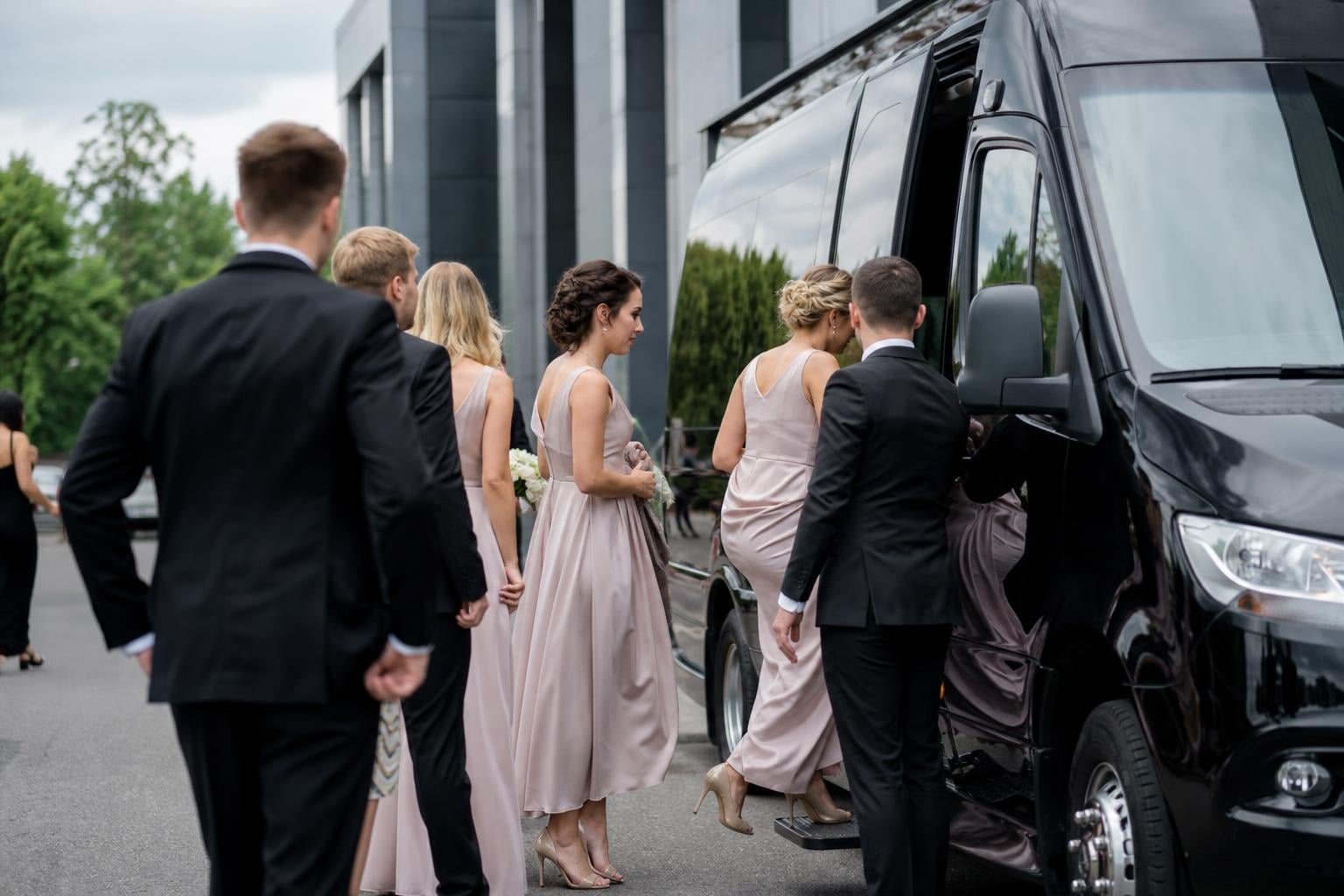
The dedicated vehicle (or vehicles) carrying the bride, groom, attendants, and sometimes immediate family. This is usually separate from the guest shuttle. The bridal party has a different schedule: they arrive earlier for photos, leave the ceremony at a different time, and often stop at a separate photo location before reaching the reception.
Ceremony-to-Photos Leg
The movement from the ceremony venue to the photography location. This leg is often the tightest in the schedule because photo time is finite and every minute lost in transit is a photo not taken. Build in 10 to 15 minutes of buffer here specifically.
Photos-to-Reception Leg
Transporting the bridal party from the photo shoot to the reception venue. If guests are shuttled separately to the reception, coordinate timing so the bridal party doesn’t arrive to an empty room or, worse, makes 80 people wait while they’re still in transit.
Guest Shuttle
A dedicated vehicle (usually a minibus or coach) running between guest accommodation and the venue. For a detailed walkthrough of how to set this up, the wedding guest shuttle logistics checklist covers every step.
Staggered Departures
Very few receptions end with everyone leaving at once. A common and practical structure is a first run at around 10:30 pm for older guests and families with children, then a final run at close. This reduces wait times, requires fewer vehicles at any one moment, and keeps the party going for those who want to stay.
End-of-Night Run / Return Transfer
The transfer home. And the one most often forgotten. One experienced planner put it bluntly: the return transfer is overlooked until the group is tired, the event has ended, and guests are standing outside in poor weather with no ride arranged. Plan the way home with the same care as the way there.
If some guests are flying out the next morning, consider how their post-wedding airport transport connects with the evening return.
Getaway Car
The vehicle that whisks the couple away at the end of the night. Often a premium sedan or classic car, separate from the guest shuttle fleet.
Multi-Venue Itinerary
When the ceremony, photos, and reception happen at three different locations. Common in South East Queensland where couples marry at a Sunshine Coast beach, shoot photos at a nearby garden, then celebrate at a hinterland estate. Each venue change multiplies the number of vehicle movements and the potential for timing conflicts.
Budget Allocation
A useful benchmark from wedding industry sources: budget roughly 5 to 10 per cent of your total event spend on transportation, depending on distances between venues. For a $40,000 wedding, that’s $2,000 to $4,000 covering all vehicle movements. If venues are close together, you’ll land at the lower end. Multiple venues spread across 30 or more kilometres push you toward the higher end.
Approximate Cost Ranges (Australian Market)
These vary by region, vehicle age, and provider, but as a starting reference for a four-hour block:
Minibus (15 to 28 guests): $300 to $600
Limousine (6 to 12 guests): $300 to $700
Party bus (20 to 40 guests): $800 to $1,200
Event and Corporate Terms
Group transfers for conferences, galas, team retreats, and corporate functions share many of the same logistics as weddings but have their own vocabulary.
Shuttle Service
A vehicle running a fixed loop between two or more points on a set schedule. Unlike a charter, a shuttle operates on a timetable (for example, every 30 minutes between the hotel and conference centre). Best for events where attendees arrive and depart at different times.
For Brisbane-specific corporate logistics, see how to arrange group transport for corporate events.
After-Hours Surcharge
An additional fee for transfers booked outside standard operating hours, commonly between 8 pm and 6 am. This is standard across premium Australian transfer providers. If your event ends at midnight, factor the surcharge into your budget rather than being surprised on the invoice.
Corporate Billing
Consolidated invoicing for multiple transfers under one account. Useful when a company is booking airport pickups, hotel-to-venue shuttles, and return transfers across several days. Learn how this works in the corporate billing guide.
Flight Manifest
A version of the passenger manifest that includes flight numbers, arrival times, and terminal information. Essential when you’re coordinating airport pickups for conference attendees arriving on different flights throughout the day.
VIP Transfer
A premium, usually sedan-based transfer for keynote speakers, executives, or distinguished guests who need to arrive separately from the main group. Often includes meet-and-greet at the airport.
Meet-and-Greet
A service where the driver meets passengers at a specific point (airport arrivals hall, hotel lobby, venue entrance) holding a name board. This differs from a curbside pickup, where the passenger has to find the vehicle. For large groups with members who don’t know the area, meet-and-greet removes a significant source of confusion and delay.
Multi-Stop Transfer
When a single vehicle makes several pickups before heading to the destination. If the journey involves several stops, allow enough time at each address for passengers to board without holding up the rest of the group. A common mistake is scheduling five-minute gaps between stops when ten minutes is realistic.
Staging Zone
The area where vehicles wait before passengers board. At venues, this might be a designated parking area near the entrance. At airports, it could be the ground transport waiting bay. Confirm the staging zone with both the venue and the transport provider so vehicles aren’t circling or double-parked.
Booking and Safety Terms
These terms cover the fine print and the duty-of-care considerations that separate a well-planned transfer from a risky one.
Accredited Chauffeur
In Queensland, professional passenger transport drivers must hold government accreditation. This isn’t optional. It means the driver has passed background checks, holds the correct licence class, and meets ongoing compliance requirements. When booking, ask whether drivers are accredited, especially if you’re using a new or unfamiliar provider.
For a full breakdown of what to expect from a professional driver, see the chauffeur service etiquette guide.
Cancellation Policy
The terms governing refunds if you cancel or modify a booking. Policies vary significantly between providers. Some offer full refunds up to 48 hours before the transfer, with reduced refunds inside that window and no refund within 24 hours. Read the cancellation terms before you book, not after.
Price-Match Guarantee
A commitment from the provider to match or beat a competitor’s quoted price for an equivalent accredited service. Not all providers offer this, and the terms matter (same vehicle class, same accreditation level, same route). When one does offer it, it simplifies comparison shopping. You can read about one such guarantee at the lowest fare guarantee page.
Duty-of-Care Transport
This is the safety argument for providing group transport, and it goes beyond convenience. On a tech professional forum (Team Blind), one user described a rural wedding venue 10 to 25 minutes from hotels with an open bar but no shuttle arranged, calling it “pretty stupid.” Multiple respondents agreed. When your event serves alcohol and guests need to travel on unfamiliar roads, providing a shuttle isn’t just a nice gesture. It’s a responsibility.
Child Restraint Compliance
Australian law requires appropriate child restraints for children under seven. If your guest list includes young families, confirm that your transport provider can supply correctly fitted child seats and boosters. Some providers include these at no extra charge, while others charge a fee or require you to bring your own.
Capacity Planning
The process of matching your guest count to the right number and size of vehicles. Get this wrong and you get the cautionary tale that circulates on Reddit: one couple apparently relied on a single cab for roughly 100 guests. Someone did the math and pointed out that 100 people divided into a four-person cab would require 25 round trips. The story is almost certainly exaggerated, but the underlying point is real. Under-capacity planning is the most common and most visible failure in group transfers.
Common Mistakes: The Anti-Patterns
Understanding how to plan group transfers for weddings and events also means understanding what not to do. These are the patterns that experienced planners and transport providers see again and again.
Under-Capacity Booking
Trying to fit too many people into too few vehicles. The Reddit “one cab for 100 guests” story is extreme, but milder versions happen constantly. A 28-seat minibus for 32 guests. A sedan for a bridal party of five plus a photographer. Always use net capacity, not gross, and build in that 10 per cent buffer.
Forgetting the Return Transfer
Everyone plans the outbound journey. The return is treated as an afterthought, or not planned at all. This leaves guests stranded, calling rideshares at surge pricing, or worse, driving after drinking. Plan both directions from the start.
No Single Coordinator
When responsibility is shared among five people, it belongs to nobody. Multiple people texting the driver, giving different instructions, changing pickup times. Appoint one coordinator and make sure every guest knows who that person is.
Booking Too Late for Peak Season
Spring weekends and the October-to-December corridor in South East Queensland are peak wedding season. If you’re shopping for group transport in August for a November wedding, you’re late. The best vehicles were booked six months ago.
Ignoring Luggage Volume
A wedding group doesn’t just carry people. They carry garment bags, emergency kits, change-of-shoes bags, card boxes, gifts, signage, photography equipment, and sometimes overnight luggage. If you haven’t accounted for cargo space, the vehicle that seats 12 might only practically hold 8.
Skipping the 48-Hour Reconfirmation
Everything looks perfect on paper until the hotel changes its pickup bay, the ceremony moves indoors, or three guests cancel. Two days out, reconfirm every detail. It takes ten minutes and prevents the kind of surprises that take hours to fix.
Frequently Asked Questions
How far in advance should I book group transfers for a wedding?
Six months to a year ahead is the safest window, especially for spring and autumn dates in popular regions like the Gold Coast hinterland or Sunshine Coast. If you’re booking for a weekday or off-peak date, three months may be sufficient, but earlier is always better for vehicle selection.
How many vehicles do I need for a given number of guests?
Count the guests who will realistically use transport, add 10 per cent, then match to available vehicle sizes. For example, 35 confirmed guests should be matched to a 45-seat coach, not a 35-seat one. If guests are spread across multiple hotels, you may need two smaller vehicles rather than one large one.
What information should I provide to the transport provider?
At minimum: event date, start and end times, number of passengers, pickup and drop-off addresses, any multi-stop requirements, luggage or equipment notes, and whether children will be travelling. A full passenger manifest with names and mobile numbers makes day-of coordination dramatically smoother.
Should I book hourly or point-to-point for a wedding?
It depends on the number of legs and the predictability of your timing. If the ceremony, photos, and reception are at different locations and the schedule might shift, hourly booking gives you flexibility. If you simply need guests moved from a hotel to a venue and back at fixed times, point-to-point is more cost-effective.
Is providing a shuttle for guests a legal requirement?
Not in a strict legal sense. But when your venue serves alcohol and guests must travel on roads they don’t know, particularly in rural or semi-rural areas, providing transport is a clear duty-of-care measure. Beyond safety, it’s practical: guests relax and enjoy themselves more when they don’t have to worry about driving.
What does an after-hours surcharge typically cover?
It compensates the driver and provider for working outside standard business hours, usually 8 pm to 6 am. The surcharge varies by provider but is standard across the Australian premium transfer market. Ask for the exact amount when quoting so it doesn’t appear as a surprise on your final invoice.
How do I handle transport for guests with young children?
Confirm that your provider supplies correctly rated child restraints and that drivers are trained to install them. Under Australian law, children under seven require an appropriate restraint. Some providers, including those operating in the Queensland market, include child seats at no additional cost, so ask specifically during the quoting process.
Planning group transfers for weddings and events is genuinely one of those tasks that rewards preparation and punishes procrastination. The terminology can feel overwhelming at first, but every term in this glossary maps to a real decision you’ll need to make. Start early, appoint a coordinator, build in buffer time, and plan the return journey with the same attention as the outbound.
When you’re ready to move from planning to booking, get in touch with specific details about your event, and a provider can match the right vehicles to your run sheet.