

How To Arrange A Luggage Trailer For Surfboards | 2026 Guide
TLDR
To arrange a luggage trailer for surfboards, book a private transfer in advance and tell the provider the packed length of your longest board bag, the number of board bags, your passenger count, and your total luggage. Do not wait until pickup day to mention surfboards. Many taxis, rideshares, and shared shuttles cannot guarantee space for long board bags, and some shared shuttles refuse boards over 183 cm entirely.
What Is a Luggage Trailer for Surfboards?
A luggage trailer for surfboards is an extra cargo trailer attached to a transfer vehicle. It carries long, bulky, or fragile items (surfboard travel bags, golf bags, prams, bikes, extra suitcases) outside the passenger cabin so the car interior stays clear for people.
This matters more than most surfers expect. Queensland Government guidance states that vehicle loads must be safely restrained and must not endanger road users, passengers, or road infrastructure source. Cramming a 7-foot board bag into the back seat of a sedan creates exactly the kind of hazard those rules exist to prevent. It can block visibility, interfere with child seats, and make the cabin uncomfortable for everyone.
An enclosed luggage trailer solves this by giving boards their own separate, protected space. For airport transfers, hotel pickups, and surf-town drop-offs across South East Queensland, the trailer should be requested before your trip and confirmed with the provider using exact measurements.
If you are new to the concept of pre-booked ground transport, this guide on what an airport transfer includes explains how the broader process works.
When You Should Request a Luggage Trailer
Not every surfboard trip requires a trailer. A single shortboard might fit in the boot of a larger vehicle. But the moment space becomes uncertain, a trailer becomes worth the extra planning.
The FIT Test
Use this quick decision framework before booking:
F, Fit. Will the packed board bag actually fit inside the confirmed vehicle without folding seats, blocking the driver’s sightline, or squeezing passengers?
I, Inventory. How many passengers, suitcases, prams, child seats, golf bags, and board bags are travelling together? Families with surfboards almost always need extra cargo space.
T, Timing. Is this an airport transfer with a flight to catch? An early-morning pickup? A late-night arrival? If timing is critical, do not gamble on finding a willing rideshare driver at 4:30 AM.
If any one of those three letters raises doubt, request the trailer.
Specific Scenarios That Call for a Trailer
Your board bag is longer than 6 feet (183 cm)
You are carrying more than one board bag
You have suitcases plus surfboards plus a pram or port-a-cot
Children need car seats, eating into cabin space
You are heading on a long-distance route like Brisbane Airport to Gold Coast, Noosa, or Byron Bay
You are part of a group surf trip with multiple board bags
How to Arrange a Luggage Trailer for Surfboards in 7 Steps
This is the practical checklist. Follow it and you will avoid the “driver can’t take it” scenario that catches so many travellers off guard.
1. Measure the Packed Surfboard Bag
This is the single most important step. Travellers consistently quote the surfboard’s naked length, but providers need the packed bag dimensions. Once you add padding, fin protection, board socks, towels, and wetsuits, the bag gets longer and bulkier than you think.
Practitioners on Reddit report this exact problem. In one r/surfing thread, a user said their 7’4″ board bag measured 118 inches (about 300 cm) in total linear dimensions and had to be left behind at the airport because it exceeded the airline’s limit source. The same principle applies to ground transfers. Measure after packing, in centimetres, and give the provider the longest packed length.
2. Count Every Large Item
Include suitcases, carry-ons, prams, golf clubs, bike bags, and mobility aids. Do not leave anything out. A “small” pram and two extra suitcases can fill a boot that might otherwise have fit a shortboard.
3. Tell the Provider the Number of Passengers
Include children and infants. Child seats affect vehicle layout significantly. My Private Transfers provides free child and infant seats for ages 0 to 7, with baby capsules on request, but those seats take up cabin space that would otherwise be available for gear.
4. Confirm the Longest Board Bag the Provider Can Carry
This is where many surfers get caught. Shared shuttles, for example, may have strict limits. Con-X-ion’s FAQ states that surfboards must be under 6 ft (183 cm) and that longer boards cannot be transported due to coach trailer size restrictions source. If your packed bag exceeds that, a shared shuttle is not an option.
My Private Transfers offers optional enclosed luggage trailers, including for surfboards up to approximately 1.9 m. If your board bag is longer, contact the team directly with your measurements so they can advise on vehicle and trailer options.
5. Request the Trailer During Booking
Do not assume a trailer can be added at pickup. Trailers need to be allocated in advance with the right vehicle and driver. Make the request when you first book, not on the morning of your flight.
You can get an instant quote and add your surfboard details online, or contact the team with your board-bag measurements if you have a complex setup.
6. Ask for Written Confirmation
Your booking confirmation should show the trailer or oversized-luggage notes. If it does not, follow up before travel day.
7. Prepare the Board Bag for Handoff
Remove fins where possible. Pad rails, nose, and tail. Label the bag with your name and phone number. Keep loose accessories (fin key, wax, leashes, repair kits) in a separate pouch so nothing rattles around inside the trailer.
Sample Booking Message
Here is copy-paste language you can send to any transfer provider:
“Hi, we need an airport transfer with surfboards. We have 2 adults, 2 children, 4 suitcases, 1 pram, and 2 surfboard travel bags. The longest packed board bag is 190 cm. Please confirm whether we need a luggage trailer and whether the boards are accepted.”
This kind of specificity prevents misunderstandings and gives the provider exactly what they need.
What Details to Give the Transfer Company
When arranging a luggage trailer for surfboards, provide all of the following:
Longest packed board-bag length so the provider can confirm trailer fit. Example: “1 board bag, 195 cm long.”
Number of board bags so they can estimate trailer space. Example: “Two coffin bags, one with two boards inside.”
Total luggage count so the vehicle is not undersized. Example: “Four suitcases, two carry-ons, one pram.”
Passenger count including children. Example: “Two adults, two children.”
Child seat needs. Example: “One baby capsule, one booster.”
Flight number so the driver can track arrival time. Example: “QF123 arriving 10:40.”
Pickup terminal. Example: “Brisbane Domestic arrivals.”
Destination address. Example: “Broadbeach hotel” or “Noosa holiday house.”
Return trip details. Surfboards need trailer space both ways. Many travellers arrange arrival transport but forget departure transport.
If you are travelling with kids and surfboards, this guide on family-friendly Brisbane transfers with child seats covers how child restraints and luggage trailers work together.
Luggage Trailer vs Taxi vs Rideshare vs Shared Shuttle
Not every surf trip demands a private transfer with a trailer. But not every alternative will work either. Here is an honest comparison.
Private Transfer with Trailer
Pre-arranged space, fixed plan, door-to-door service, boards kept out of the cabin. This is the best option for families, longboards, multiple boards, and airport deadlines. The cost is higher than public transport or shared shuttles, but the certainty is worth it when timing matters.
Shared Shuttle
Often cheaper per person. But board limits apply. Con-X-ion charges $10 per surfboard and caps length at under 183 cm source. Pickup windows can be 20 minutes wide because the shuttle is collecting multiple passengers. For a solo traveller with a short board and a flexible schedule, this can work. For a family with longboards and a flight to catch, it probably will not.
Taxi or Maxi Taxi
Available on-demand at airport ranks. Brisbane Airport says taxis operate 24/7 from sheltered ranks at both Domestic and International terminals, with a $4.86 fee added to fares collected from the airport source. The problem is fit and driver acceptance. A standard taxi cannot fit a longboard. A maxi taxi might, but you are hoping the right vehicle is available when you need it.
Rideshare (Uber, Didi, Ola)
App convenience is the draw. But there is no guaranteed roof rack, no trailer, and the driver may cancel or refuse your board. In an Uber driver forum thread, riders asked whether drivers would take an 8-foot surfboard to the airport for a 4:30 AM pickup, and responses showed clear uncertainty about whether any driver would accept the job source. For shortboards and non-critical trips, rideshare can work. For longboards or early flights, it is a gamble.
One TripAdvisor user in a Gold Coast forum asked directly whether Uber or a taxi would take a surfboard from the airport to Miami Beach. The responses were uncertain. That kind of uncertainty is exactly what a pre-booked luggage trailer eliminates.
For a deeper look at the differences between chauffeur services and rideshare apps, including luggage handling, read this chauffeur vs rideshare comparison.
Self-Drive
Full control over loading and timing. But you need a vehicle large enough (or with roof racks), and you have to deal with parking, tolls, fatigue after a flight, and Queensland’s load-restraint rules. The government says loads projecting more than 1.2 m from the rear require a warning device, and total width must not exceed 2.5 m source. Do not improvise with boards sticking out of the boot.
Airline Rules vs Ground Transfer Rules: A Critical Difference
Here is something most surfers do not realize: an airline may accept a surfboard that your ground transfer cannot carry.
Qantas accepts surfboards on Australian domestic and international routes if they are in a surfboard bag and do not exceed 32 kg or 277 cm in length (240 cm on QantasLink Dash 8 aircraft) source. Virgin Australia accepts surfboards on B737, A320, and F100 aircraft with a maximum length of 3.0 m, provided items over 32 kg go as freight source. Jetstar defines oversized baggage as anything over 1 m in any direction, with a maximum of 2.3 m on most aircraft (2.77 m on Boeing 787 international flights) source.
Compare those generous airline limits to the ground transfer reality. Con-X-ion’s shared shuttle caps surfboards at 183 cm. That is a difference of almost a full metre compared to Qantas.
The takeaway: check airline limits before you fly, but check ground-transfer limits before you land.
For travellers connecting through Brisbane Airport with oversized surfboard bags, this guide on Brisbane Airport domestic transfer logistics covers terminal navigation and luggage handling.
How to Pack Surfboards Before Putting Them in a Trailer
A trailer protects boards from the chaos of the passenger cabin, but good packing still matters. Boards can shift during transport. Rails can crack. Fins can puncture adjacent bags.
Remove fins where possible. Both Qantas and Virgin Australia recommend this source. Place fins in an enclosed compartment or tape them securely to the board.
Use a padded surfboard bag or travel coffin. This is non-negotiable for any trip involving a trailer or checked baggage.
Protect rails with pipe insulation or pool noodles. This is the most common first-hand advice from travelling surfers on Reddit. One r/surfing packing thread shows consistent recommendations to use pipe insulation around rails, bubble wrap between boards, and extra nose and tail protection source.
Wrap nose and tail separately. These are the most vulnerable points.
Fill empty space inside the bag. Use towels, wetsuits, cardboard, or bubble wrap to stop boards from moving. Practitioners on Reddit emphasize that most damage happens because of movement inside the bag, not because of a single impact.
Label the bag clearly with your name and phone number. If you are using a trailer, the driver may need to identify your bag among other luggage.
Keep loose items in a separate pouch. Fin keys, wax, leashes, and repair kits should not be floating around.
Common Mistakes When Arranging a Luggage Trailer for Surfboards
These are the errors that create problems on transfer day. Avoid all of them.
Mentioning the surfboard only at pickup. By then, the vehicle and trailer have already been assigned. If the trailer is too small or was not booked at all, there is nothing the driver can do.
Giving board length instead of packed bag length. A 6’2″ board might become a 200 cm bag once padded. The provider needs the packed measurement.
Forgetting that multiple boards in a coffin bag add width and weight. Two boards in one bag create a significantly larger, heavier item.
Assuming a taxi or UberXL will definitely accept an 8-foot board. Maybe they will, maybe they will not. Do not rely on maybe when you have a flight to catch.
Assuming airline acceptance equals shuttle acceptance. As shown above, Qantas may accept a 277 cm board bag that a shared shuttle would refuse.
Forgetting the return transfer needs the same trailer. Book both directions at once.
Packing fins loosely. Loose fins puncture bags and damage other boards.
Not checking trailer or oversized-luggage fees. Trailers may incur an extra fee. Get the full quote before travel.
Choosing the cheapest option despite tight flight timing. A $10 saving on a shared shuttle is not worth missing a $500 flight.
South East Queensland Examples
Brisbane Airport to Gold Coast Surf Trip
A family arrives at Brisbane Airport with two board bags (one coffin with two shortboards, one single longboard bag at 195 cm), four suitcases, and two children in car seats. The vehicle cabin is fully committed to passengers and child restraints. A luggage trailer is essential, and it should be arranged at booking so the provider can assign a vehicle rated for towing.
For this route specifically, see Brisbane Airport transfer options.
Gold Coast Airport to Burleigh or Miami
A solo traveller with one shortboard might consider a taxi or rideshare. But as the TripAdvisor thread showed, travellers are genuinely unsure whether a driver will accept the board. A pre-booked transfer removes that uncertainty. If you are flying into Gold Coast Airport, check out Gold Coast Airport transfer options.
As a contingency, Gold Coast Airport’s Smarte Carte service stores odd-sized or oversized items such as surfboards between 6:00 AM and 6:00 PM daily source. If your transfer timing creates a gap, this storage option can help bridge it.
Noosa or Sunshine Coast Holiday House
Multiple boards plus suitcases on a long drive create sustained handling risk. Boards sliding around in a packed cabin for 90 minutes is not the same as a 15-minute ride. An enclosed trailer keeps boards secure and separate for the full journey. For Sunshine Coast routes, this Sunshine Coast to Brisbane Airport transfer guide covers options and timing.
Risk Tiers: How Urgently Do You Need a Trailer?
Low risk. One shortboard, one traveller, flexible trip. Confirm vehicle size with the provider. A trailer is optional but not essential.
Medium risk. One board plus three suitcases plus a family. Request a trailer or a large vehicle. Do not leave it to chance.
High risk. Longboard, multiple board bags, early airport transfer. Book a private trailer and confirm in writing.
Very high risk. Board bag exceeds the provider’s stated limit. Ask for an alternative vehicle, a larger trailer, or investigate freight options.
Arranging a Luggage Trailer for Surfboards with My Private Transfers
My Private Transfers is a Brisbane-based private airport transfer and chauffeured limousine service covering Brisbane, Gold Coast, Sunshine Coast, Ipswich, Logan, Toowoomba, and surrounding areas. The service offers optional enclosed luggage trailers, including for surfboards up to approximately 1.9 m. All chauffeurs are Queensland Government-accredited, and the service includes meet-and-greet at major airports, free child and infant seats for ages 0 to 7, and 24/7 online instant quotes and bookings.
Trailer and after-hours fees may apply. Use the quote tool or contact the team to get a confirmed price with your specific surfboard and luggage details.
Travelling with surfboards? Request an enclosed luggage trailer when you book your private transfer. Include your packed board-bag length, number of surfboards, passenger count, and total luggage so the right vehicle and trailer can be assigned.
Frequently Asked Questions
Do I need a luggage trailer for one surfboard?
If the packed board bag fits safely in the confirmed vehicle without blocking seats, visibility, or luggage space, you may not need a trailer. If the board is long, there are multiple passengers, or you also have suitcases, prams, or golf clubs, request a trailer. When in doubt, ask the provider before booking.
What surfboard measurements should I give the transfer company?
Give the packed board bag’s longest length in centimetres, plus the number of board bags and total luggage count. Do not give only the board’s unbagged length. Padding and protective layers add significant bulk.
Can a shared airport shuttle take surfboards?
Sometimes, but limits vary. Con-X-ion states surfboards must be under 6 ft (183 cm) and that longer boards cannot be transported due to coach trailer size restrictions source. Always check before booking.
Can Uber or a taxi take a surfboard?
Sometimes. It depends on vehicle size, board length, driver acceptance, and timing. For airport deadlines, longboards, or families with other luggage, pre-booking a transfer with confirmed trailer space is the safer choice.
Should I remove fins before travel?
Yes, where possible. Both Qantas and Virgin Australia recommend removing fins or protecting the fin area for checked surfboards source. The same applies before loading into a trailer. Protruding fins can damage other bags and the trailer interior.
What is the difference between a luggage trailer and roof racks?
A luggage trailer carries boards and bags in a separate enclosed cargo space behind the vehicle. Roof racks carry boards on top and require correct strapping, weather exposure management, and load-limit checks. For airport transfers with suitcases and families, an enclosed trailer is usually cleaner, more predictable, and safer.
Can a surfboard go inside the passenger cabin?
Only if the provider confirms it can fit safely without blocking passenger seating, visibility, doors, or driver controls. Queensland load-safety guidance says loads must not make the vehicle unsafe or endanger passengers source. For most longboards and coffin bags, the answer is no.
When should I request the trailer?
Request it at booking, not on the day. The provider needs time to allocate the correct vehicle, driver, and trailer. Last-minute requests often cannot be fulfilled, especially during peak travel periods.

How to Choose an Airport Transfer Company: 2026 Checklist
TLDR
Choosing an airport transfer company comes down to reducing risk, not just finding the lowest price. Check that the operator is licensed, the quote is fixed with clear inclusions, the company tracks your flight, pickup instructions are specific to your terminal, and the vehicle fits your passengers plus luggage. If you have children under seven, verify the restraint type before booking, not just whether child seats are “available.”
What Is an Airport Transfer Company?
An airport transfer company is a pre-booked ground transport provider that moves passengers between an airport and another destination, whether that is a home, hotel, office, cruise terminal, or regional town. These companies may operate private cars, chauffeured vehicles, vans, minibuses, coaches, or shared shuttles.
The key difference from a walk-up taxi or on-demand rideshare is that the trip is arranged in advance, usually with a confirmed pickup time, destination, vehicle type, and price. If you want a fuller explanation of what an airport transfer is and how it compares to other transport modes, that guide covers the basics.
Brisbane Airport alone reported 22.6 million passengers in FY24, up 12.5% from the previous year, with direct connections to 32 international ports and 62 domestic destinations source. Within that enormous volume of arrivals and departures, Brisbane Airport lists taxis, the Airtrain, rideshare, shuttle buses, council buses, car hire, and parking as transport options source. A pre-booked transfer company sits alongside all of these, but serves a specific purpose: removing uncertainty before the trip even starts.
A good airport transfer company is not just “a car to the airport.” It is a logistics service. The company should know your flight number, where to meet you, how much luggage you have, whether children need restraints, what happens if the flight is delayed, and who you call if something goes wrong.
Start With Your Trip Risk, Not the Cheapest Fare
Most advice on how to choose an airport transfer company begins and ends with “compare prices.” That is backwards. The right starting point is the failure cost of your specific trip. What happens if the driver does not show up? What happens if the vehicle cannot fit your luggage? What happens if your flight lands two hours late?
Here is a simple framework.
Low-risk trip: Solo traveller, daytime arrival, light luggage, flexible schedule. A train, taxi, rideshare, or shuttle is probably fine. The Airtrain from Brisbane Airport to Brisbane City takes about 20 minutes and costs $23.30 for an adult source.
Medium-risk trip: Couple with luggage, late arrival, hotel check-in deadline, unfamiliar with the airport. A pre-booked private transfer gives more predictability than hoping a rideshare is available at midnight.
High-risk trip: Family with children needing restraints, oversized luggage, business meeting on arrival, cruise embarkation with a hard departure time, early-morning flight, elderly traveller, medical appointment, or a long-distance regional destination. This is where choosing an airport transfer company carefully pays off. You need a fixed price, flight tracking, clear meeting instructions, a licensed driver, human support, and a vehicle confirmed for your passengers and luggage.
BITRE’s 2025 data puts domestic on-time arrivals at just 76.9% and departures at 77.7%, with a 2.5% cancellation rate source. Roughly one in four flights was not on time. Flight tracking and waiting-time policies are not nice extras. They are operational necessities.
For a deeper look at whether a pre-booked chauffeur or a standard taxi suits your situation, the chauffeur vs taxi comparison breaks down the five main differences.
Check Licensing, Accreditation, and Real Business Details
Before comparing prices, confirm the company is legally allowed to carry paying passengers. This is the minimum threshold, not a premium feature.
In Queensland, all public passenger service drivers must be authorised, and operators must be accredited under the Transport Operations (Passenger Transport) Act 1994. This covers taxis, buses, limousines, and booked hire services source. New driver authorisation applicants pay a criminal history check fee, and authorisation can be valid for up to five years source.
For ride-booking services specifically, passengers should check the vehicle plate matches the app, and vehicles must pass annual safety inspections source.
When figuring out how to choose an airport transfer company, ask these questions before you compare a single fare:
Are your drivers authorised for booked passenger transport?
Are you an accredited passenger transport operator?
Can I see your terms and cancellation policy before paying?
Will my booking confirmation show company name, phone number, pickup details, and fare inclusions?
Avoid operators with no visible business name, no local phone number, and no published terms. Arrivals-hall touts or drivers who approach without an authorised booking are a risk worth avoiding.
Demand a Fixed Quote, But Read the Inclusions
A fixed price is only useful if the quote clearly states what is included. This is one of the biggest gaps in competitor advice. They say “get a fixed price” without explaining that a vague quote can hide just as many surprises as a metered fare.
Brisbane Airport estimates taxi fares from the airport to Brisbane City at $67 to $82 one way, with a $4.86 airport fee added to both taxi and rideshare fares collected from the airport, plus tolls on top source.
A good airport transfer quote should answer all of these:
Is the fare one-way or return?
Is it per vehicle or per person?
Are tolls included?
Is airport parking for meet-and-greet included?
How much waiting time is included?
What if the flight is delayed?
Are child seats free or paid?
Is oversized luggage extra?
Are after-hours or public holiday surcharges included?
What is the cancellation and refund cutoff?
If you want a structured walkthrough of exactly how to break down transfer pricing, the guide on how to compare chauffeur quotes covers inclusions, hidden fees, and price-match strategies.
Do not assume “fixed price” means “cheapest.” It means easier to compare and budget when the quote states what is in it.
Confirm Flight Tracking and Waiting Time Rules
This is where many airport transfer companies look identical on paper but differ dramatically in practice. “We track your flight” is a common claim. The question is what happens next.
Transfer operations practitioners note that airport transfers are operationally harder than standard point-to-point rides because flights are delayed, terminals change, baggage claim takes variable time, and traffic fluctuates. Flight tracking and structured meet-and-greet are identified as core operational differentiators source.
When choosing an airport transfer company, ask specifically:
What exactly happens if my flight is delayed by 45 minutes? Two hours? Arrives early?
When does the included waiting time start: at scheduled landing, actual landing, or when I exit to arrivals?
Will the driver contact me, or do I need to find them?
Is there a dispatcher or support number I can reach after hours?
Practitioners on Reddit who discuss airport transfers in various cities report that one of the most common complaints is a driver not being there after a delayed flight, or the company ignoring WhatsApp messages when plans change source. One thread about airport pickup timing shows travellers genuinely unsure how much time to allow for customs, baggage, and terminal size, and they expect experienced drivers to monitor flight information in real time rather than requiring the passenger to manage logistics while still at the gate source.
A weak answer to “do you track flights?” is simply “yes.” A strong answer includes the flight number process, the waiting policy, and what happens when things go sideways.
Make Sure the Pickup Method Matches Your Needs
Where and how you meet the driver matters more than many travellers expect. The difference between a meet-and-greet inside the terminal and a rideshare pickup zone can be 15 minutes of walking, confusion, and stress after a long flight.
Brisbane Airport states that rideshare users must follow signs to designated rideshare booking areas. At the International Terminal, the rideshare pickup exit is at the end of the building. At the Domestic Terminal, rideshare pickup sits on the central road between taxi pickup and passenger pickup source. Taxis operate 24/7 from sheltered ranks outside both terminals, while the Airtrain runs weekdays 5:04am to 10:04pm and weekends 6:04am to 10:04pm source.
Meet-and-greet service, where the driver waits inside the terminal holding a name board, removes wayfinding friction entirely. This matters most for first-time visitors, families juggling children and luggage, older travellers, anyone with poor phone roaming, and late-night international arrivals. The airport pickup sign and meet-and-greet guide explains what a professional pickup process should look like from the passenger’s perspective.
If your flight lands outside Airtrain hours or during a quiet period when taxi ranks are thin, a pre-booked transfer with confirmed 24/7 availability becomes the safest bet for Brisbane Airport transfers.
Match the Vehicle to Your Passengers and Luggage
Here is a reality check most competitor articles skip: passenger seats are not the same as luggage capacity. A vehicle advertised as seating “up to 7 passengers” often assumes minimal luggage. Fill all seven seats and there may be no room left for suitcases.
Before booking, count everything:
Adults
Children
Infant seats and boosters (these reduce usable cabin space)
Checked suitcases
Carry-on bags
Prams or strollers
Port-a-cots
Surfboards (note the length)
Golf bags
Wheelchairs or walkers
If any of these items are oversized or numerous, ask whether the company offers a van, a trailer, or both. Some providers offer optional enclosed luggage trailers that can handle surfboards up to around 1.9 metres and other bulky holiday gear. If you are comparing how to choose an airport transfer company for a luggage-heavy holiday, this is a make-or-break detail.
One of the reasons comparison articles on Brisbane airport transfers repeatedly link suitability to group size, luggage allowance, and child-seat confirmation is that this is where bookings go wrong in practice source.
If Travelling With Children, Verify the Restraint
This section alone could save a family trip from starting badly. It is also one of the strongest reasons to choose an airport transfer company carefully rather than grabbing whatever is available at the kerb.
Queensland law says child restraints are not required on taxis, limousines, ride-booking services, buses, or trains. However, passengers may be able to pre-book a service with a child restraint if enough notice is given. If a restraint is in the vehicle, the driver is responsible for ensuring the child is properly restrained source.
That legal exemption confuses many parents. It does not mean unrestrained travel is the safest option. Queensland’s general rules require children up to seven years to be in a properly fastened, Australian Standard-approved child restraint (AS/NZS 1754) when those rules apply. Overseas restraints must not be used in Queensland unless they comply with the same standard source.
The ACCC has cited an RACV estimate that approximately 70% of child restraints are not installed correctly source. “Available” is not the same as “correctly fitted.”
Family travel forums reinforce this. Practitioners on Tripadvisor and Reddit repeatedly report that child seats may be old, worn, unavailable, or not guaranteed unless requested and confirmed ahead of time.
When choosing an airport transfer company as a parent, ask:
What restraint type will you provide for my child’s age, height, and weight?
Will the seat be installed before pickup?
Is the seat Australian Standard-approved (AS/NZS 1754)?
Can the vehicle fit the child seats plus pram and luggage?
Is the child seat included in the fare?
My Private Transfers provides free child and infant seats for ages 0 to 7, with baby capsules on request, and pre-booked private rides that ensure the right restraint is fitted before you arrive. For families in South East Queensland, this is a strong reason to get an instant quote and compare.
Read Reviews Like an Investigator
Generic advice says “check reviews.” Better advice says search within reviews for specific terms that reveal operational quality.
Reddit users discussing private transfers consistently advise choosing a company with many credible reviews rather than a provider with only a small handful of positive ones source. Volume and recency matter more than a perfect star rating.
When reading reviews for an airport transfer company, search for these terms:
“no show”
“late”
“flight delayed”
“driver waiting”
“WhatsApp” or “phone”
“refund”
“child seat” or “baby seat”
“luggage”
“early morning”
“cruise”
Look at how the company responds to negative reviews. A pattern of no-shows, unreachable support, refund disputes, or drivers not tracking delayed flights is a clear warning source. A company that responds constructively to complaints, acknowledges mistakes, and explains what changed is more trustworthy than one with only five-star testimonials on its own website.
Direct Operator vs Marketplace Booking
When learning how to choose an airport transfer company, you will encounter two booking paths: booking directly with a local operator, or booking through a third-party marketplace or aggregator platform.
Both can work. Marketplaces offer convenience and side-by-side comparison. Direct booking with a local operator may provide clearer accountability and local support if something goes wrong.
Complaint threads on Reddit and Tripadvisor often involve bookings where the passenger had a voucher or app confirmation but no reliable local operator contact. When the driver did not appear or the flight changed, nobody was reachable. This suggests a practical precaution: if booking through a marketplace, make sure you receive the local operator’s name, a direct phone number, exact meeting instructions, the waiting policy, and the cancellation or refund process before you land.
LinkedIn content from global transfer companies highlights that supplier-network monitoring and partner quality control are ongoing operational concerns source. National or multi-city coverage is useful, but the reader should ask how partner operators are vetted and monitored.
Red Flags When Choosing an Airport Transfer Company
Watch for these warning signs before booking:
No visible business name, ABN, or address
No published terms and conditions
Only vague “from” pricing
“Airport pickup” with no terminal-specific meeting instructions
No flight number requested during booking
No waiting-time policy stated
No child-seat confirmation process
No way to declare oversized luggage
Only email support for a late-night arrival
Few or no recent reviews on independent platforms
Review patterns showing no-shows, late drivers, refunds refused, or unreachable support
Driver contacts you outside the official booking channel to change price or payment method
Company cannot explain whether tolls, airport fees, and parking are included
Price significantly lower than every comparable provider for a long-distance route
If several of these apply, keep looking.
Quick Checklist Before You Book
Choose an airport transfer company that can answer “yes” to all of these:
Is the company licensed and accredited where required?
Are drivers authorised or professionally vetted?
Is the quote fixed and clear about inclusions?
Are tolls, airport fees, parking, and waiting time explained?
Does the company track your flight by flight number?
Are meeting instructions specific to your terminal?
Is support available by phone or SMS around pickup time?
Does the confirmed vehicle fit your passengers and luggage?
Are child seats guaranteed, correctly specified, and included in the fare?
Are cancellation and refund terms published?
Do independent reviews show consistent airport-transfer reliability?
Is there a backup plan if the driver or vehicle has an issue?
When My Private Transfers Is a Good Fit
For travellers in South East Queensland, My Private Transfers matches this checklist for journeys where predictability matters: family airport transfers with confirmed child seats, corporate pickups, late or early airport runs, cruise transfers, luggage-heavy holidays, and long-distance transfers between Brisbane, Gold Coast, Sunshine Coast, Noosa, Toowoomba, and the Byron Bay corridor.
Key facts from the service:
Private-only, pre-booked rides with government-accredited chauffeurs in Queensland
Meet-and-greet at major airports with a name board
Free child and infant seats for ages 0 to 7, baby capsules on request
Optional enclosed luggage trailers for bulky gear including surfboards up to around 1.9 metres
Instant online quotes and 24/7 booking availability
Price Match Guarantee versus accredited Queensland operators (at least $1 less)
Cancellation policy: 100% refund up to 48 hours before, 50% between 24 and 48 hours, none within 24 hours
After-hours surcharge for trips between 8pm and 6am
Private transfers cost more than a train, bus, or rideshare. After-hours and trailer fees may apply. National coverage beyond South East Queensland relies on associate partners, so service consistency outside the core region can vary. These are honest trade-offs worth knowing.
If you are travelling through Brisbane, Gold Coast, Sunshine Coast, Toowoomba, Noosa, or the Byron Bay corridor and need a private airport transfer with confirmed pickup details, child-seat options, and luggage planning, get an instant quote or contact the team for specific requests like baby capsules, trailers, corporate accounts, or complex routes.
Frequently Asked Questions
What is the most important thing when choosing an airport transfer company?
Reliability. Price matters, but reliability comes from licensing, flight tracking, clear pickup instructions, a fixed quote with stated inclusions, a vehicle that fits your passengers and luggage, and support that is contactable when it counts. A cheap transfer that does not show up costs far more than a slightly pricier one that does.
Is a private airport transfer better than a taxi?
Not always. A taxi is fine for short, flexible, daytime trips with light luggage. A private transfer is usually better for families with children, business travellers on tight schedules, long-distance transfers, late-night arrivals, oversized luggage, cruise departures, and anyone who wants a fixed quote and pre-arranged pickup. The chauffeur vs rideshare comparison covers this in more detail.
How far in advance should I book an airport transfer?
Book as early as possible for families, groups, child seats, trailers, late-night or early-morning pickups, holidays, and peak travel periods. Short-notice bookings may be possible, but availability of specific vehicles and child restraints is less predictable.
What should be included in an airport transfer quote?
Route, date, time, vehicle type, passenger and luggage count, tolls, airport fees, parking, waiting time, meet-and-greet, child seats, after-hours fees, cancellation terms, payment surcharges, and a support contact number. If any of these are missing from the quote, ask before paying.
What happens if my flight is delayed?
A reliable company tracks your flight by number and adjusts the pickup time accordingly. The booking should state how much waiting time is included after landing and what to do if baggage claim or customs delays you further. Companies that do not ask for your flight number during booking are unlikely to track it.
Do taxis and rideshares in Queensland need child restraints?
Queensland law says child restraints are not required on taxis, limousines, ride-booking services, buses, or trains. However, passengers may be able to pre-book some of these services with a child restraint if enough notice is given. If a restraint is in the vehicle, the driver must ensure the child is properly restrained source. Safety-conscious families often choose a private transfer specifically because the correct seat is guaranteed and fitted before pickup.
How do I check if an airport transfer company is legitimate?
Look for a published business name, ABN or company registration, local phone number, physical address, published terms and conditions, clear pricing, independent reviews, and driver or operator accreditation. In Queensland, all booked hire and limousine drivers must hold a current Driver Authorisation. If the company cannot provide basic business details, that is a red flag.
Should I book direct or through a marketplace?
Both can work well. Direct booking may give clearer accountability and faster local support. Marketplaces help compare options quickly. If using a marketplace, make sure you receive the local operator’s name, a direct phone number, meeting-point instructions, the waiting policy, and refund terms before your flight lands.

Arranging Group Transport for Conferences and Meetings
TLDR
Arranging group transport for conferences and meetings means planning and running multi-stop ground movement for delegates between airports, hotels, venues, and off-sites using coaches, minibuses, vans, and sedans. The key is sizing your fleet correctly (use cycle-time math, not guesswork), locking in compliance early (especially Queensland Driver Authorisation and DSAPT accessibility standards), and pre-booking venue loading docks. Plan for 75 to 85 percent seat fill per cycle to absorb uneven arrivals, and always add at least one standby vehicle.
What It Means and When You Need It
Arranging group transport for conferences and meetings is the process of planning, scheduling, and operating ground movement for delegates across multiple stops. Think airport pickups, hotel-to-venue shuttles, off-site dinner transfers, and end-of-event egress. It covers the full vehicle mix: 50-seat coaches for plenary sessions, minibuses for breakout groups, and sedans or SUVs for VIP speakers arriving on tight schedules.
You might also hear this called “delegate shuttles,” an “arrivals and departures program” (A&D program), or “hotel-venue circulators.” Whatever the label, the goal is the same: get the right number of people to the right place at the right time without long queues, missed sessions, or kerbside chaos.
Why does it matter? Because transport is often the first and last touchpoint delegates have with your event. A smooth shuttle operation supports your ESG goals by consolidating individual car trips. It reduces friction at hotel kerbs and venue docks. And it prevents the reputational damage that comes from 400 delegates standing in a car park wondering where their bus is.
As one event planner guide puts it, structured shuttle planning is essential for conferences and multi-venue events. Getting it wrong is expensive. Getting it right is invisible, which is exactly how it should be.
The Core Variables to Lock Early
Before you call a single coach operator, nail down these four inputs. Every other decision flows from them.
Headcount Profile and Peaks
Not all sessions create equal demand. A 1,200-person plenary empties in minutes, while staggered breakouts trickle out over an hour. Map your program timeline against expected transport demand. Identify the spikes: opening session arrivals, lunch-break off-sites, gala dinner departures, and final-day checkout surges.
Geography and Route Mapping
Walk (or drive) every route before the event. Map each hotel, note the kerb access, and confirm whether coaches can physically stop there. Some CBD hotels allow only a 5-minute kerb dwell for loading. Others have rear service lanes that fit a 57-seat coach but require advance booking.
For South East Queensland events, this means confirming loading dock availability at venues like the Brisbane Convention and Exhibition Centre (BCEC) or the Gold Coast Convention and Exhibition Centre (GCCEC). Both venues require pre-booked dock and service road access with specific vehicle length and height restrictions. If your coach is 13.5 metres long and the dock clearance is 4.2 metres, you need to know that before day one, not during it.
Accessibility Requirements
Identify delegates who use wheelchairs, mobility aids, or have visual or hearing needs. Under the Disability Standards for Accessible Public Transport (DSAPT), transport providers must ensure accessible conveyances, continuous access pathways, and information in multiple formats (PA announcements, printed schedules, digital displays). This is not optional. It shapes your vehicle selection, dwell-time calculations, and marshal briefings.
Compliance and Licensing
In Queensland, any operator providing booked-hire transport must hold a Driver Authorisation, and entities arranging bookings need a Booking Entity Authorisation. Your RFP should require vendors to supply their authorisation numbers, certificate of currency for public liability and vehicle insurance, and their fatigue management policy. Skipping this step creates legal exposure and, as practitioners on Reddit have reported from large festival shuttle operations, missing vehicle credential stickers can cause hour-plus delays at checkpoints.
Vehicle Mix and Typical Capacities
Choosing the right vehicles is about matching capacity to route characteristics. Here is a quick reference for Australian conferences.
Full-size coach (50 to 57 seats): The workhorse for high-volume routes. Australian operators typically offer 50 to 57 seat configurations. Most efficient for long loops or point-to-point transfers between a convention centre and a cluster of hotels. Requires adequate road width, turning circles, and dock clearance.
Mid-coach or minibus (24 to 33 seats): Better for tight CBD streets, short-loop circulators, or “sweeper” runs behind the main coach routes. Useful when you need frequency over capacity.
Sedans, SUVs, and MPVs: Reserved for VIPs, keynote speakers, sponsors, and late arrivals on staggered windows. These vehicles are nimble and avoid the kerb conflicts that come with parking a full coach outside a hotel lobby during check-in rush. For business travel with chauffeur services, accredited operators can provide meet-and-greet, flight tracking, and discreet service for high-profile guests.
Luggage trailers: If your conference includes incentive-trip delegates travelling with families, enclosed trailers handle surfboards, golf bags, and port-a-cots without cramming the cabin. For events where delegates fly into Brisbane, Gold Coast, or Sunshine Coast airports and need onward transfers with bulky gear, premium vehicle options with trailer capacity solve a real problem.
How to Size Your Shuttles: Quick Math
Most planning guides say “order enough buses.” That is not helpful. Here is how to calculate what you actually need.
The Shuttle Sizing Formula
The FHWA special-event shuttle framework gives a clear formula:
Route service time = round-trip travel time + (number of stops x [average load time + average unload time + average dwell per stop])
Once you know the route service time, divide your peak demand by the effective capacity per cycle to find how many vehicle rotations you need per hour. Then divide that by the number of cycles each vehicle can complete per hour.
A Worked Example
Suppose you are arranging group transport for conferences and meetings in Brisbane’s South Bank precinct. Your setup:
Route: Two hotel stops plus one venue stop (BCEC)
Round-trip drive time: 14 minutes
Loading at hotels (combined): 2 minutes
Unloading at venue: 1 minute
Buffer for traffic, signals, dwell variability: 3 minutes
Total cycle time: 20 minutes
That means each coach completes 3 cycles per hour. With 56-seat coaches at 80 percent target utilisation (roughly 45 usable seats per trip), each coach moves about 135 passengers per hour.
If 600 delegates need to arrive within a 60-minute window, you need approximately 600 divided by 135, which equals 4.4 coaches. Round up to 5, then add 1 standby. Total: 6 coaches.
Why You Should Never Plan at 100 Percent Fill
Research from the Transit Capacity and Quality of Service Manual shows that dwell-time variability alone can reduce effective capacity by 25 to 33 percent if you do not buffer for it. People board in clusters, not neat single-file lines. Some delegates stop to ask the driver a question. Others need help with luggage.
Additionally, wheelchair ramp deployment adds roughly 30 to 60 seconds per boarding, plus securement time. If you have even two wheelchair users per cycle, that is an extra 2 to 4 minutes of dwell, which eats into your cycle time and reduces throughput.
Plan for 75 to 85 percent seat utilisation. It costs slightly more in vehicles but prevents the cascading delays that ruin an entire morning’s schedule.
On-the-Day Playbook: Staging, Signage, and Comms
Staging and Marshals
Assign a marshal at every hotel pickup point and at the venue drop-off zone. Equip them with branded paddles or boards, a printed run-sheet, and a radio or WhatsApp channel connected to dispatch. The marshal’s job is simple: confirm headcounts, signal departure readiness, and communicate delays upstream.
Practitioners on LinkedIn who manage large-scale event transport recommend building optionality into your plan, meaning backup vehicles and alternate routes that can be activated within minutes. One large medical meeting case study involved 30 buses on 6 routes servicing 28 hotels, which illustrates the dispatch complexity that even a mid-size conference can generate.
Venue Load-Zone Rules
At BCEC and GCCEC, you need to pre-book loading docks and confirm coach dimensions against height and length clearances. If your event involves freight (exhibition stands, AV equipment) arriving through the same dock as passenger vehicles, coordinate porter roles to avoid conflicts. The BCEC freight and logistics guidelines detail timing windows and vehicle requirements. For events needing concierge support with dock timing and meet-and-greet coordination, a dedicated logistics partner can manage the details.
Signage and Wayfinding
At every pickup point, post a QR code linking to a live timetable. Include the pickup location photo (not just an address), shuttle frequency, and “what to do if you miss the last shuttle” instructions. Good chauffeur and pickup signage practices apply here too: high-contrast text, clear naming, and visible branding so delegates can spot their ride instantly.
Communications to Attendees
Publish exact pickup points with a photo or map in your delegate app or printed program. Include frequency (“every 10 minutes from 7:30am”), last-bus times, and SMS or push-notification updates for delays. Proactive communication is the single most cited success factor in planner guides to group transportation. For answers to common delegate questions about meeting points, timing, and pickup procedures, a well-maintained FAQ resource prevents dozens of panicked calls on the morning of the event.
Post-Event Egress
Stagger your first departures 30 to 60 minutes before the official close. Experience from event planners on Reddit consistently shows that older guests, families, and those with early flights depart well before the headline act finishes. If you only start shuttles when the closing speaker wraps up, you will face a 600-person queue and a 90-minute wait.
Festival shuttle threads on Reddit offer a cautionary tale: when egress capacity is mis-sized, particularly after a keynote or headliner that ends simultaneously for everyone, multi-hour waits become the story of the event. Buffer seat capacity for the late peak. Always.
Accessibility, Licensing, and Venue Rules (Australia and QLD)
DSAPT Obligations
The Disability Standards for Accessible Public Transport require accessible conveyances, information in accessible formats, and continuous access pathways. In practice, this means:
At least one wheelchair-accessible vehicle on each route
Priority seating identified and communicated
PA announcements and printed timetables supplemented by digital formats
Marshal briefings on assistance etiquette (ask before helping, maintain dignity)
Build the extra dwell time from ramp deployment and securement directly into your cycle-time calculations. Do not treat it as an afterthought.
Queensland Compliance
Every transport provider at your event should hold a valid Queensland Driver Authorisation. If your vendor also takes bookings (rather than simply supplying vehicles), they need a Booking Entity Authorisation. Your RFP checklist should request authorisation numbers, certificate of currency for public liability, vehicle insurance documentation, and a fatigue management policy. For context on accreditation standards, Queensland-based operators can outline how these requirements work in practice.
Costs and How to Control Them
Main Cost Drivers
When arranging group transport for conferences and meetings, costs are driven by:
Vehicle size and type: Larger coaches cost more per hour but less per seat
Hours on hire and minimum blocks: Most operators quote 4 to 5 hour minimums
Deadhead: Travel time from the depot to your first pickup (and back after the last drop-off)
After-hours surcharges: Early morning (before 6am) and late night (after 8pm) attract premiums
Tolls, parking permits, and event marshals
Branding and signage: Custom wraps or magnetic panels for shuttle identification
Indicative Australian Ranges
These figures come from public operator guides and vary by city, season, and vehicle type. Always get a live quote.
Sydney operator guidance suggests roughly $120 to $180 per hour depending on vehicle and season
Melbourne references range from $100 to $250 per hour for minibuses through to full-size coaches
One-way coach transfers in Melbourne can run from approximately $400 (small coach) to $1,200 (57-seat coach) as a directional guide
For VIP and speaker transfers, smaller private vehicles on an hourly or per-trip basis often make more sense than dedicating a full coach. Getting an instant quote for sedan or SUV transfers gives planners a quick budget line item for the executive transport component.
When comparing quotes across providers, look beyond the headline rate. Check what is included (tolls, parking, GST) and what is extra. A practical guide to comparing chauffeur quotes can help procurement teams evaluate like for like.
Sustainability Benefits in One Glance
A full coach carrying 50 to 57 passengers produces roughly one quarter of the per-passenger CO2 emissions compared to an average petrol car on equivalent journeys. That is not a marginal improvement. It is a step change.
The Bus Industry Confederation (BIC) in Australia notes that modal shift to buses can save hundreds of thousands of tonnes of CO2 annually across the country. For conference planners facing ESG reporting requirements or sustainability committee scrutiny, consolidating 300 individual taxi trips into 6 coach rotations is one of the simplest, most defensible actions available. Include the per-passenger emissions comparison in your post-event sustainability report.
Risks and How to Avoid Them
Permit and credential failures. Build a permit checklist 8 weeks out. Confirm venue dock bookings, route permits, and vehicle credential stickers. One missing sticker can strand a bus at a checkpoint for over an hour, as practitioners on Reddit have documented from large-event shuttle operations.
Under-estimating egress demand. The closing session creates the sharpest demand spike of the entire event. Buffer seat capacity by at least 20 percent above your peak arrival calculation, because arrivals spread over 90 minutes but departures concentrate in 30.
Driver and vehicle shortages. Cross-book between partner operators. Have at least one standby vehicle and driver on site during peak windows. Collect rider feedback after day one to tune headways for day two. One event transport specialist on LinkedIn recommends treating day one as a live rehearsal, with the real optimisation happening overnight before day two.
Hotel kerb chaos. Multiple events sharing the same hotel creates a kerb war. Coordinate with the hotel’s guest services team to reserve a specific loading window and lane. Assign your marshal early to claim the space before competing shuttles arrive.
Mini-Checklists (Copy and Paste Ready)
Sizing Cheat-Sheet
Peak passenger demand within the arrival or departure window
Target headway (gap between buses at each stop)
Round-trip route time including all stops
Average dwell per stop (load + unload + buffer)
Accessibility allowance (add 30 to 60 seconds per wheelchair boarding)
Target seat utilisation: 75 to 85 percent
Apply the FHWA formula, then add 1 standby vehicle
AU/QLD Compliance Box
Confirm vendor holds Queensland Driver Authorisation
Confirm Booking Entity Authorisation if vendor takes bookings
Request certificate of currency (public liability, vehicle insurance)
Request fatigue management policy
Confirm DSAPT approach for accessible vehicles and information
Verify vehicle dimensions against venue dock restrictions
Venue Logistics Box
Have you booked the loading dock and confirmed coach lengths and clearances?
Are passenger flows separated from freight bump-in and bump-out?
Are porters or marshals assigned at the dock?
Is signage installed at the venue entrance directing delegates to the shuttle pickup?
Attendee Communications Box
Publish pickup points with a photo or map
State shuttle frequency and first and last bus times
Provide SMS, app, or QR-code access to live updates
Include “What to do if you miss the last shuttle” instructions
Confirm accessibility provisions in delegate communications
KPIs to Track Post-Event
On-time departure percentage (target: 95 percent or above)
Mean wait time at each stop
Seat utilisation per cycle
DSAPT assistance requests fulfilled
Incident rate (breakdowns, delays over 10 minutes)
Attendee satisfaction score on transport (post-event survey)
Actioning This in South East Queensland
For conferences at BCEC, GCCEC, or hotels across Brisbane and the Gold Coast, the transport plan will typically combine large coach shuttles for the bulk of delegates with smaller vehicles for VIPs, speakers, and overflow.
My Private Transfers provides corporate and event transport, private car and bus charters, meet-and-greet, and 24/7 pre-booked private rides with QLD-accredited chauffeurs. This makes them well suited for VIP and speaker movements, small-group transfers, and backup capacity when the main shuttle schedule does not fit a particular guest’s itinerary. For incentive trips where delegates travel with families, child seats are provided at no extra cost, and luggage trailers handle bulky items. Multi-city coordination across Sydney, Melbourne, and other capitals is available through associate networks.
Need accredited chauffeurs for VIP movements, or a backstop for your conference shuttles in SEQ? Get an instant quote or contact the team directly to discuss complex multi-day itineraries. For PCOs and wholesale partners, the agent and partner booking portal streamlines repeat event bookings.
Frequently Asked Questions
How many buses do I need for a 500-person conference?
It depends on your route cycle time and arrival window. Using the sizing formula above, a 20-minute cycle with 56-seat coaches at 80 percent utilisation moves about 135 passengers per coach per hour. For 500 delegates arriving in 60 minutes, you need roughly 4 coaches plus 1 standby. Always run the math rather than guessing.
What vehicle credentials should I check in Queensland?
At minimum, confirm the operator holds a Queensland Driver Authorisation and, if they arrange bookings, a Booking Entity Authorisation. Request their certificate of currency for public liability and vehicle insurance, plus their fatigue management policy.
How do I handle wheelchair-accessible transport at a conference?
Under DSAPT, you must provide accessible vehicles, continuous access pathways, and information in accessible formats. Factor in 30 to 60 seconds of additional dwell time per wheelchair boarding when calculating cycle times. Brief marshals on assistance etiquette and assign at least one accessible vehicle to each route.
What is the biggest mistake planners make when arranging group transport for conferences and meetings?
Under-estimating egress demand. Arrivals spread naturally across a 60 to 90 minute window, but departures concentrate immediately after the closing session. Planners who size shuttles based on arrival patterns alone end up with multi-hour queues at the end of the event.
How far in advance should I book conference shuttle services?
For events with 200 or more delegates, book at least 8 to 12 weeks out. This gives you time to confirm venue dock access, coordinate with hotels on kerb windows, and build in the permit and credential verification steps that prevent day-of surprises.
Can I use the same vehicles for airport transfers and venue shuttles?
Yes, but schedule carefully. Airport transfers have unpredictable timing (delayed flights, customs queues), while venue shuttles need clockwork precision. Many planners use dedicated vehicles for each function and only cross-deploy standby units. For speaker and VIP airport pickups, a separate corporate private transfer with flight tracking and meet-and-greet keeps the main shuttle operation undisturbed.
How do I justify shuttle costs to stakeholders?
Lead with the sustainability angle: a full coach produces roughly one quarter of the per-passenger CO2 of individual cars. Then add the productivity argument: 500 delegates each spending 20 minutes finding a taxi equals 167 hours of lost conference time. Shuttles eliminate that waste and reduce the total number of vehicle movements around your venue.
What KPIs should I report after the event?
Track on-time departure percentage, mean wait time, seat utilisation, accessibility assistance fulfilled, incident rate, and attendee CSAT on transport from your post-event survey. These six metrics give you enough data to refine your plan for the next event and demonstrate accountability to stakeholders.

How to Confirm Driver Meet Points at Busy Terminals 2026
TLDR
Confirming a driver meet point at a busy terminal comes down to three steps: agree on the exact terminal, pickup style, and landmark 24 hours before travel, then reconfirm with a live ETA when you land, and finally exchange a specific door or bay number before either party moves. Vague instructions like “meet me at arrivals” are the number one cause of missed pickups. This guide gives you copy-and-paste message templates, location-specific directions for South East Queensland terminals, and a fail-safe script for when things go wrong.
What Is Driver Meet Point Confirmation?
Driver meet point confirmation is the process of agreeing, documenting, and reconfirming the exact rendezvous spot, time, and fallback plan so a passenger and driver can find each other quickly at congested transport hubs.
It solves a specific, expensive problem. When someone texts “I’ll be at arrivals,” that could mean any of a dozen doors, multiple levels, or several distinct zones. At a place like Brisbane Airport, which processes millions of passengers each year across two terminals roughly four kilometres apart, “arrivals” is not a location. It is a category.
Understanding how to confirm driver meet points at busy terminals prevents missed connections, circling fines from kerbside marshals, and the stress that comes with standing outside baggage claim wondering where your ride is. It works by aligning on precise wayfinding elements: door numbers, bay letters, zone designations, landmarks, and floor levels. When both parties name the same physical object, the pickup happens in seconds instead of minutes.
My Private Transfers, which uses government-accredited chauffeurs and offers meet-and-greet at major terminals, builds this confirmation process into every booking. But the principles below work regardless of whether you are coordinating with a professional service, a rideshare driver, or a friend picking you up.
The 3-Layer Confirmation Playbook
The most reliable way to confirm driver meet points at busy terminals is a three-stage communication sequence. Each layer adds specificity as the pickup window narrows.
Layer 1: T-24 Hours (Pre-Trip Setup)
This is your foundation. At least a day before travel, swap these details:
Terminal and airline. Never assume. Brisbane Airport has separate domestic and international terminals. Gold Coast Airport has rideshare zones distinct from the general pickup area. Confirm which building.
Flight number. This lets the driver track your arrival in real time and adjust for delays.
Pickup style. State exactly how the meeting will work. “Inside meet and greet at the Arrivals Hall” is different from “kerbside Passenger Pick-Up at International Level 2.” Spell it out.
Map link or terminal sketch. If the terminal publishes a pickup map (most do), share it. Brisbane Airport publishes clear signage guides for international pickup that show the green Passenger Pick-Up lane from the Arrivals Hall.
Lyft’s best-practice guide for concierge airport pickups confirms this: the number-one cause of missed meets in app-booked rides is failing to confirm the exact terminal and designated pickup area with the rider ahead of time.
Layer 2: T-60 to T-15 Minutes (Staging)
The driver is now staged and the passenger is either at the gate or approaching the terminal.
For the driver:
Park in the official waiting area, not at the kerb. At Brisbane Airport, this means using the designated pick-up waiting areas or Skygate until the passenger is physically ready. Kerbside is actively policed. Marshals will move you on if you linger.
If doing an inside meet and greet, park in short-term parking and position yourself in the Arrivals Hall with your name sign ready.
For the passenger:
After landing, send a text with a live ETA. Include whether you have checked luggage (“Landed. Checked bags: yes. Estimate 20 min to exit.”). This single message lets the driver time their move from the waiting area to the kerb perfectly.
Practitioners on Reddit who regularly pick up passengers at BNE report that the waiting areas and Skygate staging are the only practical options, because kerbside enforcement is strict and you cannot simply idle at the terminal.
Layer 3: T-0 to T+15 Minutes (The Actual Pickup)
This is where most pickups fall apart. The passenger has cleared baggage claim and is somewhere near the exit. The driver is ready to move. Now what?
Confirm the exact door, bay number, or zone letter that both parties can see. At international airports, doors are often numbered (Dulles Airport in the US uses Doors 1 through 7 as rendezvous markers). At Gold Coast Airport, rideshare uses designated Zones A and B. Whatever convention the terminal uses, name it explicitly.
The critical rule from Uber’s driver pickup guidance: if either party cannot find the other, call or message through the app and exchange a landmark plus a door or bay number. Do not move until both acknowledge the same landmark.
This matters more than it sounds. If the passenger walks toward Bay C while the driver circles to Bay A, both are now moving targets and the problem compounds.
Copy-and-Paste SMS Templates
Knowing how to confirm driver meet points at busy terminals is easier when you have ready-made messages. Adapt these to your situation.
Inside Meet and Greet (International Arrivals)
“Hi [Name], welcome to Brisbane. I’m [Driver], standing in the Arrivals Hall (Level 2) with a sign that reads ‘[SURNAME]’. When you exit Customs, turn left toward the green Passenger Pick-Up signs. I’ll be 20 m past the doors by [landmark].”
Kerbside Pickup (International)
“Hi [Name], please exit to the Passenger Pick-Up lane (green signs). Stand at Arrival Door [X]. Text me ‘At Door X’. I’ll enter the lane once you confirm you’re at the kerb.”
Rideshare Zones (Gold Coast Airport, OOL)
“Hi [Name], OOL uses rideshare Zones A/B. Follow the airport signs to Rideshare Pick-Up and tell me ‘Zone A’ or ‘Zone B’. I’ll meet you there in [min]. Note: OOL runs on QLD time.”
Cruise Terminal (BICT)
“Hi [Name], I’m at Brisbane International Cruise Terminal pickup. Exit the terminal and proceed to the signed 2-minute Passenger Pick-Up area. Text me the bay number. I’ll roll in once you’re at the kerb.”
Ferry Wharf (Tangalooma, Holt Street)
“Hi [Name], meet at the signed drop-off/pick-up zone outside Holt St Wharf (220 Holt St, Pinkenba). I’ll be at the kerb within 2 to 3 minutes. Please text when you’re outside.”
If you are coordinating pickups for a corporate team or event, My Private Transfers’ corporate service handles this confirmation process for multi-passenger bookings across South East Queensland.
What “Meeting Point” Actually Means at Terminals
Three terms cause the most confusion when people try to confirm driver meet points at busy terminals. Knowing the difference saves time.
Doors
Many airports number the doors along their arrival frontage. When someone says “meet me at Door 3,” they mean a specific, numbered entrance or exit on the kerbside face of the terminal. This is the most precise kerbside reference available at airports that use this convention.
Zones
Zones (often labelled A, B, C or by colour) are designated sections of the pickup area, usually reserved for rideshare or commercial vehicles. Gold Coast Airport, for example, splits its rideshare pickup into Zone A and Zone B. If your terminal uses zones, confirm the letter, not just “the rideshare area.”
Bays
Bays are individual vehicle slots within a zone, typically marked with numbers or letters on the pavement or kerb signs. Cruise terminals and ferry wharves often use bays. At BICT, for instance, there is a signed 2-minute pick-up area at the terminal frontage with specific bays.
The Meeting Point Pictogram
Many international terminals mark a designated meeting area with a standardised pictogram, a recognisable icon showing two people converging. If your terminal has one, it works as an excellent fallback rendezvous. Both parties can agree: “If we lose each other, go to the Meeting Point icon.”
Always confirm which convention your terminal uses. “I’m at Zone B, Bay 3” is worlds better than “I’m outside.”
South East Queensland Terminal Quick Reference
For travellers and drivers in the Brisbane, Gold Coast, and Sunshine Coast region, here are the specifics that matter when confirming meet points.
Brisbane Airport (BNE), International
After baggage claim, passengers follow green “Passenger Pick-Up” signage from the Arrivals Hall on Level 2, cross the pedestrian crossing to the kerbside pickup zone. Drivers should use the green Passenger Pick-Up lane and depart immediately once loaded. Stage at the official waiting areas or Skygate until the passenger confirms they are at the kerb.
For Brisbane Airport transfers with a professional chauffeur, the driver typically meets inside the Arrivals Hall with a name sign, removing kerbside coordination entirely.
Brisbane Airport (BNE), Domestic
The domestic terminal uses signed pick-up and drop-off lanes. For longer greetings or when helping with luggage, use ParkShort rather than blocking the kerbside lane. Kerbside enforcement at the domestic terminal is just as strict as international.
Gold Coast Airport (OOL)
Rideshare pickup uses designated zones (Zone A/B). Do not assume the pickup is outside your airline’s exit. Walk to the signed rideshare area.
The critical quirk here: Gold Coast Airport sits on the Queensland/New South Wales border but operates on Queensland time year-round. During daylight saving months, nearby NSW towns are one hour ahead. Confirm which clock you are both using. This catches people out more than you would expect.
For a pre-booked Gold Coast Airport transfer, the driver coordinates timing based on your flight number and handles the zone logistics for you.
Sunshine Coast Airport (MCY)
This is the easiest terminal in the region for meet-point confirmation. The airport offers 10 minutes of free parking in all car parks for greeters, making inside meet-and-greet straightforward. For Sunshine Coast transfers, the compact terminal layout means the driver can park briefly and walk in to meet you.
Brisbane International Cruise Terminal (BICT, Pinkenba)
The terminal has a dedicated taxi rank approximately 120 metres from the entrance, a rideshare zone on site, and a signed 2-minute pick-up/set-down area at the front of the terminal building. Disembarkation days are chaotic. Confirm the bay number, not just “outside the terminal.” For cruise transfers, coordinate timing around the ship’s actual docking and customs clearance, which can shift by an hour or more.
More detail on the Port of Brisbane pickup process is available on the Fisherman Island transfer page.
Holt Street Wharf (Tangalooma Ferries)
The signed passenger pick-up and drop-off is at 220 Holt Street, Pinkenba. Allow extra buffer time at ferry arrival peaks, as hundreds of passengers exit at once and the pickup area is small. For Tangalooma ferry transfers, confirm the ferry’s scheduled arrival time and text “outside now” rather than expecting the driver to guess.
What to Do When You Cannot Find Each Other
Even with solid preparation, things go sideways. Flights land at different gates. Passengers exit from unexpected doors. Phone signals drop. Here is a step-by-step fail-safe for confirming driver meet points at busy terminals when the initial plan falls apart.
The Stop-Move-Align Script
Stop moving. Both parties freeze where they are. Movement is the enemy. If you are both walking around looking for each other, you may repeatedly miss each other by seconds.
Text: “Stay where you are. What sign do you see?” Exchange one visible landmark and one door, bay, or zone identifier. A landmark is anything permanent and obvious: “I’m next to the currency exchange booth near Door 4.”
Escalate to a voice call. If text is unclear, call through the app or directly. Describe what you see.
If still lost, the passenger returns to the Meeting Point icon or the Information Desk. These are fixed, well-signed locations that both parties can find independently.
The driver returns to the official waiting area and loops back on confirmation. Do not circle the terminal. It wastes fuel, risks fines, and makes you a moving target.
Only after both read back the same door, bay, or zone should the driver enter the kerb. This is the non-negotiable rule. Repeat it back. “You’re at Door 5, international kerbside, Level 2?” “Yes, Door 5.” Then, and only then, move.
This sequence works at airports, cruise terminals, and ferry wharves. The principle is the same: stop, align on a shared reference point, then converge.
The 5-Step Printable Checklist
For any terminal pickup, confirm these five items in order:
Terminal and flight/vessel number. Which building? Which carrier?
Pickup style. Inside meet and greet, kerbside, or rideshare zone?
Landmark, door, bay, or zone. The specific physical marker both parties will use.
Fallback point. If the plan fails, where does the passenger go? (Meeting Point icon, Information desk, or a named café.)
“Only roll in when rider is at the kerb.” The driver does not enter the pickup lane until the passenger confirms they are standing at the agreed spot.
Ready to skip the coordination hassle entirely? Get an instant quote from My Private Transfers and have a government-accredited chauffeur handle the entire meet-point process for you.
Frequently Asked Questions
Is kerbside pickup always allowed at airports?
No. Most busy terminals enforce strict time limits at the kerb, typically two to five minutes for active loading only. At Brisbane Airport, marshals will move you on if you idle. If you need to go inside to help with luggage or meet a passenger in the hall, park in short-term parking instead.
When is an inside meet and greet better than kerbside?
An inside meet works best for international arrivals (where passengers may be disoriented after customs), elderly travellers, families with young children, or anyone with mobility challenges. The driver waits inside the Arrivals Hall with a name sign. It removes all kerbside timing pressure. For more on how this works, see the My Private Transfers FAQ.
What if the flight is delayed?
If you have shared the flight number during booking (Layer 1), any professional transfer service will track the delay and adjust. For personal pickups, the passenger should text an updated ETA as soon as they know the new landing time. The driver should remain in the waiting area, not the kerbside lane.
How do I handle the Gold Coast Airport time zone issue?
Gold Coast Airport (OOL) operates on Queensland time year-round, even though it physically straddles the QLD/NSW border. During daylight saving months (October to April), NSW clocks are one hour ahead. Always confirm which time zone you are both referencing. Setting your phone to “Brisbane” time before coordinating is the simplest fix.
What is the difference between a door, a zone, and a bay?
A door is a numbered entrance or exit on the terminal building itself. A zone is a lettered or colour-coded section of the pickup area, often for rideshare or taxis. A bay is an individual vehicle slot within a zone, marked on the pavement. Always confirm which convention your terminal uses so there is no ambiguity.
Can I use these confirmation steps for rideshare pickups too?
Absolutely. The 3-layer confirmation playbook works for any pickup scenario, from professional chauffeurs to Uber to a friend with a car. The only difference is the specific tools: rideshare apps show the driver’s location in real time, but you still need to confirm the zone letter and avoid moving until both parties agree on the spot.

Airport Transfer Inclusions: Complete Guide (2026)
TLDR
Airport transfer inclusions are the services, amenities, and features bundled into the base price of a pre-booked transfer. Standard inclusions typically cover door-to-door service, meet-and-greet at the terminal, flight monitoring, luggage assistance, and a fixed price with a professional driver. Optional extras like child seats, luggage trailers, and Wi-Fi vary widely between providers, so always confirm what’s included before you book.
What Does “Airport Transfer Inclusions” Mean?
An airport transfer is a pre-booked transportation service that moves passengers between an airport and their destination, whether that’s a hotel, a home address, a cruise terminal, or another airport. If you want a fuller explanation of how these services work, see our guide on what an airport transfer is.
“Airport transfer inclusions” refers specifically to what comes bundled in the base price of that booking. Think of it as the line between what you’re paying for and what costs extra. Understanding these inclusions matters because providers package their services differently. One company’s standard offering might be another’s paid add-on. Without knowing the difference, comparing quotes becomes guesswork.
The term applies differently depending on the type of transfer. A private airport transfer typically bundles the most inclusions into the base fare. Shared shuttles include less. Ride-hail services like Uber include almost nothing beyond the ride itself. The rest of this guide breaks down each category so you can evaluate any provider on a like-for-like basis.
Standard Inclusions in a Private Airport Transfer
When you book a private airport transfer, the following services are typically included in the quoted price. These represent industry norms across reputable providers.
Door-to-Door Service
A private transfer picks you up from a specific address and drops you at another. There are no shared stops, no zone-based dropoffs, and no walking to a bus bay. The vehicle is reserved exclusively for you and your travel companions, providing a direct ride with no detours.
Meet-and-Greet at the Terminal
This is one of the features that separates a proper airport transfer from a taxi rank. Your driver waits inside the terminal with a name board. For domestic flights, the driver typically waits near the baggage carousel area. For international arrivals, they’ll be in the arrivals hall after customs.
This small detail matters more than it sounds. Practitioners on TripAdvisor forums (particularly those discussing Gold Coast and Brisbane airport arrivals) consistently mention that the meet-and-greet eliminates the single biggest stress point after landing: figuring out where your driver is. One competitor’s own marketing puts it well: drivers meet families in the arrivals terminal, help with luggage, get kids into car seats, and get everyone buckled up safely.
Flight Monitoring and Pickup Adjustments
Quality providers track your flight status in real time and adjust the pickup time if your flight is delayed. This means you don’t pay a penalty for airline problems, and your driver isn’t circling the airport burning time. Premium global services like Blacklane provide up to 60 minutes of complimentary wait time at airports, with adjustments made automatically when passengers add their flight number during booking.
Luggage Assistance
Your driver helps load and unload bags. The standard luggage allowance is typically one large suitcase plus one carry-on per passenger, though this varies. The key point is that someone physically helps you with your bags, which is not something you get with shared shuttles or ride-hail services.
Fixed, Pre-Quoted Price
The price you see at booking is the price you pay. Reputable providers include tips, local taxes, and fees in the quoted amount with no hidden extras. This is a fundamental inclusion that distinguishes pre-booked transfers from metered taxis or surge-priced ride-hail apps.
Professional, Licensed Driver
In Queensland, this means a driver holding a QLD Driver Authorisation, operating a commercially insured vehicle. This isn’t just a credential, it means the driver has cleared health and police character checks. For Brisbane Airport transfers and other South East Queensland routes, government accreditation is the baseline standard families and corporate travellers should expect.
Complimentary In-Vehicle Amenities
Most private transfer providers include bottled water and air conditioning as standard. Vehicles are typically late-model, clean, and well-maintained. These are small touches, but they reflect the gap between a private transfer and other options where you might climb into a car with no water, questionable cleanliness, and a driver you know nothing about.
Optional Inclusions That Vary by Provider
This is where airport transfer inclusions get interesting, and where the biggest differences between providers show up. These features might be free with one company, paid with another, and completely unavailable with a third.
Child and Infant Seats
This is the single most discussed inclusion in Australian travel forums. Parents travelling with young children consistently raise child seat availability as the number one pain point when booking ground transport from airports. The anxiety is well-founded.
Here’s the legal context: in Queensland (and all Australian states), child restraints are not legally required in personalised transport services such as taxis, limousines, and ride-booking services. The exemption exists because these vehicles serve different passengers throughout the day. But “not legally required” doesn’t mean “not important.” It means many providers simply don’t bother offering child seats at all.
Shared shuttle operators are a prime example. Con-X-ion, one of Australia’s largest airport shuttle services, explicitly states they do not provide baby capsules or other child restraints and recommends small children sit on a parent’s lap.
This makes child seat availability a genuine differentiator among private transfer providers. My Private Transfers provides free child seats for children aged 0 to 7 years, with baby capsules available on request. For families, this single inclusion can be the deciding factor. You can learn more about family airport transfers with free child seats and luggage trailers on our family transfers page.
Luggage Trailers and Oversized Items
Travelling with surfboards, golf bags, extra holiday luggage, or bulky items like prams and port-a-cots? Some providers offer optional enclosed trailers that accommodate oversized gear (including surfboards up to approximately 1.9 metres). This is typically an add-on that incurs an extra fee, but the fact that it’s available at all is something many travellers don’t realise until they’re trying to cram a surfboard into a sedan.
Wi-Fi
Some premium providers offer Wi-Fi on request. It’s not universal, but for business travellers or anyone needing connectivity after a long international flight, it’s worth asking about during booking.
Airport Check-In Assistance
A handful of chauffeur services will actually help you with the airport check-in process. This is rare but valuable for elderly travellers, those unfamiliar with the airport, or anyone managing children and luggage simultaneously.
Vehicle Tier Upgrade
Many providers offer at least two tiers. An economy tier might feature a Toyota, Honda, or Ford. A premium upgrade gets you a Mercedes, Audi, or BMW. The base inclusions are usually the same across tiers; what changes is the vehicle itself. For corporate airport transfers, the premium tier is often the default expectation.
Common Exclusions and Surcharges to Watch For
This section matters just as much as knowing what’s included. Travel experts warn that a cheap fare isn’t always the best deal, because many budget transfer providers add hidden charges for airport tolls, parking fees, extra stops, or waiting charges after the initial quote. Travellers should ask for an all-inclusive quote upfront and confirm whether tolls, GST, waiting time, and airport entry fees are covered.
Here are the most common exclusions and surcharges across the industry.
After-Hours and Night Surcharges
Transfers between 8 pm and 6 am commonly attract a surcharge. This is an industry-wide practice, not something specific to any one provider. If you’re catching a red-eye or arriving late, ask about this upfront.
Holiday and Peak-Season Surcharges
The Christmas and New Year period is the most common trigger. Surcharges of $20 to $40 per trip are typical during late December and early January. Some providers also add surcharges around major events and public holidays.
Toll Road Charges
This is one of the most frequently overlooked exclusions. Some providers absorb tolls into the quoted price. Others add them on top. If your route between the airport and your destination includes toll roads (common around Brisbane and the Gold Coast), confirm whether tolls are included or extra.
Extra Stop Fees
If you need the driver to make an additional stop beyond your booked route, expect an added fee. This might be a quick stop at a pharmacy or a detour to drop someone at a different address. It’s usually modest but should be confirmed beforehand.
Waiting Time Beyond the Free Allowance
Most private transfer providers include a free waiting window at the airport, typically 30 to 60 minutes. Beyond that, per-minute or per-hour charges may apply. At street addresses (like a hotel pickup), the free waiting period is usually shorter, around 15 minutes.
Trailer and Equipment Fees
As mentioned above, luggage trailers and oversized item handling are generally available but charged separately. If you know you’ll need a trailer, factor this into your price comparison.
Inclusions Compared: Private Transfer vs. Shared Shuttle vs. Ride-Hail
The easiest way to understand airport transfer inclusions is to compare what each type of service actually provides. This table covers the four main options travellers choose between.
Inclusion | Private Transfer | Shared Shuttle | Ride-Hail (Uber) | Public Transport |
|---|---|---|---|---|
Door-to-door service | Yes | Zone-based stops | Yes | Station-based |
Meet-and-greet at terminal | Standard | Curbside only | No | No |
Flight monitoring | Standard | Sometimes | No | No |
Fixed pre-booked price | Yes | Yes | No (surge pricing) | Yes |
Luggage assistance | Yes | Limited | Rarely | Self-service |
Child seats available | Provider-dependent | Rarely | No | No |
Complimentary water | Common | Rarely | No | No |
Wi-Fi | On request | No | No | No |
Privacy (exclusive vehicle) | Yes | No (shared) | Yes | No (shared) |
Free waiting time at airport | 30 to 60 minutes | Scheduled departure | 2 to 5 minutes | N/A |
The takeaway is clear. Private transfers bundle the most inclusions into the fare. Shared shuttles trade convenience for a lower price. Ride-hail apps offer door-to-door service but with unpredictable pricing and almost no extras. Public transport is the cheapest option but requires complete self-service.
For routes like Gold Coast Airport transfers or Sunshine Coast Airport transfers, understanding these differences helps you choose the option that genuinely fits your needs rather than just the one with the lowest headline number.
How to Check Inclusions Before You Book
Not every provider makes their inclusions obvious. Use this five-point checklist before confirming any airport transfer booking.
1. Ask if the price is truly all-inclusive. Confirm whether tolls, GST, parking fees, and airport access charges are included in the quoted fare. If the provider can’t give you a straight answer, that’s a red flag.
2. Confirm child seat availability and type. If you’re travelling with children, don’t assume seats will be provided. Ask specifically what types are available (rear-facing, forward-facing, booster) and whether they’re free or charged.
3. Check the free waiting time and flight monitoring policy. How long will the driver wait at the airport if your flight is late? Does the provider actively track flights and adjust pickup times?
4. Clarify luggage limits and trailer availability. How many bags per person? Can oversized items be accommodated? Is a trailer available, and if so, what does it cost?
5. Ask about after-hours or holiday surcharges. If your transfer falls outside standard hours or during a peak period, get the surcharge amount in writing before booking.
Taking five minutes to run through this checklist can save you from unexpected charges and frustration on arrival day. If you’d like to see what’s included in a specific quote, you can get an instant quote to see a full breakdown for your route.
Why Airport Transfer Inclusions Matter More Than Ever
The global pre-booked airport transfer market was estimated at USD 13.4 billion in 2025 and is projected to reach USD 38.8 billion by 2035, growing at 11.2% annually. That growth reflects a clear traveller preference for predictable, pre-arranged ground transport over the uncertainty of taxi ranks and surge pricing.
As the market grows, so does the variation between providers. More companies are entering the space, and the gap between what’s included in a “budget” transfer and a “premium” one keeps widening. Knowing how to read airport transfer inclusions is no longer optional for travellers who want value for money. It’s a basic travel skill.
For questions specific to our service, check our frequently asked questions page or review our service terms and conditions for full details on cancellations, refunds, and surcharge policies.
Frequently Asked Questions
Are child seats included in airport transfers?
It depends entirely on the provider. Shared shuttles rarely offer them. Ride-hail services don’t provide them. Some private transfer companies charge extra, while others include them free. In Australia, child restraints are legally exempt in taxis and booked hire vehicles, so many operators don’t bother. Always confirm availability when booking, especially for children under 7.
Is meet-and-greet included, or do I meet the driver outside?
With most private airport transfer providers, a terminal meet-and-greet is standard. The driver waits inside the arrivals area with a name board. Shared shuttles typically require you to find the pickup bay outside. Ride-hail drivers wait in a designated pickup zone, and you come to them.
What happens if my flight is delayed? Do I pay extra?
Reputable private transfer providers monitor your flight and adjust the pickup time at no extra charge. The key is to provide your flight number when booking. Most include 30 to 60 minutes of free waiting time at the airport. Beyond that, additional charges may apply depending on the provider’s policy.
Are tolls included in the quoted price?
Not always. Some providers include tolls in their all-inclusive pricing. Others add them as a separate charge. This is one of the most common sources of unexpected costs, so ask before you book.
What’s the difference between economy and premium transfer inclusions?
The core inclusions (door-to-door service, meet-and-greet, flight monitoring, luggage help) are usually the same across both tiers. The difference is the vehicle. Economy tiers use standard sedans like Toyota or Honda. Premium tiers offer Mercedes, Audi, or BMW. The service experience is comparable; the ride is more comfortable.
Can I bring surfboards or oversized luggage?
Many private transfer providers offer optional enclosed trailers for oversized items. Surfboards, golf bags, and extra holiday luggage can usually be accommodated if you mention them at booking. Expect the trailer to carry an additional fee.
How do airport transfer inclusions differ from a taxi?
A taxi gives you a ride. A private airport transfer gives you a pre-booked, fixed-price service with a named driver, terminal meet-and-greet, flight tracking, luggage help, and often complimentary amenities. The gap in service level is significant, which is why understanding what’s included matters when comparing prices.
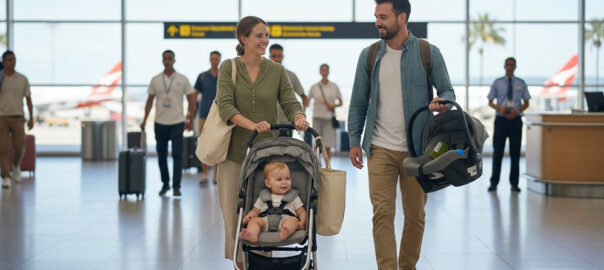
Airport Travel With Baby Australia: 2026 A-to-Z Glossary
TLDR: Airport travel with a baby in Australia involves confusing terms, state-specific car seat laws, and dozens of small decisions that add up fast. This glossary defines every term parents encounter, from baby capsules and the Queensland taxi exemption to lap infants and gate-checking prams. Pre-booked private transfers with confirmed child seats eliminate the biggest ground transport headache, and knowing the rules at security and boarding makes the rest straightforward.
Planning airport travel with a baby in Australia means wading through rules and terminology that nobody explains in one place. What’s a lap infant versus a child fare? Can a taxi legally carry your baby without a car seat in Queensland? What does gate-checking a pram actually involve?
Every ranking guide online covers this topic as a long, scrolling essay. This page takes a different approach. It’s a plain-English glossary organized by stage of the journey: getting to the airport, getting through the airport, and getting on the plane. Each entry defines the term, explains why it matters when you’re travelling with a baby, and flags the Australian-specific rules you need to know.
Whether you’re flying out of Brisbane, the Gold Coast, or the Sunshine Coast, bookmark this page before your next trip.
Ground Transport Terms
These are the terms you’ll encounter when figuring out how to get your family from home (or your hotel) to the airport terminal.
Baby Capsule (Rear-Facing Infant Restraint)
A baby capsule is a portable, rear-facing car seat designed for newborns up to roughly 6 to 12 months old (or about 9 to 12 kg). It clicks into a base that stays installed in the car, and many models also clip onto pram frames.
Why it matters for airport travel: Australian law requires all children under six months to travel in a rear-facing restraint in private vehicles. If you’re booking a taxi, rideshare, or transfer to the airport, the capsule question is the first thing to sort out. Most taxis and rideshare drivers do not carry baby capsules. Quality private airport transfer services will provide one free and pre-installed when you book, which removes this problem entirely.
Convertible Car Seat
A car seat that starts rear-facing (suitable from birth) and later converts to forward-facing as the child grows. Unlike a capsule, it stays fixed in the vehicle and doesn’t detach for carrying.
Why it matters: If you’re driving your own car to the airport and parking there, a convertible seat works fine. But if you need a transfer service, you’ll want to confirm they can provide the right restraint type for your child’s age, rather than hauling your own seat to the terminal.
Forward-Facing Car Seat (With Harness)
For children roughly six months to four years old. The child sits upright and is held by an internal harness system. In Australia, children must remain rear-facing until at least six months of age, and the national recommendation is to keep them rear-facing as long as possible.
Booster Seat
For children approximately four to seven years old. A booster seat positions the adult seatbelt correctly across the child’s body rather than using its own harness. Both high-back and backless versions exist. Under Australian law, children must use an approved restraint until age seven.
ISOFIX Anchor Points
An international standard for connecting child car seats directly to a vehicle’s chassis using built-in anchor points, rather than threading the seatbelt through the seat. ISOFIX provides a more secure and easier installation. Most modern Australian vehicles have ISOFIX points, but not all transfer or taxi vehicles do. If this matters to you, confirm it at booking.
Taxi Exemption (Queensland)
This is the single most confusing rule for parents planning airport travel with a baby in Australia, especially in Queensland.
In QLD, children are not legally required to use a car seat in taxis and rideshare vehicles. Children under one year old can be held on the lap of a person aged 16 or older (without sharing a seatbelt). Children aged one to seven can use a standard three-point seatbelt but must not sit in the front row if the vehicle has two or more rows.
The exemption exists because taxis historically couldn’t carry seats for every possible child age. But legal does not mean safe. Safety experts universally recommend using a car seat whenever possible. Pre-booked services that provide fitted child seats cut through this grey area completely.
Important state difference: In NSW, children under 12 months must be in an approved car seat even in taxis. Source: Bounty Parents Rules vary by state, so always check the requirements for your departure location.
Private Airport Transfer
A pre-booked, door-to-door car service with a professional driver. Unlike taxis or rideshare, the vehicle, driver, and any child seats are confirmed before your travel day. The price is fixed at booking, with no meters or surge pricing.
For families, the key advantage is certainty. You know the car seat will be there, the driver will be waiting, and the vehicle will have space for your luggage and baby gear. Practitioners on Whirlpool forums consistently note the difficulty of ordering Uber with child seats. The consensus: bringing your own seat for rideshare is awkward but sometimes necessary, and pre-booked services with included seats are preferred.
For a deeper look at what this service involves, the guide on what is an airport transfer breaks down the differences between private transfers, shared shuttles, and public transport.
Meet-and-Greet Service
A service where the transfer driver meets you inside the terminal, usually at the arrivals hall or baggage carousel for domestic flights, or the international arrivals hall for overseas flights. The driver holds a name board with your name and waits according to your flight schedule.
Why it matters with a baby: When you’re juggling a baby, a pram, carry-on bags, and a nappy bag, the last thing you want is to wander around a pickup zone trying to find your ride. Members of the Noosa Crew Facebook group have noted the difference directly, with one community member comparing options: “Private transfer costs more but you get meet n greet, door to door and… child seats. Shuttle bus, cheaper maybe but…” The meet-and-greet alone can justify the price difference when you’re travelling with an infant.
Accredited Chauffeur (QLD Driver Authorisation)
In Queensland, drivers of booked hire vehicles must hold a Driver Authorisation issued by the Department of Transport and Main Roads. This requires passing police checks and health assessments. When booking any transfer service for airport travel with a baby in Australia, confirming the driver holds this accreditation is a basic safety check.
After-Hours Surcharge
An additional fee charged by transfer services for pickups or drop-offs outside standard hours, typically between 8 PM and 6 AM. Common across the industry. If you’re catching an early morning or late-night flight with a baby, factor this into your budget. For full details on how surcharges and cancellations work, the FAQ page covers booking specifics.
Enclosed Luggage Trailer
An additional trailer towed behind the transfer vehicle to accommodate bulky family items: port-a-cots, surfboards, extra suitcases, and strollers that won’t fit in a standard boot. Not available with taxis or rideshare. This is one of those things you don’t think about until you’re standing at the kerb with a pram, two suitcases, a port-a-cot, and a sedan that clearly won’t fit it all.
Price Match Guarantee
A commitment from a transfer provider to match or beat a competitor’s quoted price for an equivalent service. My Private Transfers guarantees to match any accredited QLD operator’s price and discount it by at least one dollar, which takes the guesswork out of price comparisons.
The Real-World Problem These Terms Solve
In October 2025, a Brisbane mother and her baby were left stranded at Brisbane Airport after three taxis refused to take them. The drivers reportedly rejected them because the trip was too short. The mother posted on Reddit: “We walk up the taxi rank, to not only be refused by one but three.” Source: The Nightly
This is not an isolated incident. Practitioners on the r/brisbane subreddit regularly confirm frustration with taxis that don’t carry car seats at Brisbane Airport. A pre-booked private transfer with confirmed child seats solves both the availability problem and the safety question in one step. You can get an instant quote for your family airport transfer and lock in the price before you travel.
At the Airport: Terms Every Parent Should Know
Once you arrive at the terminal, a different set of terms takes over.
Parent Room (Parenting Room)
Dedicated rooms inside airport terminals equipped with baby change facilities, feeding chairs, and microwaves for warming bottles or food.
Brisbane Airport locations: The Domestic Terminal has parent rooms on Level 1 (near Qantaslink Check-in, opposite Baggage Reclaim 1, and next to the Airtrain Ticket Desk) and on Level 2 (Qantas end, Virgin end, and the Central satellite). The International Terminal also has parent rooms throughout. Source: BNE.com.au
Knowing where these are before you arrive saves you from walking the full length of the terminal with a screaming baby. Pull up the terminal map on your phone while you’re still in the car.
Security Screening with a Baby
Babies and children go through the security checkpoint with a parent. They do not go through body scanners. Strollers and prams are screened separately (placed on the X-ray belt or hand-checked).
The formula rule: Baby formula, breast milk, and baby food are permitted through Australian airport security. There are no quantity restrictions on powdered formula. Liquids like pre-mixed formula and breast milk are exempt from the standard 100ml liquid rule, though they may be tested. Source: BNE.com.au
This is one of the most searched questions for parents planning airport travel with a baby in Australia, and the answer is reassuring: bring what you need. Security staff are experienced with families.
Gate-Check (Pram/Stroller)
The practice of using your pram right up to the aircraft door, where ground crew tag it and stow it in the cargo hold. You collect it either at the aircraft door on arrival or at baggage claim, depending on the airline and airport.
Gate-checking is free on most Australian airlines. Jetstar allows prams to be checked as part of your checked baggage allowance. The advantage is obvious: you keep your baby in the pram through the terminal, through the gate area, and right up to the plane door.
Family / Priority Boarding
Most Australian airlines allow families with small children to board before general boarding begins. This gives you time to get settled, stow your gear, and organise the baby before the aisle fills up.
However, Brisbane Airport’s own advice notes that “boarding last can work better” since it reduces the time your baby is confined in a cramped seat. Which approach works depends on your baby’s temperament. An active crawler might do better boarding late. A baby who settles easily in your arms might prefer the quiet of an early board.
Interactive Play Area
Some terminals have play zones for children. Brisbane’s International Terminal has a permanent interactive screen in the Village Green area, located after passport control. It won’t entertain a newborn, but if you’re travelling with a toddler and an infant, the play area can save your sanity during a long wait.
Airline and Ticketing Terms
Airlines use specific age classifications that differ from car seat age brackets. Getting these right when booking avoids confusion at check-in.
Lap Infant
A child under two years old who travels seated on an adult’s lap using a special infant extension seatbelt. The child does not get their own seat. On Qantas domestic flights (QF-coded), no fare is required for lap infants. Other airlines charge a nominal lap infant fee. Source: Point Hacks
Infant (Airline Definition)
Under two years old. This is the airline’s definition, and it differs from car seat age brackets. The moment your child turns two, they need their own seat and a child fare. If your baby turns two during your trip, most airlines require the child fare for the return leg.
Child (Airline Definition)
Two to 11 years old. Children in this bracket need their own seat and ticket. The fare is usually a percentage of the adult fare on domestic routes.
Bassinet (In-Flight)
A small cot that attaches to the cabin wall (the bulkhead) for infants to sleep in during flight. Weight and size limits apply.
Critical limitation on domestic flights: On Qantas, bassinets are only available on A330 aircraft, which mainly operate on Perth routes. They are not available on Boeing 737s, which make up the majority of domestic flights. Bassinets generally cannot be pre-booked and are requested at check-in on a first-come basis. Source: Point Hacks
If you’re flying Sydney to Brisbane or Melbourne to Gold Coast, don’t count on a bassinet. Plan to hold your baby for the flight.
Infant Extension Seatbelt
The extra belt clip that attaches to the adult seatbelt, creating a loop for a lap infant. Flight attendants provide this during boarding. It’s standard equipment, not something you need to bring.
Bulkhead Seat
The front-row seats in each cabin section, where the wall (bulkhead) is directly in front of you instead of another row of seats. This is where bassinets attach when available. Bulkhead seats also offer more legroom, which matters when you’re holding a baby on your lap for hours. Request these seats at check-in if bassinets are available on your aircraft.
Brisbane and Queensland-Specific Terms
Since most searches for airport travel with baby Australia skew heavily toward Queensland, here are the local terms you need.
Terminal Transfer Bus (Brisbane Airport)
The free orange shuttle bus that runs between Brisbane’s Domestic Terminal (T2) and International Terminal (T1), which are approximately 4 km apart. It runs every 10 minutes, from 4:00 AM to 1:30 AM daily.
If you’re connecting between a domestic and international flight at Brisbane Airport, this bus is how you get between terminals. It’s pram-accessible, but managing a baby, luggage, and a stroller on a shuttle bus during a connection is a juggling act. For a full breakdown of how the connection works, the domestic transfer Brisbane Airport guide covers timing, luggage handling, and alternatives.
Airtrain (Brisbane)
A rail connection between both Brisbane Airport terminals and the city. The inter-terminal fare is approximately $5. Trains run every 15 to 30 minutes depending on time of day. The stations are pram-accessible with lifts.
Brisbane Airport Domestic Terminal (T2) and International Terminal (T1)
These are separate buildings roughly 4 km apart. You cannot walk between them. This catches out first-time Brisbane travellers who assume the terminals are connected.
Gold Coast Airport (OOL)
A single-terminal airport at Coolangatta on the Queensland-NSW border. Simpler layout than Brisbane, with shorter walking distances. For families flying in or out of OOL, Gold Coast Airport private transfers with free child seats are available for door-to-door service.
Sunshine Coast Airport (MCY)
A smaller regional airport at Marcoola. Compact, easy to navigate, and far less hectic than Brisbane or the Gold Coast. Ideal for families who can fly directly here. If you’re heading to or from MCY, Sunshine Coast Airport transfers cover the region from Caloundra to Noosa.
Uber Child Seat Availability in Australia
Uber has been trialling an “Uber Child Seat” option in Melbourne only, with forward-facing seats for children roughly one to four years old. This option is not available for infants under 12 months (no rear-facing capsules are provided), and it is not available in Brisbane or anywhere else in Queensland.
Practitioners on Reddit’s r/brisbane have recommended Shebah (a women-and-children-focused rideshare app) as an alternative for booking baby seats, though availability varies. The consistent theme across forums is that rideshare child seat options remain unreliable outside Melbourne.
Packing and Equipment Terms
Travel Pram / Compact Stroller
A lightweight, foldable pram designed for air travel. Most weigh under 7 kg, fold to cabin-luggage size (some are approved as cabin baggage on certain airlines), and can be gate-checked for free. If your everyday pram is heavy or bulky, a travel pram is worth considering for airport travel with a baby in Australia, especially if you’ll be navigating terminals solo.
Port-a-Cot / Travel Cot
A portable crib for use at your destination. Too large for cabin baggage, but most airlines accept them as checked luggage (sometimes counting toward your baggage allowance, sometimes free as an infant item). Check your airline’s policy before you fly. If you’re taking a port-a-cot to the airport, an enclosed luggage trailer on your transfer vehicle solves the boot-space problem.
Cabin Baggage Allowance (With Baby)
Most Australian airlines allow one additional bag for infant items (nappies, wipes, change of clothes, formula, bottles) on top of the adult’s cabin baggage allowance. Qantas and Virgin Australia both permit this. The size and weight limits vary by airline, so check before packing.
Nappy Bag Essentials (Airport Edition)
Not a formal term, but worth noting. For the airport and flight itself, pack: nappies (more than you think you need), wipes, a change of clothes for the baby and for you (blowouts happen at altitude), formula or snacks, a dummy or comfort toy, and any medication. Keep everything accessible, not buried in checked luggage.
Comparing Your Transport Options to the Airport
Here’s a quick reference for families weighing up how to get to the airport.
Driving and parking: Airport parking runs $150 to $400 or more per week depending on the airport and parking type. Brisbane Airport does not offer a loan stroller service, so you’ll carry your own gear from the car park. The upside is using your own car seat.
Taxi: Legally, no child seat required in QLD. Availability of car seats is not guaranteed even when pre-booked through apps like 13CABS. Risk of refusal for short trips, as the Brisbane Airport incident demonstrated.
Rideshare (Uber/DiDi): No child seat option available in QLD. Legal to hold baby on lap in QLD, but not safe. Surge pricing applies during peak times.
Private transfer: Car seat confirmed at booking. Fixed price. Meet-and-greet inside the terminal. Driver assists with luggage and baby gear. Higher upfront cost, but certainty and safety included. For families exploring this option, the page on family and group airport transfers in Queensland explains what the service looks like in practice.
Frequently Asked Questions
Do I need a car seat for my baby in a taxi in Queensland?
No. Queensland law exempts taxis and rideshare vehicles from child restraint requirements. Babies under one can be held on the lap of a person aged 16 or older. However, this exemption exists for practical reasons, not safety ones. Every child safety organisation recommends using a proper restraint whenever possible.
Can I take baby formula through airport security in Australia?
Yes. Baby formula (including powdered and pre-mixed), breast milk, and baby food are all permitted through Australian airport security. Powdered formula has no quantity restrictions. Liquid formula and breast milk are exempt from the standard 100ml liquid rule but may be tested by security staff.
Are bassinets available on domestic flights in Australia?
Rarely. On Qantas, bassinets are only available on A330 aircraft, which primarily operate Perth routes. They are not available on Boeing 737s, the most common domestic aircraft. Bassinets cannot typically be pre-booked and are allocated at check-in. For most domestic routes, plan to hold your baby as a lap infant.
How do I gate-check a pram at an Australian airport?
Use your pram through the terminal and right up to the aircraft door. At the gate, ground crew will tag it and stow it in the cargo hold. On arrival, it’s usually returned at the aircraft door (though some airports deliver it to baggage claim). Gate-checking is free on most Australian airlines.
What is the legal age for a child to fly without a car seat on a plane in Australia?
Airlines do not require car seats on aircraft for children under two who travel as lap infants. Children aged two and over need their own seat. Some parents choose to purchase a seat for their infant and use an approved car seat on board, but this is optional, not required.
How far apart are Brisbane Airport’s domestic and international terminals?
About 4 km. You cannot walk between them. The free Terminal Transfer Bus runs every 10 minutes from 4:00 AM to 1:30 AM. The Airtrain takes about two minutes between terminals and costs roughly $5. Allow at least 2 to 3 hours for international-to-domestic connections.
What transport options provide baby seats to the airport in Queensland?
Pre-booked private transfer services are the most reliable option for guaranteed baby seats. My Private Transfers provides free child and infant seats for children aged 0 to 7, including baby capsules on request. Taxis can sometimes be booked with car seats via 13CABS, but availability isn’t guaranteed. Uber does not offer child seats in Queensland.
Is it worth pre-booking a transfer just for the car seat?
For many parents, yes. The combination of a confirmed car seat, a driver who meets you inside the terminal, help with luggage, and a fixed price makes the experience significantly less stressful than the alternatives. When the alternative is standing in a taxi rank with a baby, hoping someone will take you, the value becomes clear. Get an instant quote to see what it costs for your specific trip.

Advantages of Prebooked Transport for Airport Travel (2026)
Getting to and from the airport can be the most stressful part of any trip. The uncertainty of finding a ride, the long queues after a flight, and the unpredictable costs can start or end your journey on a sour note. Fortunately, there’s a simple solution. Understanding the advantages of prebooked transport for airport travel reveals why savvy travelers are making the switch from last minute options to a seamless, scheduled service.
This guide explores the many benefits, from gaining peace of mind to saving time and money, ensuring your next airport transfer is smooth, predictable, and completely stress free.
Core Benefits: Gaining Peace of Mind and Reliability
At its heart, the choice to prebook is about removing uncertainty. It’s about starting your trip with confidence, knowing the most crucial first step is already handled.
Absolute Peace of Mind
Travel is full of variables, but your ride to the hotel shouldn’t be one of them. Prebooking your transport provides a profound sense of calm. You know a vetted professional is waiting for you, the price is set, and the vehicle is confirmed. This lets you relax and focus on your trip, not on logistical worries. Studies often show that anxiety about ground transport can negatively impact trip satisfaction, and a reliable ride is the perfect antidote.
Unmatched Reliability and Punctuality
When you have a flight to catch, being on time is non negotiable. A key advantage of prebooked transport for airport travel is reliability. Reputable services pride themselves on punctuality, with professional chauffeurs often arriving 10 to 15 minutes early. For early‑morning pickups or cool winter evenings, a breathable thermal base layer keeps you comfortable curbside. A survey of business travelers found that 36% of U.S. business travelers said convenient flight schedules were their top consideration when booking flights, highlighting the immense value of a ride that shows up on schedule. You won’t be left scrambling last minute, because a confirmed booking means your car is reserved and guaranteed.
Guaranteed Safety and Professionalism
Safety is paramount. With a prebooked service, you are entrusting your journey to a professional licensed driver. In Queensland, for example, chauffeurs must hold a specific Passenger Transport Driver Authorization, which involves rigorous background and medical checks. These drivers are not anonymous gig workers; they are vetted, insured, and accountable professionals trained in both safe driving and customer service. This is why corporate travel managers often prioritize traveler safety and reliability over cost, making prebooked services their top choice.
Saving Your Hard Earned Time and Money
While premium service is a given, the practical advantages of prebooked transport for airport travel also extend to your wallet and your schedule.
Lock in Your Rate with Fixed Pricing
Forget the anxiety of watching a taxi meter climb in traffic. Prebooked transfers come with a fixed price, so you know the exact cost upfront. This transparency is perfect for budgeting and eliminates the stress of unpredictable fares. Whether you hit rush hour traffic or there’s a necessary detour, your price remains the same.
No Surge Pricing or Hidden Fees
Rideshare apps are known for surge pricing, where fares can double or triple during peak times or bad weather. Private transfer services don’t do this. The price you are quoted is the price you pay, regardless of demand. Furthermore, reputable companies build all costs (like tolls, taxes, and airport fees) into the initial quote, so you face no hidden fees upon arrival.
Surprising Cost Savings
While a private car may seem like a luxury, it can offer significant cost savings, especially for groups. A single private van is often cheaper than two taxis or paying for multiple shuttle bus tickets. Companies like My Private Transfers even offer a Price Match Guarantee, ensuring you get premium service at a competitive rate. When you factor in the value of your time and the included amenities, the overall value is often unbeatable.
It’s All About Saving Time
Your time is valuable, and prebooking helps you keep more of it.
No Waiting in Queues: You walk past the long taxi and shuttle lines.
Direct Routes: Unlike shared shuttles that make multiple stops, your journey is direct, saving you a significant amount of travel time.
Efficient Planning: Your driver is already waiting, so you can deplane and be on your way immediately. Keep your tech tidy with reusable rubber cable ties so you can plug in fast on the go.
Ready to experience a seamless and stress free journey? Book your private transfer now and see the difference for yourself.
The Seamless Experience from Door to Door
The convenience of a prearranged ride transforms your travel experience from a chore into a pleasure. These advantages of prebooked transport for airport travel focus on making your journey effortless.
True Door to Door Service
Your ride picks you up from your specific starting point and drops you at your exact destination. There are no “nearby” drop off points or a need to find your own way for the last leg of the journey. This is especially helpful when you’re carrying heavy luggage or traveling with children.
A Personal Meet and Greet
Arriving in an unfamiliar airport can be disorienting. A meet and greet service solves this completely. Your driver will be waiting for you inside the terminal (often right after baggage claim) holding a sign with your name on it. They will then escort you to your vehicle, eliminating any confusion or stress. Once you’re settled, staying hydrated helps you reset. Consider a compact water filter jug at your accommodation for effortless, great-tasting water.
Luggage Assistance Included
Don’t risk an injury by hauling heavy bags. Professional chauffeurs provide luggage assistance, loading your bags into the vehicle and unloading them at your destination. In the U.S. alone, over 85,000 people required medical treatment for luggage related injuries in a single year, highlighting the real benefit of leaving the heavy lifting to a professional. If you have oversized items like surfboards or extra gear, services like My Private Transfers can even provide an enclosed luggage trailer. For families pushing prams in the sun, a stroller sunshade with UV 50+ protection keeps little ones comfortable between the terminal and curb.
Flight Tracking for Perfect Timing
Flights get delayed or arrive early. With flight tracking, your transfer service monitors your flight in real time and adjusts your pickup schedule automatically. Your driver will be there precisely when you land, whether your flight is on time, early, or late.
Flexible Scheduling and Prepayment
Plans change. Reputable services offer flexible scheduling with generous cancellation policies, allowing you to book with confidence. Plus, the convenience of prepayment means you handle the transaction online ahead of time. With a majority of travelers preferring cashless payments, this lets you step out of the car at your destination without fumbling for a wallet or worrying about local currency. A slim zipper wallet with 7 card slots keeps essentials together when you do need physical cards.
A Superior Journey, Customized for You
The quality of the ride itself is one of the most compelling advantages of prebooked transport for airport travel.
Unmatched Comfort
Private transfer vehicles are typically modern, clean, and spacious sedans or SUVs. Unlike the variable quality of taxis, you can expect a pristine interior, comfortable seating, and a quiet, smooth ride. You have the entire vehicle to yourself, allowing you to stretch out, relax, or catch up on work.
Your Choice of Vehicle
Need more space for a large family? Want to make an impression with a luxury vehicle? Prebooking allows you to choose the right vehicle for your needs, from an economy sedan to a premium Mercedes or a multi passenger van.
Onboard Amenities for Your Needs
Customization extends to amenities. Need a child seat for your little one? Australian law requires children under 7 to be in an appropriate restraint, and services like My Private Transfers provide them for free, saving you a major hassle. You can also request features like Wi Fi to stay productive or enjoy complimentary bottled water to refresh after a long flight. If you like to loosen up after flying, pack a lightweight non-slip yoga mat for a quick stretch at your hotel.
Navigation Handled by Local Experts
Your professional driver takes full responsibility for navigation. They use a combination of GPS technology and deep local expertise to plan the most efficient route, avoiding traffic jams and construction zones. You don’t need to give directions or worry about getting lost; you can simply sit back and enjoy the ride.
Frequently Asked Questions
What are the main advantages of prebooked transport for airport travel over a standard taxi?
The primary advantages include guaranteed availability, a fixed price with no surprise surge charges, a higher standard of vehicle comfort and cleanliness, and professional service features like meet and greet and luggage assistance.
What happens if my flight is delayed?
Reputable private transfer companies use flight tracking. They will monitor your flight’s status and automatically adjust your pickup time to match your actual arrival, so your driver is there when you land at no extra charge.
Is it more expensive to prebook airport transport?
Not necessarily. For groups or families, a single private vehicle is often more cost effective than multiple taxis or per person shuttle fees. Factoring in the absence of surge pricing and the value of time saved often makes it the smarter financial choice.
Are child safety seats provided?
Many premium services, including My Private Transfers, provide complimentary, pre installed child and infant seats upon request, ensuring your family travels safely and in compliance with local laws. This is a significant advantage over most taxis and rideshare services.
How does a prebooked service handle a lot of luggage?
When booking, you can specify your luggage needs. Companies often have larger vehicles like SUVs and vans in their fleet. For extra bulky items like skis, golf bags, or strollers, you can even request a vehicle with an enclosed luggage trailer.
Booking your ride in advance takes the guesswork out of your journey. With so many advantages of prebooked transport for airport travel, it’s the most reliable, comfortable, and stress free way to get where you need to go.
Ready to travel with confidence? For your next trip to or from Brisbane, the Gold Coast, or the Sunshine Coast, let My Private Transfers handle the driving. Get an instant quote online today!

Luggage Trailer Options and Benefits for Family Trips 2026
Is the family car starting to feel more like a sardine can on road trips? A luggage trailer transforms your travel experience by offering key benefits like increased storage capacity, dramatically improving passenger comfort and safety, and providing the versatility to haul camping or sports gear. The main options to consider involve choosing the right size, deciding between steel and aluminum construction, and selecting features like waterproof covers or enclosed tops for security.
This comprehensive guide explores all the essential luggage trailer options and benefits for family trips. We will cover everything from choosing the right size and materials to understanding safety, security, and the long term costs, so you can make an informed decision for your next adventure.
Why Your Family Needs a Luggage Trailer
The immediate benefits of using a luggage trailer go far beyond just carrying more stuff. They directly improve the quality of your journey.
Dramatically Increase Your Luggage Capacity
A standard family sedan’s trunk offers ranging from 400 to 500 liters of space. In contrast, a common 6×4 foot box trailer provides around 660 liters of volume. With studies showing on average, 59% of travelers pack two suitcases per person on vacation, that extra space is a lifesaver. All the bulky items like strollers, golf clubs, and extra bags can ride securely in the trailer.
Improve Passenger Comfort and Safety
Moving luggage from the car’s cabin to a trailer gives everyone more legroom and space to relax. A cramped car is a major source of road trip misery, but a trailer keeps the interior open and comfortable. More importantly, it enhances safety. Loose items inside a car can become dangerous projectiles in a sudden stop. A 20 pound suitcase could have the impact force of 1,000 pounds in a 55 mph crash. Using a trailer also prevents luggage from blocking the driver’s rear view, which is a common and often illegal safety hazard.
Gain Versatility for Camping and Sports Gear
A trailer’s usefulness extends well beyond suitcases. It offers incredible versatility for camping and sports gear. Tents, coolers, bikes, surfboards, skis, and even kayak and canoe gear (https://www.myprivatetransfers.com.au/fashion/?q=Para-Kayak-Y-Canoa-108x108cm-Plegable-Con-Ventana-Transparente-430178) can be easily transported. Open top trailers or those with a cage can handle tall or awkwardly shaped items, making them perfect for any outdoor adventure. One weekend it could be full of camping equipment, and the next it could be hauling sports gear for the kids.
Choosing the Perfect Trailer: What to Look For
With the benefits clear, the next step is selecting the right trailer. Here are the key luggage trailer options and benefits for family trips to consider during your search.
Trailer Size, Payload, and Vehicle Compatibility
First, think about trailer size and payload capacity. A 6×4 or 7×5 foot trailer is a popular choice for general use. However, the most important factor is the payload, which is the maximum weight the trailer can carry. For example, a trailer with a 750 kg gross limit that weighs 210 kg empty can safely carry 540 kg of cargo. Never overload a trailer, as it can lead to tire blowouts, axle failure, and dangerous instability.
You must also check your vehicle’s towing capacity. This information is in your car’s owner’s manual. Many small cars can handle unbraked trailers up to 750 kg or half the towing vehicle’s kerbside weight, whichever is lower, but exceeding this limit can cause severe damage to your engine, brakes, and transmission. Towing an overweight trailer is illegal and incredibly dangerous, as it compromises your ability to stop and control the vehicle.
Material Choice: Aluminum vs. Steel
The two most common trailer materials are steel and aluminum, each with distinct advantages.
Steel Trailers: These are strong, durable, and more affordable upfront. They are great for heavy duty use but are susceptible to rust and require regular maintenance to prevent corrosion.
Aluminum Trailers: Aluminum is significantly lighter (generally 20% lighter than steel), naturally rust proof, and holds its resale value better. The lighter weight reduces strain on your tow vehicle and can improve fuel economy. While the initial cost is higher, the low maintenance and longevity often make aluminum a worthwhile long term investment.
Smart Features for Security, Protection, and Organization
Modern trailers come with features designed to make hauling gear easier and safer. Understanding these luggage trailer options and benefits for family trips will help you get the most out of your investment.
Weather and Cargo Protection
An enclosed trailer offers the best protection from rain, sun, and dust. For an open trailer, a fitted waterproof cover (https://www.myprivatetransfers.com.au/fashion/?q=Impermeable-Y-Resistente-A-UV-Tama-o-600x230x270-Cm-Incluye-722773) is essential. A typical cover for a 6×4 trailer measures around 1.9 by 1.3 meters, ensuring your luggage stays dry even in a downpour. This protection is crucial for preventing water damage to electronics, clothes, and other sensitive items. A cover also keeps your belongings out of sight, adding a layer of security.
Customization and Storage Expansion
Many trailers can be customized to better suit your needs. You can add taller side panels or a mesh cage to increase volume, or install toolboxes and racks for better organization. An E track system, which consists of metal rails with slots for tie down accessories, offers incredible flexibility for securing loads of all shapes and sizes. This allows you to create custom anchor points exactly where you need them.
Organization with Tie Downs and E Track
Properly securing your cargo is non negotiable. Use ratchet straps, bungee cords, or heavy-duty nylon webbing tie-downs (https://www.myprivatetransfers.com.au/fashion/?q=Nylon-UIAA-CE-1-Pulgada-Para-Escalada-Y-Rescate-1-5-30-M-779912) to anchor everything firmly to the trailer’s frame or D rings. The goal is to prevent any shifting during transit, which can damage your belongings and make the trailer unstable. For maximum flexibility, an E track system allows you to add anchor points anywhere along the rail, ensuring everything from suitcases to bicycles is locked down tight.
Security and Theft Prevention
Trailers can be a target for thieves, so security is paramount. Always use a hitch lock to prevent someone from hooking up your trailer and driving away. A wheel clamp provides another strong visual deterrent, and secure doors with a high-security anti-theft lock (https://www.myprivatetransfers.com.au/fashion/?q=Seguridad-Para-Puertas-ABUS-Protecci-n-Antirrobo-Para-575259). When parked, especially overnight at a hotel, choose a well lit area. Backing the trailer up against a wall can also block access to the doors. For those who want to avoid the hassle of securing a trailer on holiday, a private chauffeured service can be an excellent alternative. When you book a vehicle with a luggage trailer through My Private Transfers, your professional driver remains with the vehicle, ensuring your belongings are always secure.
Practicalities of Towing and Ownership
From loading your gear correctly to keeping up with maintenance, here’s what you need to know about using and owning a trailer.
Safe Loading and Towing
Proper weight distribution is the most important factor for safe towing. You should place about 60% of the weight in the front half of the trailer (ahead of the axle). This ensures the trailer tracks smoothly and prevents dangerous swaying or fishtailing. An anti rattle device is a small clamp that tightens the connection between the hitch and the receiver, eliminating annoying clunking noises and creating a smoother towing experience.
For easy loading of heavy or wheeled items like mowers or motorcycles, a ramp door is a fantastic feature. For oversized items like lumber or kayaks, a removable end gate provides the flexibility to let cargo overhang safely from the back (just be sure to flag it according to local laws).
Lighting for Visibility and Safety
Functional trailer lighting is a legal requirement and a critical safety feature. Your trailer must have tail lights, brake lights, and turn signals that sync with your vehicle; a quick-connect 12V wiring pigtail (https://www.myprivatetransfers.com.au/fashion/?q=30-Cm-14-AWG-Para-Moto-Coche-Solar-Enchufe-R-pido-De-774378) makes testing and connecting easier. Before every trip, perform a quick light check to ensure everything is working. A trailer can block your car’s lights, so its own lights are the only way drivers behind you know when you are stopping or turning.
Maintenance, Cost, and Registration
The ongoing ownership costs for a small trailer are quite low. You will have an annual registration fee, which is typically much cheaper than a car’s registration, and minimal maintenance expenses. Key maintenance basics for road trips include:
Checking tire pressure and inspecting for cracks or wear.
Greasing the wheel bearings annually to prevent overheating.
Testing all lights and wiring before you depart.
Inspecting the coupler and safety chains for wear.
Warranty and Customer Service
When purchasing a new trailer, look for a solid warranty and a manufacturer with a reputation for good customer service. A warranty of at least one year on parts and a longer structural warranty on the frame provides peace of mind. Reputable manufacturers will comply with local safety standards and can readily provide replacement parts if needed.
Buying vs. Renting: The Long Term Cost
Is it more cost effective to buy or rent? If it’s a couple times a year, it may be better to rent when you need it. In-town U-Haul trailer rental prices range from $14.95 to $89.95 per day. However, if you plan to use a trailer every week or even a few times a month, buying quickly becomes more economical. An owned trailer is always available, and it holds its resale value surprisingly well.
Of course, there is a third option. For ultimate convenience on family holidays, you can skip owning or renting altogether. A service like My Private Transfers offers private airport transfers with optional enclosed luggage trailers. You get all the space you need without any of the responsibilities of ownership, making for a truly stress free start to your vacation.
Frequently Asked Questions
1. What are the main luggage trailer options and benefits for family trips?
The main benefits are a massive increase in storage space, improved passenger comfort and safety by decluttering the car, and the versatility to carry bulky sports or camping gear. Key options to consider include the trailer’s size, payload capacity, and whether it is made from steel or aluminum.
2. How much weight can a small car typically tow?
Many small sedans and hatchbacks have a towing capacity of around 750 kg for an unbraked trailer. However, you must always check your specific vehicle’s owner’s manual for the exact limit and never exceed it.
3. Is an enclosed trailer better than an open one with a cover?
An enclosed trailer offers superior security and weather protection. However, a high quality waterproof cover on an open trailer is very effective at keeping rain and dust off your cargo. An open trailer can also be more versatile for carrying tall or oddly shaped items.
4. How do I stop my trailer from swaying?
Trailer sway is usually caused by improper weight distribution. Ensure about 60% of the cargo weight is positioned in front of the trailer’s axle. Also, make sure your tire pressures are correct and that you are not towing faster than is safe for the conditions.
5. Do I need special insurance for a luggage trailer?
In many cases, the liability for a trailer is covered by the towing vehicle’s insurance policy, but you should always confirm this with your insurer. Insurance to cover theft of or damage to the trailer itself is often an optional extra.
6. Is it difficult to maintain a trailer?
No, trailers are relatively simple to maintain. The most important tasks are regularly checking tire pressure, greasing the wheel bearings once a year, and ensuring all the lights are in working order before each trip.
Your Journey, Made Easier
Choosing the right solution for your luggage needs can make the difference between a stressful journey and a relaxing family holiday. By understanding the key luggage trailer options and benefits for family trips, you can find the perfect fit, whether that means buying, renting, or opting for the seamless convenience of a chauffeured service. If you’re planning a trip in Queensland and want to travel with ease, consider getting a quote for a private transfer with a luggage trailer from a trusted provider. You can get an instant quote online and see how simple your next family trip can be.

Airport Parking vs Chauffeur Service: 2026 Cost Comparison
The bags are packed and the tickets are booked, but one crucial question remains: how are you getting to the airport? For many travelers, this decision boils down to a classic dilemma. Do you drive your own car and deal with the parking maze, or do you book a private ride and start your trip with zero hassle? This guide explores the great debate of airport parking vs chauffeur service, breaking down every factor from cost and convenience to security and stress. Ultimately, the best choice depends on your trip’s length and your travel priorities, but a chauffeur service often wins for stress-free convenience, especially on longer trips.
The Money Talk: A Full Cost Breakdown
When comparing airport parking vs chauffeur service, the first thing most people look at is the price tag. But the true cost isn’t always what it seems. A smart comparison involves looking beyond the initial quote to all the related expenses.
Airport Parking Costs
The fee for leaving your car at the airport can be a significant travel expense, especially for longer trips. At Brisbane Airport, a one‑week stay costs about $127 at AIRPARK and up to $314 at the on‑site ParkPremium car park. Major airports often treat parking as a major revenue source, with Sydney Airport having had the highest car parking revenue and profit margin per space among Australia’s large airports. These daily rates add up quickly, turning a seemingly cheap option into a hefty bill.
Hidden Costs of Driving
The true cost of driving yourself goes beyond just the parking fee. You have to account for fuel for the round trip, potential tolls, and the often forgotten vehicle wear and tear. Unexpected issues like a blown fuse or car fuse box problem can also add roadside hassle. The Australian Tax Office (ATO) calculates vehicle operating costs at $0.88 per kilometer, which covers fuel, maintenance, and depreciation.
Fixed Price vs Variable Expense
A key advantage of a pre booked chauffeur service is the fixed price. You get a quote upfront, and that’s what you pay. Driving, on the other hand, is a variable expense. Fuel prices fluctuate, and a flight delay could mean paying for an extra day of parking you didn’t budget for. Rideshare apps are also notoriously variable, with fares often jumping significantly during peak times. A fixed price from a service like My Private Transfers offers budget certainty and peace of mind.
Trip Duration and Group Size
The length of your trip heavily influences the airport parking vs chauffeur service equation.
Short Trips (1 to 3 days): Parking can sometimes be the cheaper option. A UK analysis found that for very short trips, airport parking is often more economical than a one way taxi.
Long Trips (4+ days): As parking fees accumulate, a round trip chauffeur service often becomes the more cost effective choice. Across the 50 busiest U.S. airports, 7-day on-airport economy parking ranges from $52.50 (Kansas City) to about $266 (San Diego).
For families or groups, splitting the cost of a single, larger vehicle is often far cheaper than paying for multiple public transport tickets or driving separate cars.
Convenience is King: Comparing the Travel Experience
Beyond the cost, the actual experience of getting to the terminal is a major factor in the airport parking vs chauffeur service debate.
The Beauty of Door to Door Service
A chauffeur provides true door to door service. Modern fleets, including Mercedes Sprinter vans with bright LED lighting, make early‑morning or late‑night drop‑offs feel safer. The driver picks you up from your home and drops you off directly at the departures curb, just steps from check in. Even the most convenient “walking distance” on site parking lots still involve a walk of 3 to 5 minutes for the Terminal Lot or 5 to 7 minutes from Garage 1 or 2 with all your luggage. With a private transfer, there is no trekking across car parks or wrestling with bags.
Shuttle Bus vs Direct Drop Off
Choosing off site parking means relying on a shuttle bus. This adds an extra step to your journey, including driving to the lot, waiting for the bus (which can be 10 to 15 minutes), and then riding to the terminal. A direct drop off from a chauffeur service eliminates this entire process, saving valuable time and energy. You get dropped off right at the terminal door, with no need to lug bags on and off a crowded shuttle.
Time Saving and Reliability
Time is critical on travel days. Among travelers who had missed two to three flights, 36% said traffic was the cause. A professional chauffeur knows the best routes and plans for potential traffic, significantly increasing reliability. Instead of navigating stressful highways yourself, you can use that time to relax or catch up on emails. This reliability is why many travelers are moving away from the uncertainty of parking and shuttles.
The Offsite Parking Tradeoff
Offsite parking is almost always cheaper than official airport lots, which is its main appeal. The trade off is a loss of convenience and time. You must allow for the extra steps of driving to the lot, parking, and catching the shuttle. While the savings can be worth it for longer trips, it adds a layer of complexity that a direct chauffeur service avoids.
Logistics and Peace of Mind
The smaller details of your airport transfer can have a big impact on your overall trip, from handling luggage to ensuring your car is safe.
Luggage Assistance and Oversize Gear
One of the most underrated perks of a chauffeur is luggage assistance. The driver helps load and unload your bags, a massive benefit for families, older travelers, or anyone with heavy items. For parents traveling with prams, a stroller cover keeps gear tidy in the vehicle. This is a stark contrast to the self service model of airport parking, which can be “less convenient with heavy luggage, children, or mobility concerns”.
Furthermore, if you are traveling with bulky items like surfboards or golf clubs, your own car might not have enough space. Professional services can accommodate this, with companies like My Private Transfers offering enclosed trailers to handle oversized gear.
Vehicle Security Risks
Leaving your car in a large, public parking lot for an extended period carries risks. Reports have noted rising incidents of vehicle thefts in some airport parking areas. While lots have security, your car remains exposed to potential theft, vandalism, or even just a dead battery upon your return. If you do park, consider securing visible bags with a luggage cable lock. A chauffeur service completely eliminates this risk by letting you leave your car safely at home.
The Power of Flight Monitoring
Modern chauffeur services use flight monitoring to track your arrival time. This means if your flight is delayed by an hour, your driver adjusts the pickup time accordingly. With roughly 1 in 5 flights arriving late in 2023, this is a crucial feature for a stress free arrival. Your parked car can’t adjust to a flight change, but a dedicated driver will be there when you actually land.
Catering to Your Specific Needs
Every trip is unique. The right choice in the airport parking vs chauffeur service decision often depends on your personal circumstances.
Stress Reduction
Getting to the airport is often a stressful experience. A recent survey found that 46% of travelers feel the overall airport process takes too long. Opting for a chauffeur service removes major stressors like navigating traffic, hunting for a parking spot, and worrying about timing. Knowing a professional is handling the logistics allows you to start your journey in a relaxed state of mind. Small comforts like sipping from an insulated water bottle can also keep you feeling fresh en route.
Accessibility and Mobility
For travelers with limited mobility, disabilities, or young children, a chauffeur service is invaluable. The door to door service minimizes walking and eliminates the need to navigate shuttle buses with wheelchairs or strollers. It ensures everyone in your group can travel comfortably and without physical strain.
Early or Late Flights
If you have a flight at 4 AM or one that lands at midnight, a pre booked chauffeur offers unmatched reliability. Pack a compact portable charger so your phone stays powered for pickup updates. Public transport may not be running, and navigating a dark, empty parking garage late at night can be unsettling. A chauffeur service operates 24/7, ensuring a safe and dependable ride at any hour.
The Final Verdict: How to Choose
So, what’s the final call on airport parking vs chauffeur service?
Choose Airport Parking if: You’re on a very short trip (1 to 2 days), traveling solo with light luggage, and live relatively close to the airport.
Choose a Chauffeur Service if: You’re traveling with a family or group, have lots of luggage, are going on a longer trip (4+ days), value convenience and reliability, or simply want to start and end your trip without any stress.
Before you decide, it’s always a good idea to do a quick quote comparison. Many private transfer companies offer instant online quotes, allowing you to compare the fixed cost of a chauffeur against the estimated total cost of driving and parking. You might be surprised to find that a premium door to door service is more affordable than you think.
Ready to skip the parking chaos on your next trip? You can get an instant quote and book your ride online in just a few minutes.
Frequently Asked Questions
Is airport parking cheaper than a chauffeur service?
For short trips of one or two days, parking is often cheaper. However, for longer trips of four days or more, the daily parking fees can accumulate, often making a round trip chauffeur service the more economical option, especially after factoring in fuel and vehicle wear.
What is the main advantage of a chauffeur service vs airport parking?
The primary advantage is seamless, door to door convenience. A chauffeur eliminates the stress of driving in traffic, finding parking, and dealing with shuttle buses. It also includes valuable perks like luggage assistance and flight monitoring for a truly hassle free experience.
How do I choose between airport parking vs chauffeur service for a family trip?
For families, a chauffeur service is typically the superior choice. The service includes help with luggage, and companies like My Private Transfers provide child seats free of charge. Splitting the cost of one vehicle is often cheaper and much easier than managing kids and bags through a parking garage and shuttle system.
What are the hidden costs of using airport parking?
The hidden costs include fuel for your round trip journey, road tolls, and the wear and tear on your vehicle. There’s also the intangible cost of your own time and the stress associated with navigating traffic and airport logistics.
Is a chauffeur service worth it for a solo business traveler?
Yes, for many business travelers, the time saving and reliability are well worth the cost. The ability to work or take calls during the ride, combined with the certainty of an on time arrival, makes it a productive and efficient choice when considering airport parking vs chauffeur service.
How does trip duration affect the airport parking vs chauffeur service decision?
Trip duration is a critical factor. The longer your trip, the more expensive airport parking becomes. A one week vacation could incur over $200 in parking fees, which could be more than the cost of a comfortable, pre booked round trip transfer.

One Airport Limo Provider Benefits: 2026 Expert Guide
When you’re planning a trip, ground transportation can feel like an afterthought. But getting it wrong can start (or end) your journey with stress and delays. Juggling different apps, waiting in long taxi queues, and hoping for a reliable ride is a gamble. Choosing a dedicated service unlocks a whole suite of one airport limo provider benefits that transform your travel from a chore into a seamless experience.
From the moment you book to the second you arrive, a professional service handles the details so you don’t have to. It’s about more than just a car; it’s about reliability, comfort, and peace of mind. Let’s explore the key advantages that make a private airport transfer the smartest choice for any traveler, especially for Brisbane Airport transfers.
The Foundation of a Great Ride: Reliability and Professionalism
At the core of any premium service are the fundamentals. If these aren’t right, nothing else matters. This is where the true one airport limo provider benefits begin to shine.
Unwavering Reliability and Punctuality
Peace of mind starts with knowing your ride will be there, on time, every time. Reliability is a top concern for travelers, with 35% citing it as a key factor in their transport choice. Unlike on demand services, a pre booked chauffeur service is dedicated solely to your schedule. Reputable providers like My Private Transfers monitor your flight status, automatically adjusting for delays and aiming to arrive for pickup 15 minutes early. This commitment to punctuality ensures you’re never left waiting or rushing to the gate.
The Professional Chauffeur Difference
A professional chauffeur is far more than a driver. They are trained, government accredited experts in transportation and hospitality. In a survey of corporate travel buyers, quality of drivers who are company employees scored 4.45 out of 5. This highlights the value placed on professionalism.
A chauffeur’s job includes:
Expert Navigation: They possess deep local knowledge, knowing the best routes to bypass traffic and ensure an efficient journey.
Courteous Service: From opening doors to handling your luggage, their focus is on your comfort.
Safety and Discretion: With rigorous background checks and professional training, you can relax knowing you’re in safe hands.
Local Expertise on Every Route
A driver with local expertise is your secret weapon for a smooth trip. They know the city’s traffic patterns, construction detours, and scenic shortcuts that GPS might miss. This in depth knowledge can cut travel times significantly. London’s iconic cab drivers, for example, must memorize over 25,000 streets for a reason. This expertise ensures you arrive on time and might even get a recommendation for a great local coffee spot along the way.
Tailored for Your Comfort and Convenience
Beyond simple reliability, the next layer of one airport limo provider benefits focuses on making your journey as easy and enjoyable as possible.
Ultimate Convenience
Convenience is consistently ranked as a top priority for travelers, with 47% of respondents selected convenience as the greatest influence when choosing a mode of transportation. Private transfers embody convenience. It’s a door to door, hassle free service (ideal for your next Gold Coast Airport transfer) that eliminates waiting in queues or hauling luggage through a train station. With a provider like My Private Transfers, you can use 24/7 online booking and a chauffeur will be waiting for you with a name sign at the airport.
Next Level Luxury and Comfort
Traveling can be tiring, but your transfer doesn’t have to be. A global survey found that an overwhelming 74% of travelers prioritize comfort above all else, including cost and speed. This is why Around one quarter of U.S. leisure air passengers upgraded to a preferred seat or seat with extra legroom in 2012.
A luxury private car offers:
Plush, clean interiors with ample legroom
A quiet cabin to relax or take a call
Climate control set to your preference
Complimentary bottled water for refreshment
Arriving at your destination feeling refreshed instead of frazzled is one of the most underrated one airport limo provider benefits.
Total Privacy and Security
In a private transfer, the vehicle is your personal space. You can discuss confidential business or manage a tired child without an audience. This privacy is complemented by enhanced security. Drivers are vetted professionals, and the journey is tracked. In fact, 51% say cleanliness and safety are top priorities when booking travel. For solo travelers or families, knowing your chauffeur is accredited and accountable provides invaluable peace of mind.
Services That Adapt to You
A truly premium experience is one that feels like it was designed just for you. Flexibility and personalization are where the best services truly stand out.
Personalized Service That Cares
Modern travelers feel more comfortable and valued when services are tailored to them, with 59% of travellers say their hotel stay will be significantly more comfortable with personalisation. A quality provider goes beyond just transportation by anticipating your needs.
Need a child seat for your toddler? My Private Transfers offers them for free, ensuring your little ones travel safely and in compliance with local laws. Traveling with oversized luggage like surfboards or golf bags? An optional luggage trailer can be arranged. This attention to detail transforms a standard ride into a genuinely personalized experience.
Flexible Scheduling for Real World Travel
Flights get delayed, meetings run late, and plans change. A flexible service operates around the clock and adapts to your needs. Business travelers overwhelmingly prioritize convenient travel times that fit their schedules. With a private car, you set the pickup time (perfect for Noosa and Sunshine Coast private transfers) whether it’s for a pre dawn flight or a late night arrival. If your plans shift, generous cancellation and rescheduling policies provide the freedom you need.
Making an Impact from Start to Finish
Whether for business or pleasure, from airport pickups to cruise terminal transfers, the right transportation service ensures your journey is efficient, impressive, and worry free.
The Power of an Impressive Arrival
First impressions are formed in less than seven seconds. Arriving in a clean, upscale vehicle with a professional chauffeur makes a powerful statement. It conveys professionalism, success, and that you value quality. For corporate travelers, this can help build credibility before a meeting even begins. For special occasions, it creates a memorable red carpet moment that elevates the entire event.
Built for Business Travel Suitability
For corporate travelers, efficiency and reliability are paramount. This makes a dedicated corporate chauffeur service in Brisbane a smart choice. A suitable business travel service is one that is always punctual, offers a comfortable and connected environment to work en route, and aligns with company schedules. With business travel generating as much as $12.50 in revenue for every dollar spent, ensuring executives arrive on time and prepared is a strategic investment. This is why many companies prioritize a single trusted provider for their team.
Get the VIP Treatment You Deserve
VIP treatment isn’t just for celebrities. It’s about receiving exceptional service that makes you feel valued. This includes a personal meet and greet inside the terminal, assistance with all your luggage, and a seamless, stress free journey. By choosing a service that focuses on these premium touches, you get to experience the best of what one airport limo provider benefits can offer.
Surprising Group Cost Efficiency
Traveling in a group? A private van or minibus can be surprisingly cost effective. When you split the cost among several passengers, the per person rate is often cheaper than buying individual train or shuttle tickets. You also save on potential luggage fees and the hassle of coordinating multiple rides. It’s a smarter way to travel, keeping everyone together and ensuring you all arrive at the same time.
The Ultimate Benefit: Peace of Mind
Ultimately, all these advantages combine to deliver the most important benefit of all: peace of mind. Knowing every detail is handled, from flight tracking to luggage assistance, allows you to truly relax. You can be confident your driver will be there, the vehicle will be safe, and the price is locked in. After a long flight, this freedom from worry is priceless. Choosing a trusted service is the key to a stress free journey.
Frequently Asked Questions
What are the main one airport limo provider benefits for families?
The primary benefits for families include enhanced safety with government accredited chauffeurs, the convenience of pre installed child seats at no extra cost, and ample space for luggage, strollers, and other gear. A private car also offers a calm, personal space to manage tired children after a long flight.
Is a private car service more reliable than a rideshare app?
Yes, generally. A pre booked private service is dedicated to your reservation, with drivers who plan routes in advance and monitor flight schedules. Rideshare services are on demand, making them susceptible to last minute cancellations, surge pricing, and driver availability issues, which can be risky when you have a flight to catch.
How does a professional chauffeur improve the travel experience?
A professional chauffeur elevates the experience through their training, local knowledge, and commitment to service. They ensure a safe, efficient route while providing a level of courtesy and assistance (like handling luggage) that you don’t get with standard services. Their professionalism provides a reliable and relaxing journey.
Can choosing one airport limo provider be cost effective for groups?
Absolutely. For groups of three or more, share-ride shuttles were not cheaper than standard taxis in the Commission’s analysis. It also simplifies logistics, ensuring the entire group travels together and arrives at the same time, which is a major convenience.
What does “business travel suitability” really mean for a car service?
It means the service meets the specific needs of corporate travelers. This includes absolute punctuality, professional and discreet chauffeurs, clean and comfortable vehicles that can serve as a mobile office, and streamlined booking and billing processes. It’s about providing a reliable service that supports productivity.
Why is flexible scheduling so important for airport transfers?
Air travel is unpredictable. Flexible scheduling allows you to book rides for any time, day or night, and easily adjust your booking if your flight is delayed or your plans change. This adaptability removes the stress of potentially missing your ride due to circumstances beyond your control.