
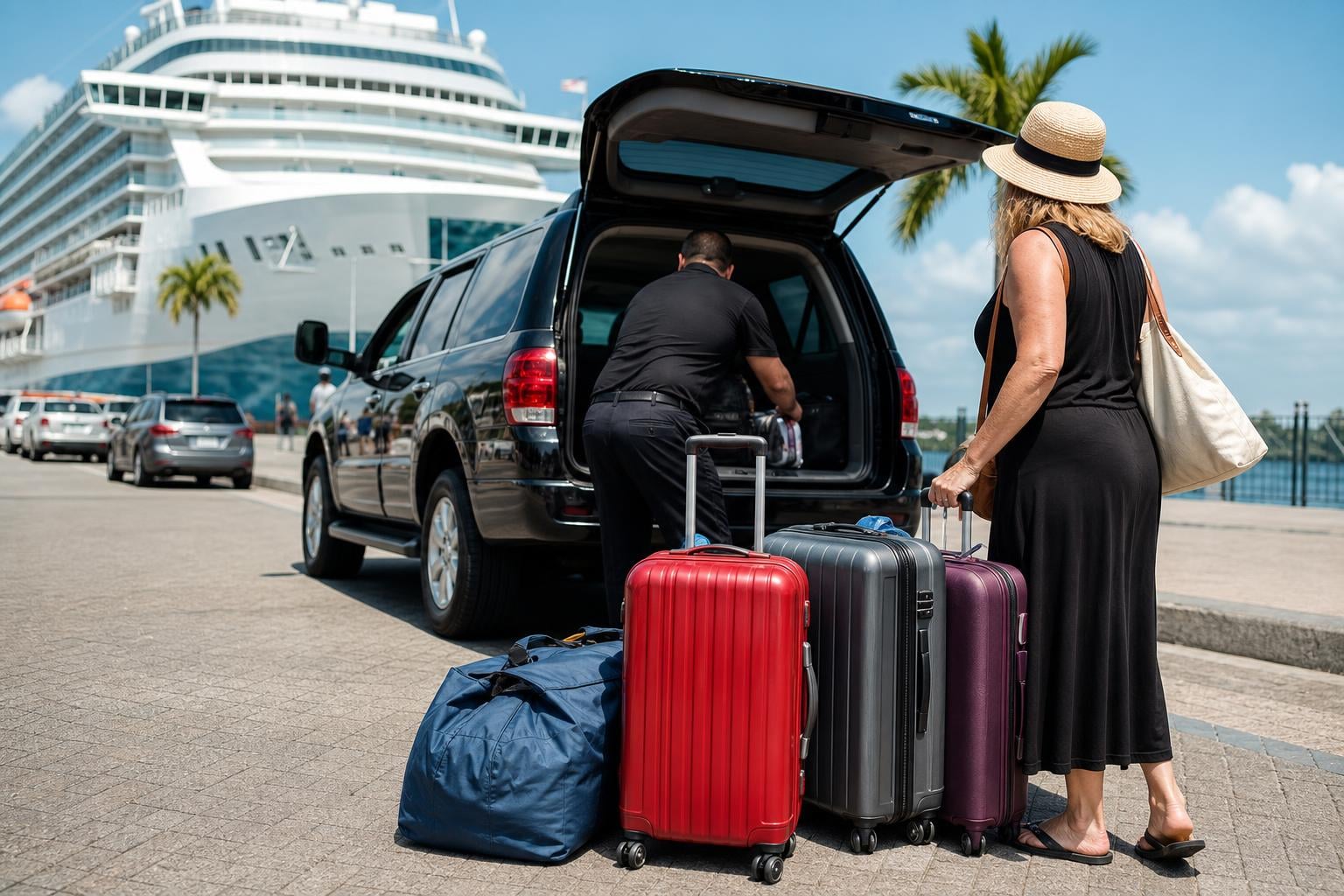
How to Plan Transfers for Cruise Passengers With Large Luggage


TL;DR
Planning transfers for cruise passengers with large luggage means sizing the vehicle for people plus bags, not people alone. Count every suitcase, stroller, child seat, and piece of oversized gear before choosing between a taxi, rideshare, or private transfer. At terminals like Brisbane International Cruise Terminal, there is no public transport and pickup zones sit 120 metres from the entrance, making vehicle choice a genuine logistical decision rather than a last-minute afterthought.
What “Large-Luggage Cruise Transfer” Actually Means
A large-luggage cruise transfer is any ride to or from a cruise terminal where the passenger group’s baggage, bulky items, or handling needs exceed what a standard sedan can comfortably carry. “Large” here is not just about suitcase dimensions. It is about whether the luggage load changes the vehicle, timing, or handling plan.
That includes obvious cases like multiple full-size suitcases, but also the items people forget to mention when booking: prams, port-a-cots, child seats, wheelchairs, walkers, golf clubs, surfboards, dive bags, and medical equipment. A family of four with four suitcases, two carry-ons, a stroller, and a baby capsule has a very different transfer problem than a couple with two bags.
Get an instant quote for cruise transfers and confirm luggage capacity before travel day.
Why Cruise Passengers Face Unusual Luggage Problems
Cruises encourage more luggage than almost any other type of travel. Passengers pack formalwear, shore-excursion gear, swimmers, multiple pairs of shoes, medications for weeks, and baby supplies. Carnival Australia suggests one bag per person for 3 to 5 night cruises and no more than two bags per person for longer sailings, with each bag up to 140 cm x 60 cm x 40 cm and 32 kg. Royal Caribbean allows up to 90 kg of luggage per guest under its booking conditions. These are generous allowances.
The problem is that a cruise line’s luggage policy and a vehicle’s boot capacity are two completely different things. As Princess Cruises notes, flights, transfers, and port services may have their own baggage limits even where the ship is flexible. The transfer vehicle is often the tightest bottleneck in the chain, not the ship.
Practitioners on Reddit’s r/royalcaribbean illustrate this well. One parent described travelling with a toddler, two large suitcases, a small rolling bag, a large duffel, and a stroller, and said carrying it all in one trip would be impossible. The community’s advice was consistent: check almost everything and use porters where available.
The 5 Checks Before Booking Any Cruise Transfer
Planning transfers for cruise passengers with large luggage requires answering five questions before selecting a vehicle.
1. Passenger Count
Count every seated person, including infants and children. If the group fills all seats in a sedan, the luggage will not fit unless everyone is travelling extremely light.
2. Bag Count and Type
Vague descriptions cause problems. “Two adults, two children, four large suitcases, two carry-ons, one stroller, and one baby capsule” is a useful booking message. “Lots of luggage” is not.
3. Oversized or Special Items
Golf clubs, surfboards, mobility scooters, and medical equipment all need confirmed space. If you are travelling with bulky gear, read about luggage trailer options before assuming everything fits in a boot.
4. Child Seats and Accessibility Needs
Queensland has exemptions for child restraints in personalised transport like taxis, limousines, and ride-booking services, meaning passengers should not assume restraints will be supplied unless arranged in advance. Families with children aged 0 to 7 need to confirm child seat availability at booking. My Private Transfers provides free child and infant seats for ages 0 to 7, with baby capsules available on request.
For more on this, see the guide to baby capsule transfers in Queensland.
5. Terminal Access and Timing
Every cruise terminal has its own rules for vehicle access, drop-off zones, and baggage handling. Those rules directly affect which vehicles can reach the closest passenger point, something most transfer guides ignore entirely.
Vehicle Choice Matrix
This table gives a practical starting point for matching your group’s load to the right vehicle.
Passenger and luggage profile | Risk with standard taxi or rideshare | Better option |
|---|---|---|
1 to 2 adults, 1 suitcase each, 1 carry-on each | Low | Taxi, rideshare, or sedan transfer |
2 adults, 3 to 4 large suitcases | Medium | SUV, wagon, or private transfer |
Family of 4 with suitcases, stroller, and car seats | High | Pre-booked van or people mover with child seats |
4 to 6 adults, 1 to 2 large bags each | High | Van, minibus, or two vehicles |
Wheelchair or mobility scooter plus suitcases | High | Accessible vehicle or larger van (confirm dimensions) |
Surfboards, golf clubs, plus cruise luggage | High | Vehicle with luggage trailer or oversized capacity |
The core rule: if the bag count is equal to or greater than the passenger count, a sedan is probably the wrong default. For groups exceeding normal vehicle capacity, see how to arrange transport for large groups.
Cruise Critic’s general transfer guide makes a similar point, noting that taxis become less practical with long distances and large luggage loads, and that private or shared vans can be useful for groups who want to ride together.
Check transfer pricing to compare vehicle options for your group size.
Brisbane International Cruise Terminal: A Worked Example
Brisbane makes an excellent case study for planning transfers with large luggage because the terminal has specific access constraints that affect vehicle choice.
The Brisbane International Cruise Terminal (BICT) sits at 1 Cruise Terminal Drive, Pinkenba, about 12 km from Brisbane Airport and 21 km from the CBD. It is not serviced by public transport, so every passenger needs road transport.
Key facts that affect large-luggage transfer planning at BICT:
Taxi and rideshare zones are approximately 120 metres from the terminal entrance, connected by an undercover walkway. That distance matters when you are managing heavy bags, children, or mobility equipment.
The 2-minute set-down zone requires the driver to remain with the vehicle. Passengers must be ready to unload quickly.
Vehicles with trailers and vehicles longer than 6.5 metres cannot enter the drop-off loop. They must use the Coach and Shuttle Area with prior permission.
There are no luggage trolleys at BICT, though cruise line staff assist passengers on arrival in the Plaza Area.
The embarking passenger path includes an elevated walkway of up to 270 metres and a boarding bridge of about 55 metres. Wheelchair availability is limited and should be discussed with the cruise line in advance.
Practitioners on Reddit’s r/brisbane report that Uber or taxi from Brisbane Airport to the port generally works, but they advise leaving spare time because the route feels industrial and non-obvious. That is fair advice for light travellers. But for families with multiple suitcases, strollers, and young children, “it generally works” is not a strong enough plan.
For Brisbane cruise passengers needing a pre-booked ride, Port of Brisbane transfers can be arranged with the correct vehicle type and terminal access handling.
What to Do With Large Bags at the Terminal
Understanding the baggage handoff process is just as important as choosing the right vehicle. Cruise terminals are not airports with automated conveyor belts visible from check-in. The flow is different.
On embarkation day, large checked bags go to baggage drop or porters near the terminal entrance. Carnival Australia says large items should be checked at baggage drop before entering the terminal. Those bags are delivered later to the stateroom, sometimes hours later. Passengers keep only a day bag through security and onto the ship.
Experienced cruisers on Reddit’s r/Cruise consistently recommend handing large bags to porters and keeping essentials in a backpack. Complaints centre on dragging oversized bags through scanners and waiting hours for cabin access with nowhere to put them.
Attach cruise luggage tags before arriving at the terminal. Carnival includes tags with the eTicket and asks passengers to tag each bag before arrival.
What to Keep in Your Day Bag
Pack anything you will need before checked bags reach your cabin:
Passport or photo ID and boarding documents
Medications
Phone, charger, and wallet
Valuables and electronics
Swimmers and sunscreen
Change of clothes
Nappies, wipes, and formula for infants
Glasses, hearing aids, or medical devices
Royal Caribbean Australia’s own carry-on list includes ID, SetSail Pass, medicines, toiletries, sunscreen, swimmers, change of clothes, adaptors, and chargers. For a complete walkthrough of this process, read the embarkation day luggage flow guide.
Embarkation vs Disembarkation: Plan Both Directions
Most people plan the ride to the cruise terminal but forget about getting home. Disembarkation is often harder.
On embarkation day, the process is relatively controlled. You arrive during your assigned time window, drop checked bags, and board.
On disembarkation day, thousands of passengers exit in waves, collect luggage in the terminal, and scramble for transport. If you have heavy luggage, no mobile data, children in tow, or a same-day flight, this is where poor planning creates real stress. Cruise Critic forum threads about Brisbane port-to-airport transfers show that travellers worry about phone access, taxi availability, and timing pressure.
The practical fix: pre-book a return transfer before you sail. If you have a same-day flight after disembarkation, allow generous buffer time for immigration, luggage collection, terminal exit, and the drive to the airport. For guidance on managing that timing, read about tight flight connections and onward transport.
Large-Luggage Transfer Mistakes to Avoid
These are the errors that cause the most problems on cruise travel days:
Booking a vehicle based on passenger count only. The bags need seats too, figuratively speaking.
Describing luggage as “standard” when it is not. Be specific about every item.
Forgetting strollers, car seats, and port-a-cots. These take up real space.
Assuming a rideshare will send a large enough vehicle. Unless you book a specific category, vehicle size is unpredictable.
Assuming child restraints will be supplied. They often are not, especially in taxis and rideshare.
Arriving at BICT without knowing the drop-off rules. Trailers cannot use the 2-minute zone.
Putting passports or medications in checked cruise bags. You will not see those bags for hours.
Booking a tight flight after disembarkation without accounting for exit delays and road time.
There are clear benefits to pre-booking a private transfer, particularly when luggage, children, or tight schedules make certainty more valuable than flexibility.
FAQ
What counts as “large luggage” for a cruise transfer?
Large luggage is any combination of bags, gear, or equipment that changes the vehicle you need. If every passenger has a full-size suitcase, or the group also carries strollers, child seats, mobility aids, golf clubs, or surfboards, you are in large-luggage territory and should confirm vehicle capacity before booking.
Will a standard taxi fit four passengers with cruise luggage?
Usually not comfortably. Four passengers with four large suitcases, carry-ons, and any additional items like strollers will exceed a standard sedan’s boot. A van, people mover, or vehicle with a luggage trailer is a safer choice.
Is there public transport to Brisbane International Cruise Terminal?
No. The Brisbane International Cruise Terminal is not currently serviced by public transport. Passengers need a taxi, rideshare, shuttle, private vehicle, or pre-booked transfer.
Can a vehicle with a luggage trailer use the BICT drop-off zone?
No. Port of Brisbane says vehicles with trailers and vehicles longer than 6.5 metres cannot enter the 2-minute drop-off loop. They must use the Coach and Shuttle Area with prior permission.
What should I keep in my day bag when boarding a cruise?
Keep your passport or ID, boarding documents, medications, phone and charger, valuables, swimmers, sunscreen, a change of clothes, and any child supplies. Your checked bags may not reach your cabin for several hours after boarding.
Should I pre-book a transfer or just grab a taxi at the terminal?
For solo travellers or couples with light bags, a taxi can work fine. For families, groups with multiple large suitcases, passengers with mobility equipment, or anyone with oversized gear, pre-booking a vehicle with confirmed luggage capacity is the safer option. At BICT, the taxi rank is 120 metres from the entrance with no luggage trolleys available.
How early should I book a cruise transfer for a large group?
Book as soon as you know your passenger count, luggage load, and cruise schedule. On busy sailing days, BICT can process thousands of passengers, and vehicle availability tightens. Providing your transfer company with exact bag counts and special requirements at booking time ensures the right vehicle shows up.
Book a private cruise transfer with confirmed vehicle size, child seats, and luggage capacity before sailing day.