
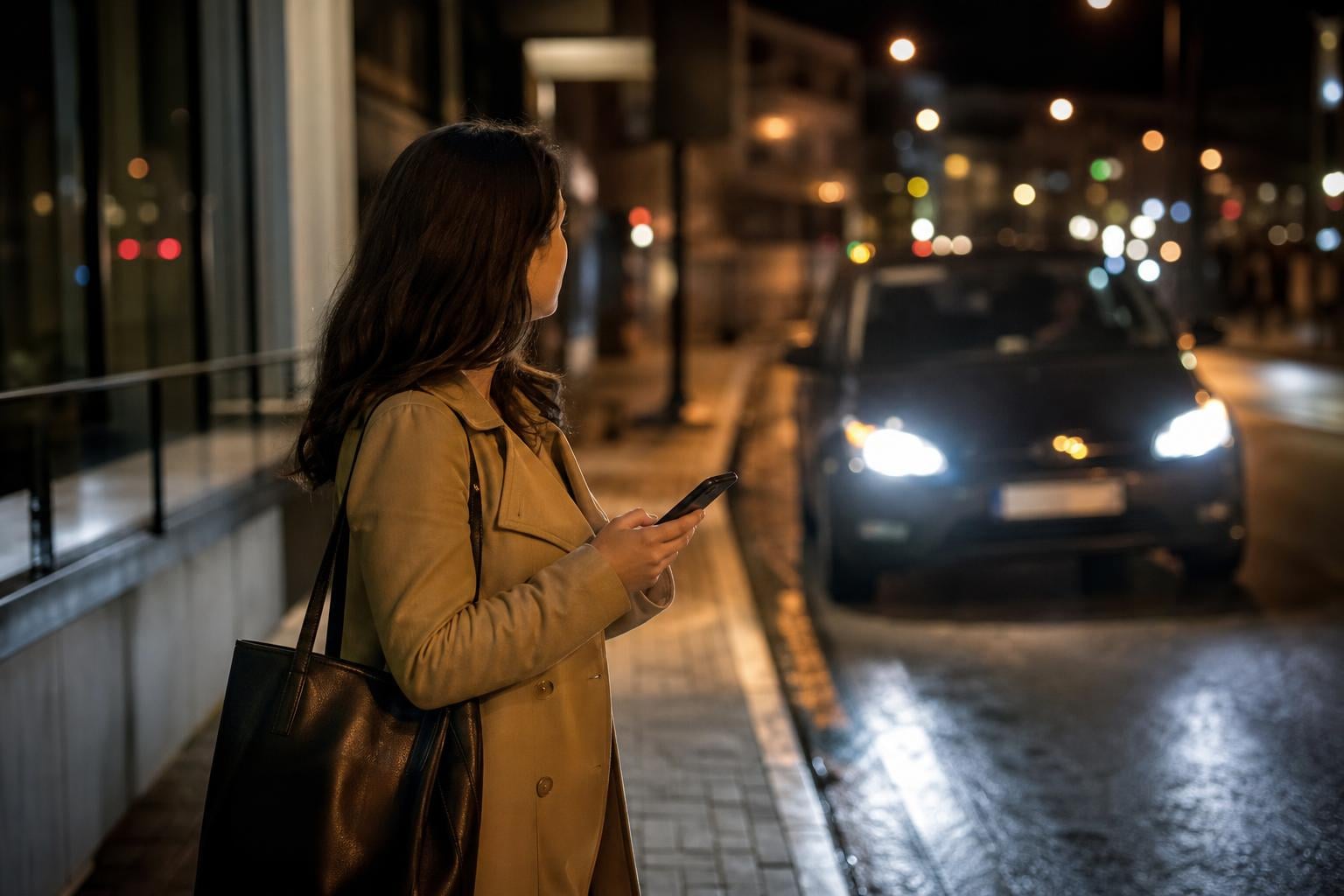
Late-Night Rideshares: Safety & Privacy Concerns (2026)


TL;DR
Late-night rideshare trips introduce specific safety and privacy risks that daytime travel doesn’t. These include impersonation scams, reduced driver availability, surge pricing pressure, extensive data collection, and heightened vulnerability for solo travelers (especially women). Understanding the key terms and tools, from PIN verification to address anonymization, helps you make informed transport decisions. For travelers who want to eliminate these variables entirely, pre-booked private transfers with accredited chauffeurs offer a fundamentally different model.
Why This Glossary Exists
Most people pull up a rideshare app at 11pm without thinking twice. And statistically, they’ll be fine. Uber maintains that 99.9% of its U.S. trips occur without incident. But at Uber’s scale, that still translates to more than 400,000 trips with reports of sexual assault or misconduct between 2017 and 2022, according to legal analysis of Uber’s safety data.
The concerns about safety and privacy when using rideshares late at night aren’t hypothetical. They’re backed by incident data, breach histories, and the lived experience of millions of riders. This glossary defines the terms you’ll encounter when researching those risks, explains why each one matters more after dark, and points toward practical solutions.
Whether you’re a solo traveler landing at Brisbane Airport at midnight, a parent researching options for a university student, or a corporate travel manager building policy, this is your reference guide.
If you prefer to skip rideshare risk entirely, pre-booked airport transfers with government-accredited chauffeurs offer a straightforward alternative.
Physical Safety Terms You Should Know
Driver Screening and Background Checks
What it means: The process a rideshare platform or transport company uses to vet drivers before allowing them to carry passengers.
For Uber and Lyft, this typically involves criminal record checks, driving history reviews, and identity verification. The catch is that rideshare drivers are independent contractors using personal vehicles, which means safety standards can be unreliable, differing significantly from one ride to the next. Screening depth varies by jurisdiction, and re-screening intervals differ between platforms.
In Queensland, accredited chauffeur drivers go through a government-managed vetting process that includes police checks, medical assessments, and ongoing compliance requirements. The distinction matters. A professional driver service operating under government accreditation is held to a regulatory standard that independent contractor models don’t replicate.
Why it matters at night: you have less ability to assess a driver or vehicle in the dark. The screening that happened before the trip becomes your primary safety layer.
PIN Verification (Verify Your Ride)
What it means: A feature that requires riders to share a unique four-digit code with their driver before the trip starts. The driver must enter the correct PIN to begin the ride, confirming you’re getting into the right car.
Uber lets you activate PIN verification for all trips or only at night (9pm to 6am). This night-only mode exists precisely because concerns about safety and privacy when using rideshares late at night spike after dark.
The feature was accelerated after the murder of University of South Carolina student Samantha Josephson in 2019. Police say she was killed after apparently mistaking a stranger’s car for her Uber ride. PIN verification directly addresses that scenario.
Practitioners on Reddit’s r/uber community frequently recommend checking driver star ratings (looking for 4.89 or above) as a supplement to PIN verification, particularly for late-night trips.
RideCheck
What it means: An automated monitoring system that detects anomalies during a trip. If a ride goes off-course, stops unexpectedly for an extended period, or ends early, RideCheck sends an in-app notification asking if you’re okay.
Think of it as a digital safety net. It won’t physically intervene, but it creates a documented flag and gives you quick access to emergency contacts or Uber support.
At night, when unfamiliar routes can feel more disorienting, RideCheck provides a layer of reassurance. That said, it only works if you’re paying attention to your phone, which brings us to intoxication risk (covered below).
Impersonation Risk (Getting in the Wrong Car)
What it means: The danger of entering a vehicle that isn’t your assigned rideshare, either because someone is deliberately posing as your driver or because you’ve mistakenly approached the wrong car.
This is one of the most cited concerns about safety and privacy when using rideshares late at night. Outside bars, concert venues, and airports after dark, multiple rideshare vehicles often cluster in the same area. Dimly lit pickup zones make license plates hard to read.
As one safety guide puts it, “other ill-intentioned people may see someone waiting for an Uber and take the opportunity to impersonate that driver.” Fake rideshare drivers are more common than most riders assume.
The defense is simple but requires discipline: verify the license plate, car make/model, and driver’s name before getting in. Use PIN verification. And never respond “yes” when a driver pulls up and asks “are you [your name]?” Instead, ask them who they’re picking up.
For travelers who want to eliminate this risk entirely, a meet-and-greet service at the terminal solves the problem. The driver holds a name board at a pre-arranged location. You can read about confirming driver meet points at busy airports.
Surge Pricing at Night
What it means: Dynamic pricing that multiplies base rideshare rates during high-demand periods. Late-night surges of 1.5x to 3x or more are common, particularly during bar closing hours, after major events, or in areas with limited driver availability.
Surge pricing creates indirect safety risks. Riders who balk at inflated fares sometimes wait in unsafe locations for prices to drop. Others rush to accept any available vehicle without properly verifying details. Some abandon rideshares altogether and walk through poorly lit areas.
Fixed-rate transport eliminates this pressure. When you know the price before you book, there’s no incentive to cut corners on verification.
You can compare transfer pricing for pre-booked options to see how fixed rates stack up against typical surge windows.
Share My Trip (Trip Sharing)
What it means: A feature available on both Uber and Lyft that lets you share your live location and trip details with a trusted contact. Your friend or family member can track your route in real time without needing the app.
Both platforms now allow you to automate this. You can set trip sharing to activate for every ride, or only for rides after a certain hour. If you’re someone who frequently uses rideshares late at night, automating trip sharing after 9pm removes the step of remembering to do it manually.
Community advice on Quora and Reddit consistently ranks trip sharing as the single most important late-night safety habit, even ahead of PIN verification.
Women+ Connect and Women Rider Preference
What it means: Platform features that let female riders request a female driver, or that match women drivers with women passengers.
Lyft calls its version Women+ Connect. Uber refers to its version as Women Rider Preference. Availability varies by market, and matching isn’t guaranteed because it depends on driver supply.
The demand for these features reflects hard data. According to analysis of rideshare assault cases, 90% of rideshare assault victims are women, and drivers are the accused party in about 68% of reported cases.
Independent women-only services have also emerged. Kimberly Evans created “Just Her Rideshare,” a company that exclusively employs female drivers, specifically targeting women who feel unsafe in standard rideshare environments.
For women traveling alone at night, these tools are worth knowing about, even if they don’t fully resolve the underlying concerns about safety and privacy when using rideshares late at night.
Safety Preferences Hub
What it means: A centralized settings screen (currently in Uber’s app) where you can customize which safety features activate and when.
Features can be configured to turn on based on time of day (every ride after 9pm, or only on weekends) and location (within 50 meters of a bar or restaurant, for example). This means the app can automatically enable PIN verification, trip sharing, and check-in prompts based on context.
Most riders don’t know this exists. Spending five minutes configuring your Safety Preferences before your next late-night trip is one of the highest-value actions you can take.
Privacy and Data Terms Explained
Privacy concerns are the underreported half of the equation. Most articles about rideshare safety focus entirely on physical risk. But the data you hand over every time you open the app creates its own category of vulnerability.
Location Tracking (GPS Data Collection)
What it means: Rideshare apps collect precise GPS coordinates before, during, and sometimes after your trip. This creates a detailed record of your movements.
The scale is significant. Roughly 29 different data points are collected per ride, and 76% of that data is visible to others within the platform’s ecosystem. Beyond GPS, apps collect your identity information (full name, email, phone number, profile photo, date of birth), payment data (credit card numbers, bank details, transaction history), and behavioral patterns.
Continuous data collection can function as surveillance, raising questions about how much these companies know about your movements and habits, especially when you’re using rideshares during vulnerable hours.
Address Anonymization
What it means: A feature that hides your exact pickup or drop-off address from the driver after a trip ends.
Without this feature, your driver retains access to the precise address where they picked you up or dropped you off. For late-night rides to your home, this is an obvious privacy concern.
Uber includes address anonymization among its safety tools. Enabling it means drivers see only the general area rather than your specific house number or apartment.
Late-night conversations with drivers can feel more casual, but as one rideshare safety practitioner notes, “avoid sharing your full name, where you live specifically, your work schedule, or whether you live alone. Friendly conversation is fine. Oversharing personal details is unnecessary.” Address anonymization enforces this boundary on the technical side.
Data Breach
What it means: An incident where unauthorized parties gain access to user data stored by the rideshare company.
The defining example is Uber’s 2016 breach, which affected 57 million users and drivers worldwide, including approximately 50 million riders and 7 million drivers. Rather than disclosing the breach, Uber paid the hackers $100,000 to delete the data and sign a non-disclosure agreement, framing it as a bug bounty payout. The company eventually paid a $148 million settlement to 50 U.S. states.
Part of that settlement involved “God View,” an internal tool Uber employees used to track the real-time locations of specific journalists and celebrities.
When you hand over personal data to a rideshare app, you’re trusting that company’s security infrastructure. Breaches happen, and the track record isn’t reassuring.
Third-Party Data Sharing
What it means: The practice of rideshare companies sharing your personal data with external organizations.
Uber shares data with service providers, business partners, legal authorities, and parties involved in corporate transactions (like mergers or acquisitions). The categories are broad, and the potential for misuse, including unauthorized sharing or use beyond the stated purpose of improving rideshare services, is real.
For riders concerned about privacy when using rideshares late at night, this means your travel patterns, frequent locations, and personal details may flow to organizations you’ve never heard of.
Ride History
What it means: A complete log of every trip you’ve taken, including dates, times, routes, pickup and drop-off locations, driver details, and fare information.
This record is useful for expense tracking or dispute resolution. It’s also a detailed map of your life, showing where you go, when, and how often. If your account is compromised or your phone is accessed by someone else, ride history reveals a great deal.
Periodically reviewing and deleting old ride history is a simple privacy measure most riders never take.
Background Tracking
What it means: The app’s ability to access your location even when you’re not actively using it. This is controlled by your phone’s location permissions.
Most rideshare apps request “Always Allow” location access during installation. Changing this setting to “While Using the App” stops background tracking and limits data collection to active ride sessions. This single settings change is the most impactful privacy step available to you.
On both iPhone and Android, you can adjust this under Settings > Privacy > Location Services (or the equivalent path for your device).
Late-Night Risk Factors Defined
Beyond specific app features and data practices, several situational risk factors intensify concerns about safety and privacy when using rideshares late at night.
Reduced Driver Availability
What it means: Fewer rideshare drivers are active between midnight and 5am, precisely when demand from bar-goers, event attendees, and late-arriving travelers peaks.
This supply-demand mismatch creates two problems. First, longer wait times, which mean standing in potentially unsafe locations. Second, less selectivity. When only one driver is available, you’re less likely to decline based on low ratings or a vehicle that doesn’t match the app description.
Pre-booked services operate on a different model. Your driver is assigned in advance and shows up regardless of how many other requests exist at that hour. For anyone arriving at Brisbane Airport on a late flight, arranging pickups for late-night arrivals removes this variable completely.
Intoxication Risk (Passenger-Side)
What it means: The well-documented fact that passengers who have been drinking are less capable of performing basic safety checks, including verifying the correct car, monitoring their route, or recognizing warning signs.
Uber’s own research found that 53% of women reported feeling unsafe at night even when walking alone within a mile of their home. Add alcohol to that baseline anxiety and the result is impaired judgment at the moment it matters most.
Community discussions on Reddit and Quora consistently emphasize that the riders most at risk late at night are those who are too impaired to use the safety features designed to protect them. This is a systemic gap that no app feature fully solves.
Pickup-Point Safety and Visibility
What it means: The physical characteristics of where you wait for your ride. Dimly lit streets, empty parking lots, and unfamiliar neighborhoods all increase vulnerability.
At night, identifying the correct vehicle is harder. License plates are difficult to read. Car colors look different under streetlights. And standing alone with your phone out signals to anyone watching that you’re waiting for a pickup.
The standard advice is to wait inside a well-lit venue until the app shows your driver has arrived. But this isn’t always possible, especially at airport terminals, suburban streets, or event venues after closing.
After-Hours Surcharges vs. Surge Pricing
What it means: Two different pricing mechanisms that both increase the cost of late-night travel, but operate very differently.
Surge pricing in rideshare apps is dynamic and unpredictable. It can multiply fares by 2x or 3x without warning and fluctuate minute to minute. After-hours surcharges, used by traditional transport and chauffeur services, are fixed, published, and applied transparently. You know the surcharge exists before you book.
The difference matters because unpredictable pricing creates decision pressure. A rider staring at a 2.8x surge at 1am may make choices, like walking to a cheaper pickup zone or accepting a lower-rated driver, that compromise their safety.
The Pre-Booked Alternative: How Private Transfers Address These Concerns
Understanding rideshare risks is useful. But some travelers, particularly families, corporate travelers, and anyone arriving in an unfamiliar city after dark, prefer to avoid the risk profile entirely. Here’s what that alternative looks like.
Pre-Booked Private Transfer
What it means: A car service arranged before your travel date, with the vehicle, driver, and pickup details confirmed in advance. The central difference is certainty. A rideshare matches you to an available driver when you request one. A private transfer assigns your driver before the day of travel.
This eliminates impersonation risk (the driver knows your name, you know theirs), surge pricing (the rate is fixed at booking), and driver availability gaps (someone is committed to your pickup regardless of demand).
For travelers weighing their options, the benefits of pre-booked private transfers are worth reviewing in detail.
Government-Accredited Chauffeur
What it means: In Queensland, a chauffeur who has completed the government’s accreditation process, including police checks, medical fitness requirements, and vehicle inspections. This is a regulatory standard, not a self-reported quality claim.
My Private Transfers operates with QLD government-accredited chauffeurs, which means every driver meets a documented compliance threshold. This contrasts with the independent contractor model where screening varies by platform and jurisdiction.
Meet-and-Greet Service
What it means: A pickup method where the driver enters the terminal and meets you at a specific location, typically holding a name board at the domestic baggage carousel or international arrivals hall.
This approach eliminates the “wrong car” problem entirely. You’re not scanning a dark curbside for a matching license plate. Your driver is standing where they said they’d be, clearly identified, waiting specifically for you.
Fixed Pricing
What it means: A fare quoted and locked in at the time of booking, regardless of demand conditions, traffic, or time of day.
Rideshare surge pricing during late-night hours can multiply base rates unpredictably. Fixed pricing means the cost you see when you book is the cost you pay. Transparent after-hours surcharges may apply (for trips between 8pm and 6am, for example), but they’re published and known in advance, not determined by an algorithm in real time.
Family Safety at Night
Families traveling late at night face a specific gap. Rideshare services like Uber and Lyft generally do not provide child seats, leaving parents to bring their own or travel without them. In Queensland, child restraint laws are strict, and traveling without a properly fitted seat is both illegal and dangerous.
My Private Transfers provides free child and infant seats (ages 0 to 7) and baby capsules on request. For families arriving on delayed flights or red-eye services, this eliminates a significant logistical burden. You can learn more about family-friendly airport transfers across South East Queensland.
Practical Steps: Putting This Glossary to Work
Knowing the terms is the first step. Here’s how to apply them before your next late-night trip, whether you choose a rideshare or an alternative.
If you’re using a rideshare:
Open your Safety Preferences hub and configure PIN verification for rides after 9pm.
Automate trip sharing so a trusted contact receives your route on every late-night ride.
Change your app’s location permission to “While Using the App” to stop background tracking.
Enable address anonymization so drivers can’t view your home address after the trip.
Never confirm your name to a driver who approaches you. Ask them to state it first.
Avoid wearing headphones and keep personal details out of conversation.
If you want to avoid the risk profile entirely:
Pre-book a private transfer with an accredited chauffeur service. Your driver, vehicle, and pickup details are confirmed before you travel. There’s no surge, no impersonation risk, and no scrambling for a car at 1am.
Get an instant quote for your next late-night transfer.
Frequently Asked Questions
Are rideshares actually dangerous late at night?
Statistically, the vast majority of rideshare trips are incident-free. However, late-night travel introduces specific risk factors: reduced driver supply, impaired passengers, poor visibility at pickup points, and surge pricing that pressures riders into rushed decisions. At scale, even a small incident rate produces thousands of reported safety issues annually. Understanding these terms helps you take practical precautions.
What personal data do rideshare apps collect?
Rideshare platforms collect approximately 29 data points per ride, including your full name, phone number, email, payment details, GPS coordinates (before, during, and sometimes after your trip), and ride history. About 76% of this data is visible to others within the platform ecosystem. Uber’s 2016 data breach exposed 57 million user records, highlighting the real consequences of this data collection.
How does PIN verification work for night rides?
You can set PIN verification to activate automatically for all rides between 9pm and 6am. When your driver arrives, the app generates a four-digit code that you share verbally. The driver enters it to start the trip, confirming you’re in the correct vehicle. This feature was introduced partly in response to incidents where riders entered the wrong car.
What is address anonymization in rideshare apps?
Address anonymization hides your exact pickup or drop-off location from the driver after the trip concludes. Without it, your driver retains access to your specific street address, which is a clear privacy concern for late-night rides home. You can enable it in your app’s privacy or safety settings.
Why do women face higher rideshare safety risks?
Data shows that 90% of rideshare assault victims are women, and drivers are the accused party in roughly 68% of reported cases. Both Uber and Lyft have introduced gender-matching features (Women Rider Preference and Women+ Connect), though availability depends on driver supply. Women-only rideshare services have also launched in some markets.
How are pre-booked transfers different from rideshares for safety?
Pre-booked transfers eliminate several late-night risks simultaneously. The driver is assigned and vetted in advance (no random matching), the price is fixed (no surge pressure), the pickup location is confirmed (often inside the terminal with a name board), and availability is guaranteed regardless of demand. For a deeper comparison, read about how chauffeur services compare to rideshares.
Can I get a child seat in a rideshare at night?
In most markets, rideshare platforms do not provide child seats. Parents must bring their own or risk traveling without one, which violates child restraint laws in Queensland and most Australian states. Pre-booked services like My Private Transfers include free child and infant seats for passengers aged 0 to 7, with baby capsules available on request.
What should I do if my rideshare ride feels unsafe?
Trust your instincts. You can end the trip at any time through the app. Both Uber and Lyft include emergency call buttons in their safety menus. If a ride goes off-route or stops unexpectedly, RideCheck may send a prompt, but don’t wait for it. Contact emergency services directly if you feel threatened, and report the incident through the app afterward.