
What Does Free Child Seat Include for Airport Transfers?


TL;DR
A free child seat for airport transfers means the provider supplies and pre-installs an age-appropriate child restraint (baby capsule, forward-facing seat, or booster seat) at no extra cost above your transfer fare. This covers children from birth to seven years old. In Queensland, this matters more than most parents realise because taxis and rideshares are legally exempt from child restraint requirements, making a pre-booked private transfer one of the only ways to guarantee your child rides in a proper seat from the airport.
Planning an airport transfer with young children creates a specific kind of stress. You’ve got luggage, a stroller, possibly a sleep-deprived toddler, and the nagging question: will there actually be a proper car seat waiting when you land? Many transfer companies advertise “free child seats,” but the details of what that includes vary more than you’d expect.
This guide breaks down exactly what a free child seat offer covers, which seat types are included, and why Queensland’s unusual legal exemption makes this a bigger deal than it first appears.
Get an instant quote to see your fare with child seats included at no extra charge.
What “Free Child Seat” Actually Means
When an airport transfer provider offers a free child seat, they are committing to three things:
Supplying the correct type of child restraint for your child’s age and size
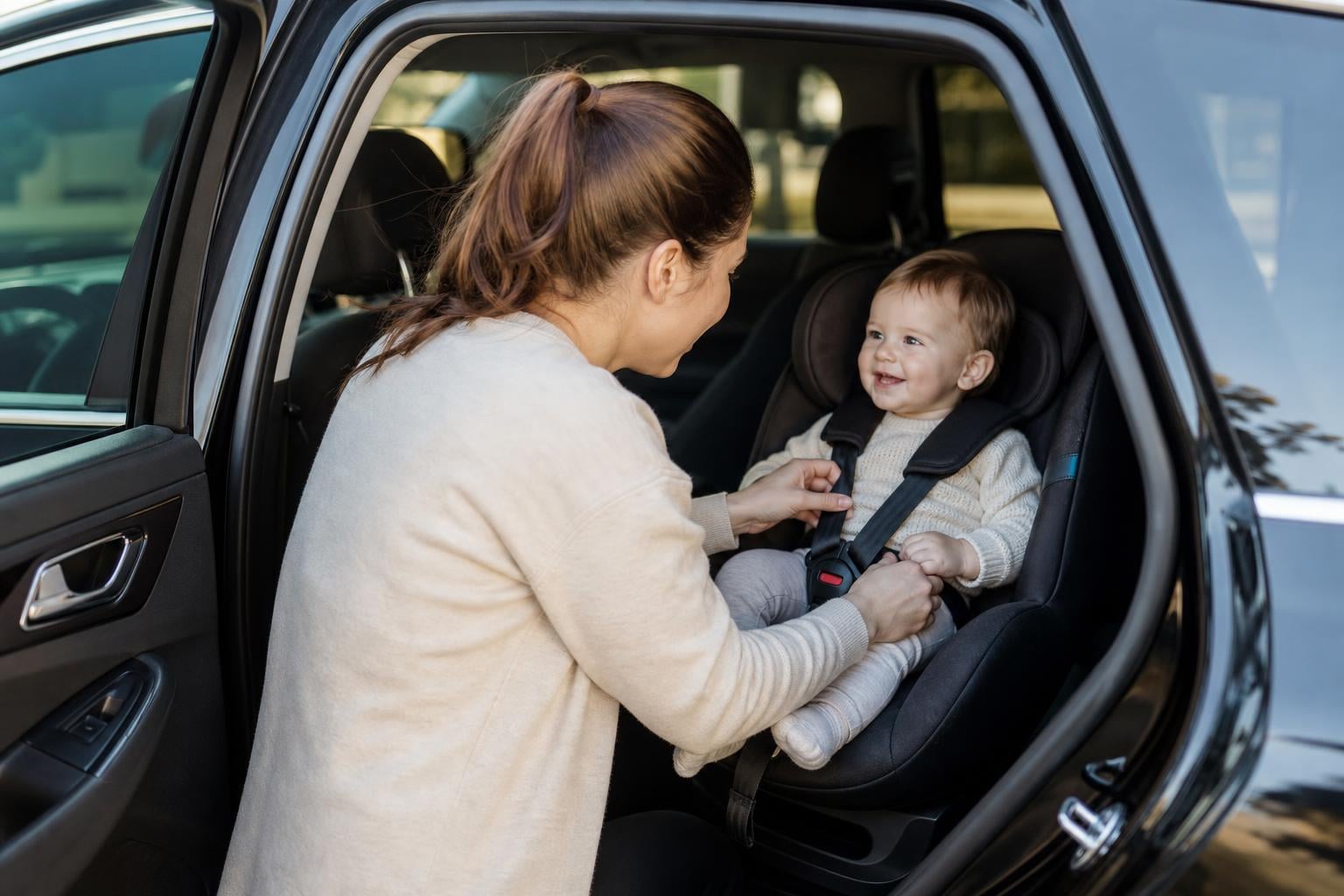
Pre-installing it in the vehicle before your pickup (not fumbling with straps at the kerb while your flight-weary family waits)
Absorbing the cost entirely, with no per-seat surcharge added to your fare
This is different from “child seats available on request for a fee,” which is the more common industry approach. It’s also completely different from shared shuttles, which typically provide no child seats at all. Con-X-ion’s FAQ, for example, explicitly states that child seats are not provided on their services, and infants must sit on an adult’s lap.
The word “free” should mean all three standard seat categories are included. If a provider only covers booster seats but charges extra for baby capsules, that’s not a genuinely free child seat offering.
For a broader explanation of what airport transfers involve, see this airport transfers overview.
The Three Seat Types Covered
A complete free child seat offering for airport transfers includes three distinct restraint types, each designed for a specific age and size range. All must comply with Australian Standard AS/NZS 1754, which governs the materials, design, construction, and testing of child restraints sold and used in Australia.
Baby Capsule (Birth to Approximately 6 Months)
A rear-facing capsule designed for newborns and young infants. Australian law requires children from birth to six months to travel in an approved rearward-facing restraint. The capsule must always face the rear of the vehicle, no exceptions. Maximum use depends on the child’s shoulder height reaching the marked limit on the restraint rather than a strict age cutoff.
This is the seat type most commonly requested by parents with infants arriving on flights. If you’re travelling with a newborn, see this detailed guide on baby capsule transfers in Queensland.
Forward-Facing Child Seat (6 Months to 4 Years)
From six months, children can use either a rearward-facing or forward-facing restraint with an internal harness. Most transfer providers install forward-facing seats with a five-point harness for this age group. The child must be seated in the rear of the vehicle.
Booster Seat (4 to 7 Years)
Children aged four to seven need either a forward-facing child restraint or a booster seat used with the vehicle’s lap-sash seatbelt. The booster raises the child so the seatbelt sits correctly across their chest and hips rather than their neck and abdomen.
Safety organisations recommend children stay in a booster seat until they reach at least 145cm tall, even after the legal requirement ends at age seven.
Quick Reference Table
Age Range | Required Seat Type | Facing Direction | Position in Vehicle |
|---|---|---|---|
Birth to 6 months | Baby capsule / rear-facing restraint | Rear-facing only | Rear seat |
6 months to 4 years | Forward-facing or rear-facing with harness | Either direction | Rear seat |
4 to 7 years | Booster seat or forward-facing restraint | Forward-facing | Rear seat |
Why Free Child Seats Matter More in Queensland
Here’s where the question of what free child seats include for airport transfers takes on real urgency, especially for families flying into Brisbane or the Gold Coast.
Queensland has a legal exemption that surprises many parents. According to the Queensland Government, child restraints are not required in taxis, limousines, or ride-booking services. Children under one year old can be held on the lap of someone over 16. Children aged one to seven must sit in the back seat and wear a seatbelt, but a dedicated child seat is not mandatory.
This exemption also applies to rideshare services like Uber and DiDi. The Queensland law treats rideshares the same as taxis for child restraint purposes.
Parents from New South Wales, where rideshare vehicles must follow the same child restraint rules as private cars, are often shocked to discover this. The National Transport Commission has flagged the inconsistency, noting that growing rideshare use across Australia makes the patchwork of state rules confusing and potentially unsafe.
Uber Child Seat Doesn’t Exist in Queensland
Some parents assume they can request an Uber with a child seat. Uber does offer a “Child Seat” ride option, but it’s currently only available as a trial in Melbourne, with a $9.99 surcharge per trip. It does not operate in Brisbane, the Gold Coast, or anywhere in Queensland.
This means families arriving at Brisbane Airport or Gold Coast Airport have two realistic options for guaranteed child seats: rent a car, or book a private transfer that includes them.
If you’re comparing providers, this checklist for choosing a transfer company covers what to look for beyond just price.
What “Free” Actually Includes vs. Common Hidden Costs
Not every company defines “free child seat” the same way. Here’s what genuine inclusion looks like compared to what some providers actually deliver.
What Full Inclusion Looks Like
Pre-installation before pickup. The driver arrives with the correct seat already fitted and inspected. You don’t need to install anything yourself.
Professional fitting by a trained chauffeur. Professional chauffeurs are trained in proper car seat installation. This directly addresses one of the biggest anxieties parents express on forums: not whether a seat is available, but whether it’s been installed correctly.
Correct seat type matched to your child’s age. You specify your child’s details at booking, and the provider selects the appropriate restraint.
No per-seat surcharge. The transfer fare is the transfer fare. No surprise line items at checkout.
What Other Providers Charge
The industry norm is to charge extra. Here’s what families typically face:
Provider Type | Typical Child Seat Cost |
|---|---|
Budget chauffeur services | $10 to $15 per seat |
Premium transfer companies | $25 per seat |
Rideshare (Melbourne only) | $9.99 surcharge per trip |
Shared shuttles | Not provided at all |
For a family with two children, the difference between a provider that includes seats free and one charging $25 per seat adds up to $50 each way, or $100 for a return trip. That’s a meaningful saving, especially on top of flights and accommodation.
Check Gold Coast fares with child seats included at no extra charge.
The Wrong Seat Problem
Price isn’t the only risk. Getting the wrong seat type is arguably worse than getting no seat. One Trustpilot reviewer recounted paying extra for an infant car seat through another provider, only to find a basic booster seat with no five-point harness or head protection waiting in the vehicle. No harness, no side-impact protection, for an infant.
This is exactly why specifying your child’s age at booking time, and choosing a provider that takes seat matching seriously, matters so much.
What to Tell the Provider When Booking
The quality of the child seat you receive depends entirely on the information you provide at booking. Here’s what to include:
Your child’s exact age. Not “toddler” or “young child.” Specify months for babies (a five-month-old needs a capsule, a seven-month-old may use a forward-facing seat).
Approximate weight and height. This helps with borderline cases. A tall three-year-old might need a different restraint than a small three-year-old.
Number of children needing seats. If you have three children under seven, mention this upfront. Larger vehicles like SUVs or people-movers can accommodate multiple car seats, but the provider needs to plan.
Whether you have special requirements. Some parents near age boundaries (say, a five-month-old who’s large for their age) may prefer a rear-facing convertible seat over a capsule. Mention your preference.
For families with complex needs or multiple children, contact the provider directly to confirm availability before booking.
Overseas Child Seats Are Illegal in Australia
This catches international visitors off guard every time. Child restraints bought outside Australia do not comply with AS/NZS 1754 and are illegal to use in Australian vehicles. A seat bought in the United States, United Kingdom, or Europe, even a high-quality one, cannot be legally used here.
Airlines will let you check your car seat as luggage for free, and practitioners on Reddit’s r/brisbane threads frequently recommend doing this for domestic travel. But for international visitors arriving at Brisbane or Gold Coast airports, your home-country seat won’t pass muster.
This makes a provider-supplied, AS/NZS 1754-compliant seat even more critical for tourists. It’s one less thing to research and worry about during an already complicated international trip.
Commonly Confused Child Restraint Terms
The terminology around child seats is surprisingly inconsistent. Here’s what each term actually means.
Baby capsule vs. baby seat vs. infant seat. These get used interchangeably, but a baby capsule specifically refers to a rear-facing, semi-reclined restraint designed for newborns up to roughly six months. A “baby seat” could mean a capsule or a rear-facing convertible. An “infant seat” is equally vague. When booking, specify your child’s age in months to avoid confusion.
Child restraint vs. child seat. “Child restraint” is the legal and technical term covering all approved devices (capsules, seats, boosters). “Child seat” is the everyday term most people use. They mean the same thing in practice.
Approved vs. non-approved. In Australia, “approved” means the restraint carries the AS/NZS 1754 mark. Any seat without this mark is not legal for use, regardless of how safe it may be by other countries’ standards.
Forward-facing vs. rear-facing. Rear-facing seats position the child looking toward the back of the car, which provides better head and neck support in a collision. Forward-facing seats face the windshield. Australian law requires rear-facing only until six months, then allows either direction until the child moves to a booster.
For more terms related to family airport travel, the airport travel with baby glossary covers additional concepts.
How Free Child Seats Compare Across Transfer Types
Understanding what free child seats include for airport transfers also means understanding what you don’t get with other transport options.
Private pre-booked transfer with free seats: The provider supplies and installs the correct restraint. The vehicle is private to your family. The driver meets you at the terminal. This is the most controlled, predictable option for families.
Taxi: Legally exempt from child restraint requirements in Queensland. Your child rides with just a seatbelt (or on your lap if under one). Some taxi drivers may have a booster in the boot, but there’s no guarantee and no obligation.
Rideshare (Uber, DiDi): Same legal exemption as taxis in Queensland. No child seat option available in the state. Practitioners on Reddit forums consistently flag this as the biggest pain point for parents, with many noting that Shebah (a women-only rideshare) is one of the few rideshare alternatives that sometimes offers child seats, though availability varies.
Shared shuttle: Child seats are not provided. Infants sit on laps. The vehicle is shared with other passengers, leaving no room for car seat installation even if you brought your own.
Rental car: You can hire a child seat from the rental company (usually $10 to $15 per day). This works well for longer stays but is overkill for a simple airport-to-hotel trip.
If the idea of sharing a shuttle with strangers while managing young kids concerns you, this article on private vs. shared transfers with children goes deeper.
Queensland’s Free Car Seat Fitting Services
Beyond what transfer providers offer, Queensland also has free child car seat fitting services where certified fitters will check your restraint is installed correctly. This is mainly relevant for parents using their own vehicles, but it’s worth knowing about if you’re a Queensland resident. The guide to free child seat fitting in Queensland explains where to find these services and when they’re useful.
FAQ
Can I bring my own child seat for the airport transfer?
Yes, most private transfer providers will allow you to use your own seat and may install it for you. However, the seat must be AS/NZS 1754 approved. Seats purchased overseas (including from the US, UK, or EU) do not meet this standard and are illegal to use in Australia.
What if I have three children who all need car seats?
Larger vehicles like SUVs or people-movers can fit up to three child restraints. Mention the number and ages of all children at booking so the provider can assign the right vehicle and prepare all seats in advance.
Do shared airport shuttles provide child seats?
Generally, no. Major shared shuttle operators explicitly state that child seats are not provided, and infants are required to sit on an adult’s lap. This is one of the strongest reasons families with young children choose private transfers instead.
Is a booster seat the same as not having a seat at all?
Not at all. A booster seat raises the child so the vehicle’s seatbelt crosses their chest and hips correctly. Without a booster, the seatbelt can ride up across the child’s neck and stomach, which is dangerous in a collision. Boosters are legally required for children aged four to seven in private vehicles.
Are child seats required in Queensland taxis and Ubers?
No. Queensland law exempts taxis, limousines, and ride-booking services from child restraint requirements. Children under one can be held on a lap, and children one to seven need only wear a seatbelt in the back seat. This exemption is why pre-booked private transfers that include child seats carry extra value for safety-conscious families.
What happens if the transfer company brings the wrong seat type?
This is a real risk, especially with budget providers. The best way to prevent it is to provide your child’s exact age in months (not just “baby” or “toddler”) when booking. Reputable providers match the restraint to your child’s age and have the seat pre-installed and inspected before you board.
Does Uber offer child seats in Brisbane or the Gold Coast?
No. Uber’s Child Seat option is a trial running only in Melbourne, with a $9.99 surcharge. It is not available anywhere in Queensland.
How much do families save with free child seats compared to other providers?
Providers that charge typically add $10 to $25 per seat. A family with two children saves $20 to $50 per trip, or $40 to $100 on a return transfer. Over a holiday with multiple legs, the savings add up quickly.
Knowing exactly what a free child seat includes for airport transfers puts you in control of your family’s safety and budget before you even land. The combination of Queensland’s legal exemption, the absence of Uber Child Seat in the state, and the limitations of shuttles and taxis makes this one of the most important details to confirm when booking.
Book a transfer with free child seats for your next Brisbane Airport trip.